Tag Archives: Credit Downgrade

Moody’s downgrades credit rating of 26 Italian banks, Spain is next

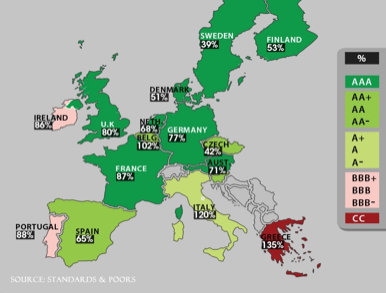
European Debt to GDP and Credit Rating

From Yahoo News.

Excerpt:

Moody’s Investors Service has downgraded the ratings on 26 Italian banks as they struggled with the effect of government austerity measures.

The rating agency said Monday that the banks are suffering because Italy is back in recession and government austerity measures are cutting demand for loans.

The banks are struggling with more loan losses, limited access to funding and weaker profits.

Moody’s noted that support of the European Central Bank lowered the default risk of many banks.

Its outlook for all 26 banks is negative.

From the Wall Street Journal.

Excerpt:

The ratings for Italian banks are now among the lowest within advanced European countries, reflecting these banks’ susceptibility to the adverse operating environments in Italy and Europe, Moody’s said in a statement. Two of the country’s largest institutions, UniCredit SpA (UCG.MI, UNCFF) and Intesa Sanpaolo SpA (ISP.MI, ISNPY), were included.

Moody’s move came hours after the firm raised an alarm on Spain, arguing the country’s banks remain vulnerable even after Madrid moved to increase the banks’ cushions against potential losses from real-estate loans.

[…]Italy, saddled with EUR1.9 trillion ($2.44 trillion) debt, has signed onto the EU’s fiscal compact that sets strict limits on the country’s deficit levels. In recent weeks, Mr. Monti has begun pressing Germany to give Italy more fiscal slack to stimulate its economy and create jobs. Mr. Monti has recently proposed that the EU create special exemptions to the budget rules when countries target their public spending on projects like broadband investments and infrastructure.

Moody’s downgrades come after the ratings firm in February placed various ratings of 114 financial institutions in 16 European countries on review for possible downgrade, highlighting the region’s banks’ vulnerability to the euro-zone sovereign debt crisis.

Moody’s is expected to follow the downgrade of Italian banks by cutting the ratings of Spanish banks. By the end of June, more than 100 European banks, as well as Wall Street giants like Bank of America Corp. (BAC) and Citigroup Inc. (C), are likely to have ratings that are at least one notch lower.

[…]Moody’s also alluded to J.P. Morgan Chase & Co.’s (JPM) recent disclosures of more than $2 billion in trading losses as a reminder of potential problems lurking at some European banks.

“Recent events highlight the risks for creditors from potential weaknesses in governance, controls and risk management, especially at some smaller, privately-held banks,” Moody’s said in its news release.

Moody’s says it will conclude its reviews by the end of June. In coming weeks, major U.S. financial institutions, Bank of America Corp., Citigroup Inc., Goldman Sachs and Morgan Stanley are likely to face downgrades.

Banks in Austria and Sweden are expected to see downgrades after Spain.

Italy’s debt is $2.44 trillion, ours is nearly $16 trillion.

The Obama administration and the debt to GDP ratio

Understand the debt crisis with this article from the Wall Street Journal.

Excerpt:

The Bush Presidency and previous GOP Congresses contributed to the current problem by not insisting on domestic cuts to finance the cost of war, and by adding the prescription drug benefit without reforming Medicare. But as recently as 2008 spending was still only 20.7%, and debt held by the public was only 40.3%, of GDP.

In the name of saving the economy from panic, the White House and the Pelosi Congress then blew out the American government balance sheet. They compounded the problem of excessive private debt by adding unsustainable public debt.

They boosted federal spending to 25% of GDP in 2009, 23.8% in 2010 (as TARP repayments provided a temporary reduction in overall spending), and back nearly to 25% this fiscal year. Meanwhile, debt to GDP climbed to 53.5% in 2009, 62.2% in 2010, and is estimated to hit 72% this year—and to keep rising. These are all figures from Mr. Obama’s own budget office.

Rather than change direction this year, Mr. Obama’s main political focus has been to preserve those spending levels by raising taxes. His initial budget in February for fiscal 2012 proposed higher spending. He then resisted the modest spending cuts that the GOP proposed for the rest of fiscal 2011.

He responded to Paul Ryan’s proposal to reform Medicare and Medicaid by calling it un-American and unworthy of debate. In the most recent budget talks, he would only consider small entitlement reforms (cuts in payments to providers) if Republicans agreed to raise taxes. He has refused even to discuss ObamaCare or serious reforms in Medicare and Social Security. Meanwhile, federal payments to individuals continue to grow as a share of all spending, as the nearby chart shows.

This is how you become the Downgrade President.

Barack Obama owns this credit downgrade. It was his party that increased spending starting in 2007.

Standard and Poor’s: there may be more downgrades

From CNBC.

Excerpt:

Standard & Poor’s may downgrade the long-term credit rating of the U.S. once again in less than three months after sending shockwaves through the bond and stock markets by stripping the nation of its top notch triple-A rating last week, according to an emergency Sunday night conference call for clients of Bank of America Merrill Lynch.

“We do expect further downgrades,” said Ethan Harris, North American economist, on the call. “We doubt the newly appointed bipartisan commission will come up with a credible long-term deficit reduction plan. Hence by November or December we would not be surprised to see S&P downgrade the debt again from AA-plus to AA.”

Harris said that the U.S. should have avoided the downgrade in the first place by meeting S&P’s demands of a $4 trillion deficit cut and a “demonstrating a sensible budget process.” What they got instead was a “deficit cut of $2.1 trillion and a budget process that’s been extremely chaotic,” said Harris.

[…]”If a disorderly Treasury market leads to the Fed embarking on QE3, repercussions for the dollar will be catastrophic,” said David Woo, head of global rates and currencies research, on the call. “Investors will be quick to conclude that U.S. monetary policy has been subjugated by fiscal policy and the Fed’s independence would be placed seriously into question.”

In other news, Estonia has actually received a recent debt rating UPGRADE:

In the midst of a world embroiled in economic turmoil, a few nations have managed to do surprisingly well—among them, Estonia. After near economic collapse during the 2008–2009 financial crisis, the country has managed to successfully bounce backwith substantial GDP growth, a vibrant trade environment, and a notable budget surplus.

During the first quarter of this year, Estonia had the highest rate of growth in the EU and the biggest drop in unemployment. In July, its credit rating was raised by Fitch to A+, a reflection of substantial economic growth.

But how did Estonia get here? Estonia possesses a flexible, open economy and investment climate that encourages competition and economic growth. It remains one of the world’s freest economies, according to The Heritage Foundation’s Index of Economic Freedom. However, prudent fiscal policies have played the largest role in Estonia’s impressive economic performance, particularly in recent years. Still, the path to fiscal conservatism was not easy; it required a lot of rigorous, painful cutback involving 9 percent of GDP in fiscal adjustments and large cuts to nominal wages.

Notice that Estonia’s economic policies are tea party conservative policies, not socialist policies.

Meanwhile, the White House has yet to respond to our first credit downgrade.