
Tag Archives: Conscience Protection

Before the rise of secularism, Americans believed in conscience

Dissent, disagreement, conscience and religious liberty
The importance of respecting the conscience of others

In the last 50 years, America exchanged religious liberty for hedonism. We used to believe that conscience was a good thing, and we respected individual differences rooted in religious convictions. But today, secular leftist politicians, lawyers and judges attack Christians using the courts. Pro-lifers, pro-marriage business owners, and people expressing Christian convictions in public have all felt what it is like to have conscience attacked by the secular leftist state.

Let’s take a look at what things were like in a different time when moral convictions had not been destroyed by secular leftism.

Consider this article in The Federalist about a new movie called “Hacksaw Ridge”.

Excerpt:

Over last weekend, I saw the new Mel Gibson flick “Hacksaw Ridge.” Gruesome and at times overshadowed by lead actor Andrew Garfield’s awkwardness, “Hacksaw Ridge” was an ode to the age-old American custom of protecting dissent by protecting the conscience.

In an age when attacks upon conscience and religious liberty grow more and more fiery, the true tale of World War II hero Desmond Doss’ conscientious objection to killing is a reminder of the difficult stakes involved in ensuring that individual liberty is the presumption that government takes toward individuals, even during war.

“Hacksaw Ridge” is the story of Doss, a Seventh Day Adventist whose religion prohibited taking the life of a fellow human being. Doss, obviously a patriot, felt obligated to serve in World War II as a medic. Where war is the business of taking life, Doss saw his role as helping save lives. That he does, as his heroism is on full display in his military record and receiving the Medal of Honor from President Truman.

The article has 6 sections.

The first one makes the point about how things have changed:

1. The Conscience Is Sacred

Doss arrived at his pacifism through religious conviction. It was an ethical precept he arrived at by religious devotion and piety, which means his pacifism was not something arbitrarily considered. Throughout the movie, the tattered Bible he carried with him everywhere he went symbolized the solemnity of his beliefs. Standing before a court martial, he was willing to go to jail for his convictions.

This is important today because so much hostility is based in rejecting religious motivation around contentious issues such as sexuality. Liberals are inclined to believe that any and all opposition to the ever-expanding lexicon of the sexual revolution is based in animus. That’s hogwash. Today’s dissenters from the sexual revolution have no use for animus. Rather, they believe the purposes of sexuality and human embodiment are different than what secular progressivism teaches.

Doss’ sincerity is a reminder that the convictions people arrive at by religious motivation are not designed to be capricious, but are ordered toward certain ends that people will naturally disagree about.

Part 3 was also good, because it explains efforts by Republicans to pass laws like the Religious Freedom Restoration Act – laws that are opposed by atheists in the Democrat party:

3. It’s Good to Accommodate People’s Consciences

When almost court-martialed for insubordination, Doss insists that his desire all along was to be a medic. This request was eventually approved. In the movie, we see the U.S. government preserve a man’s conscience by assigning him a duty that did not violate it. The U.S. government was right to accommodate Doss where accommodations can be made. In this move, it recommitted itself to an important principle at the heart of our constitutional system: The presumption of liberty.

This means it is government’s burden to prove infringing upon a person’s liberty is absolutely necessary. In Doss’ case, it was deemed unessential for him to carry a weapon, so he served in a different capacity. This is at the heart of legislation like the Religious Freedom Restoration Act, which puts the burden on the government to prove its case and make every last accommodation where possible.

The problem with people on the secular left today is that they have no empathy. For them, other people have no right to disagree because it makes them feel bad – but they don’t see how jail time and fines amounting to hundreds of thousands of dollars makes the victim of their legal attacks feel bad:

5. Protecting Conscience Means Developing Empathy for Others’ Convictions

As the movie’s plot develops, Doss’ fellow soldiers come to understand that his motives aren’t sinister. They realize that, when freed to live faithfully, Doss is there to help save their lives. Throughout this, and when they learn of his sincerity, his enemies-turned-friends gained a greater understanding of Doss’ convictions. They came to understand the force of his resolve, which dampens their mockery.

In one visceral scene in particular, Doss and the most intense warrior in his battalion are in a foxhole together. There, in seeing Doss’ devotion to sacrifice and conscience, his enemy-turned-friend makes lighthearted gestures recognizing that Doss’ motives are pure. In the crucible of conflict, progress occurs.

As in the case of Doss, protecting conscience doesn’t mean you will agree with the conscience you’re protecting. In fact, disagreement underscores the very need for protection. If conscience and religious liberty are simply ideas our society supports when popular, such protections are easily undone.

One of my favorite passages in the Bible talks about conscience.

1 Corinthians 4:2:

1 This is how one should regard us, as servants of Christ and stewards of the mysteries of God.

2 Moreover, it is required of stewards that they be found faithful.

3 But with me it is a very small thing that I should be judged by you or by any human court. In fact, I do not even judge myself.

4 For I am not aware of anything against myself, but I am not thereby acquitted. It is the Lord who judges me.

You can clearly see in today’s gay rights movement the problem with the government choosing to favor sinful behavior over religious liberty. People who are involved in sinful lifestyles don’t have the ability to do the right thing when it comes to respecting others. Engaging in a sinful lifestyle corrupts the ability to be respectful of the human rights of others. The desire to feel good and be approved of is seen as more important than respecting the right of others to disagree.

Who knows how far the secular left would go to punish dissenters from gay marriage? Although the media doesn’t cover it, there have been countless episodes of violence and vandalism, workplace persecution and job terminations, not to mention an armed attack by a domestic terrorist at the Family Research Council building. Because people in a sinful lifestyle don’t respect conscience rights of those who disagree. Conversely, when a person stands alone for a moral virtue (e.g. – chastity), there is no desire to compel others.
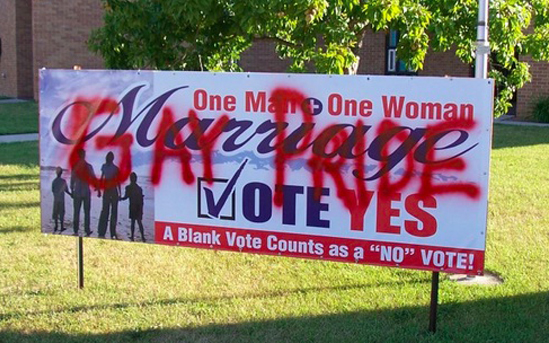
Kentucky bans pastor from prison ministry because he disagrees with homosexuality

Gay activist vandalizes pro-marriage sign

Yes, in Kentucky.

The Stream has the story.

Excerpt:

Like Christian ministers across the confessional spectrum, David Wells takes seriously the words of Jesus in the Gospel of Matthew: “I was in prison and you did not visit me.” Minister of evangelism of Pleasant View Baptist Church in McQuady, Kentucky, he has been visiting and mentoring juveniles in the Warren County Regional Juvenile Detention Center for 12 years.

Not any more. On July 7th, the Kentucky Department of Juvenile Justice (DJJ) revoked his volunteer credentials and permanently barred him from visiting, counseling or leading worship services for juveniles. He was found in violation of a newly revised departmental policy on “Sexual Orientation and Gender Identity” because he could not sign a state-mandated statement that he would not use the word “sinful” when talking about homosexuality. The policy states that volunteers:

shall not refer to juveniles by using derogatory language in a manner that conveys bias towards or hatred of the LGBTQI community. DJJ staff, volunteers, interns, and contractors shall not imply or tell LGBTQI juveniles that they are abnormal, deviant, sinful, or that they can or should change their sexual orientation or gender identity.

The acronym “LGBTQI” stands for “Lesbian, Gay, Bisexual, Transgender, Queer/Questioning, and Intersexed.”

I recommend reading the articles to get the details on the inmates, so that you see what they are in for, what their real problems are, and what it is that the pastor talks to them about.

But I want to skip to the end, which is about the conflict between the gay agenda (don’t offend me by saying that what I am doing is wrong, because it makes me feel bad) with the Constitutional right of religious liberty.

More:

The issue really isn’t the way Wells speaks to the juveniles he ministers to. The issue is what he says. In effect, the DJJ wants to remove the Bible from his hands. The policy equates the teaching of Biblical morality with derogatory and hateful speech.

Removing the Bible from a pastor’s hands is like taking a scalpel from the hands of a surgeon. The policy effectively deletes passages such as Romans 1:24-27, 1 Corinthians 6:9-10, and 1 Tim 1:10 from the New Testament. The words of Scripture are the gifts a pastor has to offer. He’s not there just to counsel the young people. He’s there to tell them the good news of Jesus Christ. That’s not hate speech, it’s love speech.

Wells is represented by Liberty Counsel. In a letter to the commissioner of the Kentucky Department of Juvenile Justice, Liberty Counsel explained that the new policy creates an unconstitutional religious test for access to the DJJ. The First Amendment prohibits the government from discriminating on the basis of viewpoint. This detention center may not prohibit the expression of biblical morality because DJJ policymakers object to the Bible.

That’s what the American Constitution says, but the authorities in other states and in federal and military prisons have begun imposing similar restrictions on religious speech. This may become one more aftershock of the Obergefell v Hodges decision. The homosexual equivalency movement wants to insert homosexual activity into the category of a protected class under State and Federal law in order to use the police power of the State against those who disagree with them. It’s one more example of a growing soft persecution underway in the United States.

I have been saying for some time that Christians have been really missing the boat by focusing on charity without theology. We are interested in being nice so we can be liked. We are not interested in telling the truth, so that we can be faithful. We spend all our money feeding hungry people and helping the poor and so on, and nothing is going to defend religious liberty – the freedom to actually treat what the Bible about God as real and serious – in public. Maybe instead of doing nice things, we can try to focus more on doing good things. We can start by not voting for secularists who charm us with their desire solve the world’s problems by redistributing wealth, and instead vote for people who promise to protect our religious liberty and our freedom of conscience. No more giving money to World Vision and the Boy Scouts of America and Susan G. Komen Race for the Cure. We have other things to think about now.

UK Tory MP: use anti-terrorism laws against Christians who say gay marriage is wrong

Gay activist vandalizes pro-marriage sign

This article appeared in the far left UK Telegraph. (H/T Dina)

It says:

New banning orders intended to clamp down on hate preachers and terrorist propagandists should be used against Christian teachers who teach children that gay marriage is “wrong”, a Tory MP has argued.

Mark Spencer called for those who use their position in the classroom to teach traditionalist views on marriage to be subject to “Extremism Disruption Orders” (EDOs), tough new restrictions planned by David Cameron and Theresa May to curb radicalisation by jihadists.

In a letter to a constituent, Mr Spencer, the MP for Sherwood in Nottinghamshire, insisted that Christian teachers were still “perfectly entitled” to express their views on same-sex marriage – but only “in some situations”.

Christian campaigners said Mr Spencer’s remarks confirmed what they had previously warned: that those who believe marriage should only be between a man and a woman would now be “branded extremists”.

[…]Ministers have signalled that the orders, expected to be a key plank of the Government planned new Counter-Extremism Bill, would be used not only curb the activities of radical Islamist clerics but those who promote other views deemed to go against “British values”.

According to the MP’s letter, the anti-terrorism laws would be used whenever teachers taught children that redefining marriage was wrong. This is the view of every Bible-believing Christian, by the way. Defending the standard definition of marriage is now the equivalent of advocating for Jihad, in British schools.

I did a quick search to see what really is going on in the UK with freedom of conscience, free speech, and so on, and I found this story:

A Christian registrar who claimed religious discrimination has today been denied an appeal by the European Court of Human Rights, in a move described as a “sad day for liberty of conscience”.

Lillian Ladele was claiming religious discrimination after being forced out of her Islington Council job over her conscientious objection to same-sex civil partnerships.

She was seeking to appeal to the Grand Chamber of the European Court of Human Rights after losing a 5-2 majority decision in January.

Two other Christians, Shirley Chaplin and Gary McFarlane, also had their applications for appeal turned down.

It’s a good idea, when deciding who to vote for, to look at other countries to see where the policies being put forward today have led. One policy that led to a terrible place, especially for men and children, was no-fault divorce. Today, we have same-sex marriage, which denies children access to their biological mother or father, or both, and makes relationships about the needs of selfish adults, instead about the needs of children. And in the UK, speaking against this second redefinition of marriage is now a crime.