
Tag Archives: Cohabitation

The Economist: marriage is still the best place for children

Marriage and family
Marriage and family

I stopped reading The Economist when they endorsed the socialist failure Barack Obama, who doubled the national debt to $20 trillion in only 8 years. However, even a stopped clock is right twice a day. And here is one of those times.

Excerpt:

However, there is one big reason to worry about the quality and longevity of people’s intimate bonds. It is that relationships often produce children, and children are profoundly affected by how their parents get on.

You could make enough confetti for a summer of weddings with all the academic papers that show how much children gain from being brought up in stable, loving families, and how much they suffer when those families break down. Culture and customs make little difference. In Japan, four-fifths of single-parent households emerge when couples divorce—a much higher share than in the West, where people usually slip into single parenthood without marrying. Japanese children living with only one parent nonetheless perform significantly worse in school tests, just as children from single-parent families do in Europe and America. In poorer countries, family breakdown can kill. According to one recent estimate, the chance that an African child will die before turning five is about 25-30 per 1,000 for those born into stable families, but 35-40 per 1,000 for the children of single, divorced or widowed parents.

Marriage is not always good for children. They do not benefit when a parent marries somebody who is not their mother or father, and seem to suffer if the parent they live with cycles through several relationships. What they seem to need most is for their biological parents to stick together. And one strong claim that can be made for marriage is that it appears to glue parents together more tightly than any other arrangement.

This part is key, especially for those millennials who think that cohabitating before marrying makes the marriage more secure:

Analysis of one large American data set by Kathryn Edin and Laura Tach, two sociologists, shows that 27% of marriages broke down within nine years of a child being born. By contrast, among couples who were merely cohabiting when a child appeared, 53% separated within nine years—and most of the remaining 47% were married by that point. Among couples who were dating but not living together when the child was born, 81% had split up.

Again, this pattern runs across national and cultural borders. Cohabiting couples behave a bit more like married couples in countries where giving birth outside marriage is very common, such as Estonia and Norway. But they seldom attain the same level of stickiness as married couples, even after controlling for the mother’s level of education.

Cohabitation doesn’t work, because it’s basically saying that I’m going to try the other person and see if I like the other person, and that sex is required to know if I like the other person. It doesn’t really matter that you know the other person really well, because you can always get out of cohabitation just by leaving. Marriage says that I’m going to commit to the other person for life, through thick and thin. Here, both people tend to do a more thorough job of selecting their partner, perhaps even consulting fathers for advice. Why? Because getting out of a marriage is a lot harder to do, and more expensive.

In the past, I’ve blogged about some factors that can make your marriage pretty much divorce proof: things like chastity, not spending too much on the wedding, age of the man and woman at marriage, education levels of each spouse, number of people attending the wedding ceremony, isolation from other divorced people, church attendance, and so on. The truth is that you can engineer a marriage that’s practically divorce proof. But if you insist on spontaneity and following your heart, then you aren’t going to care what studies say works best. A stable marriage takes preparation, and that means making pro-marriage choices all throughout your life before your marriage, instead of doing what feels right to you in the moment. What feels good in the moment is almost never the right choice if your goal is a stable marriage.
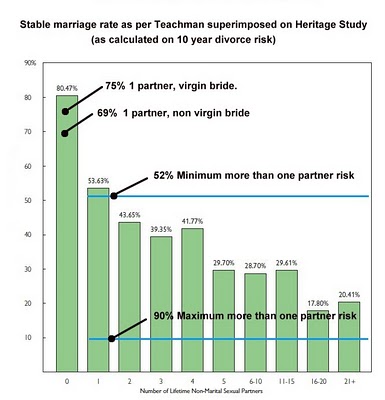
Women who delay marriage for casual sex surprised to be single in their mid-30s

Divorce risk and number of pre-marital sex partners

Dr. Mark Regnerus is a sociologist at the University of Texas at Austin. He has published books on the changing nature of relationships with Oxford University Press. His newest book argues that the Sexual Revolution has caused men to lose interest in marriage because women are now giving them sex for free, without them having to prove their husband credentials first. This causes men to be disinterested in the traditional ways of impressing a woman, namely, getting a job, moving out, being willing to commit, and being able to provide for children who may appear.

The Daily Signal provides a case study taken from Regnerus’ latest book “Cheap Sex”, which illustrates the problem.

Excerpt:

Sarah is 32 years old and recently moved to Texas from New York, looking for a new start—in more ways than one.

Brooklyn had grown too expensive for her hipster pocketbook. A relationship she had hoped would blossom and mature there had instead withered. So to Austin she came, hoping she could improve upon her modest $22,000 annual earnings the previous year.

Her most recent sexual partner—Daniel—was not actually a relationship per se. He was not the reason she moved. Rather, he was a 23-year-old American she had met in China four years before during a three-week language immersion program.

[…]When they first met, and slept together, Sarah was in a relationship with David, the man for which she had moved to, and then away from, New York. She ended up “cheating on him,” that is, David, several times.

[…]If you’re having trouble keeping times, dates, and boyfriends straight, it’s understandable. Sarah herself laughs at the drama of it all.

[…]Getting serious was never much of an option. He was 23, and she was 32: “We both knew … he was graduating from college and, you know, like we both, at least I knew it was never gonna work out. I think he kind of felt the same way.”

[…]When asked how rapidly her relationships tend to become sexual, Sarah replied, “the first or second date.” That account did not stand out from those of many other interviewees.

The numbers are on her side, too. In the 2014 Relationships in America survey, sex before the relationship begins was the modal—meaning the most common—point at which Americans report having first had sex in their current relationships.

Is her timing of sex intentional? No. “It just happens,” she reasoned.

[…]This, she claims, is the standard approach to dating among her peers, if not necessarily the most optimal: “I don’t think it’s unusual, but I think that for a lasting relationship, it’s not the best approach.”

[…]Three years later, now 35, Sarah continues to live in Austin and continues to find commitment elusive. She does not dislike her life, but it is not the one she envisioned a decade earlier.

Daniel is a musician, which doesn’t surprise me at all. A musician, student or other unemployed penniless bad boy will not make any demands on the woman, because he almost certainly has no plan for the future.  This is what many women today want: someone for right now who doesn’t want her to do anything  to prepare for marriage, e.g. – get a real job, stop the thrill-seeking, stop traveling the world. No matter what a woman says about marriage,  if her actions now show an interest in fun and thrills, then she doesn’t want marriage.

The typical woman’s plan for marriage is simply to imagine marriage happening later somehow, without her having to do anything that she doesn’t feel like doing right now. It would be like “planning” for your retirement by taking trips all over the world right now, while imagining living off the interest from a million dollars in savings at age 55. This problem is what happens when the culture tells women that they should not aspire to marriage, and should not measure men to see if they will make good husbands and fathers. If a woman cannot expect a man to be a man (protector, provider, moral and spiritual leader), then she will choose men on other criteria.

This is what women today want:

  • hot appearance
  • confident words about the future
  • empty resume
  • empty bank account
  • several years younger than they are
  • no firm convictions about morality
  • no firm convictions about theology
  • progressive political views, especially on abortion

Men who have no jobs and no money don’t lead women, and are much easier for women to manipulate. The problem with these men is – as any married woman knows – is that those men do not commit. Why not? Because they cannot afford to commit. Marriage, put simply, costs money. Starter houses cost a quarter million. Children cost a quarter million each, not counting college. Retirement costs a quarter million per spouse. And so on. But there is no one in this society telling women that they need to care about choosing men who are serious about the objective duties of the husband role.

Women love to believe that they can choose a hot, irresponsible bad boy who gives them feelings, and then magically mold him into a husband: able to work hard, save money, be self-controlled, faithful and good with children. Feelings determine the choice of man, and feelings tell them that the man can be magically transformed into a husband somehow. Perhaps by giving him premarital sex! That will make him responsible. After all, you can put out a fire with gasoline, right? This is the most common approach women today take to relationships: get drunk, have sex with hot bad boy, shack up with him, wait for him to propose marriage.

I frequently tell my female friends about women I know like the one in the article – many raised by two married parents in Christian homes. They have arts degrees, empty resumes, empty bank accounts, and histories of alcoholism, bulimia, promiscuity and/or divorce. My female friends give me the same advice: “YOU NEED TO LOWER YOUR STANDARDS OR YOU’LL NEVER GET MARRIED”. If that’s the best that they can do, then it’s no wonder that men are not interested in marriage.

If you want men to be interested in marriage, fix the root cause. The root cause of the marriage rate declining is not men. The root cause is feminism.

The Economist: marriage is still the best place for children

Marriage and family
Marriage and family

I stopped reading The Economist when they endorsed the socialist failure Barack Obama, who doubled the national debt to $20 trillion in only 8 years. However, even a stopped clock is right twice a day. And here is one of those times.

Excerpt:

However, there is one big reason to worry about the quality and longevity of people’s intimate bonds. It is that relationships often produce children, and children are profoundly affected by how their parents get on.

You could make enough confetti for a summer of weddings with all the academic papers that show how much children gain from being brought up in stable, loving families, and how much they suffer when those families break down. Culture and customs make little difference. In Japan, four-fifths of single-parent households emerge when couples divorce—a much higher share than in the West, where people usually slip into single parenthood without marrying. Japanese children living with only one parent nonetheless perform significantly worse in school tests, just as children from single-parent families do in Europe and America. In poorer countries, family breakdown can kill. According to one recent estimate, the chance that an African child will die before turning five is about 25-30 per 1,000 for those born into stable families, but 35-40 per 1,000 for the children of single, divorced or widowed parents.

Marriage is not always good for children. They do not benefit when a parent marries somebody who is not their mother or father, and seem to suffer if the parent they live with cycles through several relationships. What they seem to need most is for their biological parents to stick together. And one strong claim that can be made for marriage is that it appears to glue parents together more tightly than any other arrangement.

This part is key, especially for those millennials who think that cohabitating before marrying makes the marriage more secure:

Analysis of one large American data set by Kathryn Edin and Laura Tach, two sociologists, shows that 27% of marriages broke down within nine years of a child being born. By contrast, among couples who were merely cohabiting when a child appeared, 53% separated within nine years—and most of the remaining 47% were married by that point. Among couples who were dating but not living together when the child was born, 81% had split up.

Again, this pattern runs across national and cultural borders. Cohabiting couples behave a bit more like married couples in countries where giving birth outside marriage is very common, such as Estonia and Norway. But they seldom attain the same level of stickiness as married couples, even after controlling for the mother’s level of education.

Cohabitation doesn’t work, because it’s basically saying that I’m going to try the other person and see if I like the other person, and that sex is required to know if I like the other person. It doesn’t really matter that you know the other person really well, because you can always get out of cohabitation just by leaving. Marriage says that I’m going to commit to the other person for life, through thick and thin. Here, both people tend to do a more thorough job of selecting their partner, perhaps even consulting fathers for advice. Why? Because getting out of a marriage is a lot harder to do, and more expensive.

In the past, I’ve blogged about some factors that can make your marriage pretty much divorce proof: things like chastity, not spending too much on the wedding, age of the man and woman at marriage, education levels of each spouse, number of people attending the wedding ceremony, isolation from other divorced people, church attendance, and so on. The truth is that you can engineer a marriage that’s practically divorce proof. But if you insist on spontaneity and following your heart, then you aren’t going to care what studies say works best.