
Tag Archives: CHZ

Fine-tuning the habitable zone: tidal-locking and solar flares

Circumstellar Habitable Zone

Here’s an article from Evolution News that talks about liquid water and tidal locking, but it has even more factors that need to be fine-tuned for habitability.

Excerpt:

Stars with masses of 0.1-0.5 solar mass make up 75 percent of the stars in our Milky Way galaxy.6 These represent the red dwarfs, the M class. But these stars have low effective temperatures, and thus emit their peak radiation at longer wavelengths (red and near-infrared).7 They can have stable continuously habitable zones over long time scales, up to 10 billion years, barring other disruptions. It is also easier to detect terrestrial sized planets around them.8 But a serious problem with red dwarf stars in the K and M classes is their energetic flares and coronal mass ejection events. Potentially habitable planets need to orbit these stars closer, to be in these stars’ habitable zones. Yet the exposure to their stellar winds and more frequent and energetic flares becomes a serious issue for habitability. Because of these stars’ smaller mass, ejections get released with more violence.9 Any planet’s atmosphere would be subject to this ionizing radiation, and likely expose any surface life to much more damaging radiation.10 The loss of atmospheres in these conditions is likely, but the timescales are dependent on several factors including the planet’s mass, the extent of its atmosphere, the distance from the parent star, and the strength of the planet’s magnetic field.11 To protect its atmosphere for a long period, like billions of years, a planet with more mass and thus higher gravity could hold on to the gases better. But this larger planet would then hold on to lighter gases, like hydrogen and helium, and prevent an atmosphere similar to Earth’s from forming.12 Another consequence is that the increased surface pressure would prevent water from being in the liquid phase.13

So again, you need to have a huge, massive star in order to hold the planet in orbit over LONG distances. If it’s a short distance, you not only have the tidal-locking problem, but you also have this solar activity problem (flares, coronal ejections).

But wait! There’s more:

Another stellar parameter for advanced life has to do with UV (ultra-violet) radiation. The life-support star must provide just enough UV radiation, but not too much. UV radiation’s negative effects on DNA are well known, and any life support body must be able to sustain an atmosphere to shield them. Yet the energy from UV radiation is also needed for biochemical reactions. So life needs enough UV radiant to allow chemical reactions, but not so much as to destroy complex carbon molecules like DNA. Just this flux requirement alone requires the host star have a minimum stellar mass of 0.6 solar masses, and a maximum mass of 1.9 solar masses.14

So the ultra-violet radiation that is emitted has to be finely-tuned. (I’m guessing this assumes some sort of chemical origin-of-life scenario)

Still more:

Another requirement for habitable planets is a strong magnetic field to prevent their atmosphere from being lost to the solar winds. Planets orbiting a red dwarf star are also more affected by the star’s tidal effects, slowing the planet’s rotation rate. It is thought that strong magnetic fields are generated in part by the planet’s rotation.15 If the planet is tidally braked, then any potential for a significant magnetic field is likely to be seriously degraded. This will lead to loss of water and other gases from the planet’s atmosphere to the stellar winds.16 We see this in our solar system, where both Mercury and Venus, which orbit closer to the Sun than Earth, have very slow rotation rates, and very modest magnetic fields. Mercury has very little water, and surprisingly, neither does Venus. Even though Venus has a very dense atmosphere, it is very dry. This is due to UV radiation splitting the water molecules when they get high in the atmosphere, and then the hydrogen is lost to space, primarily, again, by solar wind.17

You have to hold on to your umbrella (atmosphere), or you get hit with dangerous rain (solar winds).

So a few more factors there, and remember, this is just the tip of the iceberg when it comes to circumstellar habitability constraints.

New study: Saturn’s orbit keeps Earth in the circumstellar habitable zone

Circumstellar Habitable Zone

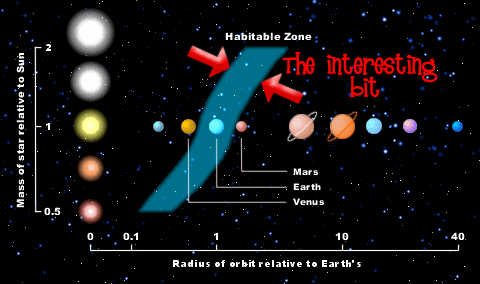
What do you need in order to have a planet that supports complex life? First, you need liquid water at the surface of the planet. But there is only a narrow range of temperatures that can support liquid water. It turns out that the size of the star that your planet orbits around has a lot to do with whether you get liquid water or not.

A heavy, metal-rich star allows you to have a habitable planet far enough from the star so  the planet can support liquid water on the planet’s surface while still being able to spin on its axis. The zone where a planet can have liquid water at the surface is called the circumstellar habitable zone (CHZ). A metal-rich star like our Sun is very massive, which moves the habitable zone out further away from the star.

If our star were smaller, we would have to orbit much closer to the star in order to have liquid water at the surface. Unfortunately, if you go too close to the star, then your planet becomes tidally locked, like the moon is tidally locked to Earth. Tidally locked planets are inhospitable to life. So we need a star massive enough to give us a nice wide habitable zone far away from the Sun itself.

But even with the right size star, which we have in our solar sytem, we still have CHZ problems. Just because a planet starts off in the circumstellar habitable zone, it doesn’t mean that it will stay there.

Jay Richards tweeted about this new article from the New Scientist, which talks about that very problem.

Excerpt: (links removed)

Earth’s comfortable temperatures may be thanks to Saturn’s good behaviour. If the ringed giant’s orbit had been slightly different, Earth’s orbit could have been wildly elongated, like that of a long-period comet.

Our solar system is a tidy sort of place: planetary orbits here tend to be circular and lie in the same plane, unlike the highly eccentric orbits of many exoplanets. Elke Pilat-Lohinger of the University of Vienna, Austria, was interested in the idea that the combined influence of Jupiter and Saturn – the solar system’s heavyweights – could have shaped other planets’ orbits. She used computer models to study how changing the orbits of these two giant planets might affect the Earth.

Earth’s orbit is so nearly circular that its distance from the sun only varies between 147 and 152 million kilometres, or around 2 per cent about the average. Moving Saturn’s orbit just 10 percent closer in would disrupt that by creating a resonance – essentially a periodic tug – that would stretch out the Earth’s orbit by tens of millions of kilometres. That would result in the Earth spending part of each year outside the habitable zone, the ring around the sun where temperatures are right for liquid water.

Tilting Saturn’s orbit would also stretch out Earth’s orbit. According to a simple model that did not include other inner planets, the greater the tilt, the more the elongation increased. Adding Venus and Mars to the model stabilised the orbits of all three planets, but the elongation nonetheless rose as Saturn’s orbit got more tilted. Pilat-Lohinger says a 20-degree tilt would bring the innermost part of Earth’s orbit closer to the sun than Venus.

So the evidence for a our solar system being fine-tuned for life keeps piling up. It’s just another factor that has to be just right so that complex, embodied life could exist here. All of these factors need to be just right, not just the orbits of any other massive planets. And you need at least one massive planet to attract comets and other such unwelcome intruders away from the life-permitting planets.

Here’s a good clip explaining the circumstellar habitable zone:

The factor I blogged about today is just one of the things you need in order to get a planet that supports life.

Here are a few of the more well-known ones:

  • a solar system with a single massive Sun than can serve as a long-lived, stable source of energy
  • a terrestrial planet (non-gaseous)
  • the planet must be the right distance from the sun in order to preserve liquid water at the surface – if it’s too close, the water is burnt off in a runaway greenhouse effect, if it’s too far, the water is permanently frozen in a runaway glaciation
  • the solar system must be placed at the right place in the galaxy – not too near dangerous radiation, but close enough to other stars to be able to absorb heavy elements after neighboring stars die
  • a moon of sufficient mass to stabilize the tilt of the planet’s rotation
  • plate tectonics
  • an oxygen-rich atmosphere
  • a sweeper planet to deflect comets, etc.
  • planetary neighbors must have non-eccentric orbits

Here is a study that I wrote about recently about galactic habitable zones.

Guillermo Gonzalez lectures on the corelation between habitability and discoverability

There are 5 video clips that make up the full lecture, which took place in 2007 at the University of California, Davis.

The playlist for all 5 clips is here.

About the speaker

Guillermo Gonzalez is an Associate Professor of Physics at Grove City College. He received his Ph.D. in Astronomy in 1993 from the University of Washington. He has done post-doctoral work at the University of Texas, Austin and at the University of Washington and has received fellowships, grants and awards from such institutions as NASA, the University of Washington, the Templeton Foundation, Sigma Xi (scientific research society) and the National Science Foundation.

Click here to learn more about the speaker.

The lecture

Here’s part 1 of 5:

And the rest are here:

Topics:

  • What is the Copernican Principle?
  • Is the Earth’s suitability for hosting life rare in the universe?
  • Does the Earth have to be the center of the universe to be special?
  • How similar to the Earth does a planet have to be to support life?
  • What is the definition of life?
  • What are the three minimal requirements for life of any kind?
  • Requirement 1: A molecule that can store information (carbon)
  • Requirement 2: A medium in which chemicals can interact (liquid water)
  • Requirement 3: A diverse set of chemical elements
  • What is the best environment for life to exist?
  • Our place in the solar system: the circumstellar habitable zone
  • Our place in the galaxy: the galactic habitable zones
  • Our time in the universe’s history: the cosmic habitable age
  • Other habitability requirements (e.g. – metal-rich star, massive moon, etc.)
  • The orchestration needed to create a habitable planet
  • How different factors depend on one another through time
  • How tweaking one factor can adversely affect other factors
  • How many possible places are there in the universe where life could emerge?
  • Given these probabilistic resources, should we expect that there is life elsewhere?
  • How to calculate probabilities using the “Product Rule”
  • Can we infer that there is a Designer just because life is rare? Or do we need more?

The corelation between habitability and measurability.

  • Are the habitable places in the universe also the best places to do science?
  • Do the factors that make Earth habitable also make it good for doing science?
  • Some places and times in the history of the universe are more habitable than others
  • Those exact places and times also allow us to make scientific discoveries
  • Observing solar eclipses and structure of our star, the Sun
  • Observing stars and galaxies
  • Observing the cosmic microwave background radiation
  • Observing the acceleration of the universe caused by dark matter and energy
  • Observing the abundances of light elements like helium of hydrogen
  • These observations support the big bang and fine-tuning arguments for God’s existence
  • It is exactly like placing observatories on the tops of mountains
  • There are observers existing in the best places to observe things
  • This is EXACTLY how the universe has been designed for making scientific discoveries

This argument from the “discoverability” of the universe has now been picked up by famous Christian philosopher Robin Collins, so we should expect to hear more about it in the future.