Tag Archives: Christianity

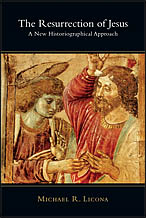
Why we work: to buy Mike Licona’s new resurrection book

Mike's new book on the resurrection

And what a big book it is! 718 pages!

Here are the details from Brian Auten:

Michael Licona, Research Professor of New Testament at Southern Evangelical Seminary, has just released a monumental new book: The Resurrection of Jesus: A New Historiographical Approach.

From the publisher:

Could there be any new and promising approach to the question of the historicity of Jesus’ resurrection? Yes, answers Michael Licona. And he convincingly points us to a significant deficiency in approaching this question: our historiographical orientation and practice. He then carefully and effectively applies his principles and methods to the question of Jesus’ resurrection.

This book is sure to become required reading for anyone exploring this field, as Michael Licona has made an extremely significant contribution to scholarship in this area.

Pick it up today.

The book is $27 dollars on Amazon, but you probably won’t need another book on the resurrection. I try not to buy books by people who haven’t debated anyone on the other side, but that won’t be a problem with Licona. He’s debated everybody on the other side – like Bart Ehrman, Richard Carrier and Shabir Ally. He’s battle-tested.

I took a look at the endorsements, and I recognize tons of historians.

Here’s one:

“Licona has tackled his subject energetically, with near-obsessive thoroughness. He concludes that if one approaches the sources without an a priori commitment to the impossibility of resurrection, the ‘Resurrection Hypothesis’ is the interpretation that most adequately accounts for the evidence. Thus, the book boldly challenges the naturalistic presuppositions of post-Enlightenment historical criticism. At the very least, Licona has shown that the usual naturalistic explanations of the resurrection tradition are, on the whole, weak, speculative and often tendentious. “I am not aware of any scholar who has previously offered such a thorough and fair-minded account of the historiographical prolegomena to the resurrection question. Furthermore, Licona’s discussion of the ‘bedrock’ historical evidence is appropriately nuanced and carefully modulated, not claiming more than can be supported by the consensus findings of qualified scholars. This lends credibility to his conclusions. Licona has presented a fair and vigorous case for his position. No doubt many readers will be unconvinced by his arguments, but no one can accuse him of naivet? or of ignoring counterarguments. “This study spans fields that are too rarely brought into conversation: New Testament studies and historiographical theory. Licona is to be commended for this undertaking and for producing a study that has both wide range and significant depth.”

—Richard B. Hays, George Washington Ivey Professor of New Testament and dean, Duke Divinity School

If you’re looking for a book on the resurrection, this might be a good one. Seems like it will cover everything.

UPDATE: Wow, big Mike Licona post up at Reason to Stand. Lots of Mike Licona videos.

Craig Hazen explains why Christianity is not like other religions

A 28-minute lecture delivered at Biola University, the best Christian university on the planet.

(Link fixed, thanks Mary)

Topics:

  • Christianity is different from other religions for several reasons
  • Christianity is testable using objective evidence
  • you can offer objective evidence for and against it
  • compare that to Zen Buddhism, for example, which is about subjective experiences
  • Buddhism is subjective, you can’t test it objectively
  • Christianity can be tested using the historical method
  • if Jesus did not rise from the dead, Christianity is false
  • Christianity is set up for inquiry
  • You can know whether the resurrection happened using historical methods
  • “faith” in Christianity is not belief without arguments and evidence
  • the Bible presents it’s claims about God as testable and public

This was very fun to watch.

Frank Turek and Wayne Grudem think you should go vote today!

EVERYONE  PLEASE GO VOTE TODAY! (NOVEMBER 2nd, 2010)

Here’s Frank Turek’s post on Jesus, Christians and politics on the Cross Examined blog.

Excerpt:

I often hear Christians claiming that we ought to just “preach the Gospel” and not get involved in politics.  This is not only a false dilemma; it’s stupid (how’s that for direct?).   If you think “preaching the Gospel” is important like I do, then you ought to think that politics is important too.  Why?  Because politics and law affects your ability to preach the Gospel! If you don’t think so, go to some of the countries I’ve visited—Iran, Saudi Arabia, China.  You can’t legally “preach the Gospel” in those countries—or practice other aspects of your religion freely—because politically they’ve ruled it out.

It’s already happening here. There are several examples where religious freedoms are being usurped by homosexual orthodoxy. This summer a Christian student was removed from Eastern Michigan University’s (a public school) counseling program because, due to her religious convictions, she would not affirm homosexuality to potential clients.  A judge agreed (a similar case is pending in Georgia).  In Massachusetts, Catholic charities closed their adoption agency rather than give children to homosexual couples as the state mandated.  In Ohio, University of Toledo HR Director Crystal Dixon was fired for writing a letter to the editor in her local newspaper that disagreed with homosexual practice.

More violations of religious liberty are on the way from the people currently in charge.  Lesbian activist Chai Feldbaum, who is a recess appointment by President Obama to the EEOC, recently said regarding the inevitable conflict between homosexuality and religious liberty, “I’m having a hard time coming up with any case in which religious liberty should win.” So much for tolerance.  The people who say they’re fighting for tolerance are the most intolerant, totalitarian people in politics.

Getting involved in politics is necessary if for no other reason to protect your religious liberty, and the liberties of us all.  So if you’re a Christian, follow the example of Christ—call out hypocrites and fools, and vote them out on Tuesday!

Religious liberty is my top priority and my core value. You can’t preach the gospel without religious liberty – so don’t just stand there and watch it slip away! Get out there and vote! The right to evangelize and discuss Christianity in public is already under attack in places like Canada and the UK! Don’t think that it can’t happen here – it can! Today is the day that you defend the gospel by defending your right to even talk about the gospel in public without having to worry that someone will censor or sue you for offending them. Get out there and vote for your liberty!

Wayne Grudem also encourages you to vote

Should Christian beliefs impact politics?

Do pastors have the right to speak from the pulpit about political, social or cultural issues?

What about the so-called “separation of church and state”?

You can find out more about Grudem’s new book here – it’s a 50+ page excerpt from the book! I’ve got my copy! And you can listen to podcasts from his Sunday School class here.

Frank Pastore thinks that politics flows from theological convictions

Frank Pastore has a Christian radio show on KKLA in Los Angeles.

Here is his post on Crosswalk.com about Christians and politics – specifically, he is responding to critics who say that he should not talk so much about politics on his Christian radio show, and that he should especially not argue about politics.

Excerpt:

Perhaps many Christians believe these things because they don’t understand politics is really an exercise of theology applied—one way we love our neighbors as ourselves. Our political and social policies should grow out of our theology, not vice versa. We are not to reverse engineer our theology based upon our political and social agendas. Our faith is foundational to everything else. For Christians, theology creates and shapes our approach to politics; for non-Christians, politics creates and shapes their approach to theology—or at least their worldview.

A Christian becomes too political when their politics is no longer rooted in their theology, when their faith becomes merely peripheral and unnecessary to their political agenda, rather than the one thing that is fundamental and essential.

How we vote to spend our tax dollars, what economic and social policies we hope to advance through votes for particular candidates, and what domestic and foreign policies we hope our government advances—these things are the applications of the values rooted in our Christian worldview.

Just as how I choose to invest my time and treasure is the best expression of whether I’m living out my Christian values, so too what the government spends money on and what policy preferences it pursues is the best expression of our true American values.

The best way for me to love my neighbor is through those things I choose to do personally. The second best way is through votes for candidates who support policies that I believe will promote the common good. Thus, I am political because I am loving, and I am loving because I am Christian. Therefore, I should argue—albeit in a God-glorifying manner—about politics.

Get out there and vote, people! And make all your friends and family vote, too!

Related posts