Tag Archives: Christianity

What does the concept of resurrection mean to Jewish theologians?

Here’s a helpful post from Eric Chabot talks about this and other interesting topics related to the resurrection.

Excerpt:

Where do we see resurrection in the Hebrew Bible?

As just stated, belief in a resurrection of persons from the dead are seen in eight passages: (Job 19:26; Ps. 17:15; 49:15; 73:24; Is. 26:19; 53:10; Dn. 12:2;12:13). The resurrection terminology is seen in two places (Ezek. 37:1-14; Hos. 6:2) to show a national and spiritual restoration brought about by the return from the exile. As far as the nature of the future bodily resurrection, it may involve a corpse or the receipt of a material body comparable to the present physical body (Job 19:26; Is. 26:19), or it may be a matter of transformation (Dn. 12:2-3 and perhaps 12:13); or glorification after reanimation, in the case of the righteous.

As far as the function of the resurrection, it may be personal vindication (Is. 26:16; 53:10-12). Resurrection may also have a function in relation to reward or punishment (Dn. 12:2; 12:13), an assumption to heaven and enriched fellowship with God (Ps. 49:15; 73:24,26), or preface to the beatific vision of God (Ps. 17:15 and possibly Job 19:26). (1)

The Greek word for resurrection is “anatasis” which means “a raising up” or “rising.” There are resuscitations in the Tanakh such as the example of Elijah and Elisha raising a person from death (1 Kings 17-23; 2 Kings 4:34-35). While these figures may have been raised in a resurrection sense, they were not raised immortal in the same way Jesus was.

Extra-Biblical Passages on Resurrection

There are also extra-biblical passages that speak about the resurrection (Enoch 92:2; 4 Ezra 7:32; Enoch 91:10; 2 Maccabees 7:9; 14; 28-29). Even the The Messiah Apocalypse, which is dated between 100 and 80 B.C.E mentions resurrection: “He [God] frees the captives, makes the blind see, and makes the bent over stand straight…for he will heal the sick, revive the dead, and give good news to the humble and the poor he will satisfy, the abandoned he will lead, and the hungry he will make rich.” (2)

In the Rabbinical literature there are explicit teachings on the resurrection. It says in the Mishnah 10.1, it says, “All Israelites have a share in the world to come; … and these are they that have no share in the world to come: he that says that there is no resurrection of the dead prescribed in the Law.” Moses Maimonides, a Jewish rabbi and a medieval Jewish philosopher who has forever influenced the Jewish and non-Jewish world said:

” The resurrection of the dead is one of the cardinal principles established by Moses our teacher. A person who does not believe this principle has no real religion, certainly not Judaism. However, resurrection is for the righteous. This is the earning of the statement in Breshit Rabbah, which declares: “the creative power of rain is both for the righteous and the wicked, but the resurrection of the dead is only for the righteous.” Our sages taught the wicked are called dead even when they are still alive; the righteous are alive even when they are dead” (Bab. Talmud Brakhot 18 b).

3 points are made here: 1. Resurrection is a cardinal principle taught in the Torah which all Jews must believe 2. It is for the righteous alone 3. All men must die and their bodies decompose. (3)

It’s important to understand that the concept of resurrection had a meaning before Christianity ever started. And it’s interesting to ask why the early Christians applied the notion of resurrection to Jesus. What is the best explanation for their decision to do such a strange thing? Why not just give up on him and deny that he was the Messiah when he was killed by the Romans?
Dr. George Yancey: advice for responding to hostility from non-Christians

Dr. George Yancey
Dr. George Yancey

This article contains an interview with Dr. George Yancey, who does research on bias against Christians. It appeared in the Christian Post.

Here’s the introduction to the interview:

What should Christians do about the hostile environment they increasingly face? In a Christian Post interview, professor George Yancey talks about his new book written for fellow Christians, Hostile Environment: Understanding and Responding to Anti-Christian Bias.

Christianophobia exists among a powerful elite subculture in the United States, University of North Texas sociologists Yancey and David Williamson wrote in So Many Christians, So Few Lions: Is There Christianophobia in the United States? While that book was written in an academic voice, in Hostile Environment, Yancey writes as a Christian speaking to fellow Christians, and offers some guidance on how Christians should respond to that anti-Christian hostility.

In an email interview with CP, Yancey said he appreciated the opportunity to speak from the heart to fellow believers about how he thinks Christians should respond to Christianophobia.

The early chapters summarize much of his work in So Many Christians, So Few Lions and helps readers understand the sources of Christianophobia. The middle chapters, “Are Christians Responsible for Christianophobia” and “Trouble Within” discuss ways to deal with hypocrisy, sin and dysfunction within the Church. The latter chapters deal more specifically with ways to confront anti-Christian bigotry.

Yancey is also careful throughout the book to distinguish between the discrimination against Christians in the United States and the violence against Christians in other parts of the world. He does not use the word “persecution,” for instance, to describe the negative experiences of Christians domestically.

“Christians are not being persecuted, but religious discrimination and bigotry in our society can affect us. We should combat that discrimination and bigotry when it rears its ugly head,” he wrote.

Here’s the part that I thought was the most interesting:

CP: What do people with Christianophobia want from Christians?

Yancey: In a nutshell they want Christians to shut up and stay in their homes and churches.

Individuals with Christianophobia have a great deal of pre-capita social and cultural power as they are more likely to be white, male, educated and wealthy than other Americans. They indicated in my research that they believe they know what is best for our society, and perhaps that is because they possess such power.

They also argue that Christians are leading us back to the “Dark Ages,” want to set up a theocracy, and oppose science. They also demand that Christians do not proselytize others since they believe that Christians are not very intelligent or are trying to manipulate others for money or power.

These beliefs and stereotypes provide them with justification to assert that they, and not Christians, should run our society and government. For this reason it is not surprising that they want Christians to stay out of the public square.

People with Christianophobia at least superficially value the ideals of religious neutrality. They perceive themselves as non-biased. So while they want to exclude Christians from the public square, they are unlikely to support measures that overtly single out Christians for punishment. This allows them to hold on to a social identity that is linked to “tolerance.”

However, they have a willingness to support measures that disproportionately punish Christians, or remove Christians from the public square, as long as such punishment or removal can be justified with non-bigoted reasons. This is similar to the concept of disparate impact that has been discussed as a part of the racial problems in the United States.

Other Christian apologists who read my blog sometimes ask me why I write so much issues outside of Christian apologetics, since that’s what I am most interested in. Well, I have encountered the attitude that Dr. Yancey is talking about when I was in university, and in the workplace as well. I understand that these very educated non-Christians think that Christians have no reasons for believing what we believe. They think it’s all superstition and bigotry. And so, they are alarmed by the idea that we are voting for public policies based on irrationality. One reason why I talk a lot about politics to get Christians thinking about policies, and reasons why we should support and oppose specific policies. Specifically, I want Christians who believe in policies that are consistent with the Bible to be able to discuss those policies with non-Christians by appealing to public, testable evidence.

But there’s another reason to talk about evidence outside of the Bible on this blog. And that reason is so that Christians understand that their faith is not private, nor is it meant to produce good feelings, nor to make them feel liked. Christianity is about truth, and we need to be studying science, history and philosophy, and making connections between what the Bible says to public, testable knowledge when we talk about our faith. We need to counter the perception that we are “dangerous” because we are irrational by being skilled at having conversations about what we believe and why. It can’t just be superstition or “this is how I was raised”. That’s what atheists find scary. They do not find it scary when we can explain ourselves. And that’s why we need to get really good at explaining how Christianity relates to these other areas. And not just explaining, but being persuasive using arguments and evidence, too.

On wargames, history and heroes: “this story shall the good man teach his son”

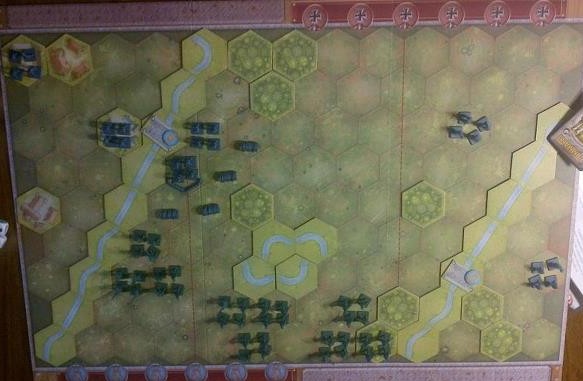
Memoir '44: Pegasus Bridge setup
Memoir ’44: Pegasus Bridge setup

Re-posting this old post because Dina and I spent Friday night playing games again! And this is one of my favorite posts. Last night was Portal 2 and Orcs Must Die! 2.

Last night, I played through the Pegasus Bridge scenario from the Memoir ’44 wargame with Dina a few times. We actually played the online version of the game, using Steam. She was very gracious to play a wargame with me, which I don’t think is necessarily the first thing on most women’s lists of things to do on a Thursday night! I appreciated her agreeing to learn how to play and then playing with me several times. I think that Christians need to plan and execute more “together” activities like that – activities that involve interaction, co-operation, communication and engagement. We try to avoid doing things where we are both spectators. Playing wargames is not the only thing we do – we also do Bible study and cooking lessons (for me), for example.

Anyway, the point of this post is to express the deeper meaning behind playing wargames. I think that it is important to recognize and celebrate those who have demonstrated good character, whether it be now, or in the past. I think that it is important for us to search out the best role models ourselves, so that they will influence the way we act in our own lives. The second world war was a clear example of good versus evil. Anyone on the Allied side who demonstrated bravery and courage should be celebrated for safeguarding the security, liberty and prosperity that we enjoy today. In the case of Pegasus bridge, the hero is Major John Howard of the British paratroops.

Here is a quick re-cap of his exploits that day from the New York Times:

Maj. John Howard, the commander of glider-borne British infantrymen who seized the strategically vital Pegasus Bridge in the first battle of the D-Day invasion of Normandy, died Wednesday in a hospital in Surrey, England. He was 86 and had lived in Burford, near Oxford.

Under cover of night on June 6, 1944, six gliders carrying 181 officers and men of the Second Oxfordshire and Buckinghamshire Light Infantry landed on the eastern flank of a 60-mile invasion front on the northern coast of France. The regiment had a heritage going back to the battles of Bunker Hill and New Orleans, to Waterloo and to World War I. Now its soldiers were in the vanguard of the invasion of Hitler’s Europe.

Major Howard’s D Company was ordered to seize two bridges, one over the Caen Canal and the other spanning the parallel Orne River. If the Germans held on to those bridges, panzer units could move across them in a counterattack isolating 10,000 British paratroopers jumping behind the British invasion beach known as Sword, where infantry forces would arrive at daybreak. And Major Howard’s men sought to strike swiftly to prevent the Germans from blowing up the bridges if they were overwhelmed; the British needed those bridges to resupply their airborne units.

British Halifax bombers towed the gliders over the English Channel, then cut them loose.

Major Howard’s lead glider landed at 12:16 A.M., only 50 yards from the Caen Canal bridge, but the glider’s nose collapsed on impact, knocking everybody aboard unconscious for a few seconds. The soldiers quickly emerged, and over the next five minutes the men directly under Major Howard killed the surprised German defenders.

The nearby Orne River bridge was captured by other troops in Major Howard’s unit, and soon the words ”Ham and Jam,” signifying mission accomplished, were radioed to the airborne.

Two British soldiers were killed and 14 wounded in the operation.

Over the next 12 hours, British paratroopers and commandos reinforced Major Howard’s men, and British forces were able to move toward the city of Caen, their flank having been protected by the capture of the bridges.

On July 16, Major Howard received the Distinguished Service Order, Britain’s second-highest award for valor. On the 10th anniversary of D-Day, he received the Croix de Guerre Avec Palme from the French Government, which had renamed the Caen Canal span Pegasus Bridge, for the flying horse symbolizing the British airborne. The road crossing the bridge was later renamed Esplanade Major John Howard.

Why is this important? Well, it’s important to think on the things that are excellent. There are so many things in the culture that are not excellent that we are confronted with every day. We have to make it our business to do things together where goodness is celebrated. Especially when manly virtues like courage are celebrated. We don’t do that much anymore. And I think there’s a connection between wargames and Christian apologetics that we need to deliberately encourage.

Here’s an excellent passage from Shakespeare’s “Henry V” that makes the point:

This day is called the feast of Crispian:
He that outlives this day and comes safe home,
Will stand a tip-toe when this day is named,
And rouse him at the name of Crispian.
He that shall live this day, and see old age,
Will yearly on the vigil feast his neighbours,
And say, ‘To-morrow is Saint Crispian:’
Then will he strip his sleeve and show his scars,
And say, ‘These wounds I had on Crispin’s day.’
Old men forget: yet all shall be forgot,
But he’ll remember with advantages
What feats he did that day. Then shall our names,
Familiar in his mouth as household words,
Harry the King, Bedford and Exeter,
Warwick and Talbot, Salisbury and Gloucester,
Be in their flowing cups freshly remembered.
This story shall the good man teach his son;
And Crispin Crispian shall ne’er go by,
From this day to the ending of the world,
But we in it shall be rememberèd;
We few, we happy few, we band of brothers;
For he to-day that sheds his blood with me
Shall be my brother; be he ne’er so vile
This day shall gentle his condition:
And gentlemen in England, now a-bed
Shall think themselves accursed they were not here,
And hold their manhoods cheap whiles any speaks
That fought with us upon Saint Crispin’s day. (4.3.43)

This is from the famous speech in which King Henry charges his men to fight well before the famous Battle of Agincourt.

You can read more about the history of the British Airborne division and Pegasus bridge. The famous historian of the second world war Stephen E. Ambrose also wrote a history of the Pegasus bridge battle, called “Pegasus Bridge: June 6, 1944“. You won’t find many military historians better than Stephen E. Ambrose!

You might be surprised how many men are interested in military history and wargames, precisely because men instinctively look up to men like John Howard who embody qualities like bravery and courage. We have a dearth of moral character in this society. And we don’t do much to teach young men about manly virtues, even in the church. I think that it is important for us to think of creative ways for us to present good character to our young men. Young women should also learn about good character, because they must separate out the good men from the bad when they are courting.

Thanks to Dina for helping me to edit this post!