
Tag Archives: Children

Why do famous atheists believe that God does not exist?

Women need to learn to choose a man who is prepared to be a father and husband
The importance of fathers for teaching children about a God who cares

Here’s a lecture by New York University professor Paul Vitz to explain a connection between atheism and fatherlessness:

Here’s an article by Paul Copan (related to the lecture) which points out how father presence/absence and father quality affects belief and disbelief in God.

Excerpt:

Seventh, the attempt to psychologize believers applies more readily to the hardened atheist.It is interesting that while atheists and skeptics often psychoanalyze the religious believer, they regularly fail to psychoanalyze their ownrejection of God. Why are believers subject to such scrutiny and not atheists? Remember another feature of Freud’s psychoanalysis — namely, an underlying resentment that desires to kill the father figure.

Why presume atheism is the rational, psychologically sound, and default position while theism is somehow psychologically deficient? New York University psychology professor Paul Vitz turns the tables on such thinking. He essentially says, “Let’s look into the lives of leading atheists and skeptics in the past. What do they have in common?” The result is interesting: virtually all of these leading figures lacked a positive fatherly role model — or had no father at all.11

Let’s look at some of them.

  • Voltaire(1694–1778): This biting critic of religion, though not an atheist, strongly rejected his father and rejected his birth name of Francois-Marie Arouet.
  • David Hume(1711–76): The father of this Scottish skeptic died when Hume was only 2 years old. Hume’s biographers mention no relatives or family friends who could have served as father figures.
  • Baron d’Holbach(1723–89): This French atheist became an orphan at age 13 and lived with his uncle.
  • Ludwig Feuerbach (1804–72): At age 13, his father left his family and took up living with another woman in a different town.
  • Karl Marx(1818–83): Marx’s father, a Jew, converted to being a Lutheran under pressure — not out of any religious conviction. Marx, therefore, did not respect his father.
  • Friedrich Nietzsche(1844–1900): He was 4 when he lost his father.
  • Sigmund Freud(1856–1939): His father, Jacob, was a great disappointment to him; his father was passive and weak. Freud also mentioned that his father was a sexual pervert and that his children suffered for it.
  • Bertrand Russell(1872–1970): His father died when he was 4.
  • Albert Camus(1913–60): His father died when he was 1 year old, and in his autobiographical novel The First Man, his father is the central figure preoccupation of his work.
  • Jean-Paul Sartre(1905–80): The famous existentialist’s father died before he was born.12
  • Madeleine Murray-O’Hair (1919–95): She hated her father and even tried to kill him with a butcher knife.
  • We could throw in a few more prominent contemporary atheists not mentioned by Vitz with similar childhood challenges:
  • Daniel Dennett (1942–): His father died when he was 5 years of age and had little influence on Dennett.13
  • Christopher Hitchens (1949–): His father (“the Commander”) was a good man, according to Hitchens, but he and Hitchens “didn’t hold much converse.” Once having “a respectful distance,” their relationship took on a “definite coolness” with an “occasional thaw.” Hitchens adds: “I am rather barren of paternal recollections.”14
  • Richard Dawkins (1941–): Though encouraged by his parents to study science, he mentions being molested as a child — no insignificant event, though Dawkins dismisses it as merely embarrassing.15

Moreover, Vitz’s study notes how many prominent theists in the past — such as Blaise Pascal, G.K. Chesterton, Karl Barth, and Dietrich Bonhoeffer — have had in common a loving, caring father in their lives.16

Here are some corrections to the list:

1) Voltaire was not an atheist but a deist who rejected claims of the Bible’s inspiration, like Paine. Voltaire’s aphorism, “If God did not exist, it would be necessary to invent him,” far from being the cynical remark it is often taken for, it was meant as a retort to the atheistic clique of d’Holbach, Grimm, and others.

2) David Hume’s religious views remain uncertain. He never said he was an atheist. A gentle skeptic suits him more.

3) Bertrand Russell was an agnostic.

Not only is there that anecdotal evidence of a psychological explanation for atheism, but there is also statistical evidence.

Excerpt:

In 1994 the Swiss carried out an extra survey that the researchers for our masters in Europe (I write from England) were happy to record. The question was asked to determine whether a person’s religion carried through to the next generation, and if so, why, or if not, why not. The result is dynamite. There is one critical factor. It is overwhelming, and it is this: It is the religious practice of the father of the family that, above all, determines the future attendance at or absence from church of the children.

If both father and mother attend regularly, 33 percent of their children will end up as regular churchgoers, and 41 percent will end up attending irregularly. Only a quarter of their children will end up not practicing at all. If the father is irregular and mother regular, only 3 percent of the children will subsequently become regulars themselves, while a further 59 percent will become irregulars. Thirty-eight percent will be lost.

If the father is non-practicing and mother regular, only 2 percent of children will become regular worshippers, and 37 percent will attend irregularly. Over 60 percent of their children will be lost completely to the church.

Let us look at the figures the other way round. What happens if the father is regular but the mother irregular or non-practicing? Extraordinarily, the percentage of children becoming regular goesupfrom 33 percent to 38 percent with the irregular mother and to 44 percent with the non-practicing, as if loyalty to father’s commitment grows in proportion to mother’s laxity, indifference, or hostility.

[…]In short, if a father does not go to church, no matter how faithful his wife’s devotions, only one child in 50 will become a regular worshipper. If a father does go regularly, regardless of the practice of the mother, between two-thirds and three-quarters of their children will become churchgoers (regular and irregular). If a father goes but irregularly to church, regardless of his wife’s devotion, between a half and two-thirds of their offspring will find themselves coming to church regularly or occasionally.

A non-practicing mother with a regular father will see a minimum of two-thirds of her children ending up at church. In contrast, a non-practicing father with a regular mother will see two-thirds of his children never darken the church door. If his wife is similarly negligent that figure rises to 80 percent!

The results are shocking, but they should not be surprising. They are about as politically incorrect as it is possible to be; but they simply confirm what psychologists, criminologists, educationalists, and traditional Christians know. You cannot buck the biology of the created order. Father’s influence, from the determination of a child’s sex by the implantation of his seed to the funerary rites surrounding his passing, is out of all proportion to his allotted, and severely diminished role, in Western liberal society.

Basically, anyone who doesn’t have a benevolent, involved father is going to have an enormously difficult time believing that moral boundaries set by an authority are for the benefit of the person who is being bounded. The best way to make moral boundaries stick is to see that they apply to the person making the boundaries as well – and that these moral boundaries are rational, evidentially-grounded and not arbitrary.

Woman explains what she was told about having children when she was young

Man teaching woman proper marksmanship

This article is by Ellie Bufkin, writing for the The Federalist. I always had a suspicion that women were being told not to marry too early, and not to have kids too early, but to instead enjoy their freedom. (With all that that entails) In some cases, it was their own mothers telling them this. Here is the story of one woman who was told to follow her dreams – as long as they didn’t involve marriage and children.

Excerpt:

Since I was young, I’ve heard a non-stop stream of encouragement for me, as a “modern woman,” to take charge of my own life, live independently, and chase my dreams. This seems like the obvious advice we should give children, except that many people spent so much time chasing their dreams and creating their bespoke lives that they forgot to have children.

While growing up in the suburbs, my post-scholastic dream did not consist of finding a partner and having babies. I wanted to see the world, experience many cultures, and live without having to worry about caring for anyone else. I ended up in a fast-paced career with a propensity for hard partying, late hours, and a taste for travel and luxury.

As years ticked by, I assumed my perfect life would simply fall into place when I was ready, my career would steadily improve, and I would be swept off my feet by a perfect man. I had many friends with the exact same expectations for their lives, and today, we are pretty much all still single and childless.

We set our expectations so high that we never achieved them. We dated people with the same hope for impossibly perfect lives and moved from city to city, hoping we could achieve a greatness that was not to be.

[…]Liberal feminists widely consider it to be morally wrong to have children in your twenties, or to have more than two children, or to continue any unplanned pregnancy. As a species, shouldn’t we want to reproduce? If we continue to reinforce the idea that having kids is a taboo choice, how long will it be before there are no children?

Many of the women I went to primary and high school with never left our little hometown, and now have their own children in the exact suburb I couldn’t wait to get away from. In my twenties, I pitied them. How could they be so uncurious as to never leave home? Weren’t we all raised to believe that women had choices now?

The next thing I want to do is to give you some facts about infertility, and whether women have accurate beliefs about infertility.

Dina sent me this UK Daily Mail article a while back, but I held onto it until I could find something to pair it with.

It says:

One of Britain’s top NHS fertility specialists last night issued a stark warning to women: Start trying for a baby before you’re 30 – or risk never having children.

In a strongly worded letter to Education Secretary Nicky Morgan, consultant gynaecologist Professor Geeta Nargund has also demanded that teenagers are taught about the dangers of delaying parenthood, because of the spiralling cost to the taxpayer of IVF for women in their late 30s and 40s.

[…]Prof Nargund said last night: ‘Ideally, if a woman is ready for a child, she should start trying by the time she is 30. She should consider having a child early because as a woman gets older, her fertility declines sharply.’

If a woman started trying early enough, doctors would still have time to diagnose problems and take action before it was too late, she said.

Her comments were endorsed by Professor Allan Pacey, outgoing chair of the British Fertility Society.

‘You need to be trying by 30 because if there is a problem and you need surgery, hormones or IVF, then you’ve got five years to sort it out,’ he said. ‘If a woman starts trying at 35, doctors have got to sort it out when she is already on a slippery fertility slope’.

My friend Drew found a study reported on by ABC News, that explained why the age of 30 is so important.

Excerpt:

By the time a woman hits 30, nearly all of her ovarian eggs are gone for good, according a new study that says women who put off childbearing for too long could have difficulty ever conceiving.

The study published by the University of St. Andrews and Edinburgh University in Scotland found that women have lost 90 percent of their eggs by the time they are 30 years old, and only have about 3 percent remaining by the time they are 40.

Now, do most women know what the experts say about infertility?

Consider this article from Aeon magazine.

It says:

Many studies show that women are not only woefully ignorant when it comes to fertility, conception and the efficacy of assisted reproductive technologies (ART) – but they overestimate their knowledge about the subject. For instance, a 2011 study in Fertility and Sterility surveyed 3,345 childless women in Canada between the ages of 20 and 50; despite the fact that the women initially assessed their own fertility knowledge as high, the researchers found only half of them answered six of the 16 questions correctly. 72.9 per cent of women thought that: ‘For women over 30, overall health and fitness level is a better indicator of fertility than age.’ (False.) And 90.9 per cent felt that: ‘Prior to menopause, assisted reproductive technologies (such as IVF) can help most women to have a baby using their own eggs.’ (Also false.) Many falsely believed that by not smoking and not being obese they could improve their fertility, rather than the fact that those factors simply negatively affect fertility.

[…]According to a 2011 study in Human Reproduction, which surveyed 410 undergraduate students, most overestimated a women’s chances of spontaneous pregnancy in all age groups, but particularly after receiving IVF beyond age 40. Only 11 per cent of the students knew that genetic motherhood is unlikely to be achieved from the mid-40s onward, unless using oocytes or egg cells frozen in advance. ‘This can be explained by technological “hype” and favourable media coverage of very late pregnancies,’ the authors concluded.

So, I guess now I’ll issue my advice to women in their 20s on how to avoid being single and childless at 35.

Money gives men confidence to pull the trigger on marriage, so you should focus your efforts on men with a solid balance sheet and a gap-less resume. Beware of men who paint a rosy picture of their finances in the future that makes you feel good, but who have not demonstrated their ability to earn or save. It’s much better to focus your time on a man who can marry you right now. The best way to tell if a man is capable of marriage is not by listening to confident words, it’s by looking to see how he has prepared to perform his roles, one of which is provider.

Be debt free. Study STEM in school, update your resume, and get a job that pays well. Jobs are not meant to be fun or fulfilling. You need to be preparing financially for marriage, and that means a normal 8-4:30 job in an office with 3% annual raises and 401K matching. The more you save to help your man with the down payment on your house, the better. Pursuing fun and spending money on frivolous things like travel makes you addicted to fun, which is unsuitable for the hard work and responsibilities in marriage. Working a hard job is a good way to break down your selfishness, and prepare you to take your obligations to others seriously. Don’t live in the moment,  do sacrifice for the future. Believe me: a woman’s debt is a serious damper on a man’s willingness to marry her.

If you went to college, chances are that you absorbed a lot of feminism. Feminism emphasizes being free of constraints, feeling happy, having fun, career over family, and independence from the needs of men and children. You need to renew your mind in order to undo the cultural denigration of marriage and children. Get yourself a marriage mentor, ask for book recommendations that will educate you about the challenges and rewards of marriage. A good marriage mentor will explain to you why marriage is a better plan than the feminist plan, and will emphasize self-denial, self-sacrifice, self-control and serving others. It’s only by getting specific about marriage and parenting that your heart will change to want to work on marriage rather than work on the things that the feminist culture prefers. I recommend Dr. Laura’s book on husbands, and lectures by Dr. Jennifer Roback Morse.

This talk of infertility made me think of a woman I know who just turned 30. She spent most of her 20s in relationships with huge, tall burly men. Race car drivers, etc. She liked to travel, especially to the beach. She liked ride around with in boats with buff guys. Now, at 30, she is very jaded about men and struggling to even get a date. In my experience, men are most open to marrying a woman who is young, athletic, and doesn’t have baggage from fun-seeking with hot bad boys. Sexual baggage usually builds impatience, mistrust and controlling behavior in a woman. Men prefer to marry virgins who are calm, stable and not addicted to alcohol or drugs. The less experience the better. The time to focus on serious marriage-minded providers and leaders is when you have what they want to marry.

Survey: young, unmarried women explain why they avoid having children

This article comes from the leftist Huffington Post.

They write:

The Huffington Post and YouGov asked 124 women why they choose to be childfree. Their motivations ranged from preferring their current lifestyles (64 percent) to prioritizing their careers (9 percent) — a.k.a. fairly universal things that have motivated men not to have children for centuries. To give insight into the complex, layered decisions women make, HuffPost asked childfree readers to discuss the reasons they have chosen not to have kids and gathered 270 responses here.

They grouped the responses into 5 categories:

  1. I want to prioritize my career
  2. I don’t like children
  3. I had a bad relationship with my parents
  4. I don’t want the financial responsibility
  5. I like my life as it is

And here are some interesting quotations:

Category 1:

I am a first-generation college graduate in my family. My mother was a single mom my entire childhood, and I was there to see that struggle. Being a parent, for a woman, means for life. Being a parent, for men, seems to be something very different. I understand raising children is a big life change and I don’t want to sell myself short on my potential to become something more and maybe even create change. I am childfree because I want to travel, move, pursue my career wholly and be able to push myself to be an inspiration to other women. If a child comes into my life, it won’t be until I am happy and successful in my work life, and not until I am secure with my finances and a marriage. I don’t want to one day wake up as an old woman wishing I had waited to have children so I could live my own life first, make mistakes, learn new things and find myself. Today kids are not for me.

Category 2:

I’m nearly 47; my boyfriend (domestic partner) of 17 years is nearly 50. I’ve never been pregnant and have taken every precaution to remain childfree. I tolerate other people’s children when I have to. I’m happiest when there are NO children around. I definitely don’t want them in my home. I like my life as it is. My boyfriend and I are both scientists. We also raise snakes and spiders! We like to travel. We travel to ride roller coasters (members of ACE — American Coaster Enthusiasts) and to attend rock concerts. I am also a performer in a senior winter guard. My plate overfloweth! I see no reason to procreate. I would be unhappy. Why be unhappy?

Category 3:

I have a great relationship with my husband. We have the time and money to travel, and that gives us precious memories. I had a bad relationship with my dad, and maybe I’m scared to treat my children like that. I’m very happy with my decision. I have a great relationship with myself too.

Category 4:

My spouse and I have talked in depth about having children. However, we both decided that our desire to travel the world is a financial burden in itself. If we have kids, we will never have the means to travel, and at the end of our life, we would rather be 100 percent committed to fulfilling our own realistic dreams rather than only able to provide a subpar life for a child. Comes down to the fact we are selfish, but at least we recognize this and made the choice early enough to avoid damaging a kid

Category 5:

The thought of having to do kiddie crap every weekend makes me want to shoot myself. I like having the extra money to save for retirement and not worry about braces, summer camp or college tuition. I can travel on a moment’s notice. I can give my all to my job and not have to worry about daycare, sick days, or having to leave my co workers to pick up my slack. I’m the “cool aunt” to all my nieces and nephews. I have more time to do the things that make me happy and productive. My relationship with my guy is not strained due to the constant neediness of children. I don’t want to put my body through pregnancy and childbirth. I can give my dog all the attention he needs and deserves.

If I had to choose one comment to represent the entire survey, it would be this one:

The moment you have children, you’re life ceases to be about yourself. Kids always take priority and I feel like I can do more for this world than just generate offspring.

I think this is the real reason why young, unmarried women choose not to prepare or plan for marriage and children . Marriage and children “some day” is like planning for your retirement by winning the lottery. It’s a way for the woman to signal to her family and friends that she will eventually want the responsibility of a husband and kids, but not right now.

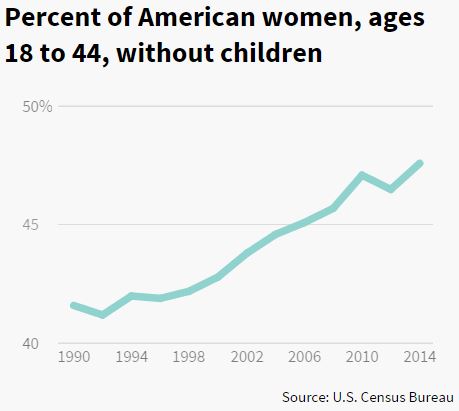
We need to move beyond a survey to quantify this, and this U.S. Census data does that:

Childless by choice, not because of men
Childless by choice, not because of men failing to “man up”

These quotations are very troubling to me. I’ve been serious about obtaining STEM degrees, saving money by not traveling, and making a plan to have a marriage and family that will serve God. I haven’t used my freedom to buy alcohol or to play the field sexually. I don’t see women being serious about choosing men who are serious about marriage – especially men who are financially prepared to pay for things like houses and children. A lot of women are even interested in men who are younger than they are, despite the fact that these men have not proven themselves in their careers and finances.

How can young, unmarried women be sincere about wanting marriage and children “some day” if they waste their 20s and 30s on men who aren’t prepared for the financial responsibility? And that’s not even to mention the fidelity responsibility – men who have self-control before marriage are more able to be faithful after marriage. It seems as if a faithful man who can provide for a family is that last thing that women want. Even if a man does find one who wants to get married, the financial situation between a marriage-minded man and a woman who has spent all her time traveling is going to be a huge mismatch.

Young, unmarried women seem to oppose marriage because they know it will impose responsibilities, expectations and obligations on them. And their parents, relatives, friends and co-workers are doing nothing to detect and counter this attitude. As Lindsay argued on this blog before, the marriage / children plan is an excellent way for Christians to make a difference. But it does take work – work that some young, unmarried women are deliberately avoiding.