Tag Archives: Canada

In Canada, a revolt against global warming socialism creates an economic boom

Before we look at Canada, let’s first look at how Barack Obama has decided to appease his green socialism supporters by rejecting the Keystone XL pipeline.

Excerpt:

The Obama administration rejected the long-delayed TransCanada oil sands crude project, a decision welcomed by environmental groups but blasted by the domestic energy industry.

After delaying the project past the November 2012 election, President Barack Obama was compelled by Congress to decide by Feb. 21 on whether to approve the pipeline that would sharply boost the flow of oil from Canada’s oil sands.

[…]Republicans, in turn, blasted Obama for breaking his promise to create jobs by scuttling the $7 billion pipeline.

House Speaker John Boehner, R.-Ohio, said Republicans will keep fighting for the Keystone pipeline because it is “good for the U.S. economy because it would create thousands of jobs.”

“All options are on the table” for fighting for the sands pipeline between the western province of Alberta and Houston, Boehner told reporters. “This is not the end of the fight.”

Republicans in the Senate have said they could legislate an approval of the pipeline that could get around any rejection by President Obama.

Just to be clear, this pipeline would be paid for with billions of dollars from a Canadian company based in Calgary, Alberta – the Houston of the North. They would pay for the pipeline, they would create the jobs here, and it would cost us nothing to take their money. This would not only cut gas prices for consumers, but it would help us to stop sending money abroad to countries that don’t like us very much.

How are the Canadians responding to Obama’s stupidity? They are already talking about building the pipeline to the west coast and selling their oil to China.

Canadian conservatives have no time for global warming nonsense.

Excerpt:

It is a cliché in journalism to declare metaphorical wars at the drop of a news release. In this case, it looks like war is exactly what Natural Resources Minister Joe Oliver launched Monday in an unprecedented open letter warning that Canada will not allow “environmental and other radical groups” to “hijack our regulatory system to achieve their radical ideological agenda.”

[…]Mr. Oliver took straight aim at a troubling trend in Canadian environmentalism — the foreign funding of Canadian green activist groups with the express purpose of shutting down Canadian resource development…  “These groups,” said Mr. Oliver, “seek to exploit any loophole they can find, stacking public hearings with bodies to ensure that delays kill good projects. They use funding from foreign special interests to undermine Canada’s national economic interest. They attract jet-setting celebrities with some of the largest personal carbon footprints in the world to lecture Canadians not to develop our natural resources.”

And they pulled out of the Kyoto Accord.

Excerpt:

Canada will formally withdraw from the Kyoto Protocol on climate change, the Minister of the Environment has said.

Peter Kent said the protocol “does not represent a way forward for Canada” and the country would face crippling fines for failing to meet its targets.

[…]The protocol, initially adopted in Kyoto, Japan, in 1997, is aimed at fighting global warming.

[…]He said meeting Canada’s obligations under Kyoto would cost $13.6bn (10.3bn euros; £8.7bn): “That’s $1,600 from every Canadian family – that’s the Kyoto cost to Canadians, that was the legacy of an incompetent Liberal government”.

They want jobs. They don’t have money to burn on a dozen Solyndras. They don’t pass job-killing regulations on energy companies.

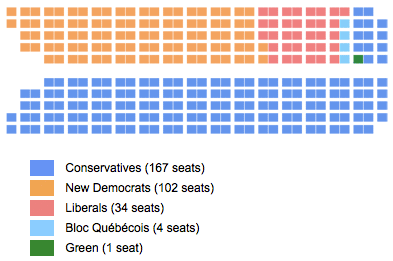
Since 2006, the Canadians have been electing and re-electing Conservative prime minister Stephen Harper. The man has a BA and MA in economics, and he comes from the same fold as Reagan and Thatcher on fiscal conservativism and foreign policy. He has no patience for leftist community organizers like Obama. The Conservatives were re-elected again in 2011, this time with a majority government. Their House of Commons is majority conservative. Their Senate is majority conservative. And Harper has been packing the Supreme Court with fresh conservatives, every time there’s a vacancy. Canada’s economy is booming. And Canadians know how to keep it booming – they are cutting corporate taxes to 15% – less than half of our 35% corporate tax rate. We could be taking their money for the Keystone XL pipeline right now, but we’re not, because we elected an anti-business ideologue instead of an economist.

Related posts

Canadian Conservative MP Joe Oliver declares war on green radicals

Canada 2011 Federal Election Seats

Terence Corcoran writes in the Financial Post about the Canadian Minister of Natural Resources Joe Oliver.

Excerpt:

Through most of 2011, Canadian energy officials in politics and industry watched with bewildered helplessness and some shock as Washington allowed environmentalists to seize control of TransCanada’s $7-billion Keystone XL pipeline issue. They stood by aghast as President Barack Obama, a captive of U.S. green activists and Hollywood movie stars, caved in to political pressure and postponed a decision to approve the project, a potential economic bonanza that promised to deliver thousands of jobs to Americans and billions of barrels of Canadian oil sands production to Texas.

No such green hijacking is going to take place in Canada, at least not without an official fight. On the eve of hearings, which begin Tuesday in Kitimat, B.C., into the $5.5-billion Northern Gateway pipeline — to carry the same oil sands production from Alberta to the West Coast and on to China — the Harper government clearly aims to do what Barack Obama cannot or will not do in America, namely stand up to the growth-killing professional green movement.

It is a cliché in journalism to declare metaphorical wars at the drop of a news release. In this case, it looks like war is exactly what Natural Resources Minister Joe Oliver launched Monday in an unprecedented open letter warning that Canada will not allow “environmental and other radical groups” to “hijack our regulatory system to achieve their radical ideological agenda.”

What a welcome war this is. Never before has a Canadian politician challenged the hitherto saintly protectors of the environment in such direct language. More importantly, Mr. Oliver took straight aim at a troubling trend in Canadian environmentalism — the foreign funding of Canadian green activist groups with the express purpose of shutting down Canadian resource development — first documented in the National Post by Vancouver investigative writer Vivian Krause.

“These groups,” said Mr. Oliver, “seek to exploit any loophole they can find, stacking public hearings with bodies to ensure that delays kill good projects. They use funding from foreign special interests to undermine Canada’s national economic interest. They attract jet-setting celebrities with some of the largest personal carbon footprints in the world to lecture Canadians not to develop our natural resources.”

That’s one reason why the Canadian economy is booming.

We elected a President who gave $535 million to Solyndra, blocked the Keystone XL pipeline, placed a moratorium on Gulf oil drilling and subsidized the Chevy Volt to by $250,000 PER VEHICLE. Note that all of the Chevy Volts sold have now been recalled for repairs. We could have been like Canada, if only we had not elected environmentalists and socialists.

Could Obama have done better? He could learn from Canada’s success

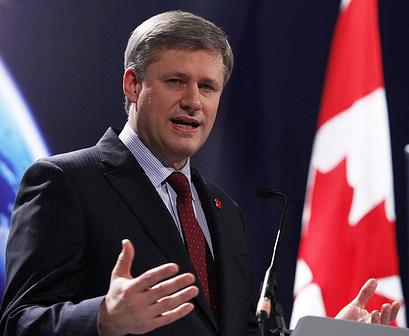
Prime Minister Stephen Harper

Here’s an editorial from Investors Business Daily.

Excerpt:

Away from the low growth and high regulation of an America under Washington’s thumb, our northern neighbor is economically strong. As 2011 ends, Canada has announced yet another tax cut — and will soar even more.

The Obama administration and its economic czars have flailed about for years, baffled about how to get the U.S. economy growing.

In reality, the president need look no further than our neighbor, Canada, whose solid growth is the product of tax cuts, fiscal discipline, free trade, and energy development. That’s made Canada a roaring puma nation, while its supposedly more powerful southern neighbor stands on the outside looking in.

On Thursday, Canadian Prime Minister Stephen Harper announced that he will slash corporate taxes again on Jan. 1 in the final stage of his Economic Action Plan, dropping the federal business tax burden to just 15%.

Along with fresh tax cuts in provinces such as Alberta, total taxes for businesses in Canada will drop to 25%, one of the lowest in the G7, and below the Organization of Economic Cooperation and Development average.

“Creating jobs and growth is our top priority,” said Minister Jim Flaherty. “Through our government low-tax plan … we are continuing to send the message that Canada is open for business and the best place to invest.”

It’s not just that Canada’s conservative government favors makers over takers. Harper’s also wildly popular for shrinking government. “The Harper government has pursued a strategic objective to disembed the federal state from the lives of citizens,” wrote University of Calgary Professor Barry Cooper, in the Calgary Herald.

Harper also has made signing free trade treaties his priority. Canada now has 11 free trade pacts in force, and 14 under active negotiation — including pacts with the European Union and India, among others.

“We believe in free trade in Canada, we’re a free-trading nation. That’s the source of our strength, our quality of life, our economic strength,” Flaherty said last month.

Lastly, Canada has pursued its competitive advantage — oil. And it did so not through top-down “industrial policy,” but by getting government out of the way.

Harper has enacted market-friendly regulations to accomplish big things like the Keystone Pipeline — and urged President Obama to move forward on it or else Canada would sell its oil to China.

These policies have been well-known since the Reagan era. But in a country that’s been institutionally socialist since the 1950s, Harper’s moves represent a dramatic affirmation for free market economics.

For Canada, they’ve had big benefits.

Canada’s incomes are rising, its unemployment is two percentage points below the U.S. rate, its currency is strengthening and it boasts Triple-A or equivalent sovereign ratings across the board from the five top international ratings agencies, lowering its cost of credit.

Is it too much to ask Washington to start paying attention to the Canadian success story?

These sound principles work every time they are tried, and they have led to a transformation in Canada.

Although this article doesn’t mention it, Stephen Harper is also the most solid statesman on foreign policy issues as well.

And here’s a view from up north from Canadian journalist Brian Lilley.

Excerpt:

Prime Minister Stephen Harper has put out his own list of accomplishments for the year that just ended but here are a few of the key conservative minded actions that spring to mind for me.

  • Ending political welfare. The per-vote subsidy that made political parties lazy and unresponsive to the voters of this country and insulated them from angering their core supporters will be gone by 2015-2016. Legislation ending the subsidy has already passed but the parties are slowly being weaned off the money and will get smaller amounts each year until the subsidy is gone.
  • They saw the light of common sense and released the names of those on their wanted list of suspected foreign war criminals. These were people that officials admitted should not be in the country, had been ordered out but that were still in Canada. At first officials would only admit there was a list of suspected war criminals but not say who they were. After much pressure, common sense won the day.
  • Ending the insane rules that would see farmers from certain provinces jailed for daring to sell their wheat to the customer of their choice. The Canadian Wheat Board still exists for those that want to use its centralized system. For those that want freedom, they now have that choice.
  • While much attention has been paid to Bill C-10, the omnibus crime bill, the government has passed C-2 (the mega-trials bill), this bill will make it easier to conduct the mega-trials now associated with organized crime without infringing on the right to a fair trial.
  • While the bill to end the gun registry has not been passed yet, it has been introduced and will pass early this year.
  • Immigration. On this file the Conservatives continue to push for ever higher numbers of newcomers while keeping those skeptical of high immigration onside by cracking down on fraud, cleaning up the system and putting Canada first.

Another thought for those, often myself included, that like to say this government is not conservative enough.

Lilley also notes that electing Harper presented a national day care program (which punishes families with stay-at-home), increasing unemployment benefits (which encourages people not to work), etc.