
Tag Archives: Budget

Who’s better at managing money – Republicans or Democrats?

One of the best jobs for managing money is being governor of a state. So, let’s take a look at the 50 states and see which ones have the best governors for managing money.

Here’s a new report from George Mason University, and it’s written up in Investors Business Daily.

IBD says:

A new report from George Mason University’s Mercatus Center ranks all 50 states based on 14 measures designed to determine whether states can pay their short-term bills and meet their long-term obligations — debt, pension liabilities and such. The data go through 2013.

The best-run states have enough cash to pay its current bills, enough revenue coming in to meet its fiscal year needs, a cushion for economic shocks, and management long-term liabilities.

The worst states, in contrast, have “tens, if not hundreds, of billions of dollars in unfunded liabilities — constituting a significant risk to taxpayers in both the short and the long term.”

[…]There’s only one factor these fiscal winners and losers share in common. And that’s their political leanings. Of the top 10 states in the Mercatus ranking, just two — Florida and Ohio — voted for the Democratic presidential candidate in the past four elections, and just one — Montana — has a Democratic governor. Even if you look at the 25 best-performing states, only three could be considered reliably liberal.

At the other end of the list, just two of the 10 lowest-ranked states — Kentucky and West Virginia — have voted for the Republican in the past four presidential elections. And while four of them have Republican governors, they all are in solid blue states and all were elected to clean up messes left by their Democratic predecessors.

It’s also worth noting that these same states consistently show up at the top and bottom of other lists that measure business friendliness, tax burden and economic freedom.

In fact, six of the 10 worst-performing states in the Mercatus ranking — California, New York, Illinois, New Jersey, Massachusetts, and Connecticut — are also states with the heaviest tax burdens and rated the least business friendly, according to rankings from the Tax Foundation and Chief Executive magazine.

It would appear, then, that abiding by a philosophy of limited government, lower taxes and fewer regulations leads to growth, prosperity and fiscal soundness.

Here’s the full map from the George Mason University study:
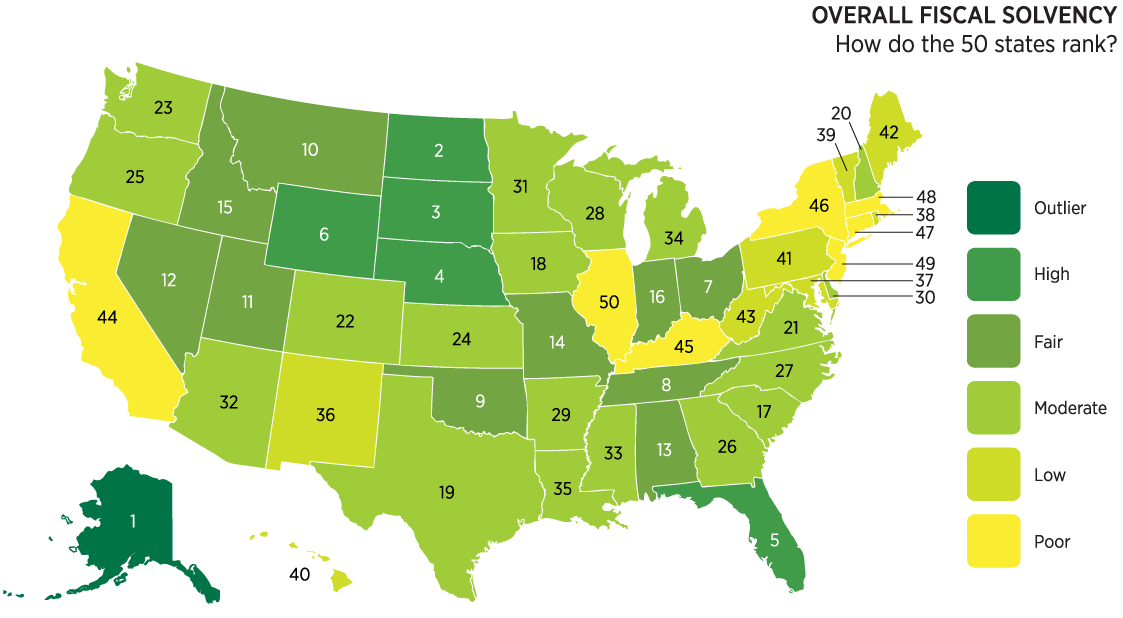
George Mason University study on fiscal solvency

At the state-level, everyone understands that Republican governors know what they are doing, because they understand economics. So then why do we forget that and elect a community organizer when it comes to the Presidency? Do we just not care about the debts we are piling onto our children when we elect wastrels and profligates?
What happened to the economy of North Carolina when Republicans cut taxes?

This story is from The Wall Street Journal.

Excerpt:

Four years ago, North Carolina’s unemployment rate was above 10 percent and the state still bore the effects of its battering in the recession. Many rural towns faced jobless rates of more than 20 percent.

But in 2013, a combination of the biggest tax rate reductions in the state’s history and a gutsy but controversial unemployment insurance reform supercharged the state’s economy and has even helped finance budget surpluses.

As Wells Fargo’s Economics Group recently put it: “North Carolina’s economy has shifted into high gear. Hiring has picked up across nearly every industry.”

The tax cut slashed the state’s top personal income tax rate to 5.75 percent, near the regional average, from 7.75 percent, which had been the highest in the South. The corporate tax rate was cut to 5 percent from 6.9 percent. The estate tax was eliminated.

Next came the novel tough-love unemployment insurance reforms. The state became the first in the nation to reject “free” federal payments for extended unemployment benefits and reduce the weeks of benefits to 20 from 26. The maximum weekly dollar amount of payments, $535, which had been among the highest in the nation, was trimmed to a maximum of $350 a week. As a result, tens of thousands of Carolinians left the unemployment rolls.

[…]After a few months, the unemployment rate started to decline rapidly and job growth climbed. Not just a little. Nearly 200,000 jobs have been added since 2013 and the unemployment rate has fallen to 5.5 percent from 7.9 percent.

[…]Even with lower rates, tax revenues are up about 6 percent this year according to the state budget office. On May 6, Gov. McCrory announced that the state has a budget surplus of $400 million while many other states are scrambling to fill gaps.

[…]Because North Carolina built in a trigger mechanism that applies excess revenues to corporate rate cuts, the business tax has fallen to 5 percent from 6.9 percent, and next year it drops to 4 percent.

Although North Carolina is too liberal for me, it is nice to see them turning their economy around with tax cuts on job creators, and benefit cuts to those who choose not to work.

At the end of the day, the only real security that any of us has comes from the skills we have developed by working and the work experience we put on our resumes. The economy is in for some harsh conditions going forward. The more we can get Americans working, the better they will be able to weather the coming storm. A little kick in the ass might hurt, but in the long-term, it’s for the best.

Scott Walker’s new budget: tax cuts, spending cuts, school choice, smaller government

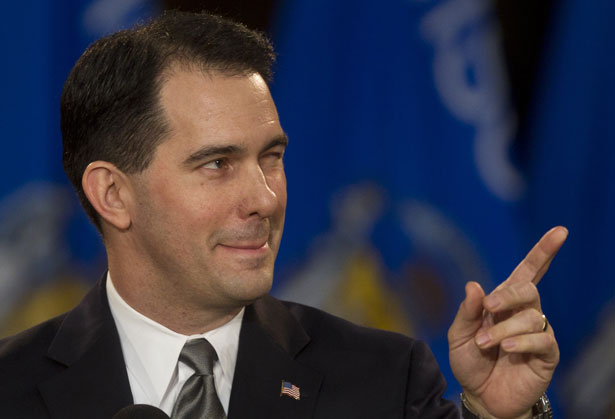
Wisconsin Governor Scott Walker

Scott Walker announces some of the items in his new Wisconsin budget.

The Daily Signal reports:

Gov. Scott Walker unveiled his proposal for Wisconsin’s state budget on Tuesday night, and he did not shy away from offering bold ideas.

The second-term Republican governor has proposed a budget for 2015-17 that would cut property taxes again, eliminate the cap on the state’s school choice program, and reform government by merging agencies.

Walker’s budget would also spin off the public University of Wisconsin System as a separate state entity and require those receiving government benefits to take a drug test.

Tax cuts, expanding school choice, smaller government.

Here are the details on the school choice expansion:

The governor also talked about expanding the state’s school choice program.

“I am excited to announce our plans to lift the cap on vouchers so more families … can have the choice to find the best school for their children,” Walker said. “Every child deserves the chance to succeed.”

If passed by the GOP-led legislature, all students living under 185 percent of the federal poverty level and currently attending a public school would have access to a voucher to attend a private school.

This expansion is on top of school choice programs already in place in the cities of Milwaukee and Racine.

Walker’s budget also expands public school choice in the form of independent charter schools. Wisconsin currently authorizes these schools in the city of Milwaukee, but nowhere else in the state. Independent charter schools are public schools, but do not operate under the auspice of the local school board or teachers’ union.

The governor has proposed a statewide board, which would authorize new charter schools statewide. In Milwaukee, the independent charter schools have repeatedly outperformed their traditional public school peers.

Oh no! What will the leftist public schools do when parents can choose not to give them money? WHO CARES!

And welfare reform:

Walker also introduced a plan recently that would build on his previous entitlement reforms.

“Our budget expands the requirement for able-bodied adults to be enrolled in an employment and training program in order to receive food stamps,” Walker announced. “Now, some might claim that we’re making it harder to get government assistance. We’re not. We’re making it easier to get a job.”

He is mean. Mean to lazy people!

The leftist New York Times reports that the streamlining of government will result in 400 public sector positions (some of which are vacant) being eliminated.

The article also reminds us why conservatives love Scott Walker:

Mr. Walker came to national prominence in 2011 largely because of his first statewide budget proposal, which relied on cuts to collective bargaining rights and increased health and pension costs for most public workers to help solve an expected budget gap.

That got rid of the massive $3.6 billion deficit he inherited from his Democrat predecessor.

But there is more. What do you think the deepest, darkest place is in the United States? I think it’s the university.

The NYT article continues:

Mr. Walker’s proposal calls for cutting about $300 million, or 13 percent, in state funds from the University of Wisconsin System, which includes 13 four-year universities and enrolls some 180,000 students. Mr. Walker’s plan would also take the unusual step of removing the university system from direct state control to a “quasi-governmental” authority that could act autonomously on issues of personnel, procurement, capital projects and tuition.

As word spread in recent days that proposed cuts were coming, some in the university system expressed deep concern, likening the focus on the universities to Mr. Walker’s earlier clashes with public-sector labor unions. At the University of Wisconsin-Madison, the Faculty Senate this week condemned the proposal. Students said they intended to organize opposition.

He went after the leftist public sector unions, and now the bloated leftist public universities. He is so mean to them! Oh well. (Fake cry)

Just ask yourself – what if the guy we chose as the Republican candidate for president actually knew what he was doing? Wouldn’t that be interesting? What if our candidate for President could do more than just play golf and read a teleprompter? What if our candidate for President could actually tell the truth instead of saying “let me be clear”, then lying, then saying “period” after the lie?

When the Green Bay Packers play NFL MVP Aaron Rodgers at quarterback, the Green Bay fans understand that he actually knows how to play football – and he is actually good at it, based on past experiences playing football. What if we chose a candidate who could actually do the job? And talk about past experiences doing the job? Wouldn’t that be something? Picking Scott Walker to be president would be like picking William Lane Craig to debate in favor of Christianity.