A man who rescued an 8-year-old girl who had been abducted by a stranger says he was “beyond scared” as he forced the alleged kidnapper to stop his truck and hand over the child.
At about 6:45 a.m. Tuesday, Victor Perez, 29, recognized the truck from media reports about the girl, who was taken while she played outside a home in Fresno, Calif., at 8:30 p.m. Monday.
He gave chase in his own vehicle and repeatedly tried to force the alleged kidnapper’s truck off the road. Eventually, Perez saw the girl’s head in the truck’s window.
“He kept getting away. He kept going round my truck. The last time I completely said, ‘Either he crashes into me or he stops.’ He stopped and pushed the little girl out,” he told NBC station KSEE 24 News.
After being forced out of the truck, the girl ran to safety.
“The first thing she told me, ‘I’m scared,'” Perez said. “She was shaking. I said, ‘You’re all right now.'”
“I thought, that could be the truck,” Perez told CNN Tuesday night.
“I had a split-second decision to decide to call 911 or go after it,” Perez told ABC News. “I decided to go after it while my cousin was dialing 911. I took a chance to go and ask a question to see if that was the man that we’re looking for.”
He got into his 1988 white Ford pickup, and began to follow. As he tried to cut off the truck, its driver reportedly told him, “I don’t have no time,” and claimed his battery was dying.”The second time I reached him, the way he acted — yes, I was, for a split second I was nervous until I saw the little girl and all fear was out the window after that,” Perez told ABC’s “Good Morning America.”
“I didn’t have no fear. I wasn’t thinking of me no more. I was just thinking we need to get that little girl to safety,” he added. “I wasn’t going to give up. … I couldn’t give up.”
“I kept telling him, ‘That’s not your little girl.’ We argued. We exchanged words,” Perez told CNN, admitting that he had wondered whether the motorist had a gun. “I was beyond scared.”
“He was hiding her — like pushing her down. I thank God he put me here to help out that little girl — that’s for sure,” he added.
On the fourth attempt, he forced the vehicle to stop.
This man is a hero! We need to make a big deal out of him in order to encourage more men to be heroes.
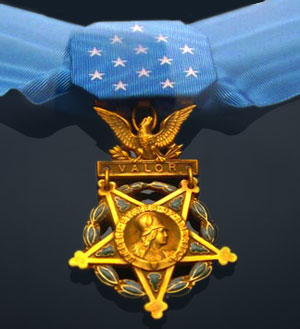
A Congressional Medal of Honor (Air Force version)
Here’s a story from the Chicago Tribune to explain how a person can win the Congressional Medal of Honor. (H/T Blackfive)
Excerpt:
The damage assessment patrol walked north about 800 meters to a bridge impassable by vehicle. Led by Miller, the team turned east, crossed the estimated 100-foot bridge and turned south into a narrow, steep valley. They had trekked for about 45 minutes.
“That’s when we walked into the hornet’s nest,” McGarry said.
About 40 insurgents had dug under rock formations in the narrow pass east of the Kunar River. Nearly 200 more were higher on a ridge, Lodyga said.
Miller’s teammates recalled that an Afghan National Army soldier spotted an insurgent obstructed by a boulder and ordered him to surrender. The man refused.
“You heard somebody yell ‘Allah Akbar,'” the Muslim phrase loosely translated as “God is great,” Lodyga said, “and then an overwhelming amount of firepower came down on us.”
Miller’s first move was to shoot and kill the insurgent who had stepped from the boulder about 20 feet away, said McGarry. Other insurgents were nearly as close, Lodyga said. He, McGarry and Cusick said it was the worst firefight they’d experienced.
“It was almost like standing in the middle of all the fireworks on the Fourth of July,” Cusick recalled. “It was very loud.”
Added McGarry, “There were so many people shooting at us, the bullets were kicking up everything around us. I kept looking over and saw Rob shooting.”
Then McGarry and the others saw something else: Miller charged the enemy, firing his lightweight machine gun at several insurgent positions. At the same time, he was calling out the directions of and distances to enemy positions.
“Robbie was shouting at everybody to bound back, bound back,” McGarry recalled, “and he was taking on the entire south area of the kill zone by himself. I couldn’t look over for too long, but it took me a second or two to take it all in.”
Miller’s approach, while bold, was tactically astute. He was engaging at least four enemy positions and drawing their fire, allowing his teammates to get to safer ground. His aim was deadly accurate. Military records credit him with killing more than 16 insurgents and wounding 30.
In the first few moments, Cusick, the commander, was severely wounded when a bullet struck near his left collarbone and tore an exit hole in his left shoulder blade. His lung was punctured. One of the team members ran to his side and thrust a needle in his chest, allowing him to breathe.
While firing at the enemy, the rest of the team also was seeking cover, McGarry said.
Miller kept charging and firing, and when he had stopped firing, he threw at least two grenades “into enemy machine gun fire that basically had the patrol locked down,” Lodyga said. “He took them out.”
[…]So much chaos was roiling that patch of the narrow pass where the Special Forces were ambushed that it’s unclear how long Miller charged and engaged the insurgents. Those on the patrol said it could have been five to 15 minutes before he was shot inches below his right armpit, a spot unprotected by body armor.
“I don’t know if he stayed on his feet or not after he was shot,” Lodyga said, “but I do know he turned toward the enemy position and kept firing. He killed two or three right there.”
Two to five minutes later, Miller was struck again under his left armpit and died immediately. The entry points of the wounds indicate his arms were raised to fire his weapon, a young man facing death courageously.
“At the end of the day,” Lodyga said, “if Robbie hadn’t been courageous and did what came as second nature to him, you’d be looking at eight dead Special Forces. That’s what Robbie gave his life for.”
The military goes even further, contending that Miller’s actions also saved the lives of an estimated 12 Afghan National Army soldiers.
Although tens of millions of men and women have worn the uniform of the armed forces for the U.S., fewer than 3,500 have earned a Medal of Honor.
Actually, it’s much rarer than that – the military has really tightened up the requirements in the last 100 years or so. Basically, you have to give your life to save many others under heavy fire in order to win a medal of honor. They are extremely rare.
The Medal of Honor is awarded by the President in the name of Congress to a person who, while a member of the Army, distinguishes himself or herself conspicuously by gallantry and intrepidity at the risk of his or her life above and beyond the call of duty while engaged in an action against an enemy of the United States; while engaged in military operations involving conflict with an opposing foreign force; or while serving with friendly foreign forces engaged in an armed conflict against an opposing armed force in which the United States is not a belligerent party. The deed performed must have been one of personal bravery or self-sacrifice so conspicuous as to clearly distinguish the individual above his comrades and must have involved risk of life. Incontestable proof of the performance of the service will be exacted and each recommendation for the award of this decoration will be considered on the standard of extraordinary merit.
I once read an entire book on Medal of Honor award winners in World War II. It’s hard to read those stories, because these people who won the award did amazing acts of bravery, courage and self-sacrifice, but then most of them DIED. The stories almost always end in sadness and grief. Here’s the one that really stuck with me as an example. I read that book in 1999 as part of my effort to develop humility. I wanted to break down my own pride, and so I intentionally engaged in an activity to achieve that goal.
Today, many people think it is horrible to look up to anyone who is better than we are at anything. We don’t believe in heroes any more. We think that virtues are easy. That anyone can be virtuous. That virtue takes no preparation or discipline. That brave or cowardly acts are just things that people do because they like one or the other, and that’s all. That everyone, good or evil, is basically doing what they want to do. But I don’t think that’s true. I think bravery, courage and self-sacrifice are objectively good, and that we ought to recognize and honor those virtues.
I think we need to get into the habit of realizing that the character of a person as measured against an objective standard is more important than what they can do to make ME happy. Sometimes, we just need to hold up examples of goodness to ourselves and to others, even if it makes us feel inadequate. Acknowledging what is good is the first step to being good yourself. If you don’t acknowledge that anyone is better than you are, then how will you grow? You have to look at what the best people are doing and honor them and learn from them.
I think that as Christians, the more we reflect on the message of the gospel and the example of Jesus, the more sensitive and appreciative we become of things he exemplified, like self-sacrifice and humility. Jesus deserves something like a Medal of Honor, for sacrificing his life to save others in difficult circumstances. He showed courage in the face of danger in order to die in the place of every single person who has ever lived. When we stand before him to give our account, will we have love our neighbor the same way? Will he pin something like a Medal of Honor on our chest for uncommon valor under heavy fire? Stories like Rob Miller’s makes us think about that, don’t they? And that is a good thing. The story of a war hero points beyond the story to the moral truths that are built into the universe by God himself.
So that’s why I think it’s important for Christians to be grateful to those who give their lives fighting evil in foreign lands so that we can have liberty, prosperity and security here at home. I am grateful for the sacrifice of Rob Miller. Gratitude is another virtue that we often overlook.
It is a very dark time in my life. I don’t know how else to describe it. About three or four weeks ago I changed.
[…]All I can say is that I have had some sort of mental breakdown. My strength is gone. Depression? Certainly. Anxiety? Definitely. Fighting with the Lord? Most assuredly. All I know is that I broke a few weeks ago and I don’t know how to fix myself. All of the advice that I have given to broken people over the years is now pointed back at me and I realize how empty it can be.
Why? I don’t know. I wish I did. I have spent the last few weeks obsessing with how to get “me” back. I have analyzed every possible turn. God seems to have gone AWOL and I can’t get in touch with him other than through the cold hard facts. Facts are facts. They are nice, but I am coming to realize how much I need his presence in other ways. He has not been seen in this neck of the woods in quit some time.
I am sometimes not in the best of spirits, but then I always fall back on my arguments and facts. I always thought that the facts would protect me, and they always have – from everything. Now I laugh at God when he lets bad things happen to me. I’m like “yeah, good one. You got me. So what do you want this time? More church? Or more prayer? More Bible reading? More donations?” I actually thank God for not trying to get my attention by going after my health or something more central to me. I am surprised that the facts failed Patton.
On the other hand, I understand why he feels depressed, because he and I have the same notion of what causes depression.
He says this:
My family was strong and they were all following you. Now everyone that I loved so dearly and saw you in is either dead, mentally incapacitated, doubting, or depressed. Some have three of the four. It is so dark at mom’s house. It used to be so wonderful. You were there. And my ministry: it was a joy I turned to so often and found you when you were gone in other places. For years you had surprise moves that energized my spirit with your presence. Now you have left the building here as well. I have come to the point where I am timid and insecure. The mandate that I had is gone.
I agree with this. It is extremely challenging to continue to do the right thing when God doesn’t seem to be supporting you. What is happening to him could happen to me, and I wish him a speedy recovery. But I do have some comments and I want to express them below, with humility.
My thoughts
My view of Christianity has always been consistent with being a secret agent. When things go wrong, your government abandons you and disowns you. My view of the Christian life has always been like that. Even the Father turned away from the Son when the Son was doing his duty on the Cross, atoning for the sins of the whole world. So a good Christian like Patton can do all the right things, but because people have free will, and natural evil happens, things may not work out – and that is OK. So, I have really low expectations.
For me, the Christian life is like the old spy series Mission Impossible.
Most episodes begin with the leader of the IMF getting orders from a hidden tape recorder and an envelope of photos and information which explains the mission. The tape always begins with “Good Morning Mr. Phelps/Briggs”, explains the situation, and ends with “Your mission, should you decide to accept it”, with a brief explanation of the goal of the mission, along with a reminder that “as always, should you or any of your IM force be caught or killed, the Secretary will disavow any knowledge of your actions.”
I don’t expect anything – I just do my job, and try to bleed as little as possible on God’s rug when my teeth get kicked in. I think that something idealistic died in me a long time ago when I first realized that doing the right thing gets you killed. It got Jesus killed. He was without sin, yet the Father would not save him from his duty to obey. So what’s the problem? This life doesn’t work. You can do the right thing, but there are no guarantees. We need to realize that the story of Jesus doesn’t turn happy until after he dies.
This intro to the movie Casino Royale makes my point in a cool way:
13 Furious with rage, Nebuchadnezzar summoned Shadrach, Meshach and Abednego. So these men were brought before the king,
14 and Nebuchadnezzar said to them, “Is it true, Shadrach, Meshach and Abednego, that you do not serve my gods or worship the image of gold I have set up?
15 Now when you hear the sound of the horn, flute, zither, lyre, harp, pipes and all kinds of music, if you are ready to fall down and worship the image I made, very good. But if you do not worship it, you will be thrown immediately into a blazing furnace. Then what god will be able to rescue you from my hand?”
16 Shadrach, Meshach and Abednego replied to the king, “O Nebuchadnezzar, we do not need to defend ourselves before you in this matter.
17 If we are thrown into the blazing furnace, the God we serve is able to save us from it, and he will rescue us from your hand, O king.
18 But even if he does not, we want you to know, O king, that we will not serve your gods or worship the image of gold you have set up.”
I think that Patton shows us that even the best Christians have a breaking point. I’m probably not as strong as he is – and he certainly attempts more for the Lord than I do, but I try to avoid exposing myself to threats. It’s best not to be overconfident about your limitations. Instead, live in a way so that you can stand your ground when God withdraws his support.
So here’s my advice. Save your money, don’t spend it on fun stuff. Make financial investments. Don’t take risks unless it’s for the Kingdom. Be careful to avoid sin. Don’t attempt to do more than you can handle. Don’t make poor decisions and hope to be bailed out by God. Run your faith like a business – think everything through the best you can, objectively. Focus on truth when building your worldview – not feelings. Find out how everything in life works so you aren’t surprised. Don’t believe that you can sin and escape the damage – you can’t, even if God forgives you. Tell your friends the truth, and teach them apologetics so that they can stand with you. Keep in mind that Satan is real and would love to crush your plans, and you with them. Be careful. Be prepared.
We all need to encourage one another intentionally – as if our lives depended on it. There’s a war on, soldier. Look out for the man next to you, and train him to be able to look out for you.
My favorite lecture of all time
Now may be a good time to point you all to the lecture that changed my life: Dr. Walter Bradley’s “Giants in the Land”.
Dr. Walter L. Bradley
Ph.D. in Materials Science, University of Texas at Austin, 1968
B.S. in Engineering Science, University of Texas at Austin, 1965

 WINTERY KNIGHT