

Before we see the hot pictures of Michele Bachmann from her vacation on the beach, let’s take a look at this Wall Street Journal article and find out what sorts of economics books Michele Bachmann reads on the hot beach possibly in her bathing suit.
Ms. Bachmann is best known for her conservative activism on issues like abortion, but what I want to talk about today is economics. When I ask who she reads on the subject, she responds that she admires the late Milton Friedman as well as Thomas Sowell and Walter Williams. “I’m also an Art Laffer fiend—we’re very close,” she adds. “And [Ludwig] von Mises. I love von Mises,” getting excited and rattling off some of his classics like “Human Action” and “Bureaucracy.” “When I go on vacation and I lay on the beach, I bring von Mises.”
Consider Thomas Sowell’s “The Housing Boom and Bust”. Here’s a photo of that book which Michele Bachmann reads on the hot beach possibly in a swimsuit:

The Wall Street Journal explains more:
As we rush from her first-floor digs in the Cannon House Office Building to the House floor so she can vote, I ask for her explanation of the 2008 financial meltdown. “There were a lot of bad actors involved, but it started with the Community Reinvestment Act under Jimmy Carter and then the enhanced amendments that Bill Clinton made to force, in effect, banks to make loans to people who lacked creditworthiness. If you want to come down to a bottom line of ‘How did we get in the mess?’ I think it was a reduction in standards.”
She continues: “Nobody wanted to say, ‘No.’ The implicit and then the explicit guarantees of Fannie Mae and Freddie Mac were sopping up the losses. Being on the Financial Services Committee, I can assure you, all roads lead to Freddie and Fannie.”
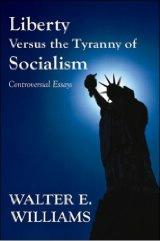
Consider Walter Williams’ “Liberty vs the Tyranny of Socialism”. Here’s a picture of that book which Michelle Bachman reads on the hot beach possibly in a bathing suit:
The Wall Street Journal explains more:
Ms. Bachmann voted against the Troubled Asset Relief Program (TARP) “both times,” she boasts, and she has no regrets since Congress “just gave the Treasury a $700 billion blank check.” She complains that no one bothered to ask about the constitutionality of these extraordinary interventions into the financial markets. “During a recent hearing I asked Secretary [Timothy] Geithner three times where the constitution authorized the Treasury’s actions, and his response was, ‘Well, Congress passed the law.'”
Insufficient focus on constitutional limits to federal power is a Bachmann pet peeve. “It’s like when you come up to a stop sign and you’re driving. Some people have it in their mind that the stop sign is optional. The Constitution is government’s stop sign. It says, you—the three branches of government—can go so far and no farther. With TARP, the government blew through the Constitutional stop sign and decided ‘Whatever it takes, that’s what we’re going to do.'”
Does this mean she would have favored allowing the banks to fail? “I would have. People think when you have a, quote, ‘bank failure,’ that that is the end of the bank. And it isn’t necessarily. A normal way that the American free market system has worked is that we have a process of unwinding. It’s called bankruptcy. It doesn’t mean, necessarily, that the industry is eclipsed or that it’s gone. Often times, the phoenix rises out of the ashes.”
Consider Milton Friedman’s “Capitalism and Freedom”. Here’s a pic of that book which Michelle Bauchman reads on the hot beach possibly in a bikini:

The Wall Street Journal explains more:
“For one, I believe my policies prior to ’08 would have been much different from [President Bush’s]. I wouldn’t have spent so much money,” she says, pointing in particular at the Department of Education and the Medicare prescription drug bill. “I would have advocated for greater reductions in the corporate tax rate and reductions in the capital gains rate—even more so than what the president did.” Mr. Bush cut the capital gains rate to 15% from 20% in 2003.
She’s also no fan of the Federal Reserve’s decade-long policy of flooding the U.S. economy with cheap money. “I love a lowered interest rate like anyone else. But clearly the Fed has had competing goals and objectives. One is the soundness of money and then the other is jobs. The two different objectives are hard to reconcile. What has gotten us into deep trouble and has people so perturbed is the debasing of the currency.”
That’s why, if she were president, she wouldn’t renominate Ben Bernanke as Fed chairman: “I think that it’s very important to demonstrate to the American people that the Federal Reserve will have a new sheriff” to keep the dollar strong and stable.
[…]Ms. Bachmann attributes many of her views, especially on economics, to her middle-class upbringing in 1960s Iowa and Minnesota. She talks with almost religious fervor about the virtues of living frugally, working hard and long hours, and avoiding debt. When she was growing up, she recalls admiringly, Iowa dairy farmers worked from 5 a.m. to 10 p.m.
Her political opponents on the left portray her as a “she-devil,” in her words, a caricature at odds with her life accomplishments. She’s a mother of five, and she and her husband helped raise 23 teenage foster children in their home, as many as four at a time. They succeeded in getting all 23 through high school and later founded a charter school.
Michele Bachman is actually willing to pass a lower corporate tax rate than even Tim Pawlenty’s 15% rate:
If she were to take her shot, she’d run on an economic package reminiscent of Jack Kemp, the late congressman who championed supply-side economics and was the GOP vice presidential nominee in 1996. “In my perfect world,” she explains, “we’d take the 35% corporate tax rate down to nine so that we’re the most competitive in the industrialized world. Zero out capital gains. Zero out the alternative minimum tax. Zero out the death tax.”
The 3.8 million-word U.S. tax code may be irreparable, she says, a view she’s held since working as a tax attorney at the IRS 20 years ago. “I love the FAIR tax. If we were starting over from scratch, I would favor a national sales tax.” But she’s not a sponsor of the FAIR tax bill because she fears that enacting it won’t end the income tax, and “we would end up with a dual tax, a national sales tax and an income tax.”
Her main goal is to get tax rates down with a broad-based income tax that everyone pays and that “gets rid of all the deductions.” A system in which 47% of Americans don’t pay any tax is ruinous for a democracy, she says, “because there is no tie to the government benefits that people demand. I think everyone should have to pay something.”
On the stump she emphasizes an “America-centered energy policy” based on “drilling and mining for our rich resources here.” And she believes that repealing ObamaCare is a precondition to restoring a prosperous economy.
[…]Ms. Bachmann also voted for the Republican Study Committee budget that cuts deeper and faster than even Mr. Ryan would. “We do have an obligation with Social Security and Medicare, and we have to recognize that” for those who are already retired, she says. But after that, it’s Katy bar the door: “Everything else is expendable to bring spending down,” and she’d ax “whole departments” including the Department of Education.
Below are some links to learn more about Michele.
Campaign speeches, interviews and debates
Speeches:
- Michele Bachmann’s Republican Leadership Conference speech
- Michele Bachmann’s speech at the Right Online Conference
Reactions from her recent debate performance:
Profiles of Michele Bachmann:
And here are some of her media interviews and speeches in the House of Representatives.
You can contribute to her campaign right here. You can be her friend on Facebook here and also here.
This post was linked by:
And tweeted by Kathleen McKinley and Robert Stacy McCain.
Related posts
- New Michele Bachmann interviews on the economy
- MUST-HEAR: Michele Bachmann gives the best speech ever
- Michele Bachmann beats RINO Mitt Romney in fundraising
- Michele Bachmann looking presidential against the liberal media
- Michele Bachmann courts homeschoolers in Iowa speech
- Michele Bachmann and Paul Ryan on the Wisconsin teacher union pensions
- Video and transcripts of response speeches by Paul Ryan and Michele Bachmann
- What was the context of Michele Bachmann’s “armed and dangerous” comment?
- AT LAST: Michele Bachmann open to presidential run in 2012
- Megyn Kelly and Michele Bachmann on the Bush tax cut deal
- CNS News interviews Michele Bachmann
- Michele Bachmann requests the resignation of Attorney General Eric Holder
- Michele Bachmann attacks government bailout of unions
- Michele Bachmann makes the case for limited government
- Why is the left so angry with Michele Bachmann and Sarah Palin?
- Michele Bachmann on Fox News with Laura Ingraham
- Democrats kill Michele Bachmann’s attempt to freeze federal salaries
- Michele Bachmann on the US taxpayer-funded bailout of Greece
- Michele Bachmann explains the Obama’s Wall Street bailout bill
- Michele Bachmann promises to work to repeal Obamacare
- Video of Michele Bachmann defending unborn children
- Michele Bachmann’s passionate and inspiring speech at CPAC 2010
- Michele Bachmann talks about Obamacare and the stimulus package
- Michele Bachmann wants to cancel bonuses for Fannie Mae and Freddie Mac CEOs
- Michele Bachmann analyzes Obama’s latest foreign policy blunders
- Congresswomen denounce Obamacare’s rationing of breast cancer exams
- Michele Bachmann video on the future of Obamacare
- Moderate George Will lauds the virtues of Michele Bachmann
- Michele Bachmann is Mrs November in new calendar (and her best video clips)


 Completely readable – completely excellent. Actually, one of my favorite reads this year. I thought, I could give this to anyone and they would understand it, enjoy it, and be challenged by it. Full of wit, humor, and sharp thinking. This definitely makes it to the top of my list. (review

 Another book with a question for a title – but
  questions are good, and this book tackles about 18 of them that are being asked the most these days. Written by Sean McDowell and Jonathan Morrow, with contributions from a ton of excellent specialists, this book is a phenomenal resource and doesn’t have to be read in any particular order. (an interview with the authors
 is another book loaded with great content – 50 essays! – with contributions from a ton of top-notch apologists. A close competitor with the previously mentioned book that happens to be a great resource.
 by William Lane Craig
 is excellent for personal study or group studies. Weighty material that is clear, precise, and put together really well. I’d give this to Christian young people in high school and college who want to strengthen their apologetics foundations. (review
 And finally, here’s the stocking stuffer of the bunch: Kreeft and Tacelli’s
  . The reason? Again, lots of material packed into a small book, organized and presented well.
 WINTERY KNIGHT