Tag Archives: Bobby Jindal

Bobby Jindal’s education reform vs Jeb Bush’s big government Common Core

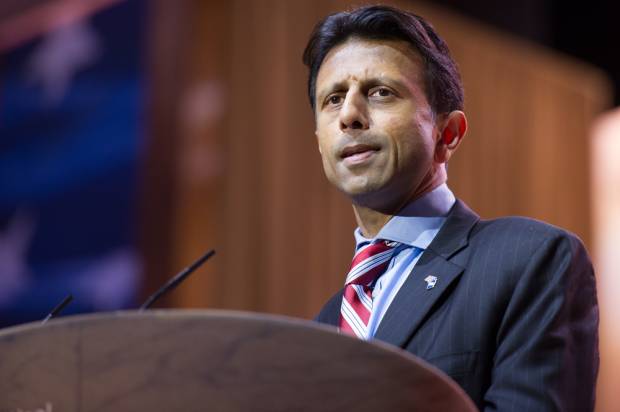
Louisiana Governor Bobby Jindal

The radically leftist National Journal compares and contrasts the education policies of Louisiana Governor Bobby Jindal with former Florida Governor Jeb Bush.

They write:

Louisiana Gov. Bobby Jindal is in Washington Monday to unveil a series of education reforms as part of his 2016 presidential preparations. But his proposals call for scaling back Washington’s role in education while promoting increased parental choice for children’s schools, better measures to assess teacher performance, and more autonomy for individual schools over their own operations.

[…]Through his policy-focused nonprofit AmericaNext, Jindal will be delivering his education proposals at a Christian Science Monitor Breakfast Monday morning, speaking at an educational forum hosted by South Carolina GOP Sen. Tim Scott and meeting with conservative writers to discuss the plan at the Heritage Foundation. He has previously released detailed policy papers on health care, foreign policy, and energy.

Jindal’s education report is a balancing act between calling for higher standards and improved accountability, while limiting the role of the federal government to offer policies to solve the problem. Jindal argues that if parents have more choice in where to send their kids to school—be it local public schools, charter schools, or using vouchers for private or parochial education—the renewed competition will itself force public schools to do a better job. His report calls for less-regimented testing requirements, even as he supports stronger state accountability measures so parents can determine the best schools for their children.

“The federal government should absolutely not be offering incentives, mandates, or coercing states to adopt a national curriculum—whether it’s Common Core or the next iteration of it,” Jindal said. “We don’t think curriculum decisions should be made at the national level. I’m all for rigor, I’m all for standards, but ultimately, I trust parents. I trust choice and competition. I don’t want a top-down, one-size-fits-all approach.” To that end, Jindal said he favors rolling back the mandates in George W. Bush’s No Child Left Behind law.

If he runs for president, Jindal is expected to make education a central part of his message. In the report, he touts the success of the New Orleans school system as a model of his school-choice pitch. After Hurricane Katrina, the city’s educational system was entirely revamped and turned over to the state-run Recovery School District. They allowed schools to be run independently; now more than 90 percent of students in the city attend charter schools. The results have been one of the country’s biggest educational success stories—the graduation rates have skyrocketed and the city’s passing rate on state tests now rival the statewide averages.

Many of Jindal’s school-choice proposals are an extension of the New Orleans experience. He calls for expanding the number charter schools, urges states to remove the caps on the number of charter schools allowed, and argues that principals should play a more active role in their schools’ direction than local school boards.

“Those on the left who believe in government power don’t trust the American people. In terms of education, the best way to drive excellence is to trust the parents. Parents know their kids best, they want what’s best for their children, and if you allow them to vote with their feet, they will then have the chance to give the best education for their kids. And we’ve seen that in New Orleans,” Jindal said.

All told, Jindal’s preferred policies are in line with what many leading educational reformers are arguing. He believes strongly that teacher quality is the strongest school-based factor in a student’s education, and he believes talented teachers should be rewarded for their work. He rails against the seniority system that keeps the most veteran teachers protected from scrutiny. He is dismissive of requiring teachers to hold educational degrees, preferring recruits that have expertise in the areas they teach. And he is bullish about the role technology can play in improving educational outcomes.

[…]But the political red meat of his proposals is directed squarely at Bush. The biggest differences between the two come from the federal role in education and over testing—two areas where the educational establishment is growing disconnected from public opinion. By calling for less testing, Jindal is taking the sides of parents who believe the sheer number of tests is crowding out time for creative endeavors—like art and music—and forcing teachers to drily teach to the test. On that front, Jindal’s critiques echo many liberals on the issue and contrast with the Bush view that progress is best measured through standardized tests.

So it’s ironic that, despite the report’s depth, Jindal’s advisers are hoping to reap the biggest political gain from conservatives by attacking Common Core and calling “the federal government [not to] touch curricula with a 10,000-foot pole.” It’s designed to clearly contrast his version of educational reform with Jeb Bush’s. “Our fundamental disagreement is on who is or should be in control of testing and curriculum. Locals v. federal. And make no mistake, the federal role in education is a huge fault line [between Jindal and Bush],” said a senior Jindal adviser.

If Jeb Bush gets the nomination, it will be like electing a Democrat on education issues – he favors big government control of education, and standardized tests controlled at the federal level. We would be much better off choosing a small-government approach like Bobby Jindal’s approach, an approach that is consistent with conservative principles and is proven to work.
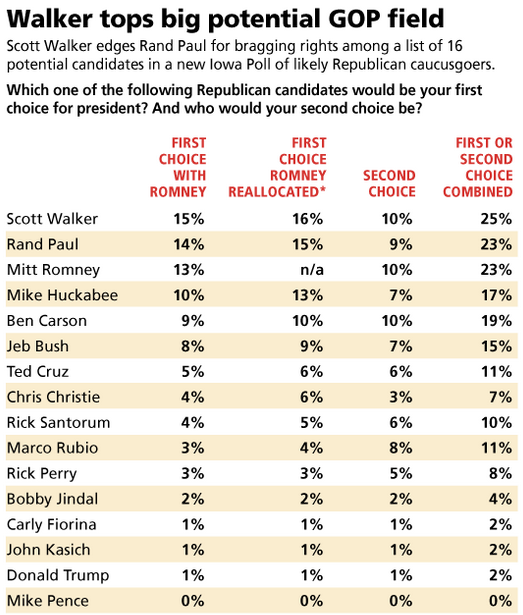
With Romney out, Scott Walker leads Iowa poll with 16%, Bush at 9%

GOP primary Iowa poll from 2/1/15

A Des Moines Register poll from Iowa came out today, showing Scott Walker in the lead, and the lead increases if Romney is out.

Here are the details:

Presidential stage newcomer Scott Walker, the conservative reform pit bull who inspired death threats from the left, has become the one to watch in the race for the Republican nomination a year out from the Iowa caucuses.

At 15 percentage points, he leads a big, tightly packed field of potential contenders in a new Des Moines Register/Bloomberg Politics Iowa Poll of likely Republican caucusgoers. The caucuses are scheduled for Feb. 1, 2016.

The Wisconsin governor is also the No. 2 most popular choice for likely caucusgoers who want an establishment candidate, and he’s the No. 2 for those who want an anti-establishment candidate, the poll shows.

“He’s in a sweet spot,” pollster J. Ann Selzer said. “People who don’t want an ultra-conservative think he’s OK. People who don’t want a moderate think he’s OK.”

[…]The day after polling wrapped up, Romney announced he’s out of the competition. When the numbers in this poll are shuffled — by giving Romney’s votes to the contenders his supporters named as their second-choice pick — the five others in the top tier gain support.

[…]Walker’s support has jumped 11 points since the last Iowa Poll. In October, only 4 percent of likely caucusgoers named Walker as their first choice for president.

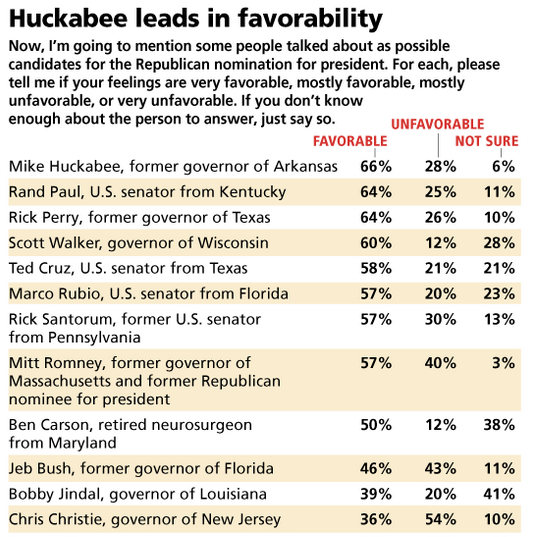
[…]At the same time, the favorability rating for Walker has climbed 11 percentage points; Carson, 9; Huckabee, 7; Cruz, 6; Santorum, 5; and Paul, 5, the new poll shows.

“The candidates perceived as more conservative are not only leading but are gaining,” GOP strategist Vin Weber, a former Minnesota congressman, noted after looking over the results.

Walker and Carson have the lowest “unfavorable” ratings:

GOP primary Favorability

This is good news for Walker, but it’s disturbing to me that Huckabee (big government tax-and-spend moderate) and Paul (Peter Pan isolationist pot-legalizer) are that high up in the poll. Ben Carson is looking good, though. I like that the leftist establishment candidates (Bush, Christie and Romney) all had high unfavorable ratings. That’s a good sign.

Walker was on ABC’s This Week show:

Wisconsin Gov. Scott Walker (R) has not officially announced that he will run for president in 2016, but he is feeling very confident about his chances.

Martha Raddatz, host of ABC’s “This Week,” asked Walker on Sunday morning whether there is a 99 percent chance he’ll run.

“I don’t know that I’d take the odds,” Walker responded. “I’ll just tell you one thing. After three elections for governor in four years in a state that hasn’t gone Republican since 1984 for president, I wouldn’t bet against me on anything.”

A new Bloomberg/Des Moines Register poll shows Walker as the favorite among possible GOP presidential candidates. The governor was the first choice of 15 percent of respondents, just edging out Kentucky Sen. Rand Paul.

Walker said he believes he could defeat likely Democratic nominee Hillary Clinton because she represents an earlier era in Washington, D.C., politics for which most Americans are not nostalgic.

“People want new, fresh leadership with big, bold ideas, and the courage to act on it,” Walker said. “And if we’re going to take on a name from the past, which is likely to be former Secretary of State Hillary Clinton, I think for the party we need a name from the future.”

Looking good. Again, we have to have a candidate who is competent enough on fiscal issues, and has the results, if we hope to get around the media’s tendency to go after social conservatives. My list right now is this:

  1. Scott Walker
  2. Bobby Jindal
  3. Rick Perry
  4. Susan Martinez
  5. Ted Cruz

Pence is off my list after a couple of recent big government missteps (state media and Medicaid expansion).

Related posts

Bobby Jindal and Mike Lee on school choice / education reform

Lousiana Governor Bobby Jindal
Louisiana Governor Bobby Jindal

This is an editorial from the Washington Examiner, authored by school choice champion Bobby Jindal.

What is school choice?

On the most basic level, school choice represents the freedom to choose — empowering parents to select the best educational options for their sons and daughters. That could be a charter school, a private school, a religious school, home schooling, or even online learning. Governments should provide parents with the personalized and individualized tools they need to help their children excel academically.

That freedom to choose in turn will provide children with the freedom to succeed. With the right educational environment, teachers and academic training; students from all locations, income brackets and demographic groups will have better tools to compete in the global economy. We need to develop the talents of every American — no matter where he or she is from, and no matter the color of his or her skin — to maximize our country’s potential.

School choice also serves another important purpose — freeing low-income children from failing schools. No child should see his God-given talents go to waste because he is stuck in a failing school — and no parent should face the disempowerment that comes from knowing her son or daughter remains trapped in a poor school, and she lacks the financial means to move that child elsewhere. We can do better — and, by allowing parents dissatisfied with their school to move with their feet, school choice gives both high-performing and low-performing schools more incentive and motivation to improve their offerings.

Finally, school choice provides parents with freedom from the status quo — an educational-industrial complex that thinks bureaucrats, not parents, can best make decisions about the lives and futures of America’s children. It’s about pushing back when the then-head of Louisiana’s largest teachers’ union said low-income parents had “no clue” how to choose the right school for their children. And it’s even about standing up to the Attorney General of the United States, when the Department of Justice asked a court to block Louisiana’s school scholarship program on civil rights grounds — even though 90 percent of the program’s participants come from racial minority groups.

I don’t like people who talk conservative but govern liberal. I want to see the achievements.

The numbers:

For here in Louisiana, we’ve put those principles to practice. Since we removed the cap on charters in 2009, we’ve authorized almost 200 charter schools throughout the state — that’s 70,000 kids who now have a choice about where they go to school. This last year, our Recovery School District became the nation’s first school district with 100 percent charter school enrollment. And the results are dramatic: The graduation rate in New Orleans has increased from 54.4 percent before Hurricane Katrina in 2004 to 72.8 percent; the percentage of New Orleans students scoring basic and above has increased from 35 percent to 63 percent; and the percentage of failing schools in New Orleans has dropped from 67 percent in 2005 to 17 percent.

We expanded our school choice scholarship program, which was initially confined to New Orleans, statewide. Parental satisfaction with the statewide scholarship program stands at a whopping 91.9 percent. We went even further though and created a dollar for dollar rebate for donations used to fund nonpublic school scholarships low-income students through our “school tuition organizations.” Between 2008 and 2013, the percentage of students in the scholarship program who are proficient in third grade English language arts has grown by 20 percentage points and in math by 28 percentage points. Again and again, we’ve proven that giving more choice to parents is not only vital, but it gets results.

We also expanded access to online and dual enrollment courses for students across the state. This year, we’ve had over 19,000 students take advantage of our Course Choice program enrolling in advanced placement courses and career and technical courses that they otherwise wouldn’t have access to.

He’s in my top 2 for the 2016 presidential race, along with Scott Walker.

I’d like to see school choice enacted at the federal level, and fortunately, Utah Senator Mike Lee has the same idea.

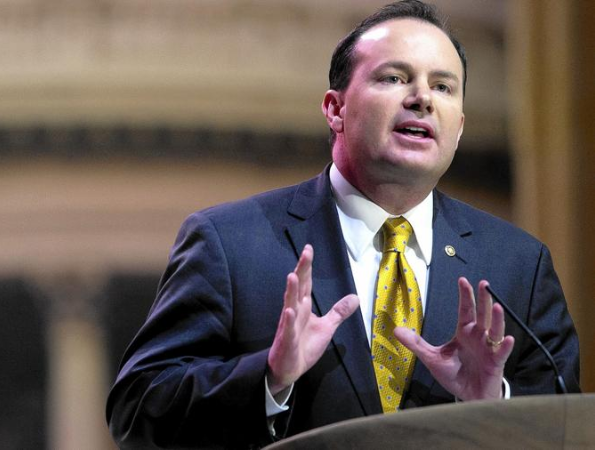
Utah Senator Mike Lee

The Daily Signal reports:

I recently introduced in the Senate a bill that would empower the people most acutely committed to the quality of our education system: America’s moms and dads. My colleague on the other side of the Capitol, Rep. Luke Messer, R-Ind., has introduced a companion bill in the House.

By giving parents more power to invest in their child’s education and to choose what school best meets their needs, the Enhancing Educational Opportunities for All Act takes an important step toward restoring accountability to our public education system—something that has been missing for far too long.

Under our current system—which has remained essentially unchanged since President Lyndon B. Johnson signed the 1965 Elementary and Secondary Education Act—most parents are powerless to influence the quality of their child’s education.

What occurs in public school classrooms around the country—what teachers teach and how they teach it—is the result of a long, convoluted, bureaucratic chain of command that zigzags its way from Washington to local school districts, but never includes parents.

First, Congress passes legislation authorizing federal bureaucrats to establish rules, regulations, and standards with which states must comply in order to receive federal education funds.

Next, state officials refine—or in some cases distort—these Washington directives, writing narrower rules for their school districts, which then establish the specific policies for individual schools.

At no point in this decision-making process are parents consulted.

Instead, they are left with a “take it or leave it” choice: either accept the education offered at the local public school—no matter how bad it may be—or buy a better alternative, by moving closer to a better school or paying private school tuition.

For America’s most affluent families, this is no big deal—they can afford private schools and so have the power to choose the school that is best for their children. For everyone else, it precludes parents from making choices about their children’s education.

So our bill would expand school choice to all parents, regardless of socio-economic status or zip code, by allowing federal “Title I” K-12 support funds to follow low-income students to any public or private school of their choice.

It would also remove the contribution limits on Coverdell education savings accounts and allow “529” account funds to cover K-12 education expenses.

Our bill would give working parents more opportunities to invest in a variety of learning services and products outside the classroom, such as tutoring, online courses and textbooks.

The problem facing our public school system today is not about a lack of money—we have nearly tripled our investments in elementary and secondary students since 1970. The problem is dysfunctional government policy—however well intentioned—and a lack of accountability.

And that’s exactly what we should expect when Washington bureaucrats have more control than parents over a child’s education. We have a moral and economic obligation to flip this equation and put parents back in the driver’s seat.

For when we tolerate a system in which the quality of a child’s education depends on her parents’ zip code, we fail to live up to the ideals at the heart of American exceptionalism.

And when millions of children learn from a young age not to dream big, but to surrender to the hopelessness of low expectations, we will live in a society where upward mobility is no longer rule but the exception.

We can and we must do better.

If a school is failing – and they often are, especially in poorer areas – then shouldn’t parents have the ability to send their kids to a better school? When I want to buy something online, I know I can always do better by comparing prices and reviews. Competition between suppliers drives prices down, and raises quality up. The customer is king in the free market. It can work in education, too.

Related posts