
Tag Archives: Birds

New study: bird origins poses a convergence challenge to common ancestry

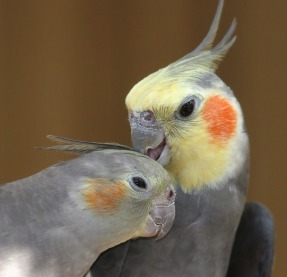
Male normal gray cockatiel preens his wife's crest
Male cockatiel preens his wife’s crest

We have to start this post with the definition of convergence in biology.

In evolutionary biology, convergent evolution is the process whereby organisms not closely related (not monophyletic), independently evolve similar traits as a result of having to adapt to similar environments or ecological niches.

It is the opposite of divergent evolution, where related species evolve different traits.

On a molecular level, this can happen due to random mutation unrelated to adaptive changes; see long branch attraction. In cultural evolution, convergent evolution is the development of similar cultural adaptations to similar environmental conditions by different peoples with different ancestral cultures. An example of convergent evolution is the similar nature of the flight/wings of insects, birds, pterosaurs, and bats.

All four serve the same function and are similar in structure, but each evolved independently.

And now, this new article on convergence in birds and humans, from Evolution News.

They write:

Everyone is familiar with the striking ability of certain birds (such as parrots) to vocalize speech, much as humans do. Well, according to the new papers published in Science that I wrote about earlier, confirming that birds arose explosively, those vocalization abilities are the result of “convergent evolution” at both the morphological and genetic levels.

Nature News reports, “The authors also conclude that vocal learning may have evolved independently in the ancestors of parrots, hummingbirds and songbirds.” But this is about more than just birds. According to a Science Daily article about the technical papers, the genetic “convergent evolution” extends to birds and humans:

“We’ve known for many years that the singing behavior of birds is similar to speech in humans — not identical, but similar — and that the brain circuitry is similar, too,” said Jarvis, an associate professor of neurobiology at the Duke University Medical School and an investigator at the Howard Hughes Medical Institute. “But we didn’t know whether or not those features were the same because the genes were also the same.”Now scientists do know, and the answer is yes — birds and humans use essentially the same genes to speak.

After a massive international effort to sequence and compare the entire genomes of 48 species of birds representing every major order of the bird family tree, Jarvis and his colleagues found that vocal learning evolved twice or maybe three times among songbirds, parrots and hummingbirds.

Even more striking is that the set of genes involved in each of those song innovations is remarkably similar to the genes involved in human speaking ability.

If you’re already thinking “This isn’t ‘convergent evolution,’ it’s common design,” you haven’t seen the best part yet. Science Daily goes on:

One of the Dec. 12 papers in Science found there is a consistent set of just over 50 genes that show higher or lower activity in the brains of vocal learning birds and humans. These changes were not found in the brains of birds that do not have vocal learning and of non-human primates that do not speak, according to this Duke team, which was led by Jarvis; Andreas Pfenning, a graduate of the PhD program in computational biology and bioinformatics (CBB); and Alexander Hartemink, professor of computer science, statistical science and biology.”This means that vocal learning birds and humans are more similar to each other for these genes in song and speech brain areas than other birds and primates are to them,” Jarvis said.

These genes are involved in forming new connections between neurons of the motor cortex and neurons that control the muscles that produce sound.

The Science paper puts it this way:

More than 50 genes contributed to their convergent specialization and were enriched in motor control and neural connectivity functions. These patterns were not found in vocal nonlearners, but songbird RA was similar to layer 5 of primate motor cortex for another set of genes, supporting previous hypotheses about the similarity of these cell types between bird and mammal brains.(Pfenning et al., “Convergent transcriptional specializations in the brains of humans and song-learning birds,” Science, Vol. 346: 1256846-1 – 1256846-13 (December 12, 2014). )

So certain birds and humans use the same genes for vocalization — but those genetic abilities are absent in non-human primates and birds without vocal learning? If not derived from a common ancestor, as they clearly were not, how did the genes get there? This kind of extreme convergent genetic evolution points strongly to intelligent design.

The rest of the article talks about the conclusions of the study authors – they think it’s a huge problem – and it is.

I hope you’re all beginning to see why I love birds so much. I just adore them. In fact, I am excited about them right now, and will probably appear silly by gushing about how great they are. Fortunately, my editorette is not hear to stop me!

Birds are not just a living disproof of naturalistic evolution. They are also loveable and adorable. (Especially parrots, of course) If you guys are considering a pet, go out and get yourself a cockatiel, if it’s your first bird, or a green-cheek conure, if you’ve had birds before. Just remember that they live 20-25 years, so you have to be ready to face responsibilities, expectations and obligations if you make a commitment like that. And you know what? That is totally awesome, to have someone to care about. It’s good stewardship to care for animals. And if you can’t commit to a parrot of your own over the long haul, then put out an additional bird feeder this winter, and vote against wind power. Wind power kills birds, and I hate it.

Also, that bird in the Evolution News post is an Indian ringneck parrot. And they are awesome!!!!

More posts on convergence

New study: another biological Big Bang, this time for bird development

Hummingbird in flight

Story from Evolution News about a new study exploring the genomes of birds.

Excerpt:

The evidence for intelligent design just keeps getting stronger. It’s long been known that the Cambrian explosion isn’t the only explosion of organisms in the fossil record. There’s also something of a fish explosion, an angiosperm explosion, and a mammal explosion. Paleontologists have even cited a “bird explosion,” with major bird groups appearing in a short time period. Frank Gill’s 2007 textbook Ornithology observes the “explosive evolution” of major living bird groups, and a paper in Trends in Ecology and Evolutiontitled “Evolutionary Explosions and the Phylogenetic Fuse” explains:

A literal reading of the fossil record indicates that the early Cambrian (c. 545 million years ago) and early Tertiary (c. 65 million years ago) were characterized by enormously accelerated periods of morphological evolution marking the appearance of the animal phyla, and modern bird and placental mammal orders, respectively.

Now, a massive genetic study published in Science has confirmed the fossil evidence that birds arose explosively. According to an article titled, “Rapid bird evolution after the age of dinosaurs unprecedented”:

His research helped confirm that some of the first lineages of modern birds appeared about 100 million years ago but that almost all of the modern groups of birds diversified in a small window of less than 10 million years, just after the dinosaurs were wiped out by an asteroid.

Another news article calls it a “‘Big Bang’ of bird evolution” and one of the technical papers uses the same language:

Paleobiological and molecular evidence suggests that such “big bang” radiations occurred for neoavian birds (e.g., songbirds, parrots, pigeons, and others) and placental mammals, representing 95% of extant avian and mammalian species, after the Cretaceous to Paleogene (K-Pg) mass extinction event about 66 million years ago (Ma).

The article further cites “an explosive diversification within Neoaves.” So both fossil and genetic evidence suggests diverse organisms arose in an “explosion” or “big bang” that lasted “less than 10 million years.”

I am excited to hear about this! Birds are my most favorite creatures in the whole world!

One of the other papers they looked at in the post found large numbers of species appearing within a 1-3 million year window.

The data from these genome studies also conflicts with the phylogenies that are different from phylogenies built from body plans.

Look:

[T]his molecular study has separated many groups previously thought to be closely related by morphological studies, as is made very clear from Figure 1 of the paper. Bird relations are thus quickly becoming a classic case of conflict between molecule-based and morphology-based trees. As Nature notes, in this study “the tree of life for birds has been redrawn by geneticists.” They simply appeal to convergent evolution (or other mechanisms) to explain away these non-tree-like patterns.

It’s not a tree – it’s a lawn.

New study: how the hummingbird performs stunning feats of aerobatics

Hummingbird in flight

New study reported by Science Daily.

Excerpt:

The sight of a tiny hummingbird hovering in front of a flower and then darting to another with lightning speed amazes and delights. But it also leaves watchers with a persistent question: How do they do it?

Now, the most detailed, three-dimensional aerodynamic simulation of hummingbird flight conducted to date has definitively demonstrated that the hummingbird achieves its nimble aerobatic abilities through a unique set of aerodynamic forces that are more closely aligned to those found in flying insects than to other birds.

The new supercomputer simulation was produced by a pair of mechanical engineers at Vanderbilt University who teamed up with a biologist at the University of North Carolina at Chapel Hill. It is described in the article “Three-dimensional flow and lift characteristics of a hovering ruby-throated hummingbird” published this fall in the Journal of the Royal Society Interface.

For some time researchers have been aware of the similarities between hummingbird and insect flight, but some experts have supported an alternate model which proposed that hummingbird’s wings have aerodynamic properties similar to helicopter blades. However, the new realistic simulation demonstrates that the tiny birds make use of unsteady airflow mechanisms, generating invisible vortices of air that produce the lift they need to hover and flit from flower to flower.

You might think that if the hummingbird simply beats its wings fast enough and hard enough it can push enough air downward to keep its small body afloat. But, according to the simulation, lift production is much trickier than that.

For example, as the bird pulls its wings forward and down, tiny vortices form over the leading and trailing edges and then merge into a single large vortex, forming a low-pressure area that provides lift. In addition, the tiny birds further enhance the amount of lift they produce by pitching up their wings (rotate them along the long axis) as they flap.

Hummingbirds perform another neat aerodynamic trick — one that sets them apart from their larger feathered relatives. They not only generate positive lift on the downstroke, but they also generate lift on the upstroke by inverting their wings. As the leading edge begins moving backwards, the wing beneath it rotates around so the top of the wing becomes the bottom and bottom becomes the top. This allows the wing to form a leading edge vortex as it moves backward generating positive lift.

According to the simulation, the downstroke produces most of the thrust but that is only because the hummingbird puts more energy into it. The upstroke produces only 30 percent as much lift but it takes only 30 percent as much energy, making the upstroke equally as aerodynamically efficient as the more powerful downstroke.

Large birds, by contrast, generate almost all of their lift on the downstroke. They pull in their wings toward their bodies to reduce the amount of negative lift they produce while flapping upward.

Awesome design in nature!

So the question I have from reading the article is this. Do birds and flying insects have a recent common ancestor? I don’t have too many friends who can answer this for me, but I asked one of them and they both said there is no recent common ancestor for hummingbirds and flying insects. So this looks like another example of convergence – common design in two animals that don’t share a recent common ancestor.