Tag Archives: Bigotry

Democrat senators attack judicial nominee for her Catholic faith

This is from National Review.

Excerpt:

This afternoon, during a confirmation hearing for 7th Circuit Court of Appeals nominee Amy Coney Barrett, Democratic senator Dianne Feinstein attacked the nominee for her Roman Catholic faith.

Barrett is a law professor at the University of Notre Dame who has written about the role of religion in public life and delivered academic lectures to Christian legal groups. Drawing on some of these materials, Feinstein launched a thinly veiled attack on Barrett’s Catholic faith, asserting that her religious views will prevent her from judging fairly.

“When you read your speeches, the conclusion one draws is that the dogma lives loudly within you,” Feinstein said. “And that’s of concern when you come to big issues that large numbers of people have fought for for years in this country.” Feinstein is clearly hinting here at the Supreme Court decision in Roe v. Wade, a ruling that Feinstein supports so vociferously that she has even called it a “super-precedent.”

[…]Other Democratic senators took issue with Barrett over her faith as well. Senate minority whip Dick Durbin criticized Barrett’s use of the term “orthodox Catholic,” insisting that it unfairly maligns Catholics who do not hold certain positions about abortion or the death penalty. (Durbin himself is a Catholic who abandoned his previous pro-life position.) “Do you consider yourself an orthodox Catholic?” he later asked Barrett point blank.

And Hawaii senator Mazie Hirono snarked, “I think your article is very plain in your perspective about the role of religion for judges, and particularly with regard to Catholic judges.”

It was reported that Feinstein actually said “The dogma lives loudly within you, and that’s of concern“. Think about that.

To me, the more important thing about this story is how comfortable secular people are about forcing their secular convictions down the throats of others. What they’re essentially saying is this: “I can use power to push my worldview onto you, and I can use power to stop you from living according to your convictions”. You can be certain that Diane Feinstein has answers to all of the same big questions that theists have answers to: “does God exist?” “did Jesus rise from the dead?” “is there a purpose to suffering and evil?” “is there life after death?”, etc. She has different answers to those same questions, but she wouldn’t accuse herself of having dogma. She feels very comfortable pushing her worldview through political power, but doesn’t think that theists ought to be able to do the same.

And this provides an interesting lesson for Christians: how did it come to be the case that Christian convictions are automatically perceived by secular leftist elites to be irrational and dangerous? Why is it that Christians shouldn’t be allowed to participate in politics, but atheists should, since they answer the same big questions with their respective worldviews? The answer is simple. Atheists perceive Christians as having a worldview that is not based on fact. And they perceive themselves as having a worldview that is based on fact. How did this happen?

Well, simply put, Christian leaders made it happen, by refusing to focus on apologetics and evangelism. For better or worse, Christian churches (from fundamentalist Pentecostal to conservative Presbyterian) have decided that evangelism and apologetics are not important enough to focus on at church. And the result of this is that as non-Christians work their way through school and into the workplace, they never encounter any intelligent Christians who have reasons and evidence for their beliefs. Not just Christian beliefs, but policy beliefs, too. The church has failed to teach their members and adherents the importance of having answers, and this (along with the Sexual Revolution) is one of the main reasons why America has gone secular.

Even if you spend your childhood and teen years in church, you will never hear serious discussion of whether God really exists or whether the Bible is historically reliable. These things will be assumed to be true. You will be shamed if you ask questions, and you will even be shamed if you study apologetics to know how to answer these questions. This is considered pious by most church leaders, no matter what denomination you’re in. Atheists are not blind to the fact that most people who profess Christ are ignorant of competing views, and cannot explain why they hold their views using reason and evidence. And this is where the perception that Christians are too dangerous to be allowed to participate in politics comes from.

This past week, I had a conversation with a senior engineer about his beliefs. He had attended Christian schools K through 12, and Christian churches his entire life. It all ended for him the minute he hit college. I perceived that he had questions that had gone unanswered, and asked him if he had ever seen any formal debates on Christianity. His answer? “I did not know that such a thing even existed”. I sent him a couple of debates to watch, and we are going to have lunch to discuss his background, because he was open to a rational discussion of the evidence. It doesn’t matter what church you are in, you will almost certainly never see a formal debate on Christianity. Because of this lack of emphasis on open debate, we lose a lot of intelligent people the minute they hit the university campus.

Things have gotten so bad, that it is now dangerous to even come out as a Christian in the education system, although there is still space to do it in the workplace, if you are careful who you speak to, and when. Most Christians I know, though, have no interest in jeopardizing their careers by being perceived as stupid at work. And yet there is this tremendous need for every Christian to reset the perceptions on ultimate questions. We must do this, or we are finished.

Anyway, it’s interesting to take a look at two of the nominees that Democrat senators opposed. Are they even qualified? Or are they anti-intellectual dingbats with no experience at all?

The Daily Signal has a helpful article about them. It turns out that they are exquisitely well-educated and have solid resumes, as well. That’s something else that Christians should not neglect if we want to be respected by secular elites.

We should all be very serious about our educations, careers and finances. Finances are important because it is an immediate signal to others that you have a wisdom about how to live. If we marry, then our marriage and children also sends a signal about competence. My view is that Christians should be learning much more than just the Bible in church. A little basic economics, basic apologetics, basic New Testament, and basic philosophy of religion would definitely help to correct the perceptions that others have of Christianity. And the study of those areas would make the average rank-and-file Christian much more confident about discussing those things in school and at work.

Positive arguments for Christian theism

Democrat Bernie Sanders proposes test to ban Christians from political office

Senator Bernie Sanders had an interesting exchange with White House deputy budget director nominee Russell Vought. Religious liberty defender David French writes about it in National Review.

First, French’s rough transcription of the dialog:

Sanders: Let me get to this issue that has bothered me and bothered many other people. And that is in the piece that I referred to that you wrote for the publication called Resurgent. You wrote, “Muslims do not simply have a deficient theology. They do not know God because they have rejected Jesus Christ, His Son, and they stand condemned.” Do you believe that that statement is Islamophobic?

Vought: Absolutely not, Senator. I’m a Christian, and I believe in a Christian set of principles based on my faith. That post, as I stated in the questionnaire to this committee, was to defend my alma mater, Wheaton College, a Christian school that has a statement of faith that includes the centrality of Jesus Christ for salvation, and . . .

Sanders: I apologize. Forgive me, we just don’t have a lot of time. Do you believe people in the Muslim religion stand condemned? Is that your view?

Vought: Again, Senator, I’m a Christian, and I wrote that piece in accordance with the statement of faith at Wheaton College:

Sanders: I understand that. I don’t know how many Muslims there are in America. Maybe a couple million. Are you suggesting that all those people stand condemned? What about Jews? Do they stand condemned too?

Vought: Senator, I’m a Christian . . .

Sanders (shouting): I understand you are a Christian, but this country are made of people who are not just — I understand that Christianity is the majority religion, but there are other people of different religions in this country and around the world. In your judgment, do you think that people who are not Christians are going to be condemned?

Vought: Thank you for probing on that question. As a Christian, I believe that all individuals are made in the image of God and are worthy of dignity and respect regardless of their religious beliefs. I believe that as a Christian that’s how I should treat all individuals . . .

Sanders: You think your statement that you put into that publication, they do not know God because they rejected Jesus Christ, His Son, and they stand condemned, do you think that’s respectful of other religions?

Vought: Senator, I wrote a post based on being a Christian and attending a Christian school that has a statement of faith that speaks clearly in regard to the centrality of Jesus Christ in salvation.

Sanders: I would simply say, Mr. Chairman, that this nominee is really not someone who this country is supposed to be about.

French comments:

This is a disgraceful and unconstitutional line of questioning from the man who came close to being the Democratic nominee for president. He’s not only imposing a religious test for public office in direct violation of Article VI of the United States Constitution, he’s gone so far as to label this decent man — who’s seeking to serve his country in a vital role — as “not someone who this country is supposed to be about.” Vought expressed entirely orthodox Christian beliefs. There is nothing “extreme” about his statements, and they mirror the statements of faith of countless Christian churches and schools across the land. Are these believers also not fit for public office?

The Christian view is, of course, that some people choose to separate themselves from God’s presence in the afterlife because of their refusal to respond to God’s revelation of himself in the time they have while they are still alive. People could respond to general revelation and the moral law written on their hearts, or if they are able to, they could investigate deeper, studying scientific evidence or historical evidence. But each person is morally obligated to seek the truth about God as he really is. God reveals himself to those who seek him.

Surprisingly, many people with advanced degrees and great careers and great wealth want nothing to do with seeking the truth about God’s existence and Jesus Christ. I know. I work next to brilliant software engineers who have utterly stupid and ignorant opinions about God’s existence and the historical Jesus. And they go their whole lives chasing health, wealth and fame rather than buckle down with the books and look into these things. They would prefer not to look into these things and that’s why they remain separated from God eternally, after they die. God isn’t grading people on whether they go to a good college, marry, have a great career, make lots of money, have lots of kids, and send their kids to great colleges to become doctors (wonderful though all that is). God is concerned about whether you know who he is, whether you accept what Jesus Christ is has done for you in history, and whether you love God in your priority-setting and decision-making.

Disagreement with non-Christians does not make Christians mean to non-Christians. You can just look at Jesus’ parable of the Good Samaritan to see how Christians are supposed to treat people that we disagree with about religion. In this life, Christians are called on to love their neighbors – including their neighbors of other faiths or of no faiths – as themselves. In fact, historically speaking, one of the main reasons why Christianity expanded so quickly is that early Christians took the obligation to love their neighbors so seriously. Unlike Democrats, we didn’t outsource caring for the poor and the sick to the government. Instead of being “generous” by spending other people’s money, we were generous with our own money. This is foreign to most Democrats, who typically give nothing to charity, but make a big show of spending taxpayer money – money that they never earned themselves.

Some people may ask, “what about those who have never heard of Jesus?” For the problem of those people who have never heard of Jesus before they die, we have the middle knowledge solution. Christians love people who disagree with them, and we hope and pray that they will take the time to investigate these matters for themselves so that they come to a true worldview. I pray for non-Christians – this is a normal part of the Christian life. Disagreeing with someone doesn’t mean that you treat them badly. For the problem of those who are not able to search out the answers from science and history, God will judge them on their response to God’s existence in nature – which everyone has access to. The design of the universe is one of the reasons given by people for an intuitive belief in a Creator and Designer, and we all have the moral law written on our hearts.

What about Sanders? Is he tolerant of other religions? Does he treat people of other religions well? My opinion based on what I know of Sanders is that Sanders is an atheist, and so he is in disagreement with the factual claims of every religion on the planet. They’re all wrong, according to Sanders. We’re already seeing a lot of attacks by secular leftists against Christians using government as a weapon. Sanders would take it up a notch, by actually preventing Christians from serving in political roles. To me, that seems like what Hitler did to the Jews in Nazi Germany – drumming them out of positions of influence solely because their religion differed from his own pagan religion.

Very interesting for me now, to think back to the Christians I knew who supported Bernie Sanders in the Democrat primary last election. Why did they do it? Sanders has virtually no positions in common with what the Bible teaches. Not just on social issues, obviously, but also on fiscal and foreign policy issues. He is the complete anti-Bible politician. I believe that the main reason that some Christians supported Bernie Sanders is because they wanted to feel good about themselves, and be perceived as “generous” by other people around them. They did not want to do this by spending their own money and time to help others. They wanted to feel good and look generous by having Bernie Sanders steal other people’s money and time to “help” others through enormous government spending and borrowing from future taxpayers. They wanted to take money away from individual taxpayers who earned the money by working, and let the secular leftists in government spend it on buying votes from their favored special interest groups. It was all about envy, theft and coveting. Things that no real Christian would ever choose when voting for President.

Hindu nationalists, led by Narendra Modi, crack down on religious liberty

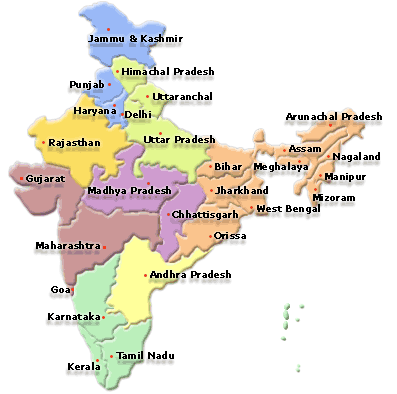
Map of India
Map of India

This was reported by the Daily Signal.

Excerpt:

In a sad development, the government of India is clamping down on religious liberty, and impoverished children stand to lose the most.

Compassion International, a Christian organization that partners with local churches around the world to improve the lives of children in poverty, began shutting down its operations in India due to financial restrictions imposed on them by the Indian government. This will leave an estimated 145,000 children worse off.

The shutdown comes after months of attempts to convince the Indian government to reverse its decision, and the clampdown on Compassion International comes amid other government actions against nearly 11,000 faith-based and secular organizations operating in India.

Compassion International is a faith-based aid organization that provides humanitarian assistance for underprivileged children around the world, and has operated in India since 1968. The group is the largest single foreign provider of assistance in India, contributing around $45 million in humanitarian aid annually.

Stephen Oakley, general counsel for Compassion International, testified that the organization hosts programs that run five to six days a week, and provides meals, medical treatment, and tutoring, as well as financial assistance for school tuition.

While these programs are run out of the local Christian churches, Compassion International denies that any forced conversions take place and does not use adherence to Christianity as a condition for providing assistance. The aid is purely based on need.

[…]Nooruddin estimates that about half of the foreign aid organizations in India have been pushed out since 2012 due to an inability to renew their licenses—something the government has made more difficult in an attempt to reduce the influence of outside organizations in India.

The concept of charity is foreign to Hinduism in particular (but not Islam), simply because if a person is poor, this is seen as a result of bad karma that they have collected because of misdeeds in past lives. It’s nothing for anyone to fix, in short, and it’s seen as best to concentrate on one’s one’s grades and one’s own wealth-building. Although most Hindus don’t want to be bothered taking care of the poor themselves, they also don’t want Christians getting the credit for doing it. So, the easiest way to stop Christians getting credit with the poor for helping the poor is to stop Christians from helping the poor – leveling the playing field between the two religions.

Evangelism and Hindu tolerance

I come from a partially Hindu background, and I have to work with a lot of Indian people in my current job as a software engineer. And I have indeed noticed an aversion to Christianity from them. it’s actually very strange. When I ask them about religion, they can talk passionately about religious diversity and how tolerant their Hinduism is. But if you dig a little more under the surface, not only do they disagree with everything I believe, but they also don’t think I should allowed to express my views in public to anyone who doesn’t already agree with me.

So why is that? Well, although many East Indian people that I speak to know a great deal about computer science and making money, they actually know almost nothing about religions other than their own. For them, religion isn’t an area for investigation about what’s true or false. For them, religion is like their nationality or race or family or community. It’s beyond logic and evidence, it’s just design for social cohesion. So, if, for example, you tell a Hindu that their oscillating eternal cosmology is factually false, they get angry because that’s not religion is for them. They don’t care whether what they believe is true or false, so long as it helps them get along with their families and communities. And since Christianity would cause a break up in their families and communities (should anyone convert), they want to stop all logical and evidential discussions of it. For a Hindu, not eating meat is more important than how the universe began, because not eating meat is social, and how the universe began is factual. Bring up facts to people who are looking for social cohesion and unity gets you the kind of response that you see from Modi and the Hindu nationalists.