Tag Archives: Big Corporation

New paper on income inequality: Does taxing the rich hurt the middle class?

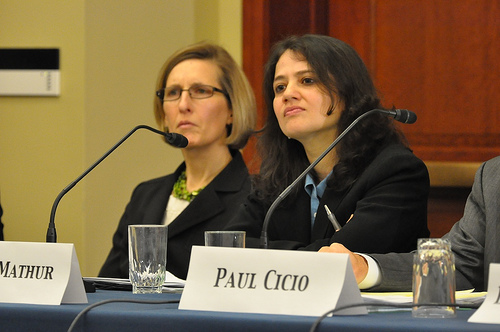
Aparna Mathur (right)

Here’s an article by Indian economist Aparna Mathur.

She writes (in part):

In a recent paper that I co-authored with Kevin Hassett, we explored the effect of high corporate taxes on worker wages. The motivation for the paper came from the international tax literature (summarized by Roger Gordon and Jim Hines in a 2002 paper1) that suggested that mobile capital flows from high tax to low tax jurisdictions. In other words, in any set of competing countries, investment flows are determined by relative rates of taxation. The current U.S. headline rate of corporate tax is 35 percent. The combined federal and state statutory rate of 39 percent is second only to Japan in the OECD. With Japan set to lower its statutory rate later this year, the U.S. rate will soon be the highest in the OECD and one of the highest in the world. What effect do these high rates have on worker wages?

When capital flows out of a high tax country, such as the United States, it leads to lower domestic investment, as firms decide against adding a new machine or building a factory. The lower levels of investment affect the productivity of the American worker, because they may not have the best machines or enough machines to work with. This leads to lower wages, as there is a tight link between workers’ productivity and their pay. It could also lead to less demand for workers, since the firms have decided to carry out investment activities elsewhere.

Our paper was one of the first to explore the adverse effect of corporate taxes on worker wages. Using data on more than 100 countries, we found that higher corporate taxes lead to lower wages. In fact, workers shoulder a much larger share of the corporate tax burden (more than 100 percent) than had previously been assumed. The reason the incidence can be higher than 100 percent is neatly explained in a 2006 paper by the famous economist Arnold Harberger.2 Simply put, when taxes are imposed on a corporation, wages are lowered not only for the workers in that firm, but for all workers in the economy since otherwise competition would drive workers away from the low-wage firms. As a result, a $1 corporate income tax on a firm could lead to a $1 loss in wages for workers in that firm, but could also lead to more than a $1 loss overall when we look at the lower wages across all workers.

Following our paper, several academic economists substantiated our results, using different data sets and applying varied econometric modeling and techniques. Some examples of these studies include a 2007 paper by Mihir A. Desai and C. Fritz Foley of Harvard Business School and James Hines Jr. of Michigan University Law School, a 2007 paper by R. Alison Felix of the Federal Reserve Bank of Kansas City, a 2009 paper by Robert Carroll of The Tax Foundation, and a 2010 paper by Wiji Arulampalam of the University of Warwick and Michael Devereux and Giorgia Maffini of Oxford.3 A recent Tax Notes article that I co-authored summarizes these various studies and also the lessons from the theoretical literature on the topic. The general consensus from theory and empirical work is that while we may argue academically about the size of the effect, there is no disagreement among economists that a sizeable burden of the corporate income tax is disproportionately felt by working Americans. On average, a $1 increase in corporate tax revenues could lead to a dollar or more decline in the wage bill.

Conservatives and liberals have the same goal. We both want to help the poor. Liberals think that taking money from the rich and giving it to the poor helps, but all it does it cause the rich to move their capital and jobs elsewhere, leaving the poor poorer. Conservatives let the rich keep their money and encourage them to risk it trying to make more money by engaging in enterprises that create wealth – creating products and services from less valuable raw materials. In a socialist system, the rich get poorer, but so do the poor. In a capitalist system, the rich get very rich, but the poor also gain more wealth. That’s what happens when corporations like Apple make IPads out of junky raw materials. That’s how wealth is created – by letting people who want to make things keep more of what they earn. We all benefit from encouraging people to make new things and provide value for their neighbors.

Related articles

Harper would ban political contributions from unions and corporations

Canadian Prime Minister Stephen Harper

From PostMedia News.

Excerpt:

Stephen Harper says scrapping taxpayer subsidies for political parties could help break Canada’s cycle of holding federal elections every few years, but his political foes say it’s another attempt to financially cripple the other parties.

On Friday, Day 7 of the campaign, Harper said he will ban the subsidies if the Conservatives win a majority government on May 2. Any party that receives more than two per cent of the vote in a general election receives a subsidy of roughly $2 per year for each vote the party received.

Harper said the system funnels taxpayers’ money to political parties they don’t necessarily support, and allows parties to operate in perpetual campaign mode.

“We think money should come from voters. Not from corporations, not from unions and not from government. (It) should come from the voters,” he told reporters.

[…]In January, Harper revealed for the first time, in an interview with Postmedia News, that a ban on the subsidies would be a “clear plank” in his party’s platform for an election.

Shortly after winning the 2008 election, the Tories proposed to end the subsidies, but that sparked anger from the opposition parties and they rallied to form a coalition that nearly defeated Harper’s government. On Friday, Harper made it clear he hasn’t changed his mind. However, in an apparent bid to take some of the sting out of the move and to reduce criticism, he revealed there would be a three-year transition.

“I’ve wanted to change this, but we’re very clear: Unless we have a majority government, we’ll never attempt to change it, because we know that in a minority government you could never move this forward. So if we get a chance to change it, we will,” Harper told reporters.

Basically, there should only be ONE WAY for parties to get money in my view. Individual contributions from workers and small businesses. Anyone who can use government to grant it a monopoly (unions, big corporations) should NOT be allowed to contribute money to politicians. Get the big money from left-wing unions and left-wing big corporations out of politics.

Here’s the latest poll, showing the Conservatives steady at 41.3% support. (H/T Jeanie)

How Democrats vote on illegal immigration, abortion, marriage and corporations

Here’s a little round-up of stories (mostly from ECM) that will help you to understand what it is that Democrats really stand for. The best way to know what they stand for is NOT to listen to speeches or media bias. The best way to know what they stand for is to look at how they vote.

Democrats want Americans to pay for health care for illegal immigrants

Story here from The Hill.

Excerpt:

Senate Finance Committee Democrats rejected a proposed a requirement that immigrants prove their identity with photo identification when signing up for federal healthcare programs.

Finance Committee ranking member Chuck Grassley (R-Iowa) said that current law and the healthcare bill under consideration are too lax and leave the door open to illegal immigrants defrauding the government using false or stolen identities to obtain benefits.

Grassley’s amendment was beaten back 10-13 on a party-line vote.

Democrats want to destroy traditional marriage

Story here from The Hill.

Excerpt:

A House Democrat will introduce a bill on Tuesday to repeal the infamous Defense of Marriage Act (DOMA), but he will not have the support of one of the law’s biggest critics.

The latest effort to revise federal marriage guidelines comes from Rep. Jerry Nadler (D-N.Y.), the chairman of the House’s subcommittee on the Constitution, Civil Rights & Civil Liberties, which oversees DOMA. His proposal, which he will unveil at a press conference next week, will include a provision to allow same-sex couples in one state to marry elsewhere, return home and still receive federal benefits.

Nadler has already secured the support of two congressmen — Reps. Tammy Baldwin (D-Wis.) and Jared Polis (D-Colo.), who will co-sponsor his effort.

Democrats want to fund abortion in their health care bill

Story from Life Site News.

Excerpt:

Sen. Orrin Hatch (R-Utah) proposed to amend the “America’s Health Future Act of 2009” under consideration by the Finance Committee led by Chairman Max Baucus (D-Mont.). His amendments would have codified current conscience protections for health-care providers with moral objections to abortion and also made permanent the Hyde Amendment, which prohibits federal funds from the Department of Health and Human Services (HHS) from paying for abortions.

Hatch instead proposed that women could purchase additional coverage for abortions through “riders” that would not be subsidized by the government.

However, the amendments were rejected by the Committee by votes of 13 – 10. In both amendments, Sen. Kent Conrad (D-N.D.) joined committee Republicans in support of the measures, while pro-abortion Sen. Olympia Snowe (R-Maine) joined Baucus’ committee Democrats to vote against the bill.

Democrats support taxpayer subsidies for big corporations that help them get elected

Story from Green Hell Blog.

Excerpt:

Sen. Barbara Boxer’s climate bill set to be released today contains a provision that will compensate General Electric quite nicely for its lobbying and media efforts promoting climate legislation.

[…]So the Boxer bill would compel airlines and the military, when purchasing new aircraft and new aircraft engines, to purchase more expensive “green” engines made by GE, according to standards set by the current and GE-lobbied Obama administration.

Keep in mind that GE CEO Jeff Immelt is member of President Obama’s Economic Recovery Advisory Council.

This is what people who voted for Obama voted for, knowingly or unknowingly. They are still responsible for these policies.

Share