

Tag Archives: Bible

Did Jesus appeal to evidence when reaching out to skeptics?

Investigation in progress

From Eric Chabot of Ratio Christi – Ohio State University.

He lists eight ways that Jesus makes his case.

Here’s one of the ways:

2. Jesus Appealed to Evidence

Jesus knew He could not show up on the scene and not offer any evidence for His Messiahship. In his book On Jesus, Douglas Groothuis notes that Jesus appealed to evidence to confirm His claims. John the Baptist, who was languishing in prison after challenging Herod, sent messengers to ask Jesus the question: “Are you the one who was to come, or should we expect someone else?” (Matt. 11:3). This may seem an odd question from a man the Gospels present as the prophetic forerunner of Jesus and as the one who had proclaimed Jesus to be the Messiah. Jesus, however, did not rebuke John’s question. He did not say, “You must have faith; suppress your doubts.” Instead, Jesus recounted the distinctive features of His ministry:

“Go back and report to John what you hear and see: The blind receive sight, the lame walk, those who have leprosy are cured, the deaf hear, the dead are raised, and the good news is preached to the poor. Blessed is the man who does not fall away on account of me.” (Matt. 11:4-6; see also Luke 7:22).

Even in the Messiah Apocalypse, which is dated between 100 and 80 B.C.E mentions a similar theme as seen in Matt.11: 4-6: “He [God] frees the captives, makes the blind see, and makes the bent over stand straight…for he will heal the sick, revive the dead, and give good news to the humble and the poor he will satisfy, the abandoned he will lead, and the hungry he will make rich.”

Jesus’ works of healing and teaching are meant to serve as positive evidence of His messianic identity, because they fulfill the messianic predictions of the Hebrew Scriptures. What Jesus claimed is this:

1. If one does certain kinds of actions (the acts cited above), then one is the Messiah.
2. I am doing those kinds of actions.
3. Therefore, I am the Messiah.

And:

5. The Miracles of Jesus

In the Bible, miracles have a distinctive purpose: they are used for three reasons:
1. To glorify the nature of God (John 2:11; 11:40)
2. To accredit certain persons as the spokesmen for God (Acts 2:22; Heb. 2:3–4)
3. To provide evidence for belief in God (John 6:2, 14; 20:30–31). (3)

Nicodemus, a member of the Jewish ruling council, the Sanhedrin, told Jesus, “‘Rabbi, we know you are a teacher who has come from God. For no one could perform the miraculous signs you are doing if God were not with him’ ” (Jn. 3:1–2). In Acts, Peter told the crowd that Jesus had been “accredited by God to you by miracles, wonders and signs, which God did among you through him” (Acts 2:22).

In Matthew 12:38-39, Jesus says, “A wicked and adulterous generation asks for a miraculous sign! But none will be given it except the sign of Jonah the prophet.” In this Scripture, God confirmed the Messianic claim when Jesus said the sign that would confirm his Messiahship was to be the resurrection.

It is important to note that not all witnesses to a miracle believe. Jesus did not do His miracles for entertainment. They were done to evoke a response. So perhaps Paul Moser is right on target in what he calls “kardiatheology” – a theology that is aimed at one’s motivational heart (including one’s will) rather than just at one’s mind or one’s emotions. In other words, God is very interested in moral transformation.

We see Jesus’ frustration when His miracles did not bring the correct response from his audience. “Even after Jesus had done all these miraculous signs in their presence, they still would not believe in him” (John 12:37). Jesus himself said of some, “They will not be convinced even if someone rises from the dead” (Luke 16:31). One result, though not the purpose, of miracles is condemnation of the unbeliever (cf. John 12:31, 37). (4)

I am forever pointing this out to people. Jesus didn’t get people to follow him because he was nice. And he didn’t just talk to people who agreed with him. He even promised “a wicked generation” his resurrection as evidence for his claims. He called his resurrection “the sign of Jonah”, and it was meant for people who were looking for a “sign”. This is the way we should be – using whatever evidence we can dig up from science, history, law, and even the social sciences (when arguing moral issues).

Read the rest here. Surprise! Jesus loves to convince people, and not just by quoting the Bible to people who already accept the Bible, either. His goal was not to make people accept his claims because of their feelings, but because of the evidence he offered them.
Dennis Prager: which sin is the worst sin?

Let's take a look at what the Bible says
Let’s take a look at what the Bible says

In this post, Dennis Prager argues that the worst sin is when people who claim to have allegiance for God perform evil acts, thus bringing God’s reputation into disrepute.

I found a Prager University video on the same topic:

Excerpt:

The worst sin is committing evil in God’s name.

How do we know?

From the third of the Ten Commandments. This is the only one of the ten that states that God will not forgive a person who violates the commandment.

What does this commandment say?

It is most commonly translated as, “Do not take the name of the Lord thy God in vain. For the Lord will not hold guiltless” — meaning “will not forgive” — whoever takes His name in vain.”

Because of this translation, most people understandably think that the commandment forbids saying God’s name for no good reason. So, something like, “God, did I have a rough day at work today!” violates the third commandment.

But that interpretation presents a real problem. It would mean that whereas God could forgive the violation of any of the other commandments — dishonoring one’s parents, stealing, adultery or even committing murder — He would never forgive someone who said, “God, did I have a rough day at work today!”

Let’s be honest: That would render God and the Ten Commandments morally incomprehensible.

As it happens, however, the commandment is not the problem. The problem is the translation. The Hebrew original doesn’t say “Do not take;” it says “Do not carry.” The Hebrew literally reads, “Do not carry the name of the Lord thy God in vain.”

This is reflected in one of the most widely used new translations of the Bible, the New International Version, or NIV, which uses the word “misuse” rather than the word “take:”

“You shall not misuse the name of the Lord your God.”

This is much closer to the original’s intent.

What does it mean to “carry” or to “misuse” God’s name? It means committing evil in God’s name.

And that God will not forgive.

Why not?

When an irreligious person commits evil, it doesn’t bring God and religion into disrepute. But when a religious person commits evil in God’s name he destroys the greatest hope for goodness on earth — belief in a God who demands goodness, and who morally judges people.

The Nazis and Communists were horrifically cruel mass murderers. But their evils only sullied their own names, not the name of God. But when religious people commit evil, especially in God’s name, they are not only committing evil, they are doing terrible damage to the name of God.

Sean McDowell has a post about Dennis Prager’s view, and he says:

Given this context, an obvious example is Muslim radicals killing innocent people in the name of God. But the most recent example, which is rightly a prominent story in the news, is the rampant sexual abuse of children by Catholic priests. The story runs deeper than most people could have ever imagined, involving the systematic cover-up of over 1,000 cases against children by 300 priests in Pennsylvania alone over the past seventy years. The individual stories are harrowing, heart-breaking and infuriating.

Sadly, these horrific actions don’t merely reflect on the individual priests, but on the Catholic Church, the entire Christian faith, and religion in general. And rightly so. Can we really blame people who abandon God when his “representatives” commit such abominable crimes?

As Prager has sadly, but correctly, observed: “No atheist activist is nearly as effective in alienating people from God and religion as are evil ‘religious’ people.”

Now, I don’t agree with Dennis on his ranking this sin as the worst. I would put carrying the Lord’s name in vain lower, and say that rebellion against God is the worst sin. That’s what I would say intellectually speaking. Emotionally speaking, I think that attacking people for their allegiance to God is the worst sin, like when gay activists go after Christian business owners for trying to take the Bible seriously about marriage, for example. Just don’t get in the way of a Christian and their relationship with God, you atheists. You’re doing something absolutely horrible when you make it harder for a Christian to follow Jesus. You might disagree with Christianity, but it would be wise not to persecute Christians, just in case we’re right about what is true.

Dennis is Jewish, so he believes that religions should be judged based on whether they produce good or not, rather than whether they are true or not. I try to listen to Dennis’ radio show as often as I can, and although he does like to discuss what we can know about God from science and history, he doesn’t think that getting the right answers to theological questions is as important as doing the right actions. I think that might be why he chose this one as the worst, because actions are more important to him. I agree with him that it is certainly very bad to invoke God in a way that makes God look bad.

Mainstream media defends Pope accused of covering up homosexual sexual assaults

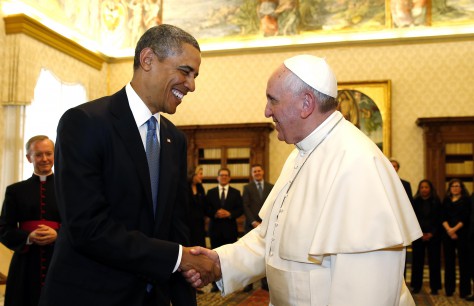
Barack Obama shakes hands with Pope Francis

During the past week, news stories reported that Pope Francis actually knew about the epidemic of sexual assaults and rapes by homosexual priests in the Catholic church. His response leaves a lot to be desired.

The National Catholic Register reported this earlier in the week:

In an extraordinary 11-page written testament, a former apostolic nuncio to the United States has accused several senior prelates of complicity in covering up Archbishop Theodore McCarrick’s allegations of sexual abuse, and has claimed that Pope Francis knew about sanctions imposed on then-Cardinal McCarrick by Pope Benedict XVI but chose to repeal them.

Archbishop Carlo Maria Viganò, 77, who served as apostolic nuncio in Washington D.C. from 2011 to 2016, said that in the late 2000s, Benedict had “imposed on Cardinal McCarrick sanctions similar to those now imposed on him by Pope Francis” and that Viganò personally told Pope Francis about those sanctions in 2013.

Archbishop Viganò said in his written statement, simultaneously released to the Register and other media, (see full text below) that Pope Francis “continued to cover” for McCarrick and not only did he “not take into account the sanctions that Pope Benedict had imposed on him” but also made McCarrick “his trusted counselor.” Viganò said that the former archbishop of Washington advised the Pope to appoint a number of bishops in the United States, including Cardinals Blase Cupich of Chicago and Joseph Tobin of Newark.

Archbishop Viganò, who said his “conscience dictates” that the truth be known as “the corruption has reached the very top of the Church’s hierarchy,” ended his testimony by calling on Pope Francis and all of those implicated in the cover up of Archbishop McCarrick’s abuse to resign.

Speaking as a Protestant, I thought that Benedict was the best Pope the Roman Catholic church ever had. I used to call him “The Protestant Pope”, because he had so few of the problems that Protestants like me dislike about Roman Catholic doctrines. It doesn’t surprise me that he did the right thing when the crisis was brought to his attention. But his successor has not done the right thing. He has different priorities.

The New York Times reported:

As he flew near Caribbean islands devastated by Hurricane Irma on his way back to the Vatican from Colombia on Sunday, Pope Francis said that political leaders and others who denied climate change reminded him of a passage from the psalms about man’s stubbornness.

[…]On the flight, the pope nevertheless appealed again to Mr. Trump, this time on his decision to end President Obama’s Deferred Action for Children Program, known as DACA.

[…]In contrast to his negative appraisal of Mr. Trump’s approach to immigration, the pope praised Italy’s efforts to welcome large numbers of migrants even as it sought to stem the tide of immigrants coming from Libya.

In fact, the defenders of the Pope made clear that his priorities are global warming and open borders, not following what the Bible says about sex outside of marriage.

Catholic journalist Emily Zanotti explains, in the Daily Wire:

In a bizarre interview with a Chicago NBC affiliate, Cardinal Blaise Cupich, head of the Archdiocese of Chicago, suggested recent claims made by a former apostolic nuncio — the Vatican’s envoy to the United States — that Pope Francis not only disregarded sexual abuse allegations against Cardinal Theodore McCarrick, but promoted McCarrick and sought his counsel, were going down a “rabbit hole.”

The Pope, Cupich told NBC, has more important things to attend to than sex abuse scandals, like climate change and immigration.

“The Pope has a bigger agenda,” Cardinal Cupich said. “He’s got to get on with other things, of talking about the environment and protecting migrants and carrying on the work of the church. We’re not going to go down a rabbit hole on this.”

Clearly, this is the focus of Catholic church leadership. Global warming and open borders both help to destroy free market capitalism, and increase the size of the secular government.  (Global warming alarmism allows the government to tax and regulate energy production and consumption, and open borders brings in a lot of low-skilled immigrants who tend to vote for higher taxes and more welfare spending). That’s the Pope’s priority. And since it’s also the mainstream media’s priority, they are defending him from his critics.

Ben Shapiro, writing in the far-left Newsweek, explains:

So, did the press leap to investigate Vigano’s claims? Did they demand answers from Pope Francis? Did we see the same type of courageous, comprehensive coverage of Francis’ activities that we saw from the Globe team circa 2003? Of course not.

Instead, mainstream media outlets went out of their way to portray Vigano as a disgruntled conservative angry at Pope Francis’ progressive interpretation of Catholic doctrine. The New York Times headlined, “Vatican Power Struggle Bursts Into Open as Conservatives Pounce.” Their print headline was even worse: “Francis Takes High Road As Conservatives Pounce, Taking Criticisms Public.”

Yes, according to the Times, the story wasn’t the sitting Pope being credibly accused of a sexual abuse cover-up—it was conservatives attacking him for it. The problem of child molestation and sexual abuse of clergy took a back seat to Francis’ leftist politics, as the Times piece made clear in its first paragraph: “Since the start of his papacy, Francis has infuriated Catholic traditionalists as he tries to nurture a more welcoming church and shift it away from culture war issues, whether abortion or homosexuality. ‘Who am I to judge?’ the pope famously said, when asked about gay priests. Just how angry his political and doctrinal enemies are became clear this weekend…”

It wasn’t just the Times. On Wednesday, Reuters headlined, “Defenders rally around pope, fear conservatives escalating war.” On Thursday, Reuters doubled down with this headline: “Conservative media move to front line of battle to undermine Pope Francis.” The Telegraph (U.K.) reported, “Vatican analysts say the attack appears to be part of a concerted effort by conservatives to oust Pope Francis, who they dislike for his relatively liberal views…

[…]The media’s disgraceful attempts to cover for Francis because of their love for his politics merely exposes the actual malign motivations of many in the media: they were happy to expose misconduct and evil inside the Catholic Church when the pope was a conservative; they’re happy to facilitate a cover-up when the pope is a liberal.

As an evangelical conservative Christian, the Bible means more to me than the opinions of any man. The Bible is God speaking to his creatures about what their priorities ought to be. So, as a Bible-believing Christian, I’m primarily concerned about chastity, fidelity, protecting the unborn and promoting natural marriage. I wish we could all agree that these things should be our priorities. People should not be having sex outside of marriage, or cheating on their spouses. Unborn children should not be killed. Young children should grow up in stable homes with their biological mother and father present.

And I also believe in small government and low taxes, because parents need to keep the money they earn, in order to run their families properly. Parents should not be taxed to pay for high energy costs (global warming alarmism causes higher energy costs, for example Germany and Canada) and unskilled immigrants (higher police, education and health care costs, as seen in places like France and the UK). I want strong families where children grow up loved and protected. And I think Catholics should agree with me on this.