Tag Archives: Bible

Does the Bible say that you should forgive someone who does not repent?

Bible study that hits the spot

Kevin Lewis, a professor of Theology and Law at the conservative Biola University, was asked this question:

Recently, I was reading Dr. Kenneth Bailey’s “Jesus Through Middle Eastern Eyes” (IVP press 2008). When commenting on Matthew 6:12-13, he writes,

“It is a common human assumption that the violator of the rights of others must ask for forgiveness before the wronged party can be expected to accept the apology and grant forgiveness…But Jesus here asks the person wronged to forgive the one responsible for the wrongdoing when when there is no confession of guilt… There is a voice from the cross that echoes across history to all saying ‘Father forgive them for they know not what they do.’ Neither Pilate nor the high priest nor the centurion offered any apology to Jesus, yet he prayed for divine forgiveness…(p.125)”

And here’s some of his response copied with permission from his Facebook note:

First, regarding God and His forgiveness, it is undisputed in orthodox Christian theology that God does not forgive everyone. The doctrine of Hell is a sufficient proof of the lack of universal forgiveness by God.

Next, it is clear that God does not forgive without repentance. This doctrine is taught in a number of texts. For example, in Luke 13:3 Jesus says, “unless you repent, you will all likewise perish.” In Mark 1:15 John the Baptist commands that we must “repent and believe the Gospel.” The connection between repentance and forgiveness of sins (i.e. “salvation”) is seen throughout the Scriptures. For example, in Acts 2:38 repentance is directly connected as a condition for the remission of sins. For additional examples of this connection see Matthew 11:20-24; Luke 24:45-49; Acts 3:19; 8:22; 17:30-31; Romans 2:4-5; II Corinthians 7:10; II Tim. 2:25-26.

So since we are to be imitators of God and forgive in the same way God forgives, we would expect the Scriptures to be consistent, stating that the condition of repentance is required to be fulfilled before believers are required to forgive each other’s sins. It does.

Jesus stated in Luke 17:3, “If your brother sins, rebuke him; and if he repents, forgive him.” Here, the meaning is clear. The word “if” (Grk. ean) introduces the condition for a rebuke and for granting forgiveness. If (subjunctive) a person sins, we must (imperative) rebuke him, and if (subjunctive) he repents, we must (imperative) forgive him. This is as clear a statement as you will find on the subject. Forgiveness is conditioned upon repentance—and this is one of the same criteria that God requires before He forgives sin.

This principle of permitting believers to withhold forgiveness unless the condition of repentance is satisfied is also explicitly seen in Matthew 18:15-17. Compared with the Luke 17:3 text above, the situation is the same. If a brother sins, reprove him; if he listens to you, you have won your brother. Here, the word “reprove” is used rather than “rebuke” and the word “listen” is employed rather than “repent,” but the meaning is virtually identical to Luke 17:3. What we see in Matthew 18 is an escalation of the issue and the result if the person fails to repent (i.e. “listen”). If the person fails to repent, we are to shun him in all appropriate ways (v. 17).

[…]Finally, I would make the case that it is harmful to a person to forgive him without requiring repentance. As seen above, the Bible is clear that sin requires a rebuke. Ignoring sin teaches sinners that sin does not bring consequences. This is harmful to their souls. Continuing to have the benefit of a righteous relationship with another and yet remain in sin against that person results in fostering a habituation of sinful inclinations in their soul, which God says brings about suffering and death.

Moreover, since the ultimate purpose of forgiveness is reconciliation, it is meaningless and harmful to forgive when no reconciliation may be had with the sinner. We cannot “walk together” in a biblical manner in righteous peace when the unrepentant sinner walks in unrighteousness. Necessarily, there is a conflict and a want of shalom. Their soul is headed in a different direction than the believer’s soul; they are walking away from God and we cannot have fellowship with darkness. God has no intimate fellowship with unrepentant people, and that is the model for Christians as well (See Matt. 18).

Regarding personal anger issues commonly raised by Christian psychologists, these types of psychologists unbiblically make unconditional forgiveness a part of therapy. By contrast, however, if a counselee will not forgive after the offending party has truly repented, the counselee sins, and this kind of unforgiveness may be one of the causes of his or her problems. But this is a separate issue from universal and unconditional forgiveness raised above.

Human beings in the image of God may be angry in appropriate ways (Eph.4:26, 31). There is a time to love and a time to hate (Ecclesiastes 3:8). The notion that Christians cannot ever hate, be angry, or lack forgiveness is an unbiblical concept. God Himself is eternally angry with sin, but He is certainly not a psychological basket case. He loves, hates, and is angry in appropriate ways. Our task as believers is to imitate this. Be angry with and hate sin appropriately (Rom. 12:9) and love what good appropriately. For example, righteous anger can evolve beyond the biblical limits to become malice, slander, and bitterness while, to give another example, an appropriate love of food can evolve beyond the biblical limits into gluttony.

I agree with Kevin, and I think it is a helpful tool for people to insist on seeing some sort of repentance and restitution from someone who wrongs you before you trust them again. If they are not even sorry for what they’ve done, and they refuse to explain why what they did is wrong, then they can’t be forgiven, and you can’t trust them again.

I think this is the key passage – Luke 17:3-4:

3 Be on your guard! If your brother sins, rebuke him; and if he repents, forgive him.

4 And if he sins against you seven times a day, and returns to you seven times, saying, ‘I repent,’ forgive him.”

That’s Jesus speaking, there.

Also, I was having a debate with someone who disagrees with all this, and while debating with her, I thought of another example.

Luke 18:9-14:

9 And He also told this parable to some people who trusted in themselves that they were righteous, and viewed others with contempt: 

10 “Two men went up into the temple to pray, one a Pharisee and the other a tax collector. 

11 The Pharisee stood and was praying this to himself: ‘God, I thank You that I am not like other people: swindlers, unjust, adulterers, or even like this tax collector. 

12 I fast twice a week; I pay tithes of all that I get.’ 

13 But the tax collector,standing some distance away, was even unwilling to lift up his eyes to heaven, but was beating his breast, saying, ‘God, be merciful to me, the sinner!’ 

14 I tell you, this man went to his house justified rather than the other; for everyone who exalts himself will be humbled, but he who humbles himself will be exalted.”

So again, no forgiveness without repentance.

Forgiveness is what happens when someone who is sinned against treats the sinner as if he had never sinned. It is not on the balance sheet. It is not brought to mind. It is not held against them in the future. The forgiver trusts the sinner again as if the previous sin had never happened.

In divine (vertical) forgiveness, there is no forgiveness without repentance. There are Bible verses above to show that.

My argument is twofold. First, there is a clear teaching of Jesus explaining the sequence of sin and forgiveness. Repentance precedes forgiveness, between humans (Luke 17:3). The verses cited by the forgive without repentance crowd don’t show the mechanics of how to forgive, they are making the point that if you want God to forgive you, you should forgive others. The parable in Luke 18:9-14 affirms this again – repentance always precedes forgiveness.

Second, we have an obligation to imitate God, and that means imitating the way he forgives those who sin against him. When I raise that with the unconditional forgiveness crowd, they want to insist that there is a difference, that the word “forgive” means different things. I’m not convinced.

Finally, I do think that forgiving someone is obligatory if they sincerely repent, and even if they screw up again and again. So long as the repentance is sincere, (like if there is restitution and a genuine effort to show an understanding how the sin affected the wronged party in writing), then forgiveness should be automatic.

Alan E. Kurschner argues that there is serious textual doubt about the originality of Luke 23:34a, a text used by the pro-unconditional-forgiveness crowd. He has a journal article coming out on it, but a synopsis of his argument is here.

He also wrote this in a comment on this blog:

Second, on Matt 6:15, this is what I have to say. Notice the then-clause: “neither will your Father forgive your sins.” This would require universalism on the Father’s part according to the unconditional interpretation given the first half: “But if you do not forgive others their sins.” Since everyone has wronged the Father is the Father required to forgive everyone even if they are not seeking forgiveness?

So I think the case for the forgiveness being conditional on repentance is pretty strong, especially when serious harm has been caused.
Does the “legacy of slavery” explain black women’s 72% out-of-wedlock birth rate?

James White asks: does the Bible apply to black women?

I don’t like Calvinist theologian James White very much, but at least he’s willing to defend the moral teachings of the Bible against the woke identity politics that is taking over Christian churches. A few months ago he tweeted something very controversial (see above), and got into a lot of hot water with fake Christians. In this post, I’ll explain why he is right.

So, as you can see above, James is concerned that black women are having so many abortions, and he thinks that the solution to this is to encourage black women to take the Bible’s advice on sexual morality. Shocking, I know.

If you read the replies to his tweet on Twitter, you’ll see millions and millions of comments calling him a racist, and telling him that slavery is to blame for EVERYTHING that black women do wrong. Basically, the James haters say that black women can do anything they want, and should never be told that it’s wrong according to the Bible, because their bad choices are all the fault of slavery. So the Bible doesn’t even apply to them, or something.

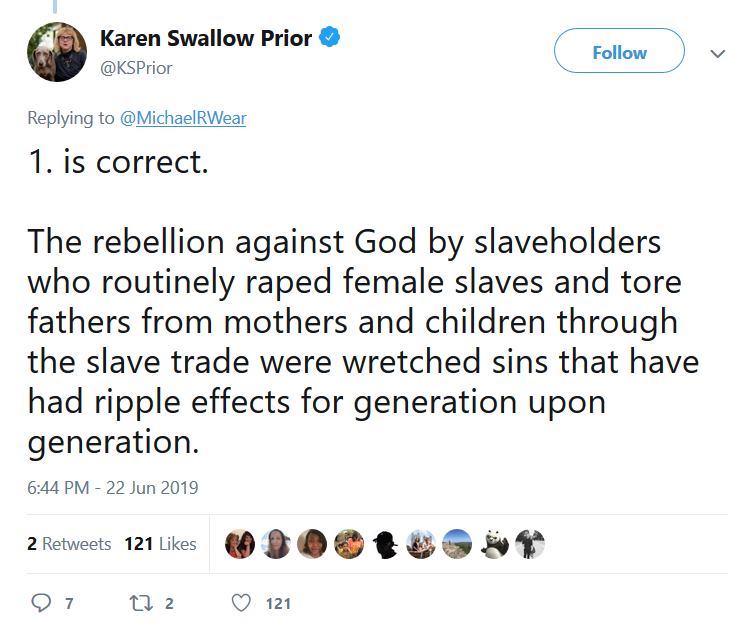
Here is an example from a radical feminist progressive named Karen Swallow Prior:

Karen Swallow Prior says that black people have no moral agency
Karen Swallow Prior says that unlike whites, blacks have no moral agency

According to the fake Christians, it’s not that black women make poor choices with sex, it’s that the ghosts of white slavers who raped their great-great-great grandmothers reach through time with magic and force them to have sex with hunky bad boys who won’t commit to them before sex. It’s not rap music calling black women hoes! It’s the ghosts of slavery past. And even if this ghost theory isn’t true, we shouldn’t tell black women not to sin, because… it would hurt their feelings. After all, the Bible isn’t a book that’s designed to set boundaries to prevent self-destructive behaviors. It encourages us to listen to our hearts, be reckless, and sin as much as we can.

So when did black community problems with sex and abortion start? Did it start with slavery times? Actually, blacks were doing GREAT at marriage and sexual matters just 50 years ago.

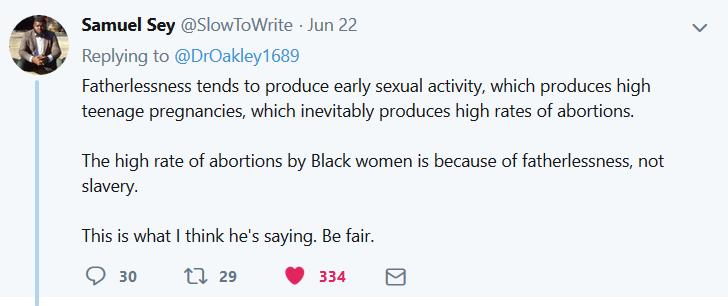
This reply to James White explained:

Blacks married at rates comparable to whites before welfare

That’s true. Black children weren’t fatherless, so they weren’t having early sex outside of marriage, and so they weren’t getting abortions.

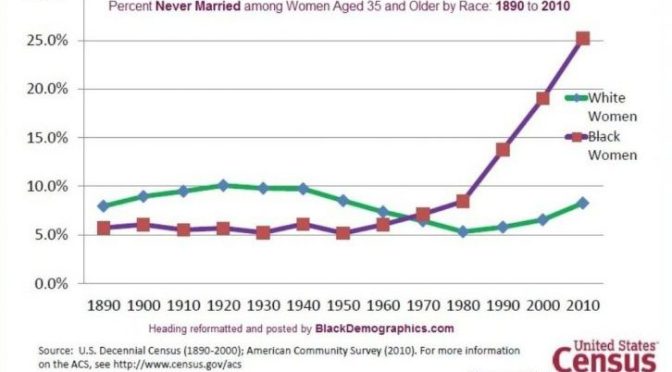
As the header graphic shows, black women were just as likely to be married as white women in the 1960s,  FAR AFTER the days of slavery.

The reason that the graph is going upward is because daughters raised in fatherless homes tend to engage in sexual activity at younger ages, because they are seeking approval from a man which their (single) mother cannot give them. It’s a tragic downwards spiral, and it affects all races. The only way to stop it is to tell women to choose marriage-minded men (not hot bad boys) and marry before having sex, like the Bible says. But woke fake Christians think the Bible is too mean, and better to allow sin by saying that sin is inevitable because slavery ghosts or something.

What’s neat is that black men who take Christianity seriously are totally on board with the facts:

Black man here. Can confirm that the Bible applies to black women.

On this blog, I don’t talk about my ethnicity myself, for confidentiality reasons, but I have said that my skin is darker than Barack Obama. I’m not white or Asian. And the reason that I don’t fall into this trap of causing babies to be born out of wedlock is because I think that when the Bible says that sex outside of marriage is a sin, that this is true. I don’t make excuses or shift blame. It’s incumbent on me to obey, since I claim to be a follower of Jesus.I’m not interested in identity politics. I’m not interested in racial divisions. I’m not interested in blame-shifting. The rules are the rules. And my following of the rules caused me to not cause abortions, according to Christian specifications. Period.

When it comes to sex outside of marriage, the answer of every Bible believing Christian is simple: I’m against it. That is the correct answer, and anything more or less than this answer is demonic. If you are a Christian, sex outside of marriage is always morally wrong. And if you try to justify it, or blame someone else, in order to excuse it, then you’re not a Christian at all. If you try to make excuses for why someone did it, you’re not a Christian. Whether you have had it and been forgiven, or never had it, the answer is always the same: it’s morally wrong. Don’t do it. Never do it.

What I am seeing from people who are critical of James White’s tweet is that they are basically trying to attack those who make moral judgments based on what the Bible says. They want to make room for sinners to sin. The root of abortion sin is sexual sin. Real  Christians discourage sexual sin, and therefore protect unborn children. Fake Christians want to be liked by appearing compassionate, so they make excuses for sexual sin. If you take the Bible seriously on morality, you won’t be liked. Those who try to excuse sin do so because their need to be liked is more important than their need to promote what the Bible teaches.

Some fake Christians will say “oh, but I do think the Bible is right about sex and marriage, but we have to care about slavery reparations and global warming and refugees and illegal immigrants and trasnsgender rights, too”. Baloney. An authentic Christian is concerned about the things that the Bible teaches are “major” things. Drunkenness is a major thing. Sexual immorality is a major thing. Divorce is a major thing. Homosexuality is a major thing. If you meet a Christian who treats those issues as minor issues, and instead majors in what the secular left tells them are major issues, then you’re talking to a fake Christian.

Christianity isn’t a brain-dead faith. You get your priorities from the Bible, and you argue those priorities using facts. The facts about marriage rates are clear and they show that the problems in the black community aren’t caused by slavery. They’re caused by single mother welfare programs. Those welfare programs taught women of all races that they didn’t have to listen to their fathers when choosing men. Those welfare programs taught women that feelings were a better guide in relationships than the Bible. Those welfare programs taught women that their eyes were a better judge of character than performance of traditional marriage roles. Those welfare programs taught women that recreational sex was a way to get a man to commit and stop being a bad boy. We need to go back to the root cause of the problem. The root cause of the problem was making excuses for disobedience to the Bible, and transferring money from married homes to out-of-control women. Of all races.

Podcast: Was Jesus a socialist? Does Christianity teach socialism?

Let's take a deep dive into the Bible
Let’s take a deep dive into the Bible

I noticed that Christianity Today, which has turned hard left in recent years, is now openly endorsing socialism. So, I thought it might be a good idea to listen to this new episode of the Think Biblically podcast, which deals with the issue of Christianity and socialism. The hosts actually brought an economist on to define socialism, then they analyze the teachings of Jesus.

Here’s the description: (H/T Nathan)

It has not been uncommon for advocates of virtually every economic system to invoke Jesus in support of their views, though some of the most ardent advocates for both capitalism and socialism did not have any particular religious views themselves (Rand, Marx). Over the years, some of the more recent advocates of socialist type economic arrangements have appealed to Jesus and the gospels in support of such systems. Economist Lawrence Reed helps us sort out the application of the teaching of Jesus to economics and its relevance for economic life today. Join us for this provocative conversation as he tackles the question of Jesus and socialism.

Show notes, including a full transcript, are available at: biola.edu/thinkbiblically

Topics:

  • who plans the economy in socialism?
  • who should own the means of production in socialism?
  • how should wealth be distributed in socialism?
  • what tools does socialism use to provide people with health care, employment, security, etc.
  • which countries have adopted socialism? North Korea? Cuba? Venezuela? How about the Scandinavian countries?
  • what in the New Testament has caused people to think that Jesus was a socialist?
  • did Jesus ever advocate for concentrating power in the government in order to meet the material needs of people?
  • did Jesus ever advocate for voluntary charity in order to meet the material needs of people?
  • in our experience, is government seen to be more compassionate or less compassionate than individual people?
  • does voluntary charity have any advantages over forced redistribution by a powerful central government?
  • what about the example of common possessions among the earliest Christians?
  • what is the Bible’s view of wealth? is it always bad to be wealthy, or does it matter how you obtained it and how you use it?
  • what does the parable of the talents tell us about socialism vs capitalism?
  • what does the parable of the good Samaritan tell us about socialism vs capitalism?
  • what does the parable of the three different shifts of workers tell us about socialism vs capitalism?
  • what about socialist policies and higher tax rates in countries like Canada and Scandinavian countries?

I have to be honest. I think that some of the economics reasoning about the parables was a stretch, because those parables are talking mainly about other topics, not economics. But it’s true that the parables aren’t friendly to socialism even if they are interpreted as being about economics.