
Tag Archives: Bible

Walt Russell explains how to read the Bible effectively

Bible study that hits the spot

Dr. Walt Russell’s book on the subject of interpreting the Bible is called “Playing With Fire: How the Bible Ignites Change in Your Soul“. I like that book, but I found four articles that summarize the main points of the book so people can understand how to read the Bible at a high livel.

Here is part one which talks about how postmodern relativism is at odds with discovering the original intent of an author.

Excerpt:

Twenty-four year-old “Janet” (not her real name) was angry at my emphasis on seeking to discover authors’ intentions when we read their texts. She was an evangelical Christian and a second grade teacher in a public school. She prided herself in helping her 20 students learn to love literature. She would read them a story as they gathered around her, and then ask each child, “What does the story mean to you?” She prodded them to come up with their own unique meanings. With such strong encouragement, the class of 20 would eventually have 20 different meanings for the one story. Janet sensed that I was a naysayer about such “love of literature.” Pouring a little emotional gasoline on the fire, I said, “Janet, you’re certainly doing your part to insure that these 7 year-olds will never recover from a radically relativistic view of meaning!” Now I had her full attention.

Here is part two which talks about the importance of knowing the genre of a text before you try to interpret it.

Excerpt:

“INDIANS SLAY TIGERS!” — the newspaper headline virtually screams out at you. The thought of something being slain is repulsive. You’re gripped by a mental image of southern India’s Bengal tiger. You imagine its beautiful face, its stripes and piercing eyes. Then your image is shattered by the sudden blast of a high-powered rifle. You see the exquisite creature writhe in pain, fall gracelessly in its tracks and die. Having read no further than the headline, you feel sick, as if you’ve witnessed something tragic.

But should you feel this way? The slaughter of an endangered species — especially one as magnificent as the Bengal tiger — is horrifying, no doubt. But suppose you failed to notice that the headline “INDIANS SLAY TIGERS!” appeared in the sports page of the morning paper. Clearly enough, it now refers to different Indians, different Tigers and a different manner of slaying than you originally thought. And is it really that tragic that the Cleveland Indians badly beat the Detroit Tigers in a major league baseball game last night? Not unless you’re a long-suffering Detroit Tigers’ baseball fan. But how do you now know that the headline is about baseball and not tiger-slaying in India? You look at the words “INDIANS SLAY TIGERS” and you know exactly what each word means. When you combine these words, how can they not mean exactly what you first thought they did — that Indians slay tigers? Answer: because their meanings are communicated (as the meanings of all words are) through genres!

Here is part three which talks about the importance of reading the context of a verse before you try to interpret it.

Excerpt:

“Never Read a Bible Verse!” That’s the title of a little booklet my friend and Christian radio personality, Gregory Koukl, has written to help people read the Bible well. What great advice. “That’s right, never read a Bible verse. Instead, always read a paragraph — at least.” But the current is flowing the other way in our popular sound-bite culture. Not to be left out (or left behind!), the Church has its own version of sound-bite culture: verse-bite culture. In verse-bite culture we take a sentence or sentence-fragment from a biblical paragraph, memorize it out of context, write it on a little card, put it on a billboard, a plaque, a rock, etc. Somehow we think that just because this little chunk of Scripture has a verse number in front of it, it was meant to be a free-standing unit of thought. Nothing could be further from the truth.

Apart from the fact that chapter and verse divisions weren’t added to the New Testament text until 1560 — long after the New Testament’s inspired authorship — there is a more important reason for never reading just a Bible verse, and instead reading at least the paragraph that contains it.

Here is part four which talks about the importance of applying the words of the Bible to your life.

One verse that is often misinterpreted is missing from the articles, but present in the STR lecture. It’s Philippians 1:6 that says “6 being confident of this, that he who began a good work in you will carry it on to completion until the day of Christ Jesus”. Russell says in the lecture that this promise is specifically intended for the church in Philippi, to whom Paul is writing, not necessarily to all Christians. He is giving them a promise just after directly referring to their good work in supporting him in his ministry. Some verses are just not meant for us, and the context reveals it.

What if you only had four minutes to defend Israel’s attack on the Canaanites?

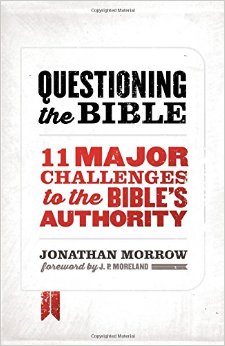
Questioning the Bible by Jonathan Morrow
“Questioning the Bible” by Jonathan Morrow

Jonathan Morrow is giving you just four minutes to respond to a well-known challenge to belief in the Christian God.

Can you handle it?

If not, here is a podcast to help you get ready.

Description:

Is the God of the Old Testament violent and bloodthirsty? Did God really command genocide? Why did Israel attack the Canaanites? These are just a few of the tough questions I tackle in this episode of the think Christianly podcast. Learn how to respond to one of the most challenging and emotional objections to Christianity in under 10 minutes.

Summary:

  • quotes Richard Dawkins to set up the objection
  • response: does God have the authority to give and take life?
  • response: after the Fall, things in the world are not the way they are supposed to be
  • response: Old Testament commands for the Jews to judge other nations are specific to them in that time
  • response: “genocide” and “ethnic cleansing” are not accurate descriptions of the attack on Canaan
  • response: the attack on the Cannanites takes place in the context of redeeming the whole world

Here is the Christian Post article he was interviewed for, where he had to answer:

Jonathan Morrow, author of Questioning the Bible: 11 Major Challenges to the Bible’s Authority, says readers are often perplexed by Old Testament scripture because “sometimes we just picture a God where anger and love can’t co-exist.” Yet he explains, “We all have seen people who have been taken advantage of and that makes us angry [because] we love them. So those emotions can co-exist.”

[…]Along that same line, Morrow clarifies that God’s instructions to the Israelite army in Deuteronomy 20 to destroy the people occupying the land of Canaan is “about judgment, not genocide.”

“The Bible teaches clearly that all people are sinful and in rebellion, kind of living in open rebellion against God, and God is just to judge anyone,” says Morrow. “But in this particular case with the Canaanites, there’s several things going on there, but one of those things was the wickedness of the people which was well documented – child sacrifices to Moloch and others, and bestiality and a lot wickedness.”

He says this judgment was necessary because “Israel’s national survival was crucial so that the Messiah – we would know Jesus as the Messiah – and God’s saving purposes of redemption to the world could one day be born because if the Messiah was supposed to come through the lineage of Israel and Israel co-mingled with this wicked people and was ultimately destroyed, that promise of hope and blessing to the whole world could not have been realized.”

[…]Morrow recognizes that Old Testament questions are particularly challenging. “We live in a sound bite culture and so this is one of those questions where it kind of gets thrown out for people, why does God command genocide, and that’s really easy to say and then it takes some time to respond to because there’s some context.”

Morrow says his sound bite answer is: “These passages are about judgment; they’re not about genocide.”

However, he encourages believers to find out the asker’s real interest in this question. “I would ask them, you know, it sounds like this is a pretty emotional question for you, why is that. Let them talk about it some so you can better understand because that’s the goal. We’re not just trying to win an argument; we’re trying to understand and help people.”

It the asker is after truth, Morrow advises Christians to “ask them … are you interested in kind of walking through and getting kind of messy about looking at the evidence for this because I’d love to share that with you, and sometimes they’ll go, ‘yeah, that’ll be great.'”

Other times, Morrow says, the asker is simply looking for “space and distance from God and this question allows them to put space between them and God.”

By the way, Morrow and McDowell’s basic apologetics book – “Is God Just a Human Invention?” – is my first pick when mentoring new people in apologetics.

UPDATE: J.W. Wartick has reviewed the 11 Questions book on his blog.

Bible study: Was the resurrection body of Jesus spiritual or physical?

Sherlock Holmes and John Watson are going to take a look at the data

So, everyone from left to right accepts the early creed in 1 Corinthians 15:3-7 being dated to 1-3 years after the death of Jesus, even atheists like Crossley, Ludemann and Crossan. The thing is, some people are not sure that the appearances of Jesus to individuals, groups, and skeptics really were physical appearances. They say “well, Paul’s appearance was non-physical, so the other ones must have been, too”.

Let’s take a look.

Here’s a paragraph from my friend Eric Chabot, from his blog Think Apologetics. He explains why Paul’s use of the word “resurrection” to describe what the other witnesses saw means bodily resurrection.

He writes:

If Paul did have a vision then the term “vision” is vague and must be defined. As Licona points out, visions are either objective (i.e., something that is seen without the use of our natural senses) or subjective (i.e., a  product of our minds). The real  problem is with the vision hypothesis is that it doesn’t explain Paul’s use of resurrection to explain what had happened to Jesus.  The two words are used for resurrection in the New Testament “anastasis” (rising up) and “egersis” (waking up), both imply a physical body. Furthermore, the use of the word “opethe” (the Greek word for appeared) shows the Gospel writers did believe that Jesus appeared physically. “There you will see (opethe) him” (Matt. 28:7); “The Lord has risen and has appeared (opethe) to Simon” (Luke 24:24). When they used “opethe” here, it means that He appeared physically to them.

So when Paul gives his list of appearances in 1 Cor. 15, the issues becomes whether the appearance to him is the same as it was to the disciples. There is no doubt the post resurrection body of Jesus (after the ascension) had to be somewhat different than the body the disciples saw. Also, whenever the New Testament mentions the word body, in the context of referring to an individual human being, the Greek word “soma” always refers to a literal, physical body.Greek specialist Robert Gundry says “the consistent and exclusive use of soma for the physical body in anthropological contexts resists dematerialization of the resurrection, whether by idealism or by existentialism.” [9] Furthermore, in N.T. Wright’s  The Resurrection of the Son of God shows that the Greek word for resurrection which is “anastasis” was used by ancient Jews, pagans, and Christians as bodily in nature.

Now, I think my view on this, and I’m not sure if Eric would correct me, is that Paul got an objective but non-physical vision of Jesus. There was something there that everyone else could see and hear, in my view. But in my view Paul’s “veridical” vision was post-ascension, and so non-physical. Paul uses the word resurrection to describe what the other eyewitnesses saw (and he met them at least twice, according to Gal 1 and Gal 2), and that means physical resurrected body.

Eric Chabot writes this in another place:

Acts 9- Paul’s Damascus Road Experience

Here we see whatever happened,  this was after the ascension. Hence, to say Paul saw the exact same Jesus before he ascended is hard to infer from the text. There simply isn’t enough information here.  The Bible says, “they heard” the same voice Paul did ” (Acts 9: 7). But they “did not see anyone ” (Acts 9: 7). Notice  Paul was physically blinded by the brightness of the light.  One way or the other, the experience involved something that was external to Paul. It wasn’t something that was the same thing as a vision that Paul talks about in 2 Cor. 12:1.  Furthermore, the phrase “he let himself be seen’” (ōphthē , aorist passive, ), is the word Paul uses  in 1 Cor. 15:7 to describe of his own resurrection appearance as the other ones in the creed. As Paul Barnett says:

“It is sometimes claimed that the word appeared (ōphthē) means a mystical seeing, as of a vision, and that since this was what Paul “saw” it was what the other apostles “saw.” In other words, after death, Jesus was taken directly to heaven whence he “appeared” to various people, mystically, as it were. This however, is not all the meaning of Paul’s words. First, the word ōphthē, “appeared” is not limited to visionary seeing it is also used for physical seeing. Moreover, the verb raise used in the phrase ‘raised on the third day” is used elsewhere in combination with the words “from the dead” which literally means “from among the corpses.” Thus raised preceding  appeared gives the latter a physical not a mystical meaning. Christ, as “raised from the dead” ….appeared.”  Furthermore, when Paul asks “ Am I not free? Am I not an apostle? Have I not seen Jesus our Lord?”(1 Cor. 9: 1), he is using the ordinary word horan, “to see” for physical sight. If “seeing” the Lord “raised from the dead” qualified others to be apostles, then Paul is, indeed, an apostle. It was no mere subjective vision that arrested Paul en route to Damascus. (8) .

In the end, word studies can’t entirely resolve this issue. We need to remember the etymological fallacy as well. We  would have to look at all the texts that speak of resurrection (including the entire 1 Cor. 15 chapter in their entire context as well as the anthropology of the New Testament. We also need to study the resurrection in light of the Second Temple Jewish period. See our reading list here for some resources that may help.

But conservative ancient historian Gary Habermas seems to think that Paul got the physical body as well.

He says:

Now, I said before in 1 Corinthians 15, Paul could have chosen to only use the word pneuma. He doesn’t. He does say “spiritual,” but he’s got an adjective there. He also says, soma, “body.” What did Paul mean?

Philippians Chapter 3. It’s a short chapter. There are 21 verses, but Paul says three things in one chapter that indicate he’s talking about a physical resurrection. In the opening verses he says, “I was a Hebrew of the Hebrews” and “as touching the law,” he says, “I was a Pharisee.” Now, it’s very well known that the Pharisee believed in a bodily resurrection. In fact, according to Acts 23, as Paul was being taken captive by the Romans to prevent his being killed, he shouted out to the group of people and said, “Why are you taking me? Because I believe in the resurrec­tion of the dead?” He meant a literal resurrection.
When the Pharisees heard that, they said there’s nothing wrong with this guy. But the Sadducees [who didn’t believe in the Resurrection] didn’t like it. So as a Pharisee, he’s agreeing with the Pharisees.
So, the first evidence is from Philippians 3. As a Pharisee, Paul believes in a physical resur­rection.
Secondly, in verse 11 he says, “That I may attain the resurrection of the dead.” Now, the normal Greek word for resurrection is anastasis, but in this passage, Philippians 3:11, he puts a prefix on there, ek anastasis. Ekanastasis, according to all Greek scholars that I know of, is translated in this passage: “The out resurrection from among the dead.” Paul said, “I want to attain the out resurrection.”
Now, to a Jew, “out resurrection” means “what goes down is what comes up.” You come out from death. And then just a few verses later, Philippians 3:20,21, he said, “From Heaven, we look for Jesus who will change our vile soma (body) to be like unto His glorious soma (or body),” when he should have said pneuma, according to this other view.
So he’s a Pharisee who believes in a physical resurrection. Ek anastasis—“resurrection from out among the dead ones.”
Thirdly, Paul says, “He Jesus will change my body to be like His body.”

So right there in Philippians 3 alone, I think the picture of Jesus being some wispy spirit that appeared to him on the road to Damascus doesn’t fit Paul’s own data.

Yes, that’s why Philippians is my favorite book. You can get so much useful theology out of it. Something about the resurrection in Phil 3, something about Jesus’ divinity in Phil 2, and loads of practical advice on stewardship, charity, fellowship, endurance and practical love for others throughout. Some of it takes a little digging, but that’s what commentaries are for, am I right? But I digress.

If you want to read something a little more challenging, I found a paper from the Evangelical Theological Society (ETS) from their journal, where it talks more about soma and anastasis. If you want a bit of a challenge, download the PDF and read it. It’s by Kirk R. MacGregor and the title is “1 Corinthians 15:3B–6A, 7 And The Bodily Resurrection Of Jesus”.