
Tag Archives: Bible Study

What is the Christian doctrine of the Trinity?

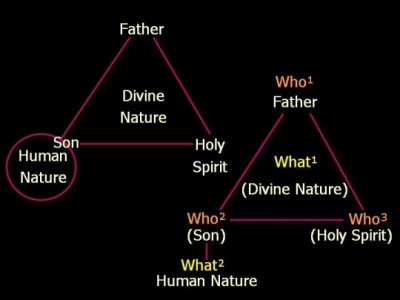
The Christian doctrine of the Trinity

I have a friend who is considering Christianity and he is stuck on the doctrine of the Trinity. Tom, this one’s for you.

Excerpt:

So, what exactly do we mean when we talk about the Trinity? Writing in the early third century, in hisAgainst Praxeas, Tertullian is credited with first employing the words “Trinity”, “person” and “substance” to convey the idea of the Father, Son and Spirit being “one in essence — but not one in person”. Indeed, Tertullian writes,

“Thus the connection of the Father in the Son, and of the Son in the Paraclete, produces three coherent Persons, who are yet distinct One from Another. These Three are, one essence, not one Person, as it is said, “I and my Father are One,” in respect of unity of substance not singularity of number.”

This concept was established as church orthodoxy at the famous Council of Nicaea in A.D. 325. The Nicene Creed speaks of Christ as “God of God, Light of Light, very God of very God, begotten not made, being of one substance with the Father.”

It is this definition that I am going to assume in the discussion that follows. Succinctly, then, the doctrine of the Trinity may be defined thusly: Within the one being or essence that is God, there exists three co-equal and co-divine distinct persons — namely the Father, Son and Holy Spirit — who share that essence fully and completely. This concept is not to be confused with polytheism, which maintains that there are multiple gods. While orthodox Christianity emphatically holds there to be only one God, we nonetheless understand God to be complex in his unity. The concept is also not to be confused with the ancient heresy of modalism, which maintains that God exists in three different modes. The Son has never been the Father and the Holy Spirit has never been the Son or the Father. Modalism is refuted by the picture given to us in all four gospels (Matthew 3:16-17; Mark 1:9-11; Luke 3:21-22; John 1:32-34) in which the Holy Spirit descends on Jesus in the form of a dove and a voice is heard from Heaven “This is my beloved Son. With him I am well pleased.” Similarly, it should be noted that the Father, Son and Spirit do not each make up merely a third of the Godhead. Rather, each of the three persons is God in the full and complete sense of the word.

Having shown that Scripture emphatically rejects the notion that the Father, Son and Spirit are synonymous persons, only five propositions remain to be demonstrated in order to provide Biblical substantiation for the concept of the Trinity. Those propositions are:

  1. There is only one eternal God.
  2. The Father is the eternal God.
  3. The Son is the eternal God.
  4. The Holy Spirit is the eternal God.
  5. Although the Father, Son and Holy Spirit are non-synonymous persons, the concept of the Trinity does not violate the law of non-contradiction.

Let’s take a look at each of these in turn.

He then takes a close look at what the Bible says about God with respect to those assertions. There can be no doubt that the Bible teaches that God is one divine substance, and three persons.

Three debates on Calvinism, Molinism and middle knowledge

Last month, I posted a philosophical debate on God and morality/purpose and a scientific/philosophical debate on God’s existence and a scientific/philosophical debate on abortion. This time it’s 3 debates featuring a Calvinist debater and a foreknowledge debater. These debates are incredibly good and very friendly and cordial. If you have never heard a debate on theology before, then these are the ones to get you started. Theological debates are more fun than you think, you just need to choose the good ones.

The two views being debated are Calvinism and Foreknowledge. Calvinism is the view that God unilaterally predetermines a selected group of individuals who will know him – the “elect”. Foreknowledge is the view that God draws people to him who he foreknows will freely respond to his overtures and come to know him. What does the Bible teach about these issues?

The Calvinist debater is Dr. James White:

James White is the director of Alpha and Omega Ministries, a Christian apologetics organization based in Phoenix, Arizona. He is a professor, having taught Greek, Systematic Theology, and various topics in the field of apologetics. He has authored or contributed to more than twenty books, including The King James Only ControversyThe Forgotten TrinityThe Potter’s Freedom, and The God Who Justifies. He is an accomplished debater, having engaged in more than one-hundred moderated, public debates with leading proponents of Roman Catholicism, Islam, Jehovah’s Witnesses, and Mormonism, as well as critics such as Bart Ehrman, John Dominic Crossan, Marcus Borg, and John Shelby Spong. He is an elder of the Phoenix Reformed Baptist Church, has been married to Kelli for more than twenty-eight years, and has two children, Joshua and Summer.

The Foreknowledge debater is Dr. Michael Brown:

Michael L. Brown holds a Ph.D. in Near Eastern Languages and Literatures from New York University and has served as a visiting or adjunct professor at Southern Evangelical Seminary, Gordon Conwell Theological Seminary (Charlotte), Trinity Evangelical Divinity School, Fuller Theological Seminary, Denver Theological Seminary, the King’s Seminary, and Regent University School of Divinity. He has contributed numerous articles to scholarly publications, including the Oxford Dictionary of Jewish Religion and the Theological Dictionary of the Old Testament. Dr. Brown is the author of twenty books, including, Our Hands Are Stained with Blood: The Tragic Story of the “Church” and the Jewish People, which has been translated into more than twelve languages, the highly-acclaimed five-volume series, Answering Jewish Objections to Jesus, a commentary on Jeremiah (part of the revised edition of the Expositor’s Bible Commentary), and several books on revival and Jesus revolution.

Now, let’s get ready to rumble!

First debate

A nice friendly debate that introduces the topic. This is the best debate for casual listeners and non-Christians.

The MP3 file is here.

Summary:

  • Introduction to Calvinist James White and some of his 90 debates
  • What is Calvinism and why is it important?
  • Does God love all people the same way in Calvinism?
  • Does God desire the salvation of all people in Calvinism?
  • Is the offer of salvation to all people a genuine offer on Calvinism?
  • Does Calvinism diminish or augment God’s sovereignty?
  • Can God accomplish his will by permitting evil creaturely actions?
  • Did Jesus die only for the “chosen”, or for the possibility of salvation for all?
  • Does a person’s responding to God’s offer of savaltion detract from Gods glory?
  • Does our ability to resist God’s grace mean that we are “stronger” than God?

There is a little static in the audio for a few seconds every time they come back from a break, but nothing major.

Second debate, on specific passages in the Bible

Same two guys, but this time they tackle the meaning of specific Bible passages.

The MP3 file is here.

The passages being disputed:

  • John 6
  • Romans 8, 9
  • Ephesians 1
Each person gets 8 minutes to exegete the text, followed by 4 minutes of cross-examination by the other debater, followed by 3 minute conclusions by each debater. These texts were chosen by the Calvinist debater.

Third debate, on specific passages in the Bible

Same two guys, but this time they tackle the meaning of specific Bible passages.

The MP3 file is here.

The passages being disputed:

  • Luke 13:34-35 (Deuteronomy 5:28-29)
  • Ezekiel 18:21-32 (Jeremiah 3:19-20; Ezekiel 22:30-31)
  • 1 John 2:1-2 (2 Pet 2:1).
Each person gets 8 minutes to exegete the text, followed by 4 minutes of cross-examination by the other debater, followed by 3 minute conclusions by each debater. These texts were chosen by the foreknowledge debater.

Gary Habermas and Joel Marcus discuss the resurrection of Jesus

A dialog between Dr. Gary Habermas and Dr. Joel Marcus.

Dr. Habermas is a conservative evangelical who argues that the evidence for the resurrection is strong. Dr. Marcus is fairly moderate, definitely not an evangelical, so it makes for an interesting, but friendly, disagreement. He agrees with Gary on some things, but not on others.

About the speakers:

Gary Habermas

Chair, Department of Philosophy, Liberty University
Distinguished Research Professor

Ph.D., History and Philosophy of Religion, Michigan State University (1976)
M.A., Philosophical Theology, University of Detroit (1973)
B.R.E., Christian Education, Bible, Social Sciences; William Tyndale College (1972)

Distinguished Research Professor; Liberty Baptist Theological Seminary and Graduate School; Chair, Department of Philosophy and Theology, Liberty University; current appointment: teaching in PhD program, Liberty University, 1981-Present.

Joel Marcus

Professor of New Testament and Christian Origins, Duke University

B.A., New York University
M.A., M.Phil., Ph.D, Columbia University-Union Theological Seminary, New York

Joel Marcus teaches New Testament with an emphasis on the Gospels and the context of early Christianity in first-century Judaism. His publications include two monographs on Mark and a two-volume commentary on the same Gospel in the Anchor Bible series (Doubleday, 2000, 2009). His current research focuses on the parting of the ways between ancient Judaism and the Christianity of the first three centuries A.D.

This is MP3 audio of the discussion is in 3 parts.

Each part is 8 Mb. The last segment is Q&A with students.