
Tag Archives: Basic Economics

Dave Rubin interviews my favorite economist: Thomas Sowell

Economist Thomas Sowell
Dr. Thomas Sowell – the best economics teacher you will ever learn from

Two half-hour interviews with my FAVORITE economist, Thomas Sowell. If you haven’t read any books by Thomas Sowell, then you don’t know how wonderful economics can be. Thomas Sowell stands for the proposition that before you adopt an economic policy, you have to consider what incentives it will create for everyone involved. And he backs up his ideas with studies that span the whole range of times and places. It turns out that many bad ideas have already been disproved in different times and places, and Thomas Sowell knows them all. Thomas Sowell is a man of facts and evidence.

Description of part one:

Dr. Thomas Sowell (Economist) joins Dave to discuss his Marxist past, free speech on campuses, distinguishing between classical liberalism and libertarianism, and his new book “Discrimination & Disparities.

Part one:

“This idiot has stumbled on something that will ruin us all”. LOL!

Description of part two:

Dr. Thomas Sowell (Economist and Author) joins Dave to discuss the role of government, the problem with minimum wage laws, his experience as a black conservative, debunking systemic racism, the importance of common decency, and his new book “Discrimination & Disparities.”

Part two:

In the comments, Dave explains that YouTube has demonetized the video. I suppose that this is because the video contains conservative ideas, and YouTube is owned by the far-left Google.

Anyway, I recommend getting your hands on some Thomas Sowell books.

This one seems to be a collection of introductory essays:

The Thomas Sowell Reader

I haven’t read it, but it has the highest reviews of any of his books. What I would recommend is picking up one of the OLDER versions of his “Basic Economics”:

Basic Economics

You can get a used one for a couple of bucks. I read the second edition a while back, and I remember that just reading the first 3 chapters knocked my socks off. Some crazy person even uploaded the audio of the edition I read to YouTube. Just listen to the first 3-4 chapters, and you’ll see what I mean. No one who wants to understand how the world really works can ignore Thomas Sowell.

One that I still haven’t read that’s short and sweet is:

The Vision of the Anointed

But a later book that is similar is actually my favorite Thomas Sowell book:

Intellectuals and Society

I also liked this one a lot:

Economic Facts and Fallacies

I once dated a homeschooled girl who came from a large, rural family. This family produced brilliant children, but the parents didn’t really believe in college. I told the girl that to marry me, she would have to get a college degree. She and her parents didn’t really like that, and we broke up. However, I did tell her that she should read Thomas Sowell, because she had some left of center views on public policy, e.g. – health care. I found out later that she went on to read SIX Thomas Sowell books in two months. After that, she went on to get a BA in economics via distance learning, with a 4.0 GPA! I think part of that transformation is due to the Thomas Sowell books. Thomas Sowell changes lives.

I have to include this clip of Thomas Sowell from a long time ago:

He understood the things we are fighting about today decades ago. This man should have been our first black president.

By the way, Dave Rubin does a lot of good interviews. This one that he did with Larry Elder was worth watching.
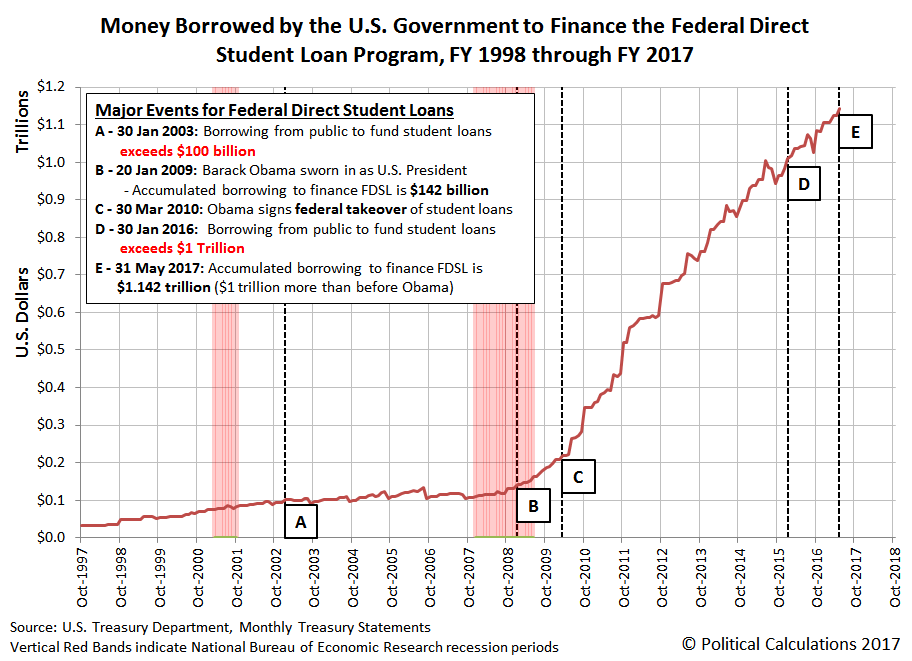
How did Obama’s plan to let government run student loans work out?

Obama nationalized student loan administration in 2010

I’m a free-market capitalist, so I believe that economic decision-making is best done by the people it concerns, not the people in government. If it is a decision that affects the family, let the family decide. If it’s a decision that affects the business, let the business owner decide. Obama has a different view – he thinks that government should make all of the decisions, even though government earns none of the money.

Here is an article in Investor’s Business Daily about his policy of letting the government take over student loan decision-making.

Excerpt:

A report from the Department of Education notes that the net cost of the federal government’s direct loan program is quickly heading into the red. This program, mind you, was supposed to be a moneymaker for the government, as students paid back federal loans with interest.

But as it turns out, borrowers have been flocking toward various loan forgiveness programs, by which the government will lose money, erasing gains from other loans. The report shows that the direct loan program went from a $25 billion surplus in 2012 to less than $5 billion by 2015.

A separate report says that this program ran a $36 billion deficit last year, up from $8.4 billion in 2016.

This is not how this federal loan program was supposed to work when President Obama launched it eight years ago.

In 2010, President Obama effectively nationalized student lending by cutting banks — which had been offering government-backed loans to students — out of the equation and having the government make the loans itself.

“By cutting out the middleman, we’ll save the American taxpayers $68 billion in the coming years,” Obama said when he signed this change into law. “That’s real money.”

As a result, federal student loan debt shot up from $154.9 billion in 2009 to $1.1 trillion by the end of 2017.

As everyone knows, under Obama’s big government leadership, the national debt skyrocketed from $10 trillion to $20 trillion in only 8 years. Obama ran up as much debt in his 8 years as ALL the other presidents, combined. Why? It’s simple. Because government isn’t as careful with other people’s money as people are careful with their own money. People make better decisions than government because they care about the money more – they earned it. The right people to solve an economic problem are the people in the families, and the people at the local bank branches nearby. When government takes over economic decision-making, they use other people’s money to buy the votes of people who make poor decisions.

We shouldn’t be allowing students to take 4-year vacations at taxpayer expense, so that they can learn English or Women’s Studies and then stick taxpayers with the bill. Some of those taxpayers had to study hard things like engineering and pay their own way. Some of those taxpayers had to get jobs in the trades as electricians and plumbers to pay for the bad decisions of these spoiled brats. Student loan administration should not be something for big government to control. When government decides who gets loans, students feel no pressure to study subjects and get credentials that will allow them to pay back what they borrowed. I want the banks to make the lending decisions and loan out their own money, so that they can deny people who are studying nonsense that won’t get a return.

That’s why we should never have elected a big-government liberal to be president. They make a lot of promises about how great they are with money, but it never works out. Big government is never the answer to problems that are outside of what the Constitution describes as the boundaries of government.

(Image Source)

How much does the average American corporation make in profit?

How much profit does the average American corporation make?

A while back, there was a story about how Americans vastly overestimate how many people in the USA are homosexual. According to Gallup polls in 2011, Americans estimated that 25% of the people in America were homosexual. In 2015, it was 23%. The actual number is about 3%. So it’s very clear that Americans can have wildly inaccurate perceptions about reality. Why are Americans so wrong? I think it’s because they see a lot of gay people in high profile areas, particularly in the entertainment industry.

I thought about this failure to perceive reality when I saw a story about how much profit Americans think that corporations make. My guess was that the average corporation makes about 5-10% profit margin. I know this because I used to buy and sell stocks regularly and that’s one of the numbers I would look at. Most Americans own stocks, so I thought they most Americans would know the number as well. But it turns out that American perceptions of corporate profits are wildly off the mark.

Check out this article from the prestigious American Enterprise Institute:

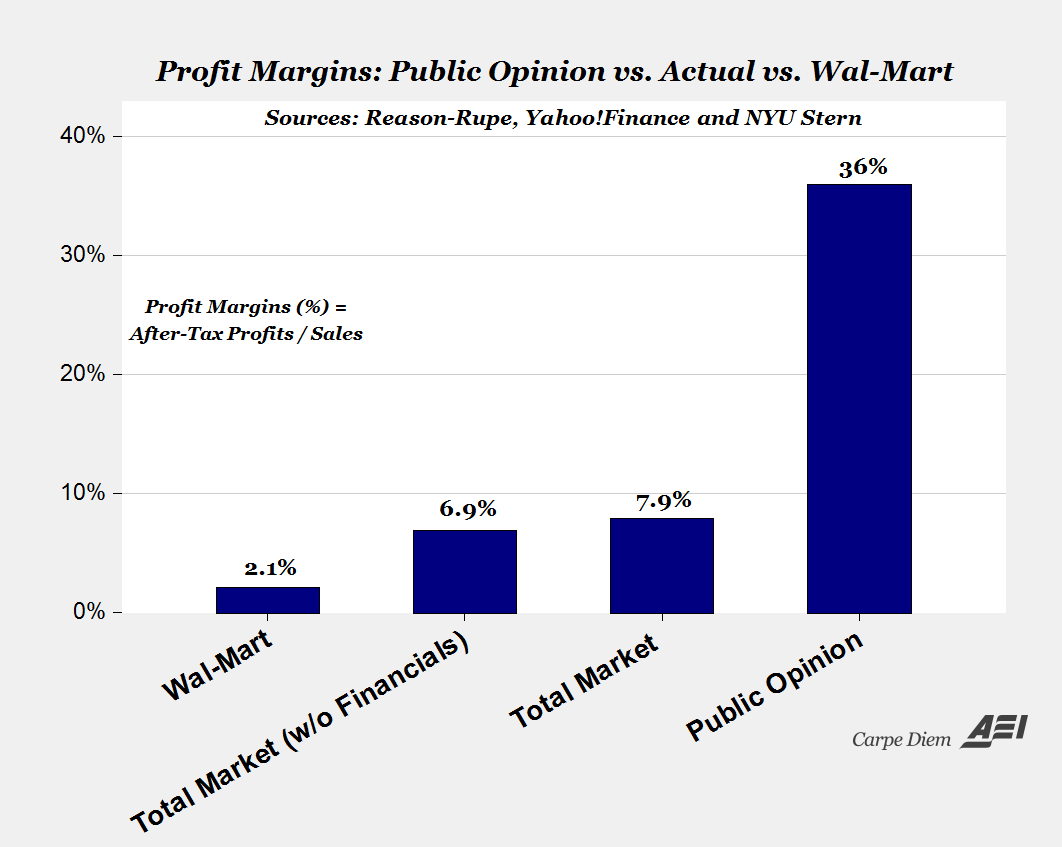
When a random sample of American adults were asked the question “Just a rough guess, what percent profit on each dollar of sales do you think the average company makes after taxes?” for the Reason-Rupe poll in May 2013, the average response was 36%! That response was very close to historical results from the polling organization ORC International polls for a slightly different, but related question: What percent profit on each dollar of sales do you think the average manufacturer makes after taxes? Responses to that question in 9 different polls between 1971 and 1987 ranged from 28% to 37% and averaged 31.6%.

How do the public’s estimates of corporate profit margins compare to reality? Not surprisingly they are off by a huge margin. According to this NYU Stern database for more than 7,000 US companies (updated in January 2018) in many different industries, the average profit margin is 7.9% for all companies and 6.9% for more than 6,000 companies excluding financials (see chart above).

[…]“Big Oil” companies make a lot of profits, right? Well, that industry (Integrated Oil/Gas) had a below-average profit margin of 5.6% in the most recent period analyzed, and separately, the Production and Exploration Oil/Gas industry is losing money, reflected in a -6.6% profit margin. For the general retail sector, the average profit margin is only 2.3% and for the grocery and food retail industry, it’s even lower at only 1.6%. And evil Walmart only made a 2.1% profit margin in 2017 (first three quarters) which is less than the industry average for general retail, possibly because grocery sales now make up more than half of Walmart’s revenue and profit margins are lower on food than general retail.

Sometimes, the government makes MORE from the sale of goods or services than the company that does ALL the work:

Interestingly, Walmart’s profit margin of 2.1% is actually less than one-third of the 6.5% the average state/local government takes of each dollar of Walmart’s retail sales for sales taxes. Think about it – for every $100 in sales for Walmart, the state/local governments get an average of $6.50 in sales taxes (and as much as $10.12 in Louisiana and $9.45 in Tennessee, see data here), while Walmart gets only $2.10 in after-tax profits!

I think that Americans are getting their false anti-corporation views from listening to the mainstream media. The mainstream media is overwhelmingly leftist according to recent studies of their political donations. I think that the anti-corporate views of the average American comes from their uncritical consumption of mainstream media propaganda. They think they are getting objective news reporting, but what they’re really getting is socialist propaganda.

Here is a short little video that explains more about profit margins, and what would happen if a socialist like Bernie Sanders were put in charge of a corporation:

If you’d like to help with this problem of anti-business economic illiteracy, please watch the video and share it, or share the AEI article, which contains the video. America will be a better country when Americans have accurate, informed beliefs about important issues.