Tag Archives: Basic Economics

Dr. Jennifer Roback Morse lectures on basic economics

Here is a podcast on basic economics from Dr. Jennifer Roback Morse.

About the speaker:

Dr. Morse is the founder of the Ruth Institute, a global non-profit organization focused on keeping the family together, protecting the rights of children and helping the millions of people who have been harmed by family breakdown.

She has authored or co-authored four books and spoken around the globe on marriage, family and human sexuality. Her work has been translated into Spanish, Chinese, Korean and Polish. Her newest book is The Sexual Revolution and Its Victims.

She earned her Ph.D. at the University of Rochester and taught economics at Yale and George Mason Universities.

A bit more about her economics credentials: Dr. Morse served as a Research Fellow for Stanford University’s Hoover Institution from 1997-2005. She received her Ph.D. in economics from the University of Rochester in 1980 and spent a postdoctoral year at the University of Chicago during 1979-80. She taught economics at Yale University and George Mason University for 15 years.

The MP3 file is here. (49 minutes)

Topics:

  • The study of economics is anti-postmodern – there is objective truth independent of what people think
  • The study of economics believes in fixed principles of human nature
  • Economics studies the allocation of scarce resources that have alternative uses
  • Economics studies how people exchange resources
  • How both people who engage in a voluntary trade always believe that they will be better off
  • How both people who engage in a voluntary trade both benefit from the exchange
  • How incentives motivate people to act
  • Understanding supply and demand
  • Understanding how “free” government services are rationed
  • Understanding opportunity costs
  • How prices signal producers to produce more or less, and consumers to buy or not buy
  • Market-driven prices versus price controls
  • The role of substitution
  • The necessity of allowing failure in a free market

The requirements of economic growth:

  • private property
  • contracts
  • the profit motive
  • competition
  • free trade
  • entrepreneurship, creativity and innovation
  • the rule of law

If you want to learn more about basic economics, I recommend picking up a book or two by Thomas Sowell – the first book I usually give away is “Intellectuals and Society”, and then next “Basic Economics”. You can find a good list of books on the website of The Institute for Faith, Work and Economics.

I think it’s important for Christians to understand basic economics, because so much of the impact we have depends not only on our personal finances, but on our ability to promote economics policies that will affect our personal finances. For example, whether you have a job or not depends on economic policy. Whether you can get food and other required resources depends on economic policy. Often, big-government regimes with poor economic policies (e.g. – North Korea) will make it impossible for you to have other liberties, like religious freedom.

Just think about how hard it would be for you to pursue a Christian life plan in a place like Venezuela, where your priorities would not be apologetics, but just finding food and avoiding death and theft at the hands of criminals.

Imagine it was you lost your job or couldn’t find work due to bad economic policy. Think of how that would affect your ability to even drive to church on Sundays, or purchase a Bible, much less being able to organize an apologetics event at the university and pay for a speaker to fly in and stay in a hotel. Economics is important for Christians to understand, because so much of our influence and effectiveness depends on it.

Is there evidence of systemic racism in the United States?

Systemic racism is the idea that people can’t lift themselves out of poverty by making good decisions, because powerful groups in society that hold the poor down, regardless of their decisions. Do you think that America is a place where no matter what choices you make, you’ll never be able to be more prosperous? That’s what the leaders of Black Lives Matter think.

Here’s what Nikole Hannah-Jones, creator of the 1619 Project, says in the New York Times (a former newspaper):

To summarize, none of the actions we are told black people must take if they want to “lift themselves” out of poverty and gain financial stability — not marrying, not getting educated, not saving more, not owning a home — can mitigate 400 years of racialized plundering.

Got that? It doesn’t matter what individual choices a non-white person takes in America, they’re going to be poor. The “systemic racism” of the powerful whites will always keep them down. Single motherhood doesn’t make people poor, and marriage doesn’t make people wealthier. Dropping out of high school doesn’t make you poor, and getting a Masters degree in computer science won’t make you wealthier.

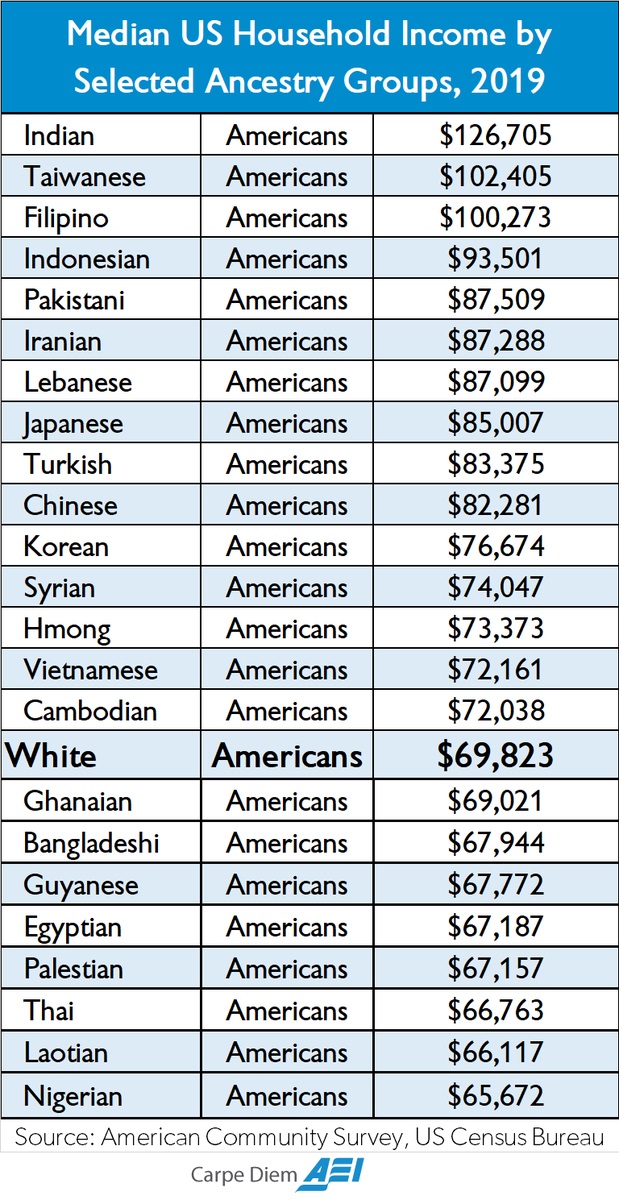
But let’s take a look at the data from the 2019 Census, and see the evidence:

Income By Ethnicity in America

White people are doing a bad job of keeping non-whites down

Well, it looks like at least SOME people of color are able to do well in America despite all the “systemic racism” that keeps non-whites down. And do you know what those non-white groups at the top have in common? They’ve made good decisions, they’ve worked hard, they haven’t blamed other people when they fail, and they’ve saved their money instead of spending it on shiny junk.

Let’s look at some decisions that the non-whites who are prosperous have made, that those further down have not.

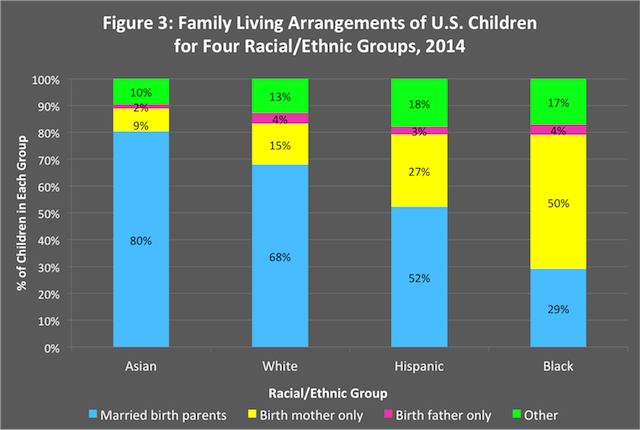
Asians marry before they have children, so the kids have two parentsAsians marry before they have children, so the kids have two parents

Education and marriage

This article is written by the far-left radical Nicholas Kristof, writing in the radically-leftist New York Times (a former newspaper).

Excerpt:

A new scholarly book, “The Asian American Achievement Paradox,” by Jennifer Lee and Min Zhou, notes that Asian-American immigrants in recent decades have started with one advantage: They are highly educated, more so even than the average American. These immigrants are disproportionately doctors, research scientists and other highly educated professionals.

It’s not surprising that the children of Asian-American doctors would flourish in the United States. But Lee and Zhou note that kids of working-class Asian-Americans often also thrive, showing remarkable upward mobility.

[…]There’s also evidence that Americans believe that A’s go to smart kids, while Asians are more likely to think that they go to hard workers… Asian-American kids are allowed no excuse for getting B’s — or even an A-. The joke is that an A- is an “Asian F.”

One reason Asians students do so well is because their parents are usually married:

Strong two-parent families are a factor, too. Divorce rates are much lower for many Asian-American communities than for Americans as a whole, and there’s evidence that two-parent households are less likely to sink into poverty and also have better outcomes for boys in particular.

American blacks have a 73% out-of-wedlock birth rate. A huge difference compared to Asians.

So, when Nikole Hannah-Jones tells you that education and marriage don’t matter, she’s just wrong.

Compound interest

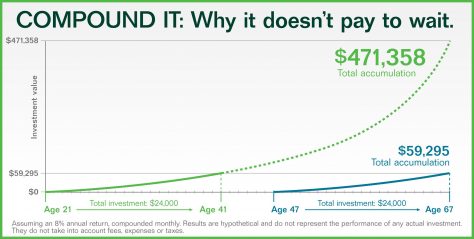
Education and marriage are important, but so is saving your money. The wealthiest people in America are typically the ones who are experts at saving money early, and investing it. They know about the law of compound interest. If you invest money early and leave it alone, then it will grow into a fortune by the time you are read to stop working.

This graph explains compound interest:

Don't trust people with non-STEM degrees to tell you how to get richInvesting $24,000 from age 21 to 41 vs investing $24000 from age 47 to 67

What does Nikole Hannah-Jones say when she looks at that graph? She doesn’t think that saving money makes a difference to having more or less wealth. She thinks skin color determines whether saving money makes you wealthy or not. The graph clearly shows what we should be recommending to young people of color. They need to stop spending money and start saving it, and the earlier the better. It doesn’t matter what your skin color is, saving money early JUST WORKS.

Similarly, when she says that home ownership doesn’t make you more wealthy, this is just terrible advice. It’s always better to pay down your own mortgage (at least when interest rates are low like they are now) than to pay someone else rent. You have to live somewhere, and paying for your own home is better because it costs about the same as rent, and then you get to keep the home when you’re done paying for it.

Communism

Nikole Hannah-Jones does have a “solution” to disparities in wealth. Her solution is communism. She wants to transfer money from those who earn, to those who don’t. But we already have tried that in the 20st century and it resulted in the deaths of over 100 million people. That’s not my opinion, that’s all documented in a book published by Harvard University Press.

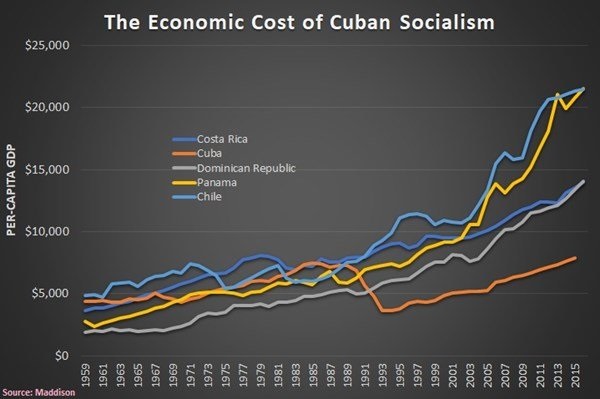
Socialism Communism Countries Per Capita GDP Income

You don’t even have to read the book to know the truth – just look at countries that score low on the Index of Economic Freedom, and compare their GDP per capita to countries that score high on the Index of Economic Freedom. The more communist a nation goes, the less wealth there is for the citizens. That’s why people in Venezuela are eating zoo animals and selling their bodies in prostitution for food, while nearby capitalist countries like Panama and Chile prosper. Nikole Hannah-Jones wants to reduce economic freedom, but we know by looking at other countries that this lowers per-capita GDP.

There’s a lot more than could be said here, but the point is that we need to be telling American blacks to make decisions that match the decisions of other successful non-white communities in America. We need to start teaching young people basic economics so they don’t fall prey to charlatans.

Dave Rubin interviews my favorite economist: Thomas Sowell

Economist Thomas Sowell
Dr. Thomas Sowell – the best economics teacher you will ever learn from

Two half-hour interviews with my FAVORITE economist, Thomas Sowell. If you haven’t read any books by Thomas Sowell, then you don’t know how wonderful economics can be. Thomas Sowell stands for the proposition that before you adopt an economic policy, you have to consider what incentives it will create for everyone involved. And he backs up his ideas with studies that span the whole range of times and places. It turns out that many bad ideas have already been disproved in different times and places, and Thomas Sowell knows them all. Thomas Sowell is a man of facts and evidence.

Description of part one:

Dr. Thomas Sowell (Economist) joins Dave to discuss his Marxist past, free speech on campuses, distinguishing between classical liberalism and libertarianism, and his new book “Discrimination & Disparities.

Part one:

“This idiot has stumbled on something that will ruin us all”. LOL!

Description of part two:

Dr. Thomas Sowell (Economist and Author) joins Dave to discuss the role of government, the problem with minimum wage laws, his experience as a black conservative, debunking systemic racism, the importance of common decency, and his new book “Discrimination & Disparities.”

Part two:

In the comments, Dave explains that YouTube has demonetized the video. I suppose that this is because the video contains conservative ideas, and YouTube is owned by the far-left Google.

Anyway, I recommend getting your hands on some Thomas Sowell books.

This one seems to be a collection of introductory essays:

The Thomas Sowell Reader

I haven’t read it, but it has the highest reviews of any of his books. What I would recommend is picking up one of the OLDER versions of his “Basic Economics”:

Basic Economics

You can get a used one for a couple of bucks. I read the second edition a while back, and I remember that just reading the first 3 chapters knocked my socks off. Some helpful person even uploaded the audio of the edition I read to YouTube. Just listen to the first 3-4 chapters, and you’ll see what I mean. No one who wants to understand how the world really works can ignore Thomas Sowell.

One that I still haven’t read that’s short and sweet is:

The Vision of the Anointed

But a later book that is similar is actually my favorite Thomas Sowell book:

Intellectuals and Society

I also liked this one a lot:

Economic Facts and Fallacies

I once dated a homeschooled girl who came from a large, rural family. This family produced brilliant children, but the parents didn’t really believe in college. I told the girl that to marry me, she would have to get a college degree. She and her parents didn’t really like that, and we broke up. However, I did tell her that she should read Thomas Sowell, because she had some left of center views on public policy, e.g. – health care. I found out later that she went on to read SIX Thomas Sowell books in two months. After that, she went on to get a BA in economics via distance learning, with a 4.0 GPA! I think part of that transformation is due to the Thomas Sowell books. Thomas Sowell changes lives.

I have to include this clip of Thomas Sowell from a long time ago:

https://youtu.be/G_sGn6PdmIo

He understood the things we are fighting about today decades ago. This man should have been our first black president.

By the way, Dave Rubin does a lot of good interviews. This one that he did with Larry Elder was worth watching.