
Tag Archives: Basic Economics

New study: Obama’s proposed minimum wage hike could destroy 1 million jobs

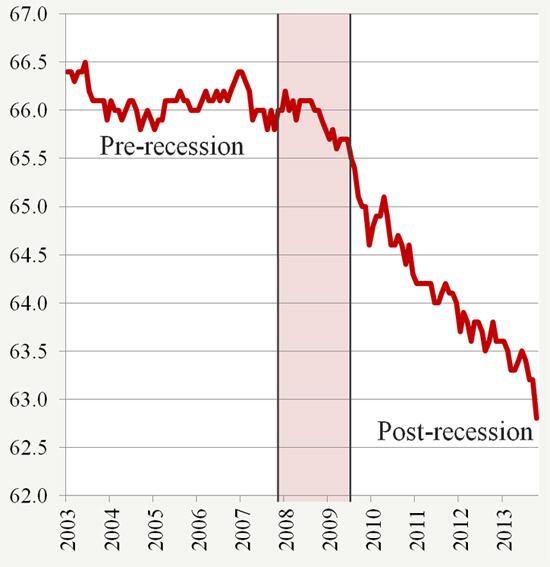
Labor Force Participation down to 62.8%

From the Daily Caller. (H/T Conway)

Excerpt:

The Obama administration’s proposal to raise the minimum wage to $10.10 an hour could result in as many 1,084,000 jobs eliminated from the work force, according to a new study conducted by the Employment Policies Institute (EPI)

“No amount of denial by the president and his political allies — and no number of ‘studies’ published by biased researchers — can change the fact that minimum wage hikes eliminate jobs for low-skill and entry-level employees. Non-partisan economists have agreed on this consensus for decades, and the laws of economics haven’t changed,” Michael Saltsman, research director at EPI, said in a statement.

He offered an alternative to the president’s plan: “Instead of raising small businesses’ labor costs and creating more barriers to entry-level employment, the president and the Senate should focus on policies that help reduce poverty and create jobs.”

The  study was released in the wake of an expected vote on a Senate bill that aims to raise the federal minimum wage from the current $7.25 an hour to $10.10 an hour — a nearly 40 percent increase.

Many Democrats argue that increasing the federal minimum will reduce poverty without having an adverse effect on unemployment.

EPI’s report, which used analysis from economists at Miami and Trinity University, reached a different conclusion.

Researchers used recently updated Census Bureau data from 2012 and 2013 to calculate how each individual state would be impacted by the proposed wage hikes. As a lump sum, Americans would see a loss of at least 360,000 jobs, and perhaps even over one million if hourly wages are increased to $10.10.

The number of job losses would be the most dramatic in large states, such as California and Texas. Economists found that California could lose as many as 100,016 jobs and Texas could see up to 128,617 jobs disappear from its economy.

This article from Investors Business Daily, written by the famous economist Thomas Sowell has more on the effects of raising the minimum wage.

Excerpt:

Switzerland is one of the few modern nations without a minimum-wage law. In 2003, the Economist magazine reported: “Switzerland’s unemployment neared a five-year high of 3.9% in February.”

In February of this year, Switzerland’s unemployment rate was 3.1%. A recent issue of the Economist showed Switzerland’s unemployment rate as 2.1%.

Most Americans today have never seen unemployment rates that low. However, there was a time when there was no federal minimum-wage law in the United States.

The last time was during the Coolidge administration, when the annual unemployment rate went as low as 1.8%. When Hong Kong was a British colony, it had no minimum-wage law. In 1991 its unemployment rate was under 2%.

[…]Most people in the lower income brackets are not an enduring class. Most working people in the bottom 20% in income at a given time do not stay there over time. More of them end up in the top 20% than remain behind in the bottom 20%.

There is nothing mysterious about the fact that most people start off in entry-level jobs that pay much less than they will earn after they get some work experience.

But when minimum-wage levels are set without regard to their initial productivity, young people are disproportionately unemployed — priced out of jobs.

In European welfare states where minimum wages, and mandated job benefits to be paid for by employers, are more generous than in the United States, unemployment rates for younger workers are often 20% or higher, even when there is no recession.

Unemployed young people lose not only the pay they could have earned but, at least equally important, the work experience that would enable them to earn higher rates of pay later on.

Minorities, like young people, can also be priced out of jobs. In the United States, the last year in which the black unemployment rate was lower than the white unemployment rate — 1930 — was also the last year when there was no federal minimum-wage law.

Inflation in the 1940s raised the pay of even unskilled workers above the minimum wage set in 1938. Economically, it was the same as if there were no minimum-wage law by the late 1940s.

In 1948 the unemployment rate of black 16-year-old and 17-year-old males was 9.4%. This was a fraction of what it would become in even the most prosperous years from 1958 on, as the minimum wage was raised repeatedly to keep up with inflation.

A survey of American economists found that 90% of them regarded minimum-wage laws as increasing the rate of unemployment among low-skilled workers.

Harvard University economist Greg Mankiw puts the level of opposition to minimum wage hikes at 79% among professional economists across the ideological spectrum.

Why is the unemployment rate for young people so high?

A few of the policies that are causing the problem are explained in this article from the American Enterprise Institute. I have highlighted the policies that discourage employers in the snippet I excerpted below.

Excerpt:

If Washington is serious about helping this vulnerable population, it should focus on increasing workers’ take home pay and lowering the business employment costs. Conventional wisdom preaches increasing minimum wages. But a far more effective policy would be to simply exempt younger workers and their employers from paying taxes related to their employment.

People in the workforce typically get their start when they are young – beginning with some entry level job where they learn basic job skills, develop effective work habits, and earn a modest wage. This important first step gives them a chance at earning wages and achieving a level of success that facilitates advance up the economic ladder. Work habits and skills are generally learned early in life or unfortunately for too many, not learned at all.

The long term damage caused by this lack of employment is very large. Income mobility has declined. The sad fact is the probability of people at the bottom moving up the income ladder is lower than it was 20 and 30 years ago. Many studies have demonstrated that three factors determine most of the difference between those who start in poverty and stay there and those who don’t – finishing high school; avoiding becoming a teenage parent, and getting a full-time job. Those who do all three have only a 2 percent chance of living in poverty and a 75 percent chance of joining the middle class.

Many economists and social scientists have suggested both demand and supply reasons why youth unemployment is so high. On the demand side, the national safety net – Food Stamps, Earned Income Tax, welfare and subsidy programs of all kinds – substantially reduce the relative benefit of working. In other words, the wage premium for working versus taking advantage of benefit programs on an after-tax basis is simply too small to encourage many people to work.

If a young person enters the work force at the minimum wage, he grosses $7.25 per hour. From this, in a place like Los Angeles, he pays federal and state income taxes and Medicare and Social Security payroll taxes which total $1.11. So, out of the $7.25 earned, he keeps just over $6. If he is single and without children, he won’t qualify for the Earned Income Tax Credit (EITC) or food stamps.

On the supply side, the cost of employing young people is high relative to their economic contribution to potential employers. An entry-level employee costs his employer much more than $7.25. In addition to his wages, the employer also pays Social Security and Medicare taxes, plus unemployment insurance, that add on an average of 92 cents. So today, the new employee costs the business $8.13 per hour, of which the young employee keeps only three-quarters.

This cost will increase further when the Affordable Care Act kicks in. Beginning in 2015, if the employer has more than 50 employees, he will have to provide health insurance for full-time workers or pay a $2,000 fine – which comes to $.96 per hour. That will make an abysmal employment situation even worse.

Overall, public policy ought to be aimed at encouraging businesses to create entry level jobs. Perversely, attempts to increase the minimum wage and institute so-called living wages would do the exact opposite. If government wanted to help create a permanent economic underclass, it would implement exactly the policies that are in place. All of us who want people to enjoy earned success ought to be outraged at these government policies.

This is important, because very often the policies proposed by people on the left are not designed to solve the problem. Thomas Sowell argues that the real purpose of leftist policies is for leftist leaders to feel self-important by getting applause from those who are economically ignorant. They push policies that sound good but that don’t actually work.

The good news is that young people are waking up. According to a Harvard University survey, 57% of young adults now disapprove of Obamacare. Even they are starting to think about what is happening to them. Maybe they can avoid the slavery that awaits them under the Democrat’s massive program of intergenerational theft, but I’m not optimistic. They have really short attention spans, and you don’t learn the fundamentals of economics on Instagram and Pinterest.

Fast-food walk out ignores basic economics: minimum wage hike creates unemployment

Investors Business Daily explains what’s wrong with the plan of fast-food industry workers to strike for higher wages.

Excerpt:

Egged on by unions, fast-food workers plan to strike in dozens of U.S. cities for much higher wages. Sadly, they’re being used to do something that’s not in their own interests.

Sensing the time is ripe, the Service Employees International Union and union-funded front groups are organizing a walkout of workers at fast-food joints in about 100 cities to protest how tough it is to live on the federal minimum wage of $7.25 an hour.

They’d like that nearly doubled to $15 — and not just for fast food, but retailing and other industries too.

Sounds great. But even by the loopy logic of the left, this is economic insanity and would lead to greater misery, fewer jobs and fewer opportunities for all.

That’s not just our opinion. Economists David Neumark and William Wascher, in their comprehensive book “Minimum Wages,” looked at virtually all the scholarly and statistical evidence worldwide, digging up literally dozens of studies.

Their finding: Minimum wage laws almost always result in a “reduction in employment opportunities for low-skilled” employees while limiting “skill acquisition by reducing educational attainment and perhaps training, resulting in lower adult wages and earnings.”

And, they said, it reduces the total amount of human capital — a huge cost to society.

The minimum wage is so devastating that roughly 85% of all economists in a recent survey — from both the left and the right sides of the spectrum — said they think it’s a bad idea.

[…]The idea that working families depend on these jobs is false. Most of those working for minimum wage are young, ages 16 to 24. They live in middle-class homes with above-average household incomes.

And as James Sherk of the Heritage Foundation notes, two-thirds of minimum-wage earners get a raise in their first year. This is how they learn to show up, work hard and get along with others — valuable life skills young people acquire as they begin work and the very things that will make them a success later on.

A higher minimum wage would cost young workers jobs and opportunities. They’d be wise to ignore the unions’ siren song of higher wages for nothing.

From Investors Business Daily, an article by famous economist Thomas Sowell has more on this issue.

Excerpt:

Switzerland is one of the few modern nations without a minimum-wage law. In 2003, the Economist magazine reported: “Switzerland’s unemployment neared a five-year high of 3.9% in February.”

In February of this year, Switzerland’s unemployment rate was 3.1%. A recent issue of the Economist showed Switzerland’s unemployment rate as 2.1%.

Most Americans today have never seen unemployment rates that low. However, there was a time when there was no federal minimum-wage law in the United States.

The last time was during the Coolidge administration, when the annual unemployment rate went as low as 1.8%. When Hong Kong was a British colony, it had no minimum-wage law. In 1991 its unemployment rate was under 2%.

[…]Most people in the lower income brackets are not an enduring class. Most working people in the bottom 20% in income at a given time do not stay there over time. More of them end up in the top 20% than remain behind in the bottom 20%.

There is nothing mysterious about the fact that most people start off in entry-level jobs that pay much less than they will earn after they get some work experience.

But when minimum-wage levels are set without regard to their initial productivity, young people are disproportionately unemployed — priced out of jobs.

In European welfare states where minimum wages, and mandated job benefits to be paid for by employers, are more generous than in the United States, unemployment rates for younger workers are often 20% or higher, even when there is no recession.

Unemployed young people lose not only the pay they could have earned but, at least equally important, the work experience that would enable them to earn higher rates of pay later on.

Minorities, like young people, can also be priced out of jobs. In the United States, the last year in which the black unemployment rate was lower than the white unemployment rate — 1930 — was also the last year when there was no federal minimum-wage law.

Inflation in the 1940s raised the pay of even unskilled workers above the minimum wage set in 1938. Economically, it was the same as if there were no minimum-wage law by the late 1940s.

In 1948 the unemployment rate of black 16-year-old and 17-year-old males was 9.4%. This was a fraction of what it would become in even the most prosperous years from 1958 on, as the minimum wage was raised repeatedly to keep up with inflation.

A survey of American economists found that 90% of them regarded minimum-wage laws as increasing the rate of unemployment among low-skilled workers.

Harvard University economist Greg Mankiw puts the level of opposition to minimum wage hikes at 79% among professional economists across the ideological spectrum.

Learn economics for Christmas

By the way, if you’re looking for a really good drama that shows the business-owner vs union-leader conflict, I really recommend the BBC production of North and South. It’s a beautiful period drama that’s based on a Christian woman’s novel. The author of the book wrote in the time of Charles Dickens, and he even named the book for her. It’s rated 8.7/10 on IMDB. It’s $19.99 on Amazon, although it sometimes goes lower than that! A great way to communicate basic economics to your liberal spouse or significant other – especially on this minimum wage issue. Oh, apparently there is a love story in it, but I didn’t really pay any attention to that part of it, other than to be pleased that there was no sex or nudity at all – not even kissing! Perfect! This DVD is WK-approved. It is also Dina-approved, because she was the one who suggested it to me.

Just to give you an idea of how much I liked it, I tried watching Downton Abbey and stopped after two episodes. It’s boring nonsense. But North and South I rated 9.5/10 and could not stop watching it once I started. There are no wasted scenes, no fluff at all. Everything they did worked to develop the theme of the story. How different it is from the garbage they have in theaters today! The presentation of capitalism is absolutely heroic, and yet the union side is presented sympathetically as well. Of course, if you want to read an economics book instead, then just get Thomas Sowell’s “Basic Economics“. One of my friends (Letitia) is actually reading that now.