
Here’s a very interesting assessment of Barack Obama’s intelligence from the Wall Street Journal. (H/T Melissa)
Excerpt:
When it comes to piloting, Barack Obama seems to think he’s the political equivalent of Charles Lindbergh, Chuck Yeager and—in a “Fly Me to the Moon” sort of way—Nat King Cole rolled into one. “I think I’m a better speech writer than my speech writers,” he reportedly told an aide in 2008. “I know more about policies on any particular issue than my policy directors. And I’ll tell you right now that I’m . . . a better political director than my political director.”
On another occasion—at the 2004 Democratic convention—Mr. Obama explained to a Chicago Tribune reporter that “I’m LeBron, baby. I can play at this level. I got game.”
[…]Then there is Mr. Obama as political tactician. He makes predictions that prove false. He makes promises he cannot honor. He raises expectations he cannot meet. He reneges on commitments made in private. He surrenders positions staked in public. He is absent from issues in which he has a duty to be involved. He is overbearing when he ought to be absent. At the height of the financial panic of 1907, Teddy Roosevelt, who had done much to bring the panic about by inveighing against big business, at least had the good sense to stick to his bear hunt and let J.P. Morgan sort things out. Not so this president, who puts a new twist on an old put-down: Every time he opens his mouth, he subtracts from the sum total of financial capital.
Then there’s his habit of never trimming his sails, much less tacking to the prevailing wind. When Bill Clinton got hammered on health care, he reverted to centrist course and passed welfare reform. When it looked like the Iraq war was going to be lost, George Bush fired Don Rumsfeld and ordered the surge.
Mr. Obama, by contrast, appears to consider himself immune from error. Perhaps this explains why he has now doubled down on Heckuva Job Geithner. It also explains his insulting and politically inept habit of suggesting—whether the issue is health care, or Arab-Israeli peace, or change we can believe in at some point in God’s good time—that the fault always lies in the failure of his audiences to listen attentively. It doesn’t. In politics, a failure of communication is always the fault of the communicator.
Much of the media has spent the past decade obsessing about the malapropisms of George W. Bush, the ignorance of Sarah Palin, and perhaps soon the stupidity of Rick Perry. Nothing is so typical of middling minds than to harp on the intellectual deficiencies of the slightly less smart and considerably more successful.
Obviously, you can’t really measure a person’s intelligence using their statements about their own intelligence in speeches read from a teleprompter. And it’s hard to assess the intelligence of someone who refuses to release any of his university transcripts. The WSJ article is right to imply that a more important way to measure intelligence is by measuring success. And we certainly are capable of looking at raw numbers to measure Obama’s success – like the unemployment rate:
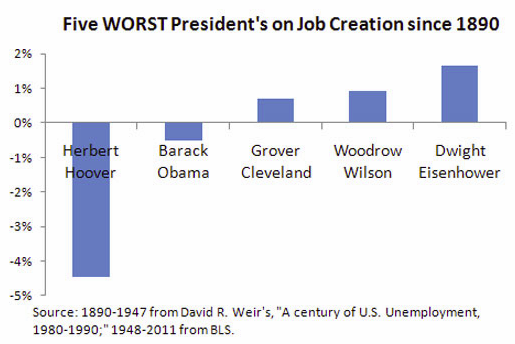
And the budget deficit:

It’s pretty easy to assess someone’s intelligence from those two numbers alone. Obviously, none of these numbers are going to matter to people who get their news by watching Jon Stewart and Stephen Colbert. Obama is the Comedy Channel president. If provoking laughter is your standard for measuring intelligence, then Obama is very smart indeed.
What are Obama’s smart policies?
Who voted for Obama?
I notice that some people in the mainstream media have begun to pick on Texas Governor Rick Perry. It turns out that Perry is also a dastardly Darwin-doubter. (H/T Mary) For the mainstream media, if you believe in traditional Christian views on theology and morality and free market capitalism, it doesn’t matter that you created more jobs than all the other states combined. You’re still “stupid” because you value prayer and doubt materialist explanations of the origins of life.
But the mainstream media thinks that secular leftists are smart regardless of practical measures like job creation. If you are a secular leftist, and you support abortion and same-sex marriage, and you spend 864 billion taxpayer dollars on things like building underground turtle tunnels, and you actually raise the unemployment rate instead of lowering it, then you are are “smart”. Understand?
So who is smart?
Thomas Sowell is smart in the traditional sense of understanding how things work in the real world.
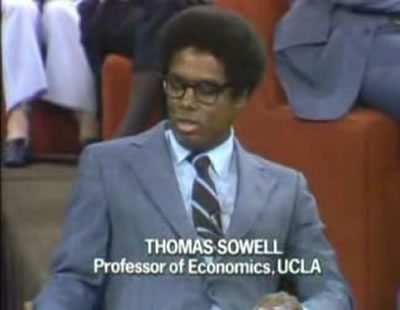
If you want to understand the realities of economic policy, why not pick up some books by an actual economist?
Here are some of his books that I recommend:
- Basic Economics, 4th edition
- Applied Economics, 2nd edition
- Intellectuals and Society
- Economic Facts and Fallacies, 2nd Edition
- A Conflict of Visions, 2nd Edition
- The Housing Boom and Bust, 2nd edition
- Inside American Education
Disclaimer: I have only read the first editions of Applied Economics, Economic Facts and Fallacies, A Conflict of Visions, and The Housing Boom and Bust. And I’ve only read the second edition of Basic Economics.
I have male and female friends who go through multiple Thomas Sowell books per month. It’s impossible to read just one. The first Thomas Sowell book you should read is Intellectuals and Society. That one is an introduction to his thought over a wide range of topics.

