Life News explained what was at stake in the “Little Sisters of the Poor” case decided yesterday by the Supreme Court:
The Little Sisters of the Poor are asking the nation’s highest court to ensure they do not have to comply with Obamacare’s abortion mandate. The mandate compels religious groups to pay for birth control and drugs that may cause abortions.
Without relief, the Little Sisters would face millions of dollars in IRS fines because they cannot comply with the government’s mandate that they give their employees free access to contraception, sterilization, and abortion-inducing drugs.
Religious liberty champion David French writes about the decision in National Review.
Excerpt:
First, the Supreme Court vacated the lower court ruling holding that the Little Sisters had to facilitate access to contraceptives and denied that the mandate substantially burdened their religion. Speaking as a person who’s argued a few cases in courts of appeal — when the court vacates the ruling you’re challenging, that’s a win.
Second, the Supreme Court provided a roadmap for an excellent resolution to the case…
[…]the Court suggested an accommodation that was far more respectful of the Little Sisters’ religious liberty than the challenged Obamacare regulations, and the government will now have extreme difficulty credibly arguing in lower courts that the Supreme Court’s own suggested compromise should be set aside.
Third, this ruling was unanimous. That means the DOJ should be far from confident that it can simply wait out the new presidential election and pursue its original claims with the same hope for success — especially if it spent the intervening years rejecting a compromise that it already seemed to accept.
Fourth, we can’t forget the context. This the second time a unanimous Supreme Court has turned back the Obama administration’s regulatory efforts to restrict religious freedom (Hosanna-Tabor Evangelical Lutheran Church and School v. EEOC was the first), and it represents yet another setback for the administration’s contraception/abortifacient mandate. The Obama administration has pushed hard against religious liberty — on occasion too hard even for the Supreme Court’s more liberal justices.
The case will now go back to the lower courts again, but SCOTUS was clear on what they expect the ruling to be – a compromise that protects religious liberty and achieves the administration’s goal of providing contraception and abortifacient drugs. Unfortunately, that’s what a Democrat administration thinks is a priority.
It’s not a complete victory, but an 8-0 decision should be solid until Trump or Hillary packs the court with pro-abortion liberals. I expect either candidate will do that, since both candidates are “very pro-choice”, and both favor partial-birth abortion.
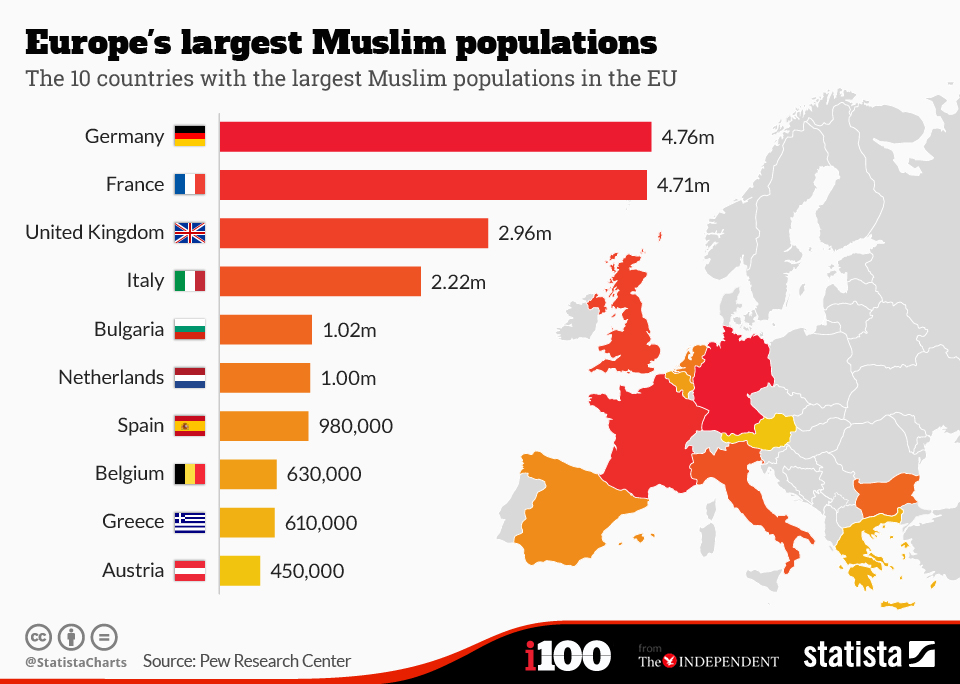
Normally, when people ask me about this question, I go straight to the 2013 Pew Research survey which I blogged about before. But now I have something even better.
Here’s a post from Ben Shapiro at Breitbart News which looks at several polls from several different countries.
Shapiro writes: (links to polls removed)
So, here is the evidence that the enemy we face is not a “tiny minority” of Muslims, let alone a rootless philosophy unconnected to Islam entirely. It’s not just the thousands of westerners now attempting to join ISIS. It’s millions of Muslims who support their general goals, even if they don’t support the group itself.
France. A new, widely-covered poll shows that a full 16% of French people have positive attitudes toward ISIS. That includes 27% of French between the ages of 18-24. Anne-Elizabeth Moutet of Newsweek wrote, “This is the ideology of young French Muslims from immigrant backgrounds…these are the same people who torch synagogues.”
Britain. In 2006, a poll for the Sunday Telegraph found that 40% of British Muslims wanted shariah law in the United Kingdom, and that 20% backed the 7/7 bombers.Another poll from that year showed that 45% of British Muslims said that 9/11 was an American/Israeli conspiracy; that poll showed that one-quarter of British Muslims believed that the 7/7 bombings were justified.
Palestinian Areas. A poll in 2011 showed that 32% of Palestinians supported the brutal murder of five Israeli family members, including a three-month-old baby. In 2009, a poll showed that 78% of Palestinians had positive or mixed feelings about Osama Bin Laden. A 2013 poll showed 40% of Palestinians supporting suicide bombings and attacks against civilians. 89% favored sharia law. Currently, 89% of Palestinians support terror attacks on Israel.
Pakistan. After the killing of Osama Bin Laden, the Gilani Foundation did a poll of Pakistanis and found that 51% of them grieved for the terrorist mastermind, with 44% of them stating that he was a martyr. In 2009, 26% of Pakistanis approved of attacks on US troops in Iraq. That number was 29% for troops in Afghanistan. Overall, 76% of Pakistanis wanted strict shariah law in every Islamic country.
Morocco. A 2009 poll showed that 68% of Moroccans approved of terrorist attacks on US troops in Iraq; 61% backed attacks on American troops in Afghanistan as of 2006. 76% said they wanted strict sharia law in every Islamic country.
Jordan. 72% of Jordanians backed terror attacks against US troops in Iraq as of 2009. In 2010, the terrorist group Hezbollah had a 55% approval rating; Hamas had a 60% approval rating.
Indonesia: In 2009, a poll demonstrated that 26% of Indonesians approved of attacks on US troops in Iraq; 22% backed attacks on American troops in Afghanistan. 65% said they agreed with Al Qaeda on pushing US troops out of the Middle East. 49% said they supported strict sharia law in every Islamic country. 70% of Indonesians blamed 9/11 on the United States, Israel, someone else, or didn’t know. Just 30% said Al Qaeda was responsible.
Egypt. As of 2009, 87% of Egyptians said they agreed with the goals of Al Qaeda in forcing the US to withdraw forces from the Middle East. 65% said they wanted strict sharia law in every Islamic country. As of that same date, 69% of Egyptians said they had either positive or mixed feelings about Osama Bin Laden. In 2010, 95% of Egyptians said it was good that Islam is playing a major role in politics.
United States. A 2013 poll from Pew showed that 13% of American Muslims said that violence against civilians is often, sometimes or rarely justified to defend Islam. A 2011 poll from Pew showed that 21 percent of Muslims are concerned about extremism among Muslim Americans. 19 percent of American Muslims as of 2011 said they were either favorable toward Al Qaeda or didn’t know.
In short, tens of millions of Muslims all over the world sympathize with the goals or tactics of terrorist groups – or both. That support is stronger outside the West, but it is present even in the West. Islamist extremism is not a passing or fading phenomenon – it is shockingly consistent over time. And the West’s attempts to brush off the ideology of fanaticism has been an overwhelming failure.
A more recent poll says that 13% of Syrian refugees support Islamic State:
A first-of-its-kind survey of the hordes of Syrian refugees entering Europe found 13% support the Islamic State. The poll should raise alarms about the risks posed by the resettlement of 10,000 refugees in the U.S.
The poll of 900 Syrian refugees by the Arab Center for Research and Policy Studies also found that another 10% of the displaced Syrians have a lukewarm, but not entirely negative, view of the terror group. That means 23% — or almost 1 in 4 — could be susceptible to ISIS recruitment.
It also means as many 2,500 of the 10,000 Syrian refugees that the Obama administration is resettling inside American cities are potential terrorist threats.
Now contrast those facts with the views of Barack Obama and his allies in the mainstream media.
President Obama told CNN’s Fareed Zakaria that 99.9 percent of Muslims reject radical Islam. He made the comments in response to a question about the White House avoiding using the phrase “Islamic terrorists.”
“You know, I think that the way to understand this is there is an element growing out of Muslim communities in certain parts of the world that have perverted the religion, have embraced a nihilistic, violent, almost medieval interpretation of Islam, and they’re doing damage in a lot of countries around the world,” said Obama.
“But it is absolutely true that I reject a notion that somehow that creates a religious war because the overwhelming majority of Muslims reject that interpretation of Islam. They don’t even recognize it as being Islam, and I think that for us to be successful in fighting this scourge, it’s very important for us to align ourselves with the 99.9 percent of Muslims who are looking for the same thing we’re looking for–order, peace, prosperity.”
So Obama denies all of these surveys, and instead invents a view of the world that is consistent with his feelings. A true man of the secular left.
This gap between belief and reality explains why he is now bringing 200,000 Syrian Muslim refugees into America, keeping Syrian Christian refugees out of America, and generally underestimating Islamic State (ISIS / ISIL) because he cannot believe that radical Islam is anything for us to be concerned about.
Is the government capable of vetting Syrian refugees to find threats?
The administration argues that it’s conducting interviews with Syrians at camps in Turkey, Jordan and Lebanon. But without security forces on the ground in Syria who can verify details, there is no way to back-check a refugee’s story to see if he is telling the truth and is, in fact, not a security threat.
Even when we had people on the ground in Iraq to screen refugees, terrorists got through the safety net.
In 2011, for instance, two Kentucky immigrants who had been resettled as Iraqi refugees were busted for trying to buy stinger missiles for al-Qaida.
It turned out that their fingerprints matched those linked to roadside bombs in Iraq. It was a major red flag that should have barred their entry, but U.S. screeners failed to take note. And the terrorists slipped into the U.S.
The administration’s vetting process for the massive influx of Syrian refugees is completely unreliable, admits the FBI official in charge of such security background checks.
“It’s not even close to being under control,” warned assistant FBI director Michael Steinbach.
We should not be believing the man who promised us that we could keep our doctor, keep our health plans, and that our health insurance premiums would go down $2,500. He is either lying, or he likes to speak on matters where he is not competent to know the truth of the matter.
Back to the wall, Brazil’s biggest socialist manque, Luiz Inacio “Lula” da Silva, has issued a loud call for tax cuts to revive his nation’s moribund economy. Why is it it takes a depression and impending political doom for socialists to recognize the truth about tax relief?
Newly named as cabinet chief by embattled President Dilma Rousseff, the once-popular and much-hailed former socialist president told a press conference Monday that he wanted tax cuts (and more consumer credit) to revive Brazil’s economy. He’s got no support from Dilma’s finance chief, and he won’t improve anything with more consumer credit. But on taxes, you heard right, a heavy-duty socialist had just embraced supply-side economics as a proven means of reviving economic growth.
And no question he believed it: “I am convinced that I can contribute, and it will be possible to change the mood in this country in a few months,” Lula declared. Such a transformation could only come of a near-death experience. Which is about economic situation in Brazil right now.
The country isn’t just experiencing a bad recession. It’s heading for what qualifies as a depression — a third year of economic contraction, with another negative 3.66% of GDP forecast in 2016. Inflation has topped 10% and unemployment is above 18%. Both huge industries and small businesses have gone belly-up. More than half of Brazil’s 95 million consumer credit accounts are delinquent, and sovereign debt has been cut to junk.
Do tax cuts work? Only about every time they are tried. But what about raising taxes – what does that do?
According to the Tax Foundation’s William McBride, citing an aggregation of 26 studies, 26 tax hikes slashed economic growth in all but three instances, while cutting taxes consistently sets the stage for economic growth. McBride found that in one study, a 1% tax hike slashes GDP by 1.3%, while a 1% tax cut yields a 1.4% rise the first year and another 1.8% gain in the second.
McBride also found that the most powerful impact comes from cutting the corporate tax, which mainly affects investment and capital formation, the very thing Lula said Brazil needs. Corporate tax cuts also fuel startups and entrepreneurial activity. Brazil’s corporate income tax is 34%, the 16th highest in the world last year.
The U.S. corporate tax rate is the third highest in the world, 39.1%. And we just got a number for the most recent GDP change in the US economy – 1.4%. The average GDP growth under Obama is much lower than under George W. Bush.
Right now, the nation is probably already in a recession. The BEA’s first estimate of 4Q2015 RGDP growth was only 0.69%, and there is mounting evidence that this will later be revised downward. However, making the wildly optimistic assumption that 2016 RGDP growth will come in at the CBO’s current forecast (2.67%), Obama will be the only U.S. president in history that did not deliver a single year of 3.0%+ economic growth.
Again, assuming 2.67% RGDP growth for 2016, Obama will leave office having produced an average of 1.55% growth. This would place his presidency fourth from the bottom of the list of 39*, above only those of Herbert Hoover (-5.65%), Andrew Johnson (-0.70%) and Theodore Roosevelt (1.41%)
No matter what happens in 2016, Obama’s record on economic growth will be considerably worse than that of the much-maligned George W. Bush. Bush 43 delivered RGDP growth averaging 2.10%, with two years (2004 and 2005) above 3.0%.
You might remember that Bush cut taxes by over $2 trillion, and that created 8.1 million new jobs before the Democrats took over the House and Senate in January of 2007. Obama? Our labor force participation is around a 38-year low. Economic growth creates jobs, and we haven’t had any under the socialist Barack Obama.
Anyway, enough of that. We’re hearing a lot about socialism these days, and how great it is. The young people have been taught by their public school teachers and others about how great socialism is. But is it really? It seems to me that in order to make that decision, we should look at countries like Brazil and Argentina and Venezuela and Cuba – where socialism has been tried – and then decide based on their experiences. We know what creates economic growth, and that’s leaving the money in the hands of the people who earn it.


 WINTERY KNIGHT