Members of the Obama administration have been pointing out how hard it would be to destroy Iran’s nuclear facilities, now that they have been built deep underground and dispersed.
That would have been something to consider during the time when President Obama was taking leisurely and half-hearted measures to create the appearance of trying to stop the Iranian nuclear program, while vigorously warning Israel not to take military action.
Time was never on our side. The risks go up exponentially the longer we wait. When the Iranian nuclear program was just getting started, it could have been destroyed before it became so big, so dispersed, and so deeply dug in underground. Now, if we wait till they actually have nuclear bombs, the same kinds of arguments for inaction will carry even more weight, when the price of an attack on Iran could be the start of a nuclear Holocaust.
Nor should we assume that we can remain safe by throwing Israel to the wolves, once the election is over, as might well happen if Obama is reelected and no longer has any political reasons to pretend to be Israel’s friend.
That kind of cynical miscalculation was made by France back in 1938, when it threw its ally, Czechoslovakia, to the wolves by refusing to defend it against Hitler’s demands, despite the mutual defense treaty between the two countries. Less than two years later, Hitler’s armies were invading France — using, among other things, tanks manufactured in Czechoslovakia.
This was just one of the expedient miscalculations that helped bring on the bloodiest and most destructive war the world has ever known. Dare we repeat such miscalculations in a nuclear age?
At the end of the Second World War, Winston Churchill said, “There never was in all history a war easier to prevent by timely action than the one which has just desolated such great areas of the globe.” It might even have been prevented “without the firing of a single shot,” Churchill said.
Those who do not learn the lessons of history are doomed to repeat them.
Here in California, students just marched on Sacramento in outrage that state-subsidized tuition at the UC and CSU campuses keeps climbing. It is true that per-unit tuition costs are rising, despite even greater exploitation of poorly paid part-time teachers and graduate-student TAs. But the protests are sort of surreal. The California legislature is overwhelmingly Democratic. The governor is a Democrat. The faculties and administrative classes are largely Democratic. Who then, in the students’ minds, have established these supposedly unfair budget priorities?
Sales, income, and gas taxes are still among the highest in the nation (and are proposed to rise even higher) — prompting one of the largest out-of-state exoduses of upper-income brackets in the nation. The state budget is pretty much entirely committed to K–12 education (whose state-by-state comparative test scores in math and science hover between 45th and 49th in the nation), prisons, social services, and public-employee salaries and pensions. Whom, then, can the students be angry at?
Are students angry at public-union salaries and pensions that are among the highest in the nation? Do they think the many highly compensated retired Highway patrol officers have shorted students at UC Davis? Are they mad at the 50,000 illegal aliens in the California prison system that might have siphoned off scholarship funds from CSU Monterey Bay? Or is the rub the influx of hundreds of thousands of children of illegal aliens who require all sorts of language remediation and extra instruction in the public schools, and so might in theory divert library funds from UC Santa Cruz?
Perhaps the students don’t want billions to be committed to high-speed rail that might rob Berkeley of needed funding, or environmental efforts to introduce salmon into the San Joaquin River, in which the $70 million spent so far in studies and surveys might have come from nearby CSU Fresno? Are they mad at state social services, whose medical expenses have skyrocketed to address the health-care needs of millions of illegal aliens, and thus in theory could curb the choice of classes at CSU Stanislaus? Are they angry that some $10–15 billion a year probably leaves the state as remittances to Mexico?
If one cannot blame the wealthy for “not paying their fair share” (the top 1 percent of Californians now pay about 37 percent of all income-tax revenue — and their numbers have decreased by one-third in recent years, as the state has come to rely on the income tax for half its revenue), or Republican majorities in government, who, then, is left to blame?
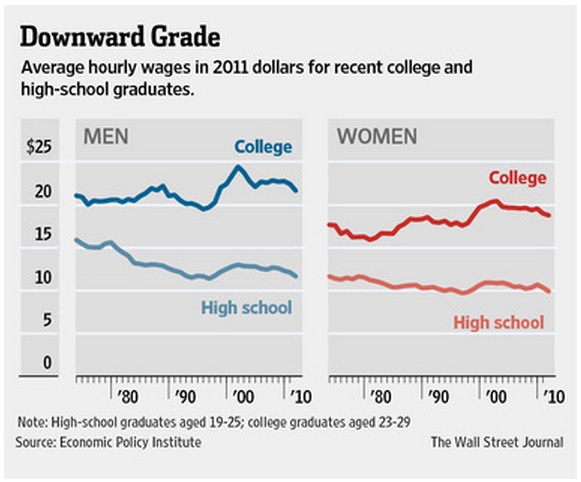
Not only are their tuition costs going UP but their likely salary is going DOWN.
Only 35 percent of students starting a four-year degree program will graduate within four years, and less than 60 percent will graduate within six years.
The U.S. college dropout rate is about 40 percent, the highest college dropout rate in the industrialized world.
Over the past 25 years, the total number of students in college has increased by about 50 percent. But the number of students graduating with degrees in STEM subjects has remained more or less constant.
In 2009, the United States graduated 37,994 students with bachelor’s degrees in computer and information science. That’s not bad, but we graduated more students with computer-science degrees 25 years ago!
Few disciplines have changed as much in recent years as microbiology, but in 2009 we graduated just 2,480 students with bachelor’s degrees in microbiology—about the same number as 25 years ago. Who will solve the problem of antibiotic resistance?
If students aren’t studying science, technology, engineering, and math, what are they studying?
In 2009, the United States graduated 89,140 students in the visual and performing arts, more than in computer science, math, and chemical engineering combined and more than double the number of visual-and-performing-arts graduates in 1985.
Moreover, more than half of all humanities graduates end up in jobs that don’t require college degrees, and those graduates don’t get a big income boost from having gone to college.
I think this is interesting. What exactly are these students paying for?
If there is one thing I learned from my love of Shakespeare, it’s that it is tragic to be the cause of your own downfall because of your own tragic flaw. Right now, there are a bunch of young people who have been totally brainwashed by the unionized public school teachers and professors to have views on economics that are completely opposite to what works in the real world. They keep voting for bigger and bigger government, which creates more and more debt in order to provide their parents with bigger and bigger benefits. They have lots of self-esteem, but very few marketable skills. Eventually, the bill for all the government spending on “helping the poor”, (e.g. – food stamps for millionaires and bailouts for bankrupt green energy firms), comes due, and it’s the students who will be paying the bill. I wonder if they will look as favorably on socialism and global warming alarmism then?
FEBRUARY 4, 2009 – Just months after President Obama’s Energy Secretary said, “Somehow we have to figure out how to boost the price of gasoline to the levels in Europe,” the Obama administration begins “scrapping leases for oil-shale development” and cancels 77 leases for oil and gas production in Utah. Gas is $1.91 a gallon.
MARCH 7, 2009 – ABC News says the White House is closely monitoring the expedited Solyndra loan project even as it was delaying new American energy production that would help make us less dependent on foreign energy. Gas is $1.94 a gallon.
JUNE 27, 2009 – President Obama urges the Senate to adopt House Democrats’ “cap and trade” national energy tax, the same one the president once admitted would cause electricity rates to “necessarily skyrocket.” Then-GOP Leader Boehner later said the bill “would raise electricity prices, increase gasoline prices, and ship American jobs to countries like China and India.” Gas is $2.50 a gallon.
JANUARY 7, 2010 – The Obama administration announces new bureaucratic hurdles to American energy production that Secretary Salazar admitted “could add delays to the leasing and drilling process.” Gas is $2.67 a gallon.
MARCH 31, 2010 – Instead of opening new areas to energy exploration and development, President Obama blocks deep-ocean energy production on 60 percent of America’s Outer Continental Shelf. Gas is $2.80 a gallon.
DECEMBER 1, 2010 –The president re-imposes and expands the moratorium on offshore energy production. Gas is $2.86 a gallon.
JANUARY 2, 2011 – TIME reported that the Obama administration issued the first in a series of regulations on January 2 designed to unilaterally impose a national energy tax. Gas is $3.05 a gallon.
MAY 5, 2011 – The White House issues a formal statement opposing House-passed Restarting American Offshore Leasing Now Act (H.R. 1230) and Putting the Gulf of Mexico Back to Work Act (H.R. 1229), legislation designed to jumpstart American energy production, address rising gas prices, and help create new jobs. Gas is $3.96 a gallon.
JUNE 21, 2011 – The White House opposes the House-passed Jobs & Energy Permitting Act that would unlock an estimated 27 billion barrels of oil and 132 trillion cubic feet of natural gas. Gas is $3.65 a gallon.
NOVEMBER 8, 2011 – The Obama Administration releases a plan for a five-year moratorium on offshore energy production, placing “some of the most promising energy resources in the world off-limits,” according to the House Natural Resources Committee. Gas is $3.42 a gallon.
JANUARY 18, 2012 – President Obama rejects the bipartisan Keystone XL pipeline and the more than 20,000 jobs that would come with it. Gas is $3.39 a gallon, and rising faster and earlier than ever before.