Tag Archives: Atheism

Atheist gets her PhD in astronomy and astrophysics and finds evidence for God

Christianity and the progress of science

Christian apologist Terrell Clemmons tweeted this testimony by Sarah Salviander, a research scientist in astronomy and astrophysics at the prestigious University of Texas at Austin.

Dr. Salviander writes:

I was born in the U.S., but grew up in Canada. My parents were socialists and political activists who thought British Columbia would be a better place for us to live, since it had the only socialist government in North America at the time. My parents were also atheists, though they eschewed that label in favor of “agnostic.” They were kind, loving, and moral, but religion played no part in my life. Instead, my childhood revolved around education, particularly science. I remember how important it was to my parents that my brother and I did well in school.

I just want to point out that I hope that all you Christian parents are taking seriously the obligation to make your kids do well in school, because even if they start out as atheists when they are young, they can still find their way back to God through study, as Sarah did.

She had a bad start, that’s for sure:

I grew up in the 1970s and 1980s, a time when science fiction was enjoying a renaissance, thanks largely to the popularity of Star Wars. I remember how fascinated I was by the original Star Wars trilogy. It had almost nothing to do with science—it’s more properly characterized as space opera—but it got me thinking about space in a big way. I also loved the original Star Trek, which was more science fiction. The stoic and logical character of Mr. Spock was particularly appealing to me. Popular science was also experiencing a renaissance at that time, which had a lot to do with Carl Sagan’s television show, Cosmos, which I adored. The combination of these influences led to such an intense wonder about outer space and the universe, that by the time I was nine years old I knew I would be a space scientist someday.

Canada was already post-Christian by the 1970s, so I grew up with no religion. In retrospect, it’s amazing that for the first 25 years of my life, I met only three people who identified as Christian. My view of Christianity was negative from an early age, and by the time I was in my twenties, I was actively hostile toward Christianity. Looking back, I realized a lot of this was the unconscious absorption of the general hostility toward Christianity that is common in places like Canada and Europe; my hostility certainly wasn’t based on actually knowing anything about Christianity. I had come to believe that Christianity made people weak and foolish; I thought it was philosophically trivial. I was ignorant not only of the Bible, but also of the deep philosophy of Christianity and the scientific discoveries that shed new light on the origins of the universe and life on Earth.

She documents a phase of following Ayn Rand and embracing “Objectivism”, but eventually she rejects it for failing to answer the big questions of life.

More:

I began to focus all of my energy on my studies, and became very dedicated to my physics and math courses. I joined campus clubs, started to make friends, and, for the first time in my life, I was meeting Christians. They weren’t like Objectivists—they were joyous and content. And, they were smart, too. I was astonished to find that my physics professors, whom I admired, were Christian. Their personal example began to have an influence on me, and I found myself growing less hostile to Christianity.

This is why I think it is so important for Christian parents to raise their children to get advanced degrees… either to become professors themselves, or to finance others (e.g. – our own children) to do advanced degrees. It is so important for university students to see Christian professors on campus. And failing that, it’s important that we bring Christian speakers in to debate non-Christian speakers on the important issues. This will not happen unless we recognize how important it is, and then make a plan to achieve it.

More:

I had joined a group in the Center for Astrophysics and Space Sciences (CASS) that was researching evidence for the big bang. The cosmic background radiation—the leftover radiation from the big bang—provides the strongest evidence for the theory, but cosmologists need other, independent lines of evidence to confirm it. My group was studying deuterium abundances in the early universe. Deuterium is an isotope of hydrogen, and its abundance in the early universe is sensitive to the amount of ordinary mass contained in the entire universe. Believe it or not, this one measurement tells us whether the big bang model is correct.

If anyone is interested in how this works, I’ll describe it, but for now I’ll spare you the gruesome details. Suffice it to say that an amazing convergence of physical properties is necessary in order to study deuterium abundances in the early universe, and yet this convergence is exactly what we get. I remember being astounded by this, blown away, completely and utterly awed. It seemed incredible to me that there was a way to find the answer to this question we had about the universe. In fact, it seems that every question we have about the universe is answerable. There’s no reason it has to be this way, and it made me think of Einstein’s observation that the most incomprehensible thing about the world is that it’s comprehensible. I started to sense an underlying order to the universe. Without knowing it, I was awakening to what Psalm 19 tells us so clearly, “The heavens declare the glory of God; the skies proclaim the work of his hands.”

That summer, I’d picked up a copy of The Count of Monte Cristo by Alexandre Dumas and was reading it in my off hours. Previous to this, I’d only known it as an exciting story of revenge, since that’s what the countless movie and TV adaptations always focused on. But it’s more than just a revenge story, it’s a philosophically deep examination of forgiveness and God’s role in giving justice. I was surprised by this, and was starting to realize that the concept of God and religion was not as philosophically trivial as I had thought.

All of this culminated one day, as I was walking across that beautiful La Jolla campus. I stopped in my tracks when it hit me—I believed in God! I was so happy; it was like a weight had been lifted from my heart. I realized that most of the pain I’d experienced in my life was of my own making, but that God had used it to make me wiser and more compassionate. It was a great relief to discover that there was a reason for suffering, and that it was because God was loving and just. God could not be perfectly just unless I—just like everyone else—was made to suffer for the bad things I’d done.

The Count of Monte Cristo is one of my favorite, favorite books as well, and had the same impact on me as it did on her.

OK, that’s enough for this post. Go read the rest, and please share it. This woman is an expert Christian apologist and her life will have an influence. Are you going to be like her? Will you mentor others to be like her? Will you marry someone like her? Will you raise children who are like her (which is my plan)? We really need everyone to pull their weight now, because everywhere you look, the truth of Christianity is under attack.

Positive arguments for Christian theism

Republican governor of Ohio signs bill banning abortions when babies feel pain

I'm Scheming Unborn Baby, and I approve this study
I’m Scheming Unborn Baby, and my sneaky plan worked perfectly! Excellent!

Wow, I’m so shocked and surprised by this – John Kasich is barely a Republican.

Life News reports:

Today, Governor John Kasich signed the Pain-Capable Unborn Child Protection Act (Sub. S.B. 127), landmark legislation which would ban late-term abortions after 20 weeks of pregnancy.  And, citing concerns it would be overturned in court, Kasich vetoed a ban on all abortions after the heart of an unborn baby begins to beat.

“I agree with Ohio Right to Life and other leading, pro-life advocates that SB 127 (a 20-week ban) is the best, most legally sound and sustainable approach to protecting the sanctity of human life,” Kasich said in a statement.

Because the heartbeat-based abortion ban will not likely survive a legal challenge in court, pro-life legislators approved the 20-week abortion ban with the hope of saving as many babies as possible under Roe v. Wade.

Why is this “20-week” legislation important? It’s important because when the national news media cover this law, they are going to put the focus where it belongs – on the unborn baby:

“On behalf of Ohio Right to Life and our statewide members, we sincerely thank Governor Kasich for his unwavering support for the unborn and our pro-life mission. By signing S.B. 127, the 20-week ban, Governor Kasich will save hundreds of unborn lives each year and he positioned the state of Ohio to directly challenge Roe v. Wade,” it told LifeNews. “The 20-week ban was nationally designed to be the vehicle to end abortion in America. It challenges the current national abortion standard and properly moves the legal needle from viability to the baby’s ability to feel pain.”

The incremental approach is realistic, and effective. In no way is the pro-life movement required to settle for this victory, either. They will take down the pro-abortion status quo one piece at a time if they have to.

So what about that premise – unborn babies feeling pain at 20 weeks. Is it really true?

Yes – this is another case where the science is all on the side of the Team Pro-Life:

One leading expert in the field of fetal pain, Dr. Kanwaljeet S. Anand at the University of Tennessee, stated in his expert report commissioned by the U.S. Department of Justice, “It is my opinion that the human fetus possesses the ability to experience pain from 20 weeks of gestation, if not earlier, and the pain perceived by a fetus is possibly more intense than that perceived by term newborns or older children.”

“The neural pathways are present for pain to be experienced quite early by unborn babies,” explains Steven Calvin, M.D., perinatologist, chair of the Program in Human Rights Medicine, University of Minnesota, where he teaches obstetrics.

Indeed, that’s why the line is set at 20 weeks, and now we can ask the Democrats why they want to hurt babies. That’s what this is really about. I have lived a long time on this planet, and I have never, ever hurt a baby. It’s not hard, you just avoid getting drunk, and chose relationships based on reason instead of feelings. Then you will never be in a position where you are tempted to hurt a baby to preserve your own happiness.

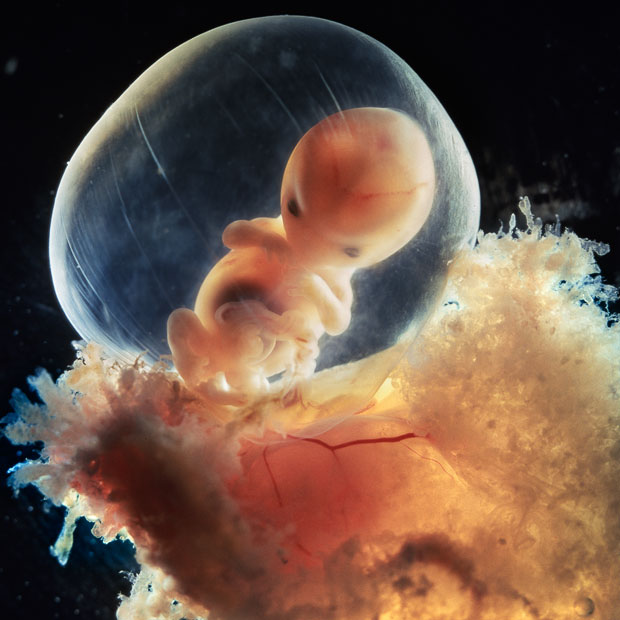
Here’s what a baby is like at 20 weeks:

You are 20 weeks pregnant. (fetal age 18 weeks)

  • Baby now weighs about 11 ounces and is roughly 7 inches long.
  • Baby is 17 cm long crown to rump, and weighs about 310 grams.
  • The baby can hear and recognize the mother’s voice.
  • The mother will probably start feeling the first fetal movements.
  • The toenails and fingernails are growing.
  • The growth of hair on the rest of the body has started.
  • The skin is getting thicker.
  • The heart can now be heard with a stethoscope.

Your baby may react to loud sounds. Baby can actually hear noises outside of the womb. Familiar voices, music, and sounds that baby becomes accustomed to during their development stages often are calming after birth. This is an important time for sensory development since nerve cells serving each of the senses; taste, smell, hearing, sight, and touch are now developing into their specialized area of the brain.

Your baby now weighs about 11 ounces and at roughly 7 inches long they are filling up more and more of the womb. Though still small and fragile, the baby is growing rapidly and could possibly survive if born at this stage.

I understand why Democrats would vote to allow abortions on unborn children at this age. The abortionists make money off of these procedures, and they make more money off of the sale of organs, sometimes cut from babies who are still alive. Some of that money makes it’s way back to the Democrats in the form of political contributions. It’s similar to the way that slavers made money off of slaves… except they didn’t torture the slaves and cut the organs out of them to sell. I guess someone standing in a slave plantation might have said to a slaver “you can’t do that, they can feel pain”. And Republicans are standing outside abortion clinics and saying “you can’t do that, they can feel pain”. But in both cases, the slavers and the abortionists are making money from their barbarism. So it doesn’t make a difference to them whether they unborn can feel pain. The important thing to them is that they are making money. And the money being made by abortionists makes its way into the coffers of Democrat politicians running for re-election. This is working as designed, according to Democrats.

Just for completeness, I must mention that even the radically leftist New York Times admits that unborn children are viable at 22 weeks. Democrats are not in favor of limits on abortion at any number of weeks. And the later the better, as far as they’re concerned – more developed babies have parts that can be sold for big money.

Matt Dillahunty debates David Robertson on atheism, morality and evil

Two horses fight it out, may the best horse win!

OK. So I think it’s safe to say that of all the Christian apologists out there, David Robertson is my least favorite debater. Why? Many reasons, but mostly because he does not bring in evidence, especially scientific evidence. And he seems to make these clever quips like G. K. Chesterton. I like evidence. I would rather that he talk about scientific and historical evidence.

Dina asked me to listen to this debate a while back, between David Robertson and agnostic Matt Dillahunty (he’s not an atheist, he’s just an agnostic). I went in absolutely convinced that Robertson was going to have his ass handed to him by Matt Dillahunty. And I could not have been more wrong.

Here’s the debate posted on YouTube (audio only):

This snarky summary is just a paraphrase from certain parts of the debate, it is not designed for accuracy, but for fun – to make you listen to the debate. Listen to the debate to get the exact words in context.

Summary:

  • Matt Dillahunty: he’s an agnostic who calls himself an atheist
  • David Robertson: he’s from Scotland, could we not get someone better?
  • Robertson opening statement is incredibly weak, as you might expect, he only had two arguments embedded in a long list of nonsense: 1) origin and design of the universe 2) reality of evil requires objective morality

1) Creation/Design:

Robertson: The fact is that matter exists. There are 3 views that could account for this fact: 1) created, 2) eternal, 3) self-generated out of nothing. Option 3) is self-contradictory, 1) requires a Creator, and 2) is falsified by the Big Bang cosmology. So what’s your view?

Dillahunty: You’re trying to get me to say what my view is, but I can just say “I don’t know” and get out of having to take any position on how matter got here.  I can say “I don’t know” to all the scientific evidence for the Big Bang cosmology, too!

2) Evil requires objective morality, requires a moral lawgiver:

Robertson: evil exists, e.g. – the Holocaust. If atheism is true, objective morality is impossible. Richard Dawkins agrees. Therefore, theism is the best explanation for the existence of evil.

Dillahunty: In my opinion, morality means doing what helps people have well-being. And I think that the Holocaust is obviously bad, because it hurts the well-being of the victims.

Robertson: The problem is that on your view, different people decide what well-being is to them. If you were raised in the Social Darwinism of the Nazi regime, you would believe that the Holocaust was the best for the well-being of the society as a whole.

Dillahunty: Isn’t it obvious that killing people is bad for their well-being?

Robertson: Is it bad for the well-being of unborn children to kill them?

Dillahunty: Yes

Robertson: So you’re against abortion, then?

Dillahunty: No

Robertson: So you think that killing the child in the womb is against the well-being of the child, but you’re for that?

Dillahunty: I don’t know! I don’t know!

Then Dillahunty tried to claim Hitler was a Christian:

Dillahunty: here is a quote by Hitler saying that secular schools are bad, and religious schools are good – see, he’s a Christian!

Robertson: when was that said and to whom?

Dillahunty: I don’t know, I don’t know!

Robertson: It was said in 1933, during an election campaign, to Catholic authorities – he was a politician, looking for votes from Catholics so he could become Chancellor.

Good and evil on atheism:

Dillahunty: good actions results in states with more well-being, and evil actions result in states with less well-being.

Brierley: but when the Nazis slaughtered all those people, they believed they were increasing well-being

Dillahunty: But you could demonstrate to them that their action is not going to increase well-being. Survival of the fittest is descriptive of what happens, but it’s not prescriptive.

Robertson: Whose well-being will human beings think about most, if not their own? Do you really think that you can stop people like Charles Manson from being evil by sitting down and trying to prove to them that they are not helping their victim’s well-being?

(A BIT LATER)

Robertson (to Dillahunty): Is it a fact that Dachau (a concentration camp) was morally wrong?

Dillahunty: (literally, not a paraphrase) I DON’T KNOW

My thoughts:

When I listened to this debate, the overwhelming conviction that emerges is that Matt Dillahunty is not someone who forms his worldview based on evidence. His rejection of the Big Bang cosmology with “I don’t know” is just atrocious. His comments about slavery in the Bible and Hitler being a Christian show that his investigations of these issues is far below the level of a responsible adult. His dallying with the Jesus-never-existed view just shows him to be fundamentally anti-intellectual, as even atheist historian Bart Ehrman denies that view. His definition of faith has nothing to do with the Bible, or Christian authorities, or Christian scholars – he invented a definition of faith that allows him to mock Christians as morons. That’s just irresponsible – letting the desire to mock others cause you to distort the definition of a word. When asked to state his positions or respond to specific evidence, his response is very often “I don’t know”. It seems to me that atheism, to him, means not pursuing truth with the aim of grasping it. He wants to keep reality at a safe distance – that’s why he says “I don’t know” so often.

On morality, it’s even worse. It’s not surprising to me that he is pro-abortion and has no opinion about concentration camps being objectively evil. Most atheists are pro-abortion, by the way. When it comes to morality, Dillahunty only has his own personal opinions, and they refer to nothing outside his own mind. (His opinion of morality as related to well-being is utilitarianism – a very problematic view – but moreover, it is his subjective view – he isn’t offering it as any sort of objective moral system that would be prescriptive instead of descriptive. Without an after-life, there is no reason for anyone to care about the moral point of view when it goes against their self-interest, anyway. Atheists use moral language, but their statements are not referring to any objective, prescriptive moral reality. Atheism is materialistic and therefore deterministic – it does not even ground the free will that is needed to make moral choices. Their view is Darwinian survival of the fittest, that’s what emerges from their origins story – and it does not rationally ground morality. The strong kill the weak, if they can. I’ve written before about how difficult it is for atheists to rationally condemn things like slavery, and nothing in Dillahunty’s presentation led me to believe that he had solved that problem.

Anybody can be an intellectually-satisfied atheist with an empty head – it’s knowledge that causes people to conform their beliefs to reality. If one strives to keep one’s head as empty as possible, then of course one can believe anything one wants. I’m glad, speaking as a Christian theist, that I get to follow the evidence wherever it leads. It seems to me that we should do that, rather than decide how we want to live first, and then invent a worldview to justify our desires.

Positive arguments for theism