Tag Archives: Arms

Michele Bachmann: hot photos from her vacation on the beach

Rep. Michele Bachmann

Before we see the hot pictures of Michele Bachmann from her vacation on the beach, let’s take a look at this Wall Street Journal article and find out what sorts of economics books Michele Bachmann reads on the hot beach possibly in her bathing suit.

Ms. Bachmann is best known for her conservative activism on issues like abortion, but what I want to talk about today is economics. When I ask who she reads on the subject, she responds that she admires the late Milton Friedman as well as Thomas Sowell and Walter Williams. “I’m also an Art Laffer fiend—we’re very close,” she adds. “And [Ludwig] von Mises. I love von Mises,” getting excited and rattling off some of his classics like “Human Action” and “Bureaucracy.” “When I go on vacation and I lay on the beach, I bring von Mises.”

Consider Thomas Sowell’s “The Housing Boom and Bust”. Here’s a photo of that book which Michele Bachmann reads on the hot beach possibly in a swimsuit:

Picture of book Michele Bachmann reads on the hot beach
Picture of a book Michele Bachmann reads on the hot beach

The Wall Street Journal explains more:

As we rush from her first-floor digs in the Cannon House Office Building to the House floor so she can vote, I ask for her explanation of the 2008 financial meltdown. “There were a lot of bad actors involved, but it started with the Community Reinvestment Act under Jimmy Carter and then the enhanced amendments that Bill Clinton made to force, in effect, banks to make loans to people who lacked creditworthiness. If you want to come down to a bottom line of ‘How did we get in the mess?’ I think it was a reduction in standards.”

She continues: “Nobody wanted to say, ‘No.’ The implicit and then the explicit guarantees of Fannie Mae and Freddie Mac were sopping up the losses. Being on the Financial Services Committee, I can assure you, all roads lead to Freddie and Fannie.”

Consider Walter Williams’ “Liberty vs the Tyranny of Socialism”. Here’s a picture of that book which Michelle Bachman reads on the hot beach possibly in a bathing suit:
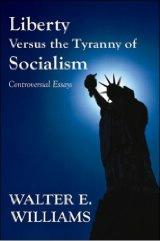
Photo of a book Michelle Bachman reads on the hot beach

The Wall Street Journal explains more:

Ms. Bachmann voted against the Troubled Asset Relief Program (TARP) “both times,” she boasts, and she has no regrets since Congress “just gave the Treasury a $700 billion blank check.” She complains that no one bothered to ask about the constitutionality of these extraordinary interventions into the financial markets. “During a recent hearing I asked Secretary [Timothy] Geithner three times where the constitution authorized the Treasury’s actions, and his response was, ‘Well, Congress passed the law.'”

Insufficient focus on constitutional limits to federal power is a Bachmann pet peeve. “It’s like when you come up to a stop sign and you’re driving. Some people have it in their mind that the stop sign is optional. The Constitution is government’s stop sign. It says, you—the three branches of government—can go so far and no farther. With TARP, the government blew through the Constitutional stop sign and decided ‘Whatever it takes, that’s what we’re going to do.'”

Does this mean she would have favored allowing the banks to fail? “I would have. People think when you have a, quote, ‘bank failure,’ that that is the end of the bank. And it isn’t necessarily. A normal way that the American free market system has worked is that we have a process of unwinding. It’s called bankruptcy. It doesn’t mean, necessarily, that the industry is eclipsed or that it’s gone. Often times, the phoenix rises out of the ashes.”

Consider Milton Friedman’s “Capitalism and Freedom”. Here’s a pic of that book which Michelle Bauchman reads on the hot beach possibly in a bikini:

Pics of a book Michelle Bockman reads on the hot beach
Pics of a book Michelle Bauchman reads on the hot beach

The Wall Street Journal explains more:

“For one, I believe my policies prior to ’08 would have been much different from [President Bush’s]. I wouldn’t have spent so much money,” she says, pointing in particular at the Department of Education and the Medicare prescription drug bill. “I would have advocated for greater reductions in the corporate tax rate and reductions in the capital gains rate—even more so than what the president did.” Mr. Bush cut the capital gains rate to 15% from 20% in 2003.

She’s also no fan of the Federal Reserve’s decade-long policy of flooding the U.S. economy with cheap money. “I love a lowered interest rate like anyone else. But clearly the Fed has had competing goals and objectives. One is the soundness of money and then the other is jobs. The two different objectives are hard to reconcile. What has gotten us into deep trouble and has people so perturbed is the debasing of the currency.”

That’s why, if she were president, she wouldn’t renominate Ben Bernanke as Fed chairman: “I think that it’s very important to demonstrate to the American people that the Federal Reserve will have a new sheriff” to keep the dollar strong and stable.

[…]Ms. Bachmann attributes many of her views, especially on economics, to her middle-class upbringing in 1960s Iowa and Minnesota. She talks with almost religious fervor about the virtues of living frugally, working hard and long hours, and avoiding debt. When she was growing up, she recalls admiringly, Iowa dairy farmers worked from 5 a.m. to 10 p.m.

Her political opponents on the left portray her as a “she-devil,” in her words, a caricature at odds with her life accomplishments. She’s a mother of five, and she and her husband helped raise 23 teenage foster children in their home, as many as four at a time. They succeeded in getting all 23 through high school and later founded a charter school.

Michele Bachman is actually willing to pass a lower corporate tax rate than even Tim Pawlenty’s 15% rate:

If she were to take her shot, she’d run on an economic package reminiscent of Jack Kemp, the late congressman who championed supply-side economics and was the GOP vice presidential nominee in 1996. “In my perfect world,” she explains, “we’d take the 35% corporate tax rate down to nine so that we’re the most competitive in the industrialized world. Zero out capital gains. Zero out the alternative minimum tax. Zero out the death tax.”

The 3.8 million-word U.S. tax code may be irreparable, she says, a view she’s held since working as a tax attorney at the IRS 20 years ago. “I love the FAIR tax. If we were starting over from scratch, I would favor a national sales tax.” But she’s not a sponsor of the FAIR tax bill because she fears that enacting it won’t end the income tax, and “we would end up with a dual tax, a national sales tax and an income tax.”

Her main goal is to get tax rates down with a broad-based income tax that everyone pays and that “gets rid of all the deductions.” A system in which 47% of Americans don’t pay any tax is ruinous for a democracy, she says, “because there is no tie to the government benefits that people demand. I think everyone should have to pay something.”

On the stump she emphasizes an “America-centered energy policy” based on “drilling and mining for our rich resources here.” And she believes that repealing ObamaCare is a precondition to restoring a prosperous economy.

[…]Ms. Bachmann also voted for the Republican Study Committee budget that cuts deeper and faster than even Mr. Ryan would. “We do have an obligation with Social Security and Medicare, and we have to recognize that” for those who are already retired, she says. But after that, it’s Katy bar the door: “Everything else is expendable to bring spending down,” and she’d ax “whole departments” including the Department of Education.

Below are some links to learn more about Michele.

Campaign speeches, interviews and debates

Speeches:

Reactions from her recent debate performance:

Profiles of Michele Bachmann:

And here are some of her media interviews and speeches in the House of Representatives.

You can contribute to her campaign right here. You can be her friend on Facebook here and also here.

This post was linked by:

And tweeted by Kathleen McKinley and Robert Stacy McCain.

Related posts

Thomas Sowell explains how liberal pacifism causes wars

Thomas Sowell

I just finished reading Thomas Sowell’s “Intellectuals and Society” and I really recommend it. I mean – this is the book of the year from 2010. If you have no interest at all in economics and politics, you should definitely buy this book and read it. If you have never read anything about conservative economics and policy, then this is the place to start. It covers a little bit of economics, a little bit of jurisprudence, a little bit of education, a little bit of foreign policy… you name it – it’s in there. And in plain English. Thomas Sowell is my favorite economist, and the economist favored most by all conservatives. I own about a DOZEN of his books. He’s that good.

I wanted to talk to you about what was in chapter 7 “Intellectuals and War” and chapter 8 “Intellectuals and War: Repeating History”. So I searched and searched and found a summary of Sowell’s arguments in those chapters.

Here’s an article from Townhall.

Excerpt:

On the international scene, trying to assuage aggressors’ feelings and look at the world from their point of view has had an even more catastrophic track record. A typical sample of this kind of thinking can be found in a speech to the British Parliament by Prime Minister Neville Chamberlain in 1938: “It has always seemed to me that in dealing with foreign countries we do not give ourselves a chance of success unless we try to understand their mentality, which is not always the same as our own, and it really is astonishing to contemplate how the identically same facts are regarded from two different angles.”

Like our former ambassador from the Carter era, Chamberlain sought to “remove the causes of strife or war.” He wanted “a general settlement of the grievances of the world without war.” In other words, the British prime minister approached Hitler with the attitude of someone negotiating a labor contract, where each side gives a little and everything gets worked out in the end. What Chamberlain did not understand was that all his concessions simply led to new demands from Hitler — and contempt for him by Hitler.

What Winston Churchill understood at the time, and Chamberlain did not, was that Hitler was driven by what Churchill called “currents of hatred so intense as to sear the souls of those who swim upon them.” That was also what drove the men who drove the planes into the World Trade Center.

Pacifists of the 20th century had a lot of blood on their hands for weakening the Western democracies in the face of rising belligerence and military might in aggressor nations like Nazi Germany and imperial Japan. In Britain during the 1930s, Labor Party members of Parliament voted repeatedly against military spending, while Hitler built up the most powerful military machine in Europe. Students at leading British universities signed pledges to refuse to fight in the event of war.

All of this encouraged the Nazis and the Japanese toward war against countries that they knew had greater military potential than their own. Military potential only counts when there is the will to develop it and use it, and the fortitude to continue with a bloody war when it comes. This is what they did not believe the West had. And it was Western pacifists who led them to that belief.

Then as now, pacifism was a “statement” about one’s ideals that paid little attention to actual consequences. At a Labor Party rally where Britain was being urged to disarm “as an example to others,” economist Roy Harrod asked one of the pacifists: “You think our example will cause Hitler and Mussolini to disarm?”

The reply was: “Oh, Roy, have you lost all your idealism?” In other words, the issue was about making a “statement” — that is, posturing on the edge of a volcano, with World War II threatening to erupt at any time. When disarmament advocate George Bernard Shaw was asked what Britons should do if the Nazis crossed the channel into Britain, the playwright replied, “Welcome them as tourists.”

That was explained even more in the book with more examples from history.

Most people think that Thomas Sowell is a libertarian, but he isn’t a full libertarian. He just reports the evidence. If the evidence is pro-war, then he’s pro-war. Ronald Reagan and Margaret Thatcher called this view “peace through strength”. There is only one reason why evil people do not attack – because they think that good people have the firepower tomake them pay dearly for their aggression, and – and this is very important – the will to use it. In the book, Sowell explains how the the left responded to the horror of world war one by undermining the will of the people to fight. They minimized patriotism and heroism, and emphasized charges of “imperialism”, moral equivalence, and lots of sob stories about victims.

Here’s an article that explains it more.

Excerpt:

In France, after the First World War, the teachers’ unions launched a systematic purge of textbooks, in order to promote internationalism and pacifism.

Books that depicted the courage and self-sacrifice of soldiers who had defended France against the German invaders were called “bellicose” books to be banished from the schools.

Textbook publishers caved in to the power of the teachers’ unions, rather than lose a large market for their books. History books were sharply revised to conform to internationalism and pacifism.

The once epic story of the French soldiers’ heroic defense against the German invaders at Verdun, despite the massive casualties suffered by the French, was now transformed into a story of horrible suffering by all soldiers at Verdun— French and German alike.

In short, soldiers once depicted as national heroes were now depicted as victims— and just like victims in other nations’ armies.

[…]France, where pacifism and internationalism were strongest, became a classic example of how much it can matter.

During the First World War, France fought on against the German invaders for four long years, despite having more of its soldiers killed than all the American soldiers killed in all the wars in the history of the United States, put together.

But during the Second World War, France collapsed after just six weeks of fighting and surrendered to Nazi Germany.

At the bitter moment of defeat the head of the French teachers’ union was told, “You are partially responsible for the defeat.”

Charles de Gaulle, Francois Mauriac, and other Frenchmen blamed a lack of national will or general moral decay, for the sudden and humiliating collapse of France in 1940.

At the outset of the invasion, both German and French generals assessed French military forces as more likely to gain victory, and virtually no one expected France to collapse like a house of cards — except Adolf Hitler, who had studied French society instead of French military forces.

Did patriotism matter? It mattered more than superior French tanks and planes.

Everybody wants peace. Everyone – on both sides of the issue. The problem is that one side – the leftists – call their opponents names like “imperialist” and talk “disarmament” and “dialog” as if they have have the answer to peace. That doesn’t work and it has never worked. Pacifism only “works” in the classroom, where naive children are forced to parrot the opinions of their secular leftist teachers who have no expertise in war or history. What has actually worked in history is peace through strength. Strength deters wars, strength deters violence. Strength – and the will to use that strength to restrain evil.

Read this to learn more about the doctrine of peace through strength, and read this to compare terrorist attacks under Bush and under Obama.

A good book to read on this topic is Frank Gaffney’s “War Footing“.

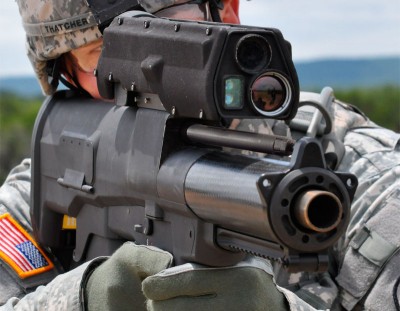
U.S. Army unveils revolutionary XM25 rifle in Afghanistan

HK XM25 25mm GL Airburst Rifle

Here’s the story from Fox News.

Excerpt:

Since the dawn of modern warfare, the best way to stay alive in the face of incoming fire has been to take cover behind a wall. But thanks to a game-changing “revolutionary” rifle, the U.S. Army has made that tactic dead on arrival. Now the enemy can run, but he can’t hide.

After years of development, the U.S. Army has unleashed a new weapon in Afghanistan — the XM25 Counter Defilade Target Engagement System, a high-tech rifle that can be programmed so that its 25-mm. ammunition detonates either in front of or behind a target, meaning it can be fired just above a wall before it explodes and kills the enemy.

It also has a range of roughly 2,300 feet — nearly the length of eight football fields — making it possible to fire at targets well past the range of the rifles and carbines that most soldiers carry today.

Lt. Col. Christopher Lehner, project manager for the semi-automatic, shoulder-fired weapon system for the U.S. Army’s Program Executive Office Soldier, said that the XM25’s capability alone is such a “game-changer” that it’ll lead to new ways of fighting on the battlefield, beginning this month in Afghanistan.

“With this weapon system, we take away cover from [enemy targets] forever,” Lehner told FoxNews.com on Wednesday. “Tactics are going to have to be rewritten. The only thing we can see [enemies] being able to do is run away.”

[…]Lehner said the first XM25s were distributed to combat units in Afghanistan this month. The 12-pound, 29-inch system, which was designed by Minnesota’s Alliant Techsystems, costs up to $35,000 per unit and, while highly sophisticated, is so easy to use that soldiers become proficient within minutes.

“That’s how intuitively easy it is, even though it’s high-tech,” Lehner said. “All a soldier needs to know how to do is laze the target. It decimates anything within its lethal radius.”

Sample usage:

A potential battlefield scenario, according to Army officials, might go something like this:

— A patrol encounters an enemy combatant in a walled Afghan village who fires an AK-47 intermittently from behind cover, exposing himself only for a brief second to fire.

— The patrol’s leader calls for the XM25 gunman, who uses the weapon’s laser range finder to calculate the distance to the target.

— He then uses an incremental button located near the trigger to add 1 meter to the round’s distance, since the enemy is hiding behind a wall.

— The round is fired, and it explodes with a blast comparable to a hand grenade past the wall and above the enemy.

Video:

It is laser-guided. You know how you can’t hit the broad side of a barn with an underslung M203 grenade launcher past a hundred yards? Yeah, well this thing is laser-guided. Laser-guided grenade launcher. Semi-automatic laser-guided grenade launcher!

You don’t even have to do standard 4F military tactics (Find, Fix, Flank, Finish). (Not to be confused with Patricia Churchland’s 4Fs of evolutionary theory – feeding, fighting, fleeing and reproducing). You can just explode a grenade right over their heads!

Made by Heckler & Koch, naturally. By the way, I fired an HK USP9 recently on my annual trip to the firing range. It rocked! Unfortunately they did NOT allow me to try the HK CAWS or the caseless HK G11. Phooey!

You can see more H&K stuff here.

Now if we could only scrap the JSF and revive the F-22, I would be much happier and safer.

Next story: U.S. Navy unveils new electromagnetic rail gun weapon system.