Tag Archives: Apologetics

William Lane Craig on the unexpected applicability of mathematics to nature

Christianity and the progress of science

You might remember that Dr. Craig used a new argument in his debate with Lawrence Krauss in Melbourne, Australia.

My notes on the debate record it thus:

The unreasonable effectiveness of mathematics:

  • The underlying structure of nature is mathematical – mathematics is applicable to nature
  • Mathematical objects can either be abstract objects or useful fiction
  • Either way, there is no reason to expect that nature should be linked to abstract objects or fictions
  • But a divine mind that wants humans to understand nature is a better explanation for what we see

And now Dr. Craig has expanded on it in the Q&A section of his Reasonable Faith web site.

The question:

Dear Dr Craig

Firstly can I thank you for all your work. My faith in Christ has been enormously strengthened through studying your work in apologetics in particular and I have grown in confidence in my Christian witness.

My question relates to numbers and mathematics as a whole. On the Defenders podcast you state that as God is the only self-existent, necessary being, numbers and mathematical objects, whilst being useful, don’t actually exist as these too would exist necessarily and independently of God. If this is the case, how can it be that mathematics is so easily applied to the natural world? Surely if mathematics only existed in our minds, we would expect to see no correlation between it and how the physical world actually is?

Michael

United Kingdom

Excerpt from the answer:

As philosopher of mathematics Mary Leng points out, for the non-theistic realist, the fact that physical reality behaves in line with the dictates of acausal mathematical entities existing beyond space and time is “a happy coincidence” (Mathematics and Reality [Oxford: Oxford University Press, 2010], p. 239). Think about it: If, per impossibile, all the abstract objects in the mathematical realm were to disappear overnight, there would be no effect on the physical world. This is simply to reiterate that abstract objects are causally inert. The idea that realism somehow accounts for the applicability of mathematics “is actually very counterintuitive,” muses Mark Balaguer, a philosopher of mathematics. “The idea here is that in order to believe that the physical world has the nature that empirical science assigns to it, I have to believe that there are causally inert mathematical objects, existing outside of spacetime,” an idea which is inherently implausible (Platonism and Anti-Platonism in Mathematics [New York: Oxford University Press, 1998], p. 136).

By contrast, the theistic realist can argue that God has fashioned the world on the structure of the mathematical objects. This is essentially what Plato believed. The world has mathematical structure as a result.

This argument was also made by mechanical engineering professor Walter Bradley in a lecture he gave on scientific evidence for an intelligent designer. You can read an essay that covers some of the material in that lecture at Leadership University.

Excerpt:

The physical universe is surprising in the simple mathematical form it assumes. All the basic laws of physics and fundamental relationships can be described on one side of one sheet of paper because they are so few in number and so simple in form (see table 1.1).

[…]It has been widely recognized for some time that nature assumes a form that is elegantly described by a relatively small number of simple, mathematical relationships, as previously noted in table 1.1. None of the various proposals presented later in this chapter to explain the complexity of the universe address this issue. Albert Einstein in a letter to a friend expressed his amazement that the universe takes such a form (Einstein 1956), saying:

You find it strange that I consider the comprehensibility of the world to the degree that we may speak of such comprehensibility as a miracle or an eternal mystery. Well, a priori one should expect a chaotic world which cannot be in any way grasped through thought. . . . The kind of order created, for example, by Newton’s theory of gravity is of quite a different kind. Even if the axioms of the theory are posited by a human being, the success of such an enterprise presupposes an order in the objective world of a high degree which one has no a priori right to expect. That is the “miracle” which grows increasingly persuasive with the increasing development of knowledge.

Alexander Polykov (1986), one of the top physicists in Russia, commenting on the mathematical character of the universe, said: “We know that nature is described by the best of all possible mathematics because God created it.” Paul Davies, an astrophysicist from England, says, “The equations of physics have in them incredible simplicity, elegance and beauty. That in itself is sufficient to prove to me that there must be a God who is responsible for these laws and responsible for the universe” (Davies 1984). Successful development of a unified field theory in the future would only add to this remarkable situation, further reducing the number of equations required to describe nature, indicating even further unity and integration in the natural phenomena than have been observed to date.

The whole paper that started this off is called “The Unreasonable Effectiveness of Mathematics”, and it is a must read for advanced Christian defenders. You can read the whole thing here.


Bible study: Was the resurrection body of Jesus spiritual or physical?

Sherlock Holmes and John Watson are going to take a look at the data

So, everyone from left to right accepts the early creed in 1 Corinthians 15:3-7 being dated to 1-3 years after the death of Jesus, even atheists like Crossley, Ludemann and Crossan. The thing is, some people are not sure that the appearances of Jesus to individuals, groups, and skeptics really were physical appearances. They say “well, Paul’s appearance was non-physical, so the other ones must have been, too”.

Let’s take a look.

Here’s a paragraph from my friend Eric Chabot, from his blog Think Apologetics. He explains why Paul’s use of the word “resurrection” to describe what the other witnesses saw means bodily resurrection.

He writes:

If Paul did have a vision then the term “vision” is vague and must be defined. As Licona points out, visions are either objective (i.e., something that is seen without the use of our natural senses) or subjective (i.e., a  product of our minds). The real  problem is with the vision hypothesis is that it doesn’t explain Paul’s use of resurrection to explain what had happened to Jesus.  The two words are used for resurrection in the New Testament “anastasis” (rising up) and “egersis” (waking up), both imply a physical body. Furthermore, the use of the word “opethe” (the Greek word for appeared) shows the Gospel writers did believe that Jesus appeared physically. “There you will see (opethe) him” (Matt. 28:7); “The Lord has risen and has appeared (opethe) to Simon” (Luke 24:24). When they used “opethe” here, it means that He appeared physically to them.

So when Paul gives his list of appearances in 1 Cor. 15, the issues becomes whether the appearance to him is the same as it was to the disciples. There is no doubt the post resurrection body of Jesus (after the ascension) had to be somewhat different than the body the disciples saw. Also, whenever the New Testament mentions the word body, in the context of referring to an individual human being, the Greek word “soma” always refers to a literal, physical body.Greek specialist Robert Gundry says “the consistent and exclusive use of soma for the physical body in anthropological contexts resists dematerialization of the resurrection, whether by idealism or by existentialism.” [9] Furthermore, in N.T. Wright’s  The Resurrection of the Son of God shows that the Greek word for resurrection which is “anastasis” was used by ancient Jews, pagans, and Christians as bodily in nature.

Now, I think my view on this, and I’m not sure if Eric would correct me, is that Paul got an objective but non-physical vision of Jesus. There was something there that everyone else could see and hear, in my view. But in my view Paul’s “veridical” vision was post-ascension, and so non-physical. Paul uses the word resurrection to describe what the other eyewitnesses saw (and he met them at least twice, according to Gal 1 and Gal 2), and that means physical resurrected body.

Eric Chabot writes this in another place:

Acts 9- Paul’s Damascus Road Experience

Here we see whatever happened,  this was after the ascension. Hence, to say Paul saw the exact same Jesus before he ascended is hard to infer from the text. There simply isn’t enough information here.  The Bible says, “they heard” the same voice Paul did ” (Acts 9: 7). But they “did not see anyone ” (Acts 9: 7). Notice  Paul was physically blinded by the brightness of the light.  One way or the other, the experience involved something that was external to Paul. It wasn’t something that was the same thing as a vision that Paul talks about in 2 Cor. 12:1.  Furthermore, the phrase “he let himself be seen’” (ōphthē , aorist passive, ), is the word Paul uses  in 1 Cor. 15:7 to describe of his own resurrection appearance as the other ones in the creed. As Paul Barnett says:

“It is sometimes claimed that the word appeared (ōphthē) means a mystical seeing, as of a vision, and that since this was what Paul “saw” it was what the other apostles “saw.” In other words, after death, Jesus was taken directly to heaven whence he “appeared” to various people, mystically, as it were. This however, is not all the meaning of Paul’s words. First, the word ōphthē, “appeared” is not limited to visionary seeing it is also used for physical seeing. Moreover, the verb raise used in the phrase ‘raised on the third day” is used elsewhere in combination with the words “from the dead” which literally means “from among the corpses.” Thus raised preceding  appeared gives the latter a physical not a mystical meaning. Christ, as “raised from the dead” ….appeared.”  Furthermore, when Paul asks “ Am I not free? Am I not an apostle? Have I not seen Jesus our Lord?”(1 Cor. 9: 1), he is using the ordinary word horan, “to see” for physical sight. If “seeing” the Lord “raised from the dead” qualified others to be apostles, then Paul is, indeed, an apostle. It was no mere subjective vision that arrested Paul en route to Damascus. (8) .

In the end, word studies can’t entirely resolve this issue. We need to remember the etymological fallacy as well. We  would have to look at all the texts that speak of resurrection (including the entire 1 Cor. 15 chapter in their entire context as well as the anthropology of the New Testament. We also need to study the resurrection in light of the Second Temple Jewish period. See our reading list here for some resources that may help.

But conservative ancient historian Gary Habermas seems to think that Paul got the physical body as well.

He says:

Now, I said before in 1 Corinthians 15, Paul could have chosen to only use the word pneuma. He doesn’t. He does say “spiritual,” but he’s got an adjective there. He also says, soma, “body.” What did Paul mean?

Philippians Chapter 3. It’s a short chapter. There are 21 verses, but Paul says three things in one chapter that indicate he’s talking about a physical resurrection. In the opening verses he says, “I was a Hebrew of the Hebrews” and “as touching the law,” he says, “I was a Pharisee.” Now, it’s very well known that the Pharisee believed in a bodily resurrection. In fact, according to Acts 23, as Paul was being taken captive by the Romans to prevent his being killed, he shouted out to the group of people and said, “Why are you taking me? Because I believe in the resurrec­tion of the dead?” He meant a literal resurrection.
When the Pharisees heard that, they said there’s nothing wrong with this guy. But the Sadducees [who didn’t believe in the Resurrection] didn’t like it. So as a Pharisee, he’s agreeing with the Pharisees.
So, the first evidence is from Philippians 3. As a Pharisee, Paul believes in a physical resur­rection.
Secondly, in verse 11 he says, “That I may attain the resurrection of the dead.” Now, the normal Greek word for resurrection is anastasis, but in this passage, Philippians 3:11, he puts a prefix on there, ek anastasis. Ekanastasis, according to all Greek scholars that I know of, is translated in this passage: “The out resurrection from among the dead.” Paul said, “I want to attain the out resurrection.”
Now, to a Jew, “out resurrection” means “what goes down is what comes up.” You come out from death. And then just a few verses later, Philippians 3:20,21, he said, “From Heaven, we look for Jesus who will change our vile soma (body) to be like unto His glorious soma (or body),” when he should have said pneuma, according to this other view.
So he’s a Pharisee who believes in a physical resurrection. Ek anastasis—“resurrection from out among the dead ones.”
Thirdly, Paul says, “He Jesus will change my body to be like His body.”

So right there in Philippians 3 alone, I think the picture of Jesus being some wispy spirit that appeared to him on the road to Damascus doesn’t fit Paul’s own data.

Yes, that’s why Philippians is my favorite book. You can get so much useful theology out of it. Something about the resurrection in Phil 3, something about Jesus’ divinity in Phil 2, and loads of practical advice on stewardship, charity, fellowship, endurance and practical love for others throughout. Some of it takes a little digging, but that’s what commentaries are for, am I right? But I digress.

If you want to read something a little more challenging, I found a paper from the Evangelical Theological Society (ETS) from their journal, where it talks more about soma and anastasis. If you want a bit of a challenge, download the PDF and read it. It’s by Kirk R. MacGregor and the title is “1 Corinthians 15:3B–6A, 7 And The Bodily Resurrection Of Jesus”.

Cambridge University professor Simon Gathercole lectures on geography in the Bible

Investigation in progress

BeThinking posted a new lecture featuring Dr. Simon Gathercole.

Here’s the speaker bio:

Dr Simon Gathercole is Senior Lecturer in New Testament Studies and Fellow of Fitzwilliam College, at the University of Cambridge. He is particularly fascinated by the connections between the New Testament and its contemporary literature.

Summary:

Simon Gathercole shows how the geographical information in the New Testament Gospels demonstrates their historical reliability and their basis in eyewitness sources. The illustrated lecture lasts about 60 minutes and is followed by about 20 minutes of Q&A.

BeThinking has a PDF containing all the slides used in the lecture.

The lecture is here:

Topics:

  • Detailed geography is difficult to fake, especially when it is far into the past
  • Bible authors would have to rely on eyewitness testimony if they wanted to get geographic details right
  • You can even cross-reference the geographic details mentioned in the New Testament with extra-Biblical sources of that time
  • Cities mentioned in the Bible are mentioned in other sources
  • Locations that are mentioned in Josephus, a Jewish historian
  • Locations that are mentioned in the Rabbis
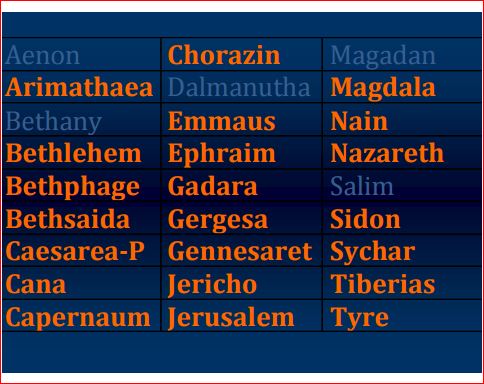
  • 22 of 27 places mentioned in the gospels are attested
  • If you compare the gospels with Josephus they are as good

Example slide – he shows where these cities in orange are mentioned outside the Bible:

At the end of the lecture 22 out of 27 cities are attested in other sources

This lecture caught my eye because it was all about connecting the Bible to evidence outside the Bible. I like evidence. You should give it a listen.