
Tag Archives: Aliens

Is Kepler-452b an Earth-like planet? Does it support life?

Apologetics and the progress of science

Previously, I blogged about a few of the minimum requirements that a planet must satisfy in order to support complex life.

Here they are:

  • a solar system with a single massive Sun than can serve as a long-lived, stable source of energy
  • a terrestrial planet (non-gaseous)
  • the planet must be the right distance from the sun in order to preserve liquid water at the surface – if it’s too close, the water is burnt off in a runaway greenhouse effect, if it’s too far, the water is permanently frozen in a runaway glaciation
  • the planet has to be far enough from the star to avoid tidal locking and solar flares
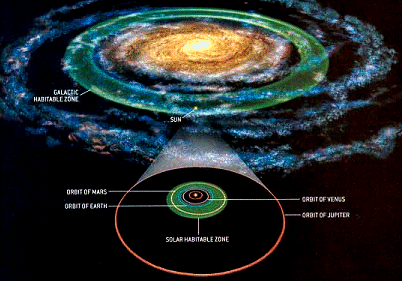
  • the solar system must be placed at the right place in the galaxy – not too near dangerous radiation, but close enough to other stars to be able to absorb heavy elements after neighboring stars die
  • a moon of sufficient mass to stabilize the tilt of the planet’s rotation
  • plate tectonics
  • an oxygen-rich atmosphere
  • a sweeper planet to deflect comets, etc.
  • planetary neighbors must have non-eccentric orbits
  • planet mass must be enough to retain an atmosphere, but not so massive to cause a greenhouse effect

Now what happens if we disregard all of those characteristics, and just classify an Earth-like planet as one which is the same size and receives the same amount of radiation from its star? Well, then you end up labeling a whole bunch of planets as “Earth-like” that really don’t permit life.

Here’s an article from The Conversation which talks about a recent case of science fiction trumping science facts. (H/T JoeCoder)

Excerpt:

NASA’s announcement of the discovery of a new extrasolar planet has been met with a lot of excitement. But the truth is that it is impossible to judge whether it is similar to Earth with the few parameters we have – it might just as well resemble Venus, or something entirely different.

The planet, Kepler-452b, was detected by the Kepler telescope, which looks for small dips in a star’s brightness as planets pass across its surface. It is a method that measures the planet’s size, but not its mass. Conditions on Kepler-452b are therefore entirely estimated from just two data points: the planet’s size and the radiation it receives from its star.

Size and radiation from its star? That’s all?

More:

Kepler-452b was found to be 60% larger than the Earth. It orbits a sun-like star once every 384.84 days. As a result, the planet receives a similar amount of radiation as we do from the sun; just 10% higher. This puts the Kepler-452b in the so-called “habitable zone”; a term that sounds excitingly promising for life, but is actually misleading.

The habitable zone is the region around a star where liquid water could exist on a suitable planet’s surface. The key word is “suitable”. A gas-planet like Neptune in the habitable zone would clearly not host oceans since it has no surface. The habitable zone is best considered as a way of narrowing down candidates for investigation in future missions.

What about plate tectonics – does it have that?

Kepler-452b’s radius puts it on the brink of the divide between a rocky planet and a small Neptune. In the research paper that announced the discovery, the authors put the probability of the planet having a rocky surface about 50%-60%, so it is by no means sure.

Rocky planets like the Earth are made from iron, silicon, magnesium and carbon. While these ingredients are expected to be similar in other planetary systems, their relative quantities may be quite different. Variations would produce alternative planet interiors with a completely different geology.

For example, a planet made mostly out of carbon could have mantles made of diamond, meaning they would not move easily. This would bring plate tectonics to a screeching halt. Similarly, magnesium-rich planets may have thick crusts that are resilient to fractures. Both results would limit volcano activity that is thought to be essential for sustaining a long lasting atmosphere.

What about retaining the right kind of atmosphere, which depends on the mass of the planet. Does it have that?

If Kepler-452b nevertheless has a similar composition to Earth, we run into another problem: gravity. Based on an Earth-like density, Kepler-452b would be five times more massive than our planet.

This would correspond to a stronger gravitational pull, capable of drawing in a thick atmosphere to create a potential runaway greenhouse effect, which means that the planet’s temperature continues to climb. This could be especially problematic as the increasing energy from its ageing sun is likely to be heating up the surface. Any water present on the planet’s surface would then boil away, leaving a super-Venus, rather than a super-Earth.

You might remember that “retain atmosphere” requirement from the lecture by Walter Bradley that I posted with a summary a few days ago.

What about having a Jupiter-sized sweeper planet – does it have that?

Another problem is that Kepler-452b is alone. As far as we know, there are no other planets in the same system. This is an issue because it was most likely our giant gas planets that helped direct water to Earth.

At our position from the sun, the dust grains that came together to form the Earth were too warm to contain ice. Instead, they produced a dry planet that later had its water most likely delivered by icy meteorites. These frozen seas formed in the colder outer solar system and were kicked towards Earth by Jupiter’s huge gravitational tug. No Jupiter analogue for Kepler-452b might mean no water and therefore, no recognisable life.

What about having a magnetic field – does it have that?

All these possibilities mean that even a planet exactly the same size as Earth, orbiting a star identical to our sun on an orbit that takes exactly one year might still be an utterly alien world. Conditions on a planet’s surface are dictated by a myriad of factors – including atmosphere, magnetic fields and planet interactions, which we currently have no way of measuring.

You know, after the whole global warming hoax, you would think that NASA would have learned their lesson about sensationalizing wild-assed guesses in order to scare up more research money from gullible taxpayers who watch too much Star Trek and Star Wars.

The best answer to this is for parents to make sure that their kids are learning the facts about astrobiology from books like “The Privileged Planet” and “Rare Earth”, where the full list of requirements for a life-supporting planet will be found. Pity that we can’t rely on taxpayer-funded public schools to do that for us, because they are too busy pushing Planned Parenthood’s sex education curriculum and global warming fears, instead of real science and engineering.
Is silicon-based life a possible alternative for carbon-based life?

In a recent debate, atheist philosopher Alex Rosenberg responded to the cosmic fine-tuning argument presented by William Lane Craig by asserting that complex life could be other than it is. He specifically mentioned silicon-based life.

Let’s see what scientists think of his speculation, using this article from Scientific American.

Excerpt:

Group IV of the Periodic Table of the Elements contains carbon (C), silicon (Si) and several heavy metals. Carbon, of course, is the building block of life as we know it. So is it possible that a planet exists in some other solar system where silicon substitutes for carbon? Several science fiction stories feature silicon-based life-forms–sentient crystals, gruesome golden grains of sand and even a creature whose spoor or scat was bricks of silica left behind. The novellas are good reading, but there are a few problems with the chemistry.

Indeed, carbon and silicon share many characteristics. Each has a so-called valence of four–meaning that individual atoms make four bonds with other elements in forming chemical compounds. Each element bonds to oxygen. Each forms long chains, called polymers, in which it alternates with oxygen. In the simplest case, carbon yields a polymer called poly-acetal, a plastic used in synthetic fibers and equipment. Silicon yields polymeric silicones, which we use to waterproof cloth or lubricate metal and plastic parts.

But when carbon oxidizes–or unites with oxygen say, during burning–it becomes the gas carbon dioxide; silicon oxidizes to the solid silicon dioxide, called silica. The fact that silicon oxidizes to a solid is one basic reason as to why it cannot support life. Silica, or sand is a solid because silicon likes oxygen all too well, and the silicon dioxide forms a lattice in which one silicon atom is surrounded by four oxygen atoms. Silicate compounds that have SiO4-4 units also exist in such minerals as feldspars, micas, zeolites or talcs. And these solid systems pose disposal problems for a living system.

So, first of all, it makes SAND. Second of all, it is so attracted to oxygen that it can’t easily join to make any other polymers that could be used in the chemistry of the minimal functions of a living system.

More:

Also consider that a life-form needs some way to collect, store and utilize energy. The energy must come from the environment. Once absorbed or ingested, the energy must be released exactly where and when it is needed. Otherwise, all of the energy might liberate its heat at once, incinerating the life-form. In a carbon-based world, the basic storage element is a carbohydrate having the formula Cx(HOH)y. This carbohydrate oxidizes to water and carbon dioxide, which are then exchanged with the air; the carbons are connected by single bonds into a chain, a process called catenation. A carbon-based life-form “burns” this fuel in controlled steps using speed regulators called enzymes.

These large, complicated molecules do their job with great precision only because they have a property called “handedness.” When any one enzyme “mates” with compounds it is helping to react, the two molecular shapes fit together like a lock and key, or a shake of hands. In fact, many carbon-based molecules take advantage of right and left-hand forms. For instance, nature chose the same stable six-carbon carbohydrate to store energy both in our livers (in the form of the polymer called glycogen) and in trees (in the form of the polymer cellulose).

Glycogen and cellulose differ mainly in the handedness of a single carbon atom, which forms when the carbohydrate polymerizes, or forms a chain. Cellulose has the most stable form of the two possibilities; glycogen is the next most stable. Because humans don’t have enzymes to break cellulose down into its basic carbohydrate, we cannot utilize it as food. But many lower life-forms, such as bacteria, can.

In short, handedness is the characteristic that provides a variety of biomolecules with their ability to recognize and regulate sundry biological processes. And silicon doesn’t form many compounds having handedness. Thus, it would be difficult for a silicon-based life-form to achieve all of the wonderful regulating and recognition functions that carbon-based enzymes perform for us.

The troubling thing I find about atheists is that they seem to be under the impression that an alternative speculative explanation is a refutation of an argument that is based in evidence.

So it goes like this:

  • origin of the universe? I can speculate about a naturalistic alternative cosmology which is falsified by observations
  • cosmic fine-tuning? I can speculate about an untestable multiverse
  • origin of life? I can speculate about unobservable aliens who seeded the Earth with life
  • Cambrian explosion? I can speculate about intermediary fossils that have not yet been discovered
  • habitability? I can speculate that habitable planets exist just outside the boundary of the observable universe
  • resurrection of Jesus? I can speculate that Jesus had an unknown, identical twin brother who showed up when he died and took his place

I think that if we are going to make a worldview, we should ground it in the evidence we have today. We should not have faith in speculative theories that we heard about on Star Trek. Seriously.

New study: gamma ray bursts make life impossible in 90% of galaxies

Galactic Habitable Zone

When you argue for theism from science, you typically use arguments like these:

  • the origin of the universe from nothing (the Big Bang)
  • the fine-tuning of cosmic constants and quantities
  • the origin of the first living cell
  • the sudden origin of animal phyla in the Cambrian explosion
  • the fine-tuning of the galaxy for complex, embodied mind
  • the fine-tuning of the solar system for complex, embodied mind
  • the fine-tuning of the planet (and moon)  for complex, embodied mind

This is a peer-reviewed article from Science, one of the most prestigious peer-reviewed journals. It speaks to the fine-tuning of the galaxy for life.

The article says:

Of the estimated 100 billion galaxies in the observable universe, only one in 10 can support complex life like that on Earth, a pair of astrophysicists argues. Everywhere else, stellar explosions known as gamma ray bursts would regularly wipe out any life forms more elaborate than microbes. The detonations also kept the universe lifeless for billions of years after the big bang, the researchers say.

[…]Astrophysicists once thought gamma ray bursts would be most common in regions of galaxies where stars are forming rapidly from gas clouds. But recent data show that the picture is more complex: Long bursts occur mainly in star-forming regions with relatively low levels of elements heavier than hydrogen and helium—low in “metallicity,” in astronomers’ jargon.

Using the average metallicity and the rough distribution of stars in our Milky Way galaxy, Piran and Jimenez estimate the rates for long and short bursts across the galaxy. They find that the more-energetic long bursts are the real killers and that the chance Earth has been exposed to a lethal blast in the past billion years is about 50%. Some astrophysicists have suggested a gamma ray burst may have caused the Ordovician extinction, a global cataclysm about 450 million years ago that wiped out 80% of Earth’s species, Piran notes.

The researchers then estimate how badly a planet would get fried in different parts of the galaxy. The sheer density of stars in the middle of the galaxy ensures that planets within about 6500 light-years of the galactic center have a greater than 95% chance of having suffered a lethal gamma ray blast in the last billion years, they find. Generally, they conclude, life is possible only in the outer regions of large galaxies. (Our own solar system is about 27,000 light-years from the center.)

Things are even bleaker in other galaxies, the researchers report. Compared with the Milky Way, most galaxies are small and low in metallicity. As a result, 90% of them should have too many long gamma ray bursts to sustain life, they argue. What’s more, for about 5 billion years after the big bang, all galaxies were like that, so long gamma ray bursts would have made life impossible anywhere.

But are 90% of the galaxies barren? That may be going too far, Thomas says. The radiation exposures Piran and Jimenez talk about would do great damage, but they likely wouldn’t snuff out every microbe, he contends. “Completely wiping out life?” he says. “Maybe not.” But Piran says the real issue is the existence of life with the potential for intelligence. “It’s almost certain that bacteria and lower forms of life could survive such an event,” he acknowledges. “But [for more complex life] it would be like hitting a reset button. You’d have to start over from scratch.”

The analysis could have practical implications for the search for life on other planets, Piran says. For decades, scientists with the SETI Institute in Mountain View, California, have used radio telescopes to search for signals from intelligent life on planets around distant stars. But SETI researchers are looking mostly toward the center of the Milky Way, where the stars are more abundant, Piran says. That’s precisely where gamma ray bursts may make intelligent life impossible, he says: “We are saying maybe you should look in the exact opposite direction.”

You need to be able to pick up enough heavy elements from surrounding supernovae to make a metal-rich star, but you have to be far enough away from other stars to avoid getting blasted with gamma rays. The metal-rich star is needed to be able to support the circumstellar habitable zone, which is the zone where liquid water exists on the planet’s surface.

It’s important to understand that this factor in the study just a few of the things you need in order to get a planet that supports life. The more factors you add, the more unexpected complex, embodied life of any kind becomes.

Here are a few of the more well-known ones:

  • a solar system with a single massive Sun than can serve as a long-lived, stable source of energy
  • a terrestrial planet (non-gaseous)
  • the planet must be the right distance from the sun in order to preserve liquid water at the surface – if it’s too close, the water is burnt off in a runaway greenhouse effect, if it’s too far, the water is permanently frozen in a runaway glaciation
  • the solar system must be placed at the right place in the galaxy – not too near dangerous radiation, but close enough to other stars to be able to absorb heavy elements after neighboring stars die
  • a moon of sufficient mass to stabilize the tilt of the planet’s rotation
  • plate tectonics
  • an oxygen-rich atmosphere
  • a sweeper planet to deflect comets, etc.
  • planetary neighbors must have non-eccentric orbits

There’s a good video on the galactic habitable zone for you to watch right here:

It takes a lot to make just one planet that can support complex, embodied life of any kind.