
Tag Archives: Abstinence

Study: women who have fewer premarital sex partners have lower risk of divorce

Man helping a woman with proper handgun marksmanship

Consider this article from Family Studies that talks about how the number of pre-marital sex partners that a woman has increases her risk of divorce.

It says:

American sexual behavior is much different than it used to be. Today, most Americans think premarital sex is okay, and will have three or more sexual partners before marrying. What, if anything, does premarital sex have to do with marital stability?

This research brief shows that the relationship between divorce and the number of sexual partners women have prior to marriage is complex. I explore this relationship using data from the three most recent waves of the National Survey of Family Growth (NSFG) collected in 2002, 2006-2010, and 2011-2013. For women marrying since the start of the new millennium:

  • Women with 10 or more partners were the most likely to divorce, but this only became true in recent years;
  • Women with 3-9 partners were less likely to divorce than women with 2 partners; and,
  • Women with 0-1 partners were the least likely to divorce.

Earlier research found that having multiple sex partners prior to marriage could lead to less happy marriages, and often increased the odds of divorce.

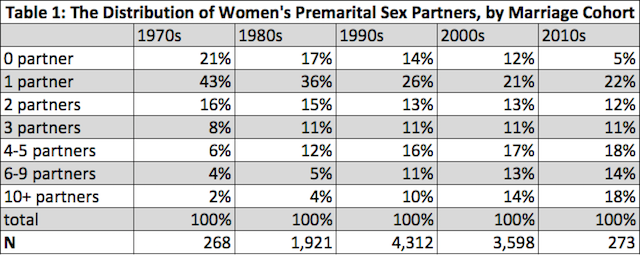
[…]Even more noteworthy has been the decline in the proportion of women who get married having had only one sex partner (in most cases, their future husbands). Forty-three percent of women had just one premarital sex partner in the 1970s.

[…]By the 2010s, only 5 percent of new brides were virgins. At the other end of the distribution, the number of future wives who had ten or more sex partners increased from 2 percent in the 1970s to 14 percent in the 2000s, and then to 18 percent in the 2010s. Overall, American women are far more likely to have had multiple premarital sex partners in recent years (unfortunately, the NSFG doesn’t have full data on men’s premarital sexual behavior, and in any event they recall their own marital histories less reliably than do women).

Here’s the change:
Women have freely chosen to dismiss the Bible and the moral law

And the problem with this, of course, is that more premarital sex partners means a higher risk of divorce:
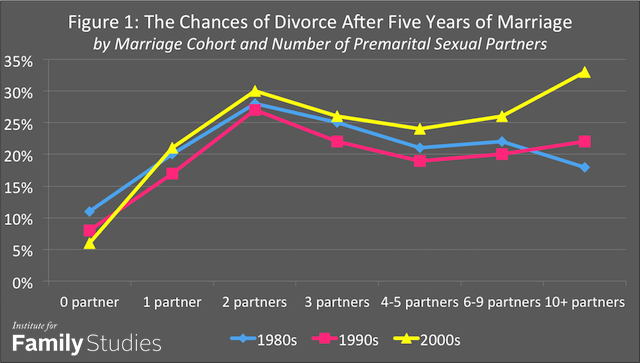
Even one non-husband premarital sex partner raises risk of divorce

Why is the 2-partner number so high?

In most cases, a woman’s two premarital sex partners include her future husband and one other man. That second sex partner is first-hand proof of a sexual alternative to one’s husband. These sexual experiences convince women that sex outside of wedlock is indeed a possibility. The man involved was likely to have become a partner in the course of a serious relationship—women inclined to hook up will have had more than two premarital partners—thereby emphasizing the seriousness of the alternative.

The Christian Post had an article about some recent numbers from the Centers for Disease Control about virgins.

Excerpt:

A new Centers for Disease Control study examines teenage health behaviors in connection to their self-reported sexual activity and shows those who remain abstinent are much healthier on many fronts than their sexually active peers.

The report, titled “Sexual Identity, Sexual Contacts, and Health-Related Behaviors Among Students in Grades 9-12, United States and Selected Sites,” showcased the results from a 2015 survey that monitored several categories of health-related behaviors like tobacco usage, drug and alcohol use, sexual habits, unhealthy dietary behaviors, and behaviors that contribute to unintentional injuries and violence.

The report concludes “that students who had no sexual contact have a much lower prevalance of most health-risk behaviors compared with students” who had sexual contact.

The article quotes Dr. Jennifer Roback Morse, who I have featured on this blog many times:

In a Monday interview with The Christian Post, Jennifer Roback Morse, founder and president of the Ruth Institute, said, “this study is remarkable because it asks questions and reports the answers, rather than avoiding questions or assuming answers.”

As Glenn Stanton noted last week in The Federalist, the results from those questions and answers are remarkable.

With regard to smoking, teenage virgins are 3,300 percent less likely to smoke daily than their peers who are sexually involved with someone of the opposite sex, Stanton computed from the report’s data. Teen virgins are 9,500 percent less likely to smoke daily than their peers who are sexually involved with someone of the same sex or in a bisexual relationship, he added. Chaste young people are also extremely less likely to use indoor tanning beds, binge drink, smoke marijuana, ride in cars as passengers with a drunk driver, and get into physical fights than their sexually active peers. Abstinent youth are also more likely to get a solid eight hours of sleep every night and eat breakfast daily.

[…]The CDC report also included findings from 25 state surveys, and 19 large, urban school district surveys conducted among students in grades 9–12 which took place between December of 2014 and September of 2015.

Now, many pro traditional marriage people will tell young men “feminism and the sexual revolution change nothing about a woman’s suitability for marriage, so go out there and get married to these women anyway”. In my experience, no one is telling women NOT to follow their hearts, and explaining to them the harm that they do by allowing their feelings to determine who they will engage in relationships.

I would like to see women make better decisions with men before they marry, rather than be influenced by their peers and culture to give themselves to men who are not marriage-minded. Maybe a little skepticism should be shown to “follow your heart”? Women need to understand what they are losing when they choose to have premarital sex.

In my group of friends, the men are aware of the Biblical prohibition on premarital sex. My friends know about the research on marriage, and what it takes to make a marriage work. We don’t follow our hearts, because we do what we know will work to achieve the results we want. We don’t listen to the culture, and we don’t listen to radical feminists. Men generally take an engineering approach to marriage – we want to know what the best practices and tradeoffs are, and then we plan and act to succeed.
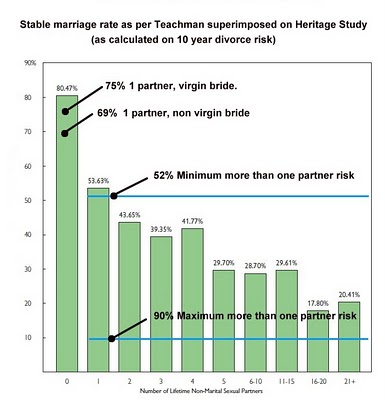
New study: women who have fewer premarital sex partners have lower risk of divorce

Man helping a woman with proper handgun marksmanship

Consider this article from Family Studies that talks about how the number of pre-marital sex partners that a woman has increases her risk of divorce.

It says:

American sexual behavior is much different than it used to be. Today, most Americans think premarital sex is okay, and will have three or more sexual partners before marrying. What, if anything, does premarital sex have to do with marital stability?

This research brief shows that the relationship between divorce and the number of sexual partners women have prior to marriage is complex. I explore this relationship using data from the three most recent waves of the National Survey of Family Growth (NSFG) collected in 2002, 2006-2010, and 2011-2013. For women marrying since the start of the new millennium:

  • Women with 10 or more partners were the most likely to divorce, but this only became true in recent years;
  • Women with 3-9 partners were less likely to divorce than women with 2 partners; and,
  • Women with 0-1 partners were the least likely to divorce.

Earlier research found that having multiple sex partners prior to marriage could lead to less happy marriages, and often increased the odds of divorce.

[…]Even more noteworthy has been the decline in the proportion of women who get married having had only one sex partner (in most cases, their future husbands). Forty-three percent of women had just one premarital sex partner in the 1970s.

[…]By the 2010s, only 5 percent of new brides were virgins. At the other end of the distribution, the number of future wives who had ten or more sex partners increased from 2 percent in the 1970s to 14 percent in the 2000s, and then to 18 percent in the 2010s. Overall, American women are far more likely to have had multiple premarital sex partners in recent years (unfortunately, the NSFG doesn’t have full data on men’s premarital sexual behavior, and in any event they recall their own marital histories less reliably than do women).

Here’s the change:

Women have freely chosen to dismiss the Bible and the moral law

And the problem with this, of course, is that more premarital sex partners means a higher risk of divorce:

Even one non-husband premarital sex partner raises risk of divorce

Why is the 2-partner number so high?

In most cases, a woman’s two premarital sex partners include her future husband and one other man. That second sex partner is first-hand proof of a sexual alternative to one’s husband. These sexual experiences convince women that sex outside of wedlock is indeed a possibility. The man involved was likely to have become a partner in the course of a serious relationship—women inclined to hook up will have had more than two premarital partners—thereby emphasizing the seriousness of the alternative.

The Christian Post had an article about some recent numbers from the Centers for Disease Control about virgins.

Excerpt:

A new Centers for Disease Control study examines teenage health behaviors in connection to their self-reported sexual activity and shows those who remain abstinent are much healthier on many fronts than their sexually active peers.

The report, titled “Sexual Identity, Sexual Contacts, and Health-Related Behaviors Among Students in Grades 9-12, United States and Selected Sites,” showcased the results from a 2015 survey that monitored several categories of health-related behaviors like tobacco usage, drug and alcohol use, sexual habits, unhealthy dietary behaviors, and behaviors that contribute to unintentional injuries and violence.

The report concludes “that students who had no sexual contact have a much lower prevalance of most health-risk behaviors compared with students” who had sexual contact.

The article quotes Dr. Jennifer Roback Morse, who I have featured on this blog many times:

In a Monday interview with The Christian Post, Jennifer Roback Morse, founder and president of the Ruth Institute, said, “this study is remarkable because it asks questions and reports the answers, rather than avoiding questions or assuming answers.”

As Glenn Stanton noted last week in The Federalist, the results from those questions and answers are remarkable.

With regard to smoking, teenage virgins are 3,300 percent less likely to smoke daily than their peers who are sexually involved with someone of the opposite sex, Stanton computed from the report’s data. Teen virgins are 9,500 percent less likely to smoke daily than their peers who are sexually involved with someone of the same sex or in a bisexual relationship, he added. Chaste young people are also extremely less likely to use indoor tanning beds, binge drink, smoke marijuana, ride in cars as passengers with a drunk driver, and get into physical fights than their sexually active peers. Abstinent youth are also more likely to get a solid eight hours of sleep every night and eat breakfast daily.

[…]The CDC report also included findings from 25 state surveys, and 19 large, urban school district surveys conducted among students in grades 9–12 which took place between December of 2014 and September of 2015.

Now, many pro traditional marriage people will tell young men “feminism and the sexual revolution change nothing about a woman’s suitability for marriage, so go out there and get married to these women anyway”. In my experience, no one is telling women NOT to follow their hearts, and explaining to them the harm that they do by allowing their feelings to determine who they will engage in relationships.

I would like to see women make better decisions with men before they marry, rather than be influenced by their peers and culture to give themselves to men who are not marriage-minded. Maybe a little skepticism should be shown to “follow your heart”? Women need to understand what they are losing when they choose to have premarital sex.

In my group of friends, the men are aware of the Biblical prohibition on premarital sex. My friends know about the research on marriage, and what it takes to make a marriage work. We don’t follow our hearts, because we do what we know will work to achieve the results we want. We don’t listen to the culture, and we don’t listen to radical feminists. Men generally take an engineering approach to marriage – we want to know what the best practices and tradeoffs are, and then we plan and act to succeed.

Does more relationship experience lead to better relationship success?

Published in the Journal of Marriage and Family

Consider this article from the Institute for Family Studies.

It says:

In most areas of life, having more experience is good. Want to be great in your chosen field? Sustained experience is essential. Want to be great at a sport? There’s no substitute for practice. And anyone who runs a business can tell you that their best employees are those who have been in the job long enough to have learned how to handle the normal well and the unexpected with wisdom.

While more experience is often beneficial in life, the story looks different when it comes to some types of experience before marriage. For example, in our Before “I Do” report, we surveyed a national longitudinal sample of young adults about their love lives prior to marriage to examine factors associated with future marital quality. We found that having more sexual and cohabiting partners before marriage is associated with lower relationship quality once married. In particular, having only ever lived with or had sex with one’s spouse was associated with higher marital quality. Our findings are consistent with other studies showing that cohabiting with more partners before marriage is associated with greater likelihood of divorce1 and that a higher number of sexual partners before marriage is associated with lower marital quality and greater likelihood of divorce.2 As we noted, what happens in Vegas may not always stay in Vegas. But why?

There are many reasons why having more romantic partners before marriage may put one at higher risk of difficulties in marriage. One of the most important explanations comes under the heading of what some call selection effects. For many people, an elevated risk of difficulties in marriage was present before they had their first relationship experience. Background characteristics such as parental divorce, low education, and economic disadvantage are associated both with having more sexual and cohabiting partners and also with lower marital quality and/or divorce.3So it may not be that having more sexual or cohabiting partners causes further risk because a lot of risk was already in motion. Selection is a big part of how relationships unfold, but is it the whole story? We believe that, in addition to selection, behavior matters and has plausible connections to marital outcomes. We are going to explain four reasons why having more relationship experience before tying the knot might make it harder to succeed in marriage.

Here are the 4 reasons:

  1. More Awareness of Alternatives
  2. Changed Expectations: The Perfect Sexual Lover (in Your Mind)
  3. More Experience Breaking It Off
  4. Babies

I have to quote the one that I’ve personally encountered in my mentoring – number three: more experience breaking it off. I’ve seen this commitmentphobia in two women who had “wild” periods in their past who had broken up with cohabitating boyfriends.

It says:

Cohabitation has characteristics that seem paradoxical. Living with a partner makes it harder to break up than dating, all other things being equal, and often now comes at a time in relationship development where people have not really chosen each other for the future.8 And yet, cohabiting couples frequently break up, and they are more likely than any other time in history not to end up marrying.9

These days, cohabitation has become more a part of the dating scene than a lead-up to marriage. Let’s call the phenomenon cohabidating. In this context, some people are getting a lot of experience at leaving serious relationships (or surviving being left). Just as with our prior point, that does not sound bad in one way—at least insofar as people are breaking off relationships that had no future. But it’s also true that people tend to get good at things they have a lot of experience doing. People can get good at moving out and moving on.

How does that impact marriage? Some people probably so deeply learn that they can survive leaving a relationship when they are unhappy with it that they leave reasonably good marriages that would have given them and their children the best outcomes in life. They bail too quickly.

Obviously, many others leave very poor or even dangerous marriages only after a lot of agonizing and effort. We’re not suggesting divorce is ever easy or that it is not sometimes the best course. But in a day and age when people get so much experience moving out and moving on, we think many may learn to do so too rapidly, and to their detriment.

If you want to get good at relationships, experience may not be the answer. Reading good studies like this, and making decisions that line up with the research is much wiser. As always, never follow your heart. Always follow rational arguments and evidence, and keep connected to a good panel of advisors who have had long-term relationships success. That’s the best way to avoid disaster.

People ask me how to learn how to do relationships well if your parents are divorced and the culture is a cesspool. The answer is to go back in time to before radical feminism, to the time when men and women had distinct roles, and had to attract each other without using sex. Men had to prove their feelings to women with actions, and when women chose men for the roles of husband and father. Parents were consulted to give advice about courtship and marriage. Where can you find this today? Well, books by Christian authors like Jane Austen are very helpful. If you like DVDs, go out and get yourself the BBC production of “North and South”, which is based on the book by Christian author Elizabeth Gaskell. My favorite romance is Edmund Rostand’s “Cyrano de Bergerac”, just make sure you get the Brian Hooker translation if you are reading it in English. Although the best version is the original French. Shakespeare is also good – I got my rule of saving the first kiss for the proposal / engagement from Henry V.

You have to dig if you are going to get away from a culture that trains people to fail to prepare for marriage. You have to fight to develop and maintain your ability to love another person well, in a Christ-like way. The culture says to treat the opposite sex like a commodity, but you should instead think of them as something designed to be presented to God. Never treat them in a way that causes damage to that vertical relationship, that’s the most important thing about them – how they see God.