Did “thousands of women” die in “back alley abortions” before Roe v. Wade?

I get into debates about abortion, and sometimes my opponent will complain that if Roe v. Wade were overturned, then thousands of women would die in illegal abortions. Well, if that ever happens to you, this post will help you to know how to respond to it.

First of all, if Roe v. Wade were overturned, then each of the 50 states would pass legislation deciding when abortions would be legal.

Here’s a map taken from the Washington Examiner:
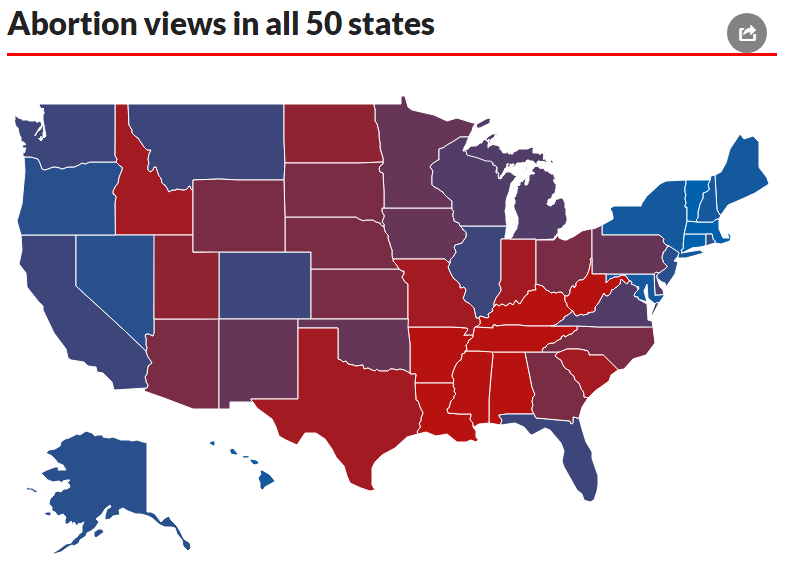
Abortion rights after Roe v. Wade is overturned

Red states are more pro-life than blue states in this map. For example, New York is ranked #6, and Tennessee is ranked #45.

So, if a woman did have irresponsible sex with a hot bad boy, then she easily could terminate her child in one of the blue states.

Second, the number thrown around by abortion advocates is not accurate. It’s simply not true that “thousands of women” were dying from poorly-performed abortions when abortion was still illegal. Actually, abortions were performed by trained medical personnel, but it just wasn’t reported to the police.

Here’s a recent article from the radically leftist Washington Post:

Erica Sackin, a Planned Parenthood spokeswoman, directed us to a 2014 policy statement issued by the American College of Obstetricians and Gynecologists (ACOG): “It is estimated that before 1973, 1.2 million U.S. women resorted to illegal abortion each year and that unsafe abortions caused as many as 5,000 annual deaths.”

There is no citation in the statement for the estimate of “as many as 5,000 annual deaths,” even though many of the other sentences are carefully documented. None of the citations around this sentence supports the figure, and there is no explanation about how it was calculated.

[…]Meanwhile, Sackin also sent a variety of reports, many of which were referenced in a footnote in a document published by NARAL Pro-Choice America. One of the citations especially caught our eye: Frederick Taussig, “Abortion Spontaneous and Induced: Medical and Social Aspects,” (1936).

Why was a study from 1936 being cited? Because in 1936, we didn’t have antibiotics! People were dying all the time from any kind of surgery – not just abortion.

More:

The advent of antibiotics such as penicillin and improved medical procedures suddenly made abortion less risky. Another prominent researcher, Christopher Tietze, argued in a 1948 paper that the number of deaths from abortion was rapidly declining because of three reasons: contraceptive methods had improved so fewer women were getting pregnant, abortion providers were getting better at avoiding infections, and many lives had been saved because of the introduction of sulfa drugs and penicillin.

[…]The data collected by Tietze showed 2,677 deaths from abortion in 1933, compared with 888 in 1945, with much of the decline in septic cases associated with illegal abortions. (The numbers also include deaths from “therapeutic abortions,” permitted by law, and “spontaneous abortions.”)

By 1959, a leading researcher wrote: “Abortion is no longer a dangerous procedure. This applies not just to therapeutic abortions as performed in hospitals but also to so-called illegal abortions as done by physicians. In 1957, there were only 260 deaths in the whole country attributed to abortions of any kind. In New York City in 1921, there were 144 abortion deaths, in 1951 there were only 15.”

The writer was Mary Steichen Calderone, at the time medical director of Planned Parenthood. She attributed the decline in the mortality rate to antibiotics and the fact that 90 percent of illegal abortions were done by trained physicians.

OK, so abortion advocates cite the study from 1936, which already relies on questionable estimates, because they know that the later numbers are far, far lower – thanks to the widespread use of antibiotics. They’re lying, essentially, because lying helps them to persuade people who think with their feelings, and don’t look too closely at facts.

My third point is simple. Even if women hurt themselves during abortions, that wouldn’t be a reason to legalize abortion. Bank robbers hurt themselves during bank robberies, and drug dealers hurt themselves during drug deals. We do not legalize criminal activities just because criminals get hurt during the commission of those activities. So the real question is, what is the unborn? If the unborn is a living human being, then abortion on demand takes the life of an innocent human being without justification, and should therefore be illegal.

UPDATE: My pro-life friend Nathan sent me a fourth response:

There is a difference today that did not exist in 1973. We have a pro-life movement. We have over 2,000 pregnancy care ministries and clinics operating throughout the continental United States. I highly doubt these clinics will just disappear overnight if abortion became illegal nationwide. Women and children will still be in need, and the free market principles that enable charity to flourish will be there to help.
Given this reality, will proponents of abortion now finally step forward to help provide the support to women necessary so they never have to choose a back alley abortion? Given how they have worked themselves into a panic about rusty coat hangers, it seems they would be the most motivated to do so. The fact many don’t seem to want to do so is telling: They just want to justify their own support for abortion, regardless of whether it helps women or not.

Are snowflakes and libertarians right to worry that killing Iranian terrorists will start a war?

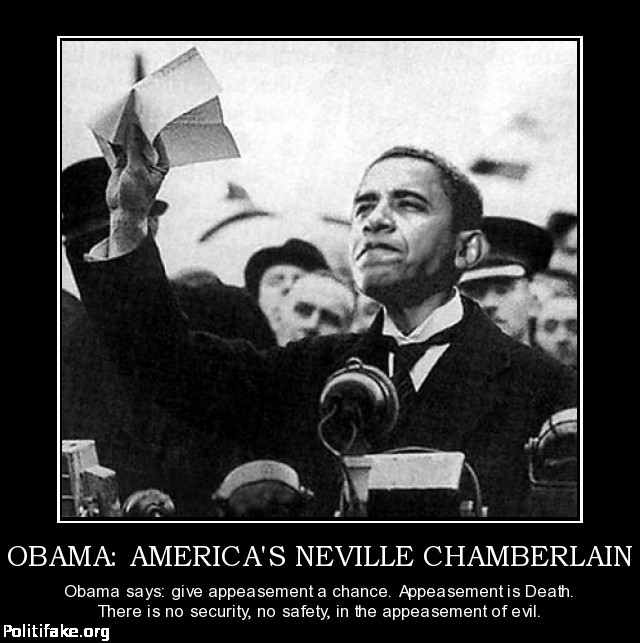
Neville Chamberlain Obama: peace in our time

I talked to a few progressives and libertarians on the weekend. They seemed to think that Trump’s decision to sanction two Iranian generals would lead to war. Now, I asked the libertarians and progressives a bit about how World War 2 started. They didn’t know anything about how it started. Let’s see what Trump did in Iran, and then look at WW2 history to see if it is likely to stop or start a war.

Before I start, I just want to say that someone shared a post by far-left filmmaker Michael Moore claiming that Americans had ever heard of Soleimani or the Quds Force. Here are my previous 134 posts on Iran, my previous 9 posts on the Quds Force, and my previous post on Soleimani. Speak for yourself, Michael Moore.

First, who is Solemani, and what is the Quds Force? The New York Times explains:

More than any other American military operation since the invasion of Iraq, the assassination yesterday of Maj. Gen. Qassim Suleimani, the head of Iran’s Qods Force of its Islamic Revolutionary Guards Corps, is a seismic event. The killings of Osama bin Laden and Abu Bakr al-Baghdadi, the leaders of al-Qaeda and the Islamic State, were certainly meaningful, but they were also largely symbolic, because their organizations had been mostly destroyed. Taking out the architect of the Islamic Republic’s decades-long active campaign of violence against the United States and its allies, especially Israel, represents a tectonic shift in Middle Eastern politics.

[…]In Lebanon, Mr. Suleimani built Lebanese Hezbollah into the powerful state within a state that we know today. A terrorist organization receiving its funds, arms and marching orders from Tehran, Hezbollah has a missile arsenal larger than that of most countries in the region. The group’s success has been astounding, helping to cement Iran’s influence not just in Lebanon but farther around the Arab world.

Building up on this successful experience, Mr. Suleimani spent the last decade replicating the Hezbollah model in Iraq, Syria and Yemen, propping up local militias with precision weapons and tactical know-how. In Syria, his forces have allied with Russia to prop up the regime of Bashar al-Assad, a project that, in practice, has meant driving over 10 million people from their homes and killing well over half a million. In Iraq, as we have seen in recent days, Mr. Suleimani’s militias ride roughshod over the legitimate state institutions. They rose to power, of course, after participating in an insurgency, of which he was the architect, against American and coalition forces. Hundreds of American soldiers lost their lives to the weapons that the Qods Force provided to its Iraqi proxies.

I think this part is worth emphasizing – Solemani was the aggressor in the Iraq embassy attack, and he has a record of attacking American armed forces:

Soleimani, who was designated and sanctioned by the U.N., E.U., and U.S. alike, directly approved Tuesday’s U.S. embassy storming in Baghdad by Iranian proxy militia Kataib Hezbollah, and was credibly assessed by Secretary of State Mike Pompeo as actively planning more “imminent” attacks against hard American assets in the Middle East, has been directly active in the mass murder of Americans. He personally oversaw the mass arming of Shiite Iraqi insurgents and it is estimated that the IRGC-QF targeted and killed over 600 Americans in Iraq from 2003–2011. The State Department asserts that this personally amounts to a whopping 17% of all deaths of U.S. military personnel during the Iraq War.

So, far from Trump’s response being disproportionate, this was actually a long-overdue response. It was even overdue from Trump.

The message that Iran got after 8 years of Obama was clear: acts of aggression committed by Iran against the United States and her allies would be rewarded, including the $1.7 BILLION payoff from the Obama administration. The Obama administration’s policy was isolationism and appeasement. And this was fine with Democrat voters, because not a single Democrat voter (or libertarian ) knew anything about Iran, the Iran deal, Soleimani, or the Quds Force. They are low-information voters.

Now let’s see how World War 2 started.

Here is a helpful lecture by military historian Victor Davis Hanson.

Germany re-armed in 1936. Austria was annexed in 1938. The Rhineland was re-occupied in 1938. Czechoslovakia was invaded in 1939. And the allied democracies did nothing to stop Hitler. Similarly, Japan also re-armed, broke treaties and invaded neighbors. And the allied democracies did nothing to stop them, despite having superior planes, tanks, and ships. This allowed the Axis powers time to research better weapons, re-arm, and gain a strategic advantage. The Axis powers could have been stopped early on, at a much lower cost in blood and treasure. It was the libertarians and the progressives with their policies of isolationism and appeasement that made World War 2 much worse than it needed to be.

VDH explains:

Hitler assumed the United States either could not or would not offer much military help to his intended European targets.

Why, then, did a relatively weak Nazi Germany between 1939 and 1941 believe that it could take on much of the world, and inspire Axis partners such as Italy and Japan to follow its suicidal lead?

The answer is obvious. British and French appeasement, Soviet collaboration and American isolation had together convinced Hitler and his Axis allies that the victors of World War I were more eager to grant concessions at any cost than were the defeated.

In the lecture, VDH explains that we know from the writings of the leaders of Germany and Japan that they interpreted the isolationist / appeasement policies of the libertarian progressives as weakness, and this is what caused them to re-arm and attack their neighbors. Prior to the historical start of WW2, the Western nations had better tanks, planes and ships than the Axis powers. But they refused to use them to deter the Axis powers. And that’s why World War 2 was much more costly and bloody than it needed to be.

Finally, I should quickly note that America pursued a different strategy in the Cold War, under Ronald Reagan. Reagan was villified by the libertarians and progressives for taking a strong stand against communism. Instead of appeasing and isolating, he put America on a war footing, making aggression costly to the Soviet Union. This approach worked to avoid an actual World War 3. Although his critics attacked him for being pro-war, his tough approach was exactly what was needed to cause the bully to back down.

Si Vis Pacem, Para Bellum

Astronomer Guillermo Gonzalez lectures on intelligent design and habitability

Christianity and the progress of science

Here is a lecture that talks about intelligent design and eclipses. There are 5 video clips that make up the full lecture.

The playlist for all 5 clips is here.

About the speaker

Guillermo Gonzalez is an Associate Professor of Physics at Grove City College. He received his Ph.D. in Astronomy in 1993 from the University of Washington. He has done post-doctoral work at the University of Texas, Austin and at the University of Washington and has received fellowships, grants and awards from such institutions as NASA, the University of Washington, the Templeton Foundation, Sigma Xi (scientific research society) and the National Science Foundation.

Learn more about the speaker here.

The lecture

Here’s part 1 of 5:

And the rest are here:

Total time: 43 minutes.

Topics:

  • What is the Copernican Principle?
  • Is the Earth’s suitability for hosting life rare in the universe?
  • Does the Earth have to be the center of the universe to be special?
  • How similar to the Earth does a planet have to be to support life?
  • What is the definition of life?
  • What are the three minimal requirements for life of any kind?
  • Requirement 1: A molecule that can store information (carbon)
  • Requirement 2: A medium in which chemicals can interact (liquid water)
  • Requirement 3: A diverse set of chemical elements
  • What is the best environment for life to exist?
  • Our place in the solar system: the circumstellar habitable zone
  • Our place in the galaxy: the galactic habitable zones
  • Our time in the universe’s history: the cosmic habitable age
  • Other habitability requirements (e.g. – metal-rich star, massive moon, etc.)
  • The orchestration needed to create a habitable planet
  • How different factors depend on one another through time
  • How tweaking one factor can adversely affect other factors
  • How many possible places are there in the universe where life could emerge?
  • Given these probabilistic resources, should we expect that there is life elsewhere?
  • How to calculate probabilities using the “Product Rule”
  • Can we infer that there is a Designer just because life is rare? Or do we need more?

The corelation between habitability and measurability.

  • Are the habitable places in the universe also the best places to do science?
  • Do the factors that make Earth habitable also make it good for doing science?
  • Some places and times in the history of the universe are more habitable than others
  • Those exact places and times also allow us to make scientific discoveries
  • Observing solar eclipses and structure of our star, the Sun
  • Observing stars and galaxies
  • Observing the cosmic microwave background radiation
  • Observing the acceleration of the universe caused by dark matter and energy
  • Observing the abundances of light elements like helium of hydrogen
  • These observations support the big bang and fine-tuning arguments for God’s existence
  • It is exactly like placing observatories on the tops of mountains
  • There are observers existing in the best places to observe things
  • This is EXACTLY how the universe has been designed for making scientific discoveries

This lecture was delivered by Guillermo Gonzalez in 2007 at the University of California at Davis. If you like this lecture, but maybe want something a bit more user friendly, check out “The Privileged Planet” DVD, or watch it online here (first 60 minutes of that video).