Facts vs feelings in the debate on gun control vs self-defense

I found a splendid at the Daily Signal article that ought to be read by everyone who has an opinion about the conflict between gun confiscation vs self-defense.

Here are the 8 points made in the article, then I’ll comment on my favorite one:

  1. Violent crime is down and has been on the decline for decades.

  2. The principal public safety concerns with respect to guns are suicides and illegally owned handguns, not mass shootings.

  3. A small number of factors significantly increase the likelihood that a person will be a victim of a gun-related homicide.

  4. Gun-related murders are carried out by a predictable pool of people.

  5. Higher rates of gun ownership are not associated with higher rates of violent crime.

  6. There is no clear relationship between strict gun control legislation and homicide or violent crime rates.

  7. Legally owned firearms are used for lawful purposes much more often than they are used to commit crimes or suicide.

  8. Concealed carry permit holders are not the problem, but they may be part of the solution.

Whenever we discuss gun violence, it’s very important to exclude suicides using a gun from the overall rate of gun deaths. Once you do that, you will find that the rate of violent crime has been declining as more and more law-abiding Americans have gone through the process to purchase a firearm for self-defense.

Let’s talk about the gun homicide rate and how the steady increase in firearm ownership has affected that. When you look at the graph below, keep in mind that two thirds of the homicide are suicides committed with a firearm.

Here is a graph:

Gun ownership up, gun violence down

The question I want to address is this: why would someone want to own a gun in the first place?

Here are the points from the list of eight points that are relevant to that question:

Higher rates of gun ownership are not associated with higher rates of violent crime.

  • Switzerland and Israel have much higher gun ownership rates than the United States but experience far fewer homicides and have much lower violent crime rates than many European nations with strict gun control laws.
  • Higher rates of concealed carry permit holders are even more strongly associated with reduction in violent crime than are “right-to-carry” states. The probable reason for this is that “right-to-carry” studies often include “open carry” states, which have not been shown to correlate with more people actually carrying or even owning firearms. Rates of concealed carry permit holders are better indicators of the number of people who actually possess and carry firearms within a given population.

There is no clear relationship between strict gun control legislation and homicide or violent crime rates.

  • Homicide and firearm homicide rates in Great Britain spiked in the years immediately following the imposition of severe gun control measures, despite the fact that most developed countries continued to experience a downward trend in these rates. This is also pointed out by noted criminologist John Lott in his book “The War on Guns.”
  • Similarly, Ireland’s homicide rates spiked in the years immediately following the country’s 1972 gun confiscation legislation.
  • Australia’s National Firearms Act appears to have had little effect on suicide and homicide rates, which were falling before the law was enacted and continued to decline at a statistically unremarkable rate compared to worldwide trends.
  • According to research compiled by John Lott and highlighted in his book “The War on Guns,” Australia’s armed and unarmed robbery rates both increased markedly in the five years immediately following the National Firearms Act, despite the general downward trend experienced by other developed countries.
  • Great Britain has some of the strictest gun control laws in the developed world, but the violent crime rate for homicide, rape, burglary, and aggravated assault is much higher than that in the U.S. Further, approximately 60 percent of burglaries in Great Britain occur while residents are home, compared to just 13 percent in the U.S., and British burglars admit to targeting occupied residences because they are more likely to find wallets and purses.
  • It is difficult to compare homicide and firearm-related murder rates across international borders because countries use different methods to determine which deaths “count” for purposes of violent crime. For example, since 1967, Great Britain has excluded from its homicide counts any case that does not result in a conviction, that was the result of dangerous driving, or in which the person was determined to have acted in self-defense. All of these factors are counted as “homicides” in the United States.

Legally owned firearms are used for lawful purposes much more often than they are used to commit crimes or suicide.

  • In 2013, President Barack Obama ordered the Centers for Disease Control and Prevention (CDC) to assess existing research on gun violence. The report, compiled by the Institute of Medicine and the National Research Council, found (among other things) that firearms are used defensively hundreds of thousands of times every year.
  • According to the CDC, “self-defense can be an important crime deterrent.” Recent CDC reports acknowledge that studies directly assessing the effect of actual defensive uses of guns have found “consistently lower injury rates among gun-using crime victims compared with victims who used other self-protective strategies.”
  • Semi-automatic rifles (such as the AR-15) are commonly used as self-defense weapons in the homes of law-abiding citizens because they are easier to control than handguns, are more versatile than handguns, and offer the advantage of up to 30 rounds of protection. Even Vox has published stories defending the use of the AR-15.
  • AR-15s have been used to save lives on many occasions [list omitted by WK]

Concealed carry permit holders are not the problem, but they may be part of the solution.

  • Noted criminologist John Lott found that, as a group, concealed carry permit holders are some of the most law-abiding people in the United States. The rate at which they commit crimes generally and firearm crimes specifically is between one-sixth and one-tenth of that recorded for police officers, who are themselves committing crimes at a fraction of the rate of the general population.
  • Between 2007 and 2015, murder rates dropped 16 percent and violent crime rates dropped 18 percent, even though the percentage of adults with concealed carry permits rose by 190 percent.
  • Regression estimates show a significant association between increased permit ownership and a drop in murder and violent crime rates. Each percentage point increase in rates of permit-holding is associated with a roughly 2.5 percent drop in the murder rate.
  • Concealed carry permit holders are often “the good guy with a gun,” even though they rarely receive the attention of the national media. Concealed carry permit holders were credited with saving multiple lives [list omitted by WK]

So, I think that those points provide a very necessary balance for the “ban guns” crowd. Gun ownership is a vital part of a free citizen’s right to self-defense. People who want to discuss gun confiscation vs self-defense need to be aware of the way guns are really used by law-abiding people to protect themselves and their families.

102 Americans died Monday while Democrats blocked Wuhan virus relief

United States Wuhan virus infections and deaths

While Nancy Pelosi was away, Republicans and Democrats co-operated to produce a bipartisan bill to provide relief to suffering Americans. But Nancy Pelosi returned and threw the bill out and instead demanded the relief legislation must contain socialist policies unrelated to relief. Meanwhile, people in America are getting sick and dying, and workers are losing their jobs.

The Daily Wire reports:

Sen. Ted Cruz (R-TX) unloaded on Senate Democrats on Monday for continuing to play partisan games in trying to reach an agreement for a massive stimulus bill to provide relief to American families and the economy.

It had looked like the two sides were going to come to an agreement on Sunday to move the proposed $1.8 trillion stimulus bill along in the process until Democrat House Speaker Nancy Pelosi ruined talks.

“It was one party — the Democratic Party saying to this chamber and the American people, ‘Hell no. We won’t even take this up and discuss it,’” Cruz said on the Senate floor. “At a time of crisis, at a time when people are dying, that’s wrong. That’s shameful.”

He added, “When we awakened this morning following the Democrats’ obstruction, worldwide, there were 372,563 reported cases of the coronavirus. In the hours since then, just today, there have been an additional 23,352 cases reported today. While the Democrats are blocking the bill 23,000 new cases today.”

“In the United States, when we started this morning, there were 35,224 cases this morning. Right now, as of the latest numbers, there are 41,708 cases in the United States today,” Cruz continued. “That means we’ve had an additional 6,484 four cases today, while the Democrats are blockading.”

Cruz noted that Senate Democrats were not even in the chamber as he talked because they had all left.

“They’re not showing up for work,” Cruz said. “They’re not doing their job.”

“In the United States, as of this morning, there were 471 deaths reported due to coronavirus. As of right now it’s 573,” Cruz continued. “That means today 102 Americans died while the Democrats were blocking consideration of this bill.”

I was watching Dan Crenshaw tweet out screenshots of the Democrat proposals yesterday. It was astonishing: they wanted to include all sorts of things that have nothing to do with protecting Americans from the threat of the virus, and the economic damage caused by people being forced to stay home.

Here’s a list of their demands:

  1. Corporate pay statistics by race and race statistics for all corporate boards at companies receiving assistance.
  2. Bailing out all current debt of postal service
  3. Required early voting
  4. Required same day voter registration
  5. 10k bailout for student loans
  6. For companies accepting assistance, 1/3 of board members must be chosen by workers
  7. Provisions on official time for union collective bargaining
  8. Full offset of airline emissions by 2025
  9. Greenhouse gas statistics for individual flights
  10. Retirement plans for community newspaper employees
  11. $15 minimum wage at companies receiving assistance
  12. Permanent paid leave at companies receiving assistance

Those things have nothing to do with the coronavirus, or the declining stock market, or the mass unemployment caused by quarantining workers. Those things might be good, but they’re not related to the immediate problem of helping Americans impacted by the virus.

By the way, I’m not sure that everything in the spending bill is great, or that we should be spending so much money. But I do know that conservatives like Tom Cotton, Dan Crenshaw, Ted Cruz, etc. have been pushing the bill, and they worked hard on negotiating it.

What should we do about the Wuhan coronavirus?

The economic cost of making workers stay home

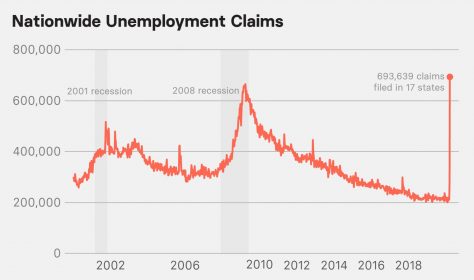
I think by now most people have realized that there is an economic cost to shutting Americans of all ages into their homes. If people can’t work, then businesses can’t make money, and they have to furlough or lay off workers. We can’t keep up this policy of making everyone stay home forever – it would lead to another Great Depression. Is there a way to get people back to work?

This article from The Federalist explains, and comes up with a different solution. The author argues that the Wuhan virus is most dangerous to the elderly, and people with pre-existing conditions. And therefore they should shelter in place securely, while the rest of us who are under age 50 keep the economy from sliding into a depression by going back to work as soon as possible.

It says:

Richard Epstein at the Hoover Institution… points out that South Korean data, which is more complete than most other countries’ data, shows huge disparities in risks between old and unhealthy and young and healthy. “Clearly, the impact on elderly and immunocompromised individuals is severe, with nearly 90% of total deaths coming from individuals 60 and over. But these data do not call for shutting down all public and private facilities given the extraordinarily low rates of death in the population under 50,” Epstein writes.

[…]The costs Americans are being forced to bear may be more than is rational to impose. Already one-fifth of working Americans are being laid off and having work hours cut due to not even one week of suspensions.

“[T]he massive curtailments of the U.S. economy can have as many health consequences as the virus itself—if millions lose income and jobs, become depressed in self-isolation, increase smoking, and drug and alcohol use, and postpone out of fear necessary buying and visits to doctors and hospitals for chronic and serious medical conditions unrelated to the virus,” writes Victor Davis Hanson.

What if the real scenario is one of these: 1) We plunge the nation into a depression that kills many businesses and addicts millions to welfare, in a nation that has already pledged more welfare than it can afford for at least the next three generations. Because of this depression, many people die due to poverty, lack of medical care, and despair. Millions more transform from workers to takers, causing a faster implosion of our already mathematically impossible welfare state.

2) The nation quarantines only at-risk populations and those with symptoms, like South Korea has, and ensures targeted and temporary taxpayer support to those groups, goes nuts cranking out ventilators and other crisis equipment such as temporary hospitals using emergency response crews, while the rest of us keep calm, wash our hands, take extreme care with the at-risk groups, and carry on.

Why would the entire nation grind to a halt when the entire nation is not at a severe risk? I would rather have a flu I am 99.8 percent likely to survive than the nation plunged into chaos indefinitely because we pulled the plug on our economy during a stampede.

At the very least, Congress should wait a week or two, while half the nation or more is home, to see how the infection rates look as millions of test kits go out. The worst-case scenario they are predicating their actions on may not be the one we’re facing. Prudence suggests a measured, wait and see approach to policy until we have better information, not chucking trillions of my kids’ dollars out the window “just in case.”

Right now, I think we should expand testing so we understand the problem better, fast-track whatever drugs are known to work, expand hospital capacity, build more N95 masks, build more ventilators, and get people under 50 back to work. This is in addition to proper hand-washing, social distancing and working from home where possible.

The cost of a depression seems to me to be much higher than what is happening to South Korea right now. They have massive testing effort and they are only quarantining people who are at high risk or who show symptoms. That makes more sense to me than shutting the economy down, or pass massive spending bills with bailouts for businesses that should not be shut down more than a month.