Guillermo Gonzalez is an Associate Professor of Physics at Grove City College. He received his Ph.D. in Astronomy in 1993 from the University of Washington. He has done post-doctoral work at the University of Texas, Austin and at the University of Washington and has received fellowships, grants and awards from such institutions as NASA, the University of Washington, the Templeton Foundation, Sigma Xi (scientific research society) and the National Science Foundation.
Is the Earth’s suitability for hosting life rare in the universe?
Does the Earth have to be the center of the universe to be special?
How similar to the Earth does a planet have to be to support life?
What is the definition of life?
What are the three minimal requirements for life of any kind?
Requirement 1: A molecule that can store information (carbon)
Requirement 2: A medium in which chemicals can interact (liquid water)
Requirement 3: A diverse set of chemical elements
What is the best environment for life to exist?
Our place in the solar system: the circumstellar habitable zone
Our place in the galaxy: the galactic habitable zones
Our time in the universe’s history: the cosmic habitable age
Other habitability requirements (e.g. – metal-rich star, massive moon, etc.)
The orchestration needed to create a habitable planet
How different factors depend on one another through time
How tweaking one factor can adversely affect other factors
How many possible places are there in the universe where life could emerge?
Given these probabilistic resources, should we expect that there is life elsewhere?
How to calculate probabilities using the “Product Rule”
Can we infer that there is a Designer just because life is rare? Or do we need more?
The corelation between habitability and measurability.
Are the habitable places in the universe also the best places to do science?
Do the factors that make Earth habitable also make it good for doing science?
Some places and times in the history of the universe are more habitable than others
Those exact places and times also allow us to make scientific discoveries
Observing solar eclipses and structure of our star, the Sun
Observing stars and galaxies
Observing the cosmic microwave background radiation
Observing the acceleration of the universe caused by dark matter and energy
Observing the abundances of light elements like helium of hydrogen
These observations support the big bang and fine-tuning arguments for God’s existence
It is exactly like placing observatories on the tops of mountains
There are observers existing in the best places to observe things
This is EXACTLY how the universe has been designed for making scientific discoveries
This lecture was delivered by Guillermo Gonzalez in 2007 at the University of California at Davis. If you like this lecture, but maybe want something a bit more user friendly, check out “The Privileged Planet” DVD, or watch it online here (first 60 minutes of that video).
Roger Trimble, standing second from the left, in front of his B-24 Liberator
I recently finished a book called “Beyond The Call: The True Story of One World War II Pilot’s Covert Mission to Rescue POWs on the Eastern Front”. It’s about a World War 2 heavy bomber pilot who completes 35 missions, and then goes into the Soviet Union (our allies, at the time) to rescue American POWs who were starving or being kidnapped or murdered by the Soviet secret police.
Later, after making contact with POWs roaming the Polish countryside, [Capt. Robert Trimble] fully embraced his mission. He saw the desperate plight of those who had been liberated from Third Reich prison camps. Many were sick, emaciated, often clothed in rags and left to fend for themselves during a brutally harsh winter.
Trimble risked his life numerous times over six weeks, helping to rescue hundreds of POWs. He came to the aid of others, too. In one daring rescue, nearly foiled by Russian agents who had become suspicious of his activities, Trimble helped 400 French women make it out of Poland and back to France.
Although he was being constantly trailed by Russian spies and informers, he would evade them, and bring food and money to the POWs, then put them on a train to Odessa, Ukraine, where they could get onto a ship going home.
Why I read military history
It is hard to develop virtues just by wishing and hoping. Something has to go into your mind that causes you to think differently, and feel differently. Everything that you watch on TV, hear on the radio, or see in the movie theater, is made by secular leftists. They aren’t trying to build your moral character. They’re goal is to break down your resistance to their unBiblical worldview and moral values. Instead of giving people who hate Jesus your money, just so you can be entertained, why not try to put something in front of your eyes that will make you better?
1Therefore I urge you, brethren, by the mercies of God, to present your bodies a living and holy sacrifice, acceptable to God, which is your spiritual service of worship.
2 And do not be conformed to this world, but be transformed by the renewing of your mind, so that you may prove what the will of God is, that which is good and acceptable and perfect.
And also this from Philippians, my favorite book of the Bible.
8 Finally, brethren, whatever is true, whatever is honorable, whatever is right, whatever is pure, whatever is lovely, whatever is of good repute, if there is any excellence and if anything worthy of praise, dwell on these things.
So you can see that when I am reading, my goal is to work on my character. I want to have feelings about things that are appropriate for a Christian man.
So why military history? Here are three reasons why I read these military history books.
Humility
First, humility. Humility used to be one of my biggest challenges. So I thought to myself “instead of seeing yourself as some heroic figure, why don’t you read about some real heroes… people who willingly gave their lives for their friends, like the Bible urges, and like Jesus did by example”.
13 Greater love has no one than this, that one lay down his life for his friends.
Military history is filled with stories of courage, bravery, self-sacrifice, endurance, unselfishness, and many other virtues. When you read about people who are better than you, doing more important things than what you’re doing, it really helps you to be humble.
The best thing for humility is reading Medal of Honor citations. You can find a bunch of them online here. And if you want a book to read, try these books about Medal of Honor recipients:
Second, endurance. I sometimes feel badly about not having found someone to marry and not having lots of children. I wanted a good marriage to be a model for others, and also to have an influence in the next generation through my children. However, whenever I read military history, I see a lot of young men dying in battle. And I think, they too won’t know what sex is like. And, they too won’t know what marriage is like. And, they too won’t know what having children is like. But it’s not just the ones who die, it’s the hardships they have to go through, as well. Cold, hunger, imprisonment, pain, loss of their friends, etc.
I remember reading about one of my favorite battles – probably the most famous battle of the Korean War, which is our most moral war. It’s about Fox Company of the 2nd Battalion, 7th Regiment, 1st Marine Division. They had to hold a hill beside a vital road against overwhelming numbers of Chinese soldiers during the freezing cold North Korean winter. I remember reading about how one soldier got up to go to the bathroom, and was nearly shot by a sniper. He fell over on his own poop, which had already frozen by the time it hit the ground. For months after, I would always think about this whenever I went into a bathroom. We have pre-warmed water in our bathrooms at work, along with soap, lysol spray, febreeze, contact lense cleaner, hand sanitizer, and other things. Just understanding what other people have to go through in war helps me to be more patient with the little tiny setbacks that I experience. I used to get very anxious when anything went wrong, because of I was raised by strict immigrant parents. That anxiety seemed to last a long time, but since I started to read military history, I’ve been much more patient. I know that things could be worse.
Thankfulness
The third thing that I’ve experienced is thankfulness. Not just for all the things that I have because of what our armed forces have done, e.g. – basic human rights, prosperity, liberty, security, etc. But also specifically about those who gave their lives so that I could live free in a free country, and practice my Christian faith without fear.
Here are two of my favorite Medal of Honor stories from World War 2, in the Battle of Pearl Harbor:
Congressional Medal of Honor Awarded Posthumously PETER TOMICH
Rank and organization: Chief Watertender, U.S. Navy. Place and date: Pearl Harbor, 7 December 1941. Born: 3 June 1893, Prolog, Austria.
Although realizing that the ship was capsizing as a result of enemy bombing and torpedoing, Tomich remained at his post in the engineering plant of the U.S.S. Utah, until he saw that all boilers were secured and all fireroom personnel had left their stations, and by so doing lost his own life.
And:
Congressional Medal of Honor Awarded Posthumously JAMES RICHARD WARD
Rank and organization: Seaman First Class, U.S. Navy. Place and date: Pearl Harbor, 7 December 1941. Born: 10 September 1921, Springfield, Ohio.
When it was seen that the U.S.S. Oklahoma was going to capsize and the order was given to abandon ship, Ward remained in a turret holding a flashlight so the remainder of the turret crew could see to escape, thereby sacrificing his own life.
I do think that it’s important for Christians to read these kinds of stories in order to feed their own awareness of what it must have been like for Jesus to give his life voluntarily for us.
There is no shortcut to gratitude. You have to constantly reflect on the sacrifices made by others for you, if you are to have any concrete reason for feeling grateful. The more you read about examples of people giving their lives for others, the more you’ll appreciate what Jesus did for you. It will make you grateful.
There is a very annoying idea out there in the culture that says that people just do whatever is easy and fun for themselves, and since everyone else is always doing what makes them feel good, then there is no need to be thankful for anything. It’s comforting for people to delude themselves with that belief, but it’s false.
My reading list
You can check out the “What I am Reading” section of the blogto see which military history books I’ve been reading.
ANNOUNCEMENT: I’m going to be on the Free Thinking Ministries podcast today at 2 PM Pacific, 5 PM Eastern, with host Tim Stratton. Join us, and we will discuss Black Lives Matter, Christianity and more. And I’ll explain my plan to achieve the American Dream as a person of color and legal immigrant to America. Live stream link here.
Systemic racism is the idea that people can’t lift themselves out of poverty by making good decisions, because powerful groups in society that hold the poor down, regardless of their decisions. Do you think that America is a place where no matter what choices you make, you’ll never be able to be more properous? That’s what the leaders of Black Lives Matter think.
Here’s what Nikole Hannah-Jones, creator of the 1619 Project, says in the New York Times (a former newspaper):
To summarize, none of the actions we are told black people must take if they want to “lift themselves” out of poverty and gain financial stability — not marrying, not getting educated, not saving more, not owning a home — can mitigate 400 years of racialized plundering.
Got that? It doesn’t matter what individual choices a non-white person takes in America, they’re going to be poor. The “systemic racism” of the powerful whites will always keep them down. Single motherhood doesn’t make people poor, and marriage doesn’t make people wealthier. Dropping out of high school doesn’t make you poor, and getting a Masters degree in computer science won’t make you wealthier.
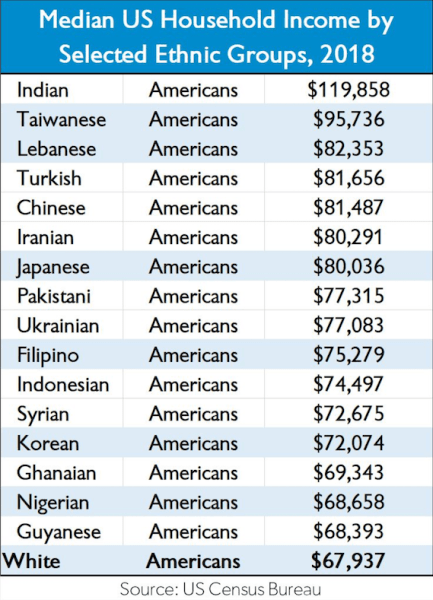
White people are doing a bad job of keeping non-whites down
Well, it looks like at least SOME people of color are able to do well in America despite all the “systemic racism” that keeps non-whites down. And do you know what those non-white groups at the top have in common? They’ve made good decisions, they’ve worked hard, they haven’t blamed other people when they fail, and they’ve saved their money instead of spending it on shiny junk.
Let’s look at some decisions that the non-whites who are prosperous have made, that those further down have not.
Asians marry before they have children, so the kids have two parents
Education and marriage
This article is written by the far-left radical Nicholas Kristof, writing in the radically-leftist New York Times (a former newspaper).
Excerpt:
A new scholarly book, “The Asian American Achievement Paradox,” by Jennifer Lee and Min Zhou, notes that Asian-American immigrants in recent decades have started with one advantage: They are highly educated, more so even than the average American. These immigrants are disproportionately doctors, research scientists and other highly educated professionals.
It’s not surprising that the children of Asian-American doctors would flourish in the United States. But Lee and Zhou note that kids of working-class Asian-Americans often also thrive, showing remarkable upward mobility.
[…]There’s also evidence that Americans believe that A’s go to smart kids, while Asians are more likely to think that they go to hard workers… Asian-American kids are allowed no excuse for getting B’s — or even an A-. The joke is that an A- is an “Asian F.”
One reason Asians students do so well is because their parents are usually married:
Strong two-parent families are a factor, too. Divorce rates are much lower for many Asian-American communities than for Americans as a whole, and there’s evidence that two-parent households are less likely to sink into poverty and also have better outcomes for boys in particular.
American blacks have a 73% out-of-wedlock birth rate. A huge difference compared to Asians.
So, when Nikole Hannah-Jones tells you that education and marriage don’t matter, she’s just wrong.
Compound interest
Education and marriage are important, but so is saving your money. The wealthiest people in America are typically the ones who are experts at saving money early, and investing it. They know about the law of compound interest. If you invest money early and leave it alone, then it will grow into a fortune by the time you are read to stop working.
This graph explains compound interest:
Investing $24,000 from age 21 to 41 vs investing $24000 from age 47 to 67
What does Nikole Hannah-Jones say when she looks at that graph? She doesn’t think that saving money makes a difference to having more or less wealth. She thinks skin color determines whether saving money makes you wealthy or not. The graph clearly shows what we should be recommending to young people of color. They need to stop spending money and start saving it, and the earlier the better. It doesn’t matter what your skin color is, saving money early JUST WORKS.
Similarly, when she says that home ownership doesn’t make you more wealthy, this is just terrible advice. It’s always better to pay down your own mortgage (at least when interest rates are low like they are now) than to pay someone else rent. You have to live somewhere, and paying for your own home is better because it costs about the same as rent, and then you get to keep the home when you’re done paying for it.
Communism
Nikole Hannah-Jones does have a “solution” to disparities in wealth. Her solution is communism. She wants to transfer money from those who earn, to those who don’t. But we already have tried that in the 21st century and it resulted in the deaths of over 100 million people. That’s not my opinion, that’s all documented in a book published by Harvard University Press.
You don’t even have to read the book to know the truth – just look at countries that score low on the Index of Economic Freedom, and compare their GDP per capita to countries that score high on the Index of Economic Freedom. The more communist a nation goes, the less wealth there is for the citizens. That’s why people in Venezuela are eating zoo animals and selling their bodies in prostitution in order to get food to eat and water to drink. Nikole Hannah-Jones wants to reduce economic freedom, but we know by looking at other countries that this reduces per-capita GDP over time.
There’s a lot more than could be said here, but the point is that we need to be telling American blacks to make decisions that match the decisions of other successful non-white communities in America. We need to start teaching young people basic economics so they don’t fall prey to charlatans.