What can Christians learn from the bravest naval aviator at the Battle of Midway?

I have been reading lots of books about the World War II battles in the Pacific theater lately, and I wanted to write a post about one of the heroes I found who was the most compelling to me. You may have seen him in the old 1976 Midway movie or the new 2019 Midway movie. But neither movie tells the full story. The man I am talking about is Lt. Commander John C. Waldron.

John Waldron was the leader of the torpedo bomber squadron on the Hornet. This squadron was composed of outdated and slow Devastator torpedo bombers, armed with the Mark 13 Mod 1 torpedoes, which malfunctioned about 90% of the time.

I found an article on the Federalist that tells the story of John Waldron:

Now there are countless men and woman who deserve to be singled out for their valor, but with the 75th anniversary of the Battle of Midway just around the corner, I thought it would be appropriate to call your attention to one of the bravest men who ever lived. A man who, knowing he was facing certain death, led the first attack against the Japanese aircraft carriers and played a direct role in what would be a decisive victory for the United States, and a defeat from which Japan would never recover. That man was Lt. Commander John C. Waldron.

Now for those who don’t know, the Battle of Midway was the turning point in the Pacific theater. The Japanese had an elaborate plan that involved attacking the U.S. base on Midway Island in order to lure the Americans into a battle which the Japanese High command felt their experience and tactics would overwhelm and annihilate the American fleet. With no significant U.S. naval presence, Hawaii and the entire West Coast would be at risk of invasion. But the Americans broke the Japanese code and set a trap of their own – hoping to destroy their enemy’s carriers and thereby establish U.S. dominance in the Pacific. And that was exactly what happened : The U.S. fleet surprised the Japanese, sank their four carriers, and took the first real step to winning the Second World War.

John Waldron was 42 years old when the USS Hornet steamed towards Midway on June 1st, 1942. Born and raised on a reservation in South Dakota, he had never seen the ocean until he attended the Naval Academy. It wasn’t long after he graduated that he moved into naval aviation. He had been assigned to be the squadron leader of the Hornet’s torpedo bombers in late 1941 and had been drilling his men tirelessly ever since. Waldron had the reputation of a tough as nails, no-nonsense commander. Not surprising, since Waldron was a direct descendant of the warriors from the Oglala Lakota tribe – part of the Great Sioux Nation. The tough skin he developed came from decades of derision from his peers over his meager beginnings, and from the racism directed at his Native American heritage. Waldron didn’t care what anyone thought of him – all he wanted to do was fight for his country. He was a natural leader and his men would follow him into the gates of Hell, which, as fate would have it, is exactly what they would do in the upcoming battle.

On the morning of June 4th, the Americans were ready to spring their trap, but in the preflight briefing aboard the Hornet there was a problem. Stanhope Ring, who was in command of the carrier’s air group, directed his pilots to head northwest of the last reported position of the Japanese fleet. Waldron disagreed with this decision, feeling that they should head in the exact direction of that last sighting. He wasn’t shy about expressing this opinion, much the displeasure of Ring. Waldron continued to lobby his superior officer several times after the briefing ended, but to no avail.

The Federalist article doesn’t talk much about Stanhope Ring, but the book I just finished called “The Battle of Midway” by Craig L. Symonds did. Ring was a very tall, good-looking, and white officer who had breezed up the chain of command thanks to his good looks and confident manner. He loved to show off for cameras, and pull rank on subordinates. He was too proud to admit that Waldron was right in front of the other pilots.

More:

The air strike force took off from the deck of the Hornet – fighters, dive bombers, and the 15 planes in Waldron’s torpedo squadron. This force would be joined in the air by similar strike forces from the other U.S. carriers – the Yorktown and the Enterprise. Shortly after the Hornet’s air group was airborne, Waldron couldn’t contain his anger anymore. He broke radio silence to tell Ring that they were headed in the wrong direction. He repeated that comment and Ring issued a terse reply that he was in charge of this group and to stay the hell off the radio. Waldron waited a couple of minutes before replying “The hell with you” and peeled his squadron off and headed due west, where he felt the Japanese fleet was.

Less than an hour later, Waldron was proved right. He had led his squadron on a direct line to the enemy. Waldron broke radio silence again to signal to Ring that he had found the fleet, but Ring and the rest of the Hornet’s planes were too far away to hear. So now, Waldron was faced with a brutal decision. If he went in to attack, he would do so without any fighter protection, and they’d be totally at the mercy of the Japanese fighters. To make matters worse, the U.S. planes (Douglas Devastators) were hopelessly outdated aircraft – their top speed was about a third of what the Japanese fighters could do. They had hoped to get the newer Grumman Avengers, but the Hornet had left Pearl Harbor before they had arrived from the mainland. All of this meant that Waldron and Torpedo 8 were looking at a suicidal attack run. […]Waldron got on the radio again and told his men “We will go in. We won’t turn back. Former strategy cannot be used. We will attack. Good luck!”

And with that, the planes of Torpedo 8 closed up their formation and bore down on the Japanese fleet, some seven miles distant.

The Japanese fighters quickly pounced on the Americans, who were going in low and slow – the only way torpedo bombers can attack. One by one the planes from Torpedo 8 were shot down. […]Every single plane in Torpedo 8 was destroyed and not one torpedo hit a Japanese ship.

Not only were the torpedo bombers of John Waldron’s VT-8 (Hornet) shot down, but two more waves led by Eugene Lindsey VT-6 (Enterprise) and Edward Massey VT-3 (Yorktown) were also repulsed without a hit.

More:

History might have viewed Waldron’s attack as more insane than brave, and utterly pointless….except for what happened next. Shortly after his failed attack, the torpedo squadron from the Enterprise attacked the fleet – and right after that the torpedo squadron from the Yorktown. Both of those squadrons had devastating casualties as well (10 of 14 planes lost and 10 of 12 respectively) without inflicting any damage on any Japanese ship. But these three attacks in succession drew the Japanese fighter cover down so low, that it left their carriers exposed to dive bomber attacks. It also burned up a lot of fuel for the fighters, who now needed to land before they could continue their defense of the fleet. The attacks also forced the Japanese carriers into defensive maneuvers, so they were unable to land any planes or launch any for a strike on the American carriers.

In addition to using up their fuel and coming down to low altitude, the Japanese CAP (combat air patrol) fighters also used up most of their dangerous 20 mm ammunition. They mostly had much weaker 7.7 mm ammunition remaining when the dive bombers from the Enterprise and Yorktown arrived.

More:

As the Japanese were trying to compose themselves after the three fierce but harmless attacks, the American dive bombers from the Enterprise and Yorktown arrived and quickly struck. Within minutes, three of the Japanese carriers were in flames – the heart of the Imperial Navy had been gutted.

[…]The other planes from the Hornet never found the Japanese ships. Ring kept his planes flying in that northwesterly direction until they were too low on fuel to keep going. They returned to the Hornet with their full payload of bombs.

[…]Now, there were a lot of heroes that day – some who lived and some who died, but the valor that John Waldron displayed in defying orders he knew were wrong and then attacking the enemy when he knew it meant certain death, place him on a special level. His actions directly helped the Americans win this crucial battle, which turned the tide of the war in the favor of the United States. He got the Navy Cross for his actions that day, but it seems astonishing to me that he wasn’t awarded the Medal of Honor – he is definitely worthy of it.

You can learn more about the Battle of Midway in this helpful video:

So, here is what I wanted to say about this.

John Waldron was not properly equipped by his organization to make a difference at Midway. His planes were too old and slow, his torpedoes almost never worked. His leader was an arrogant, incompetent coward who prevented him from leading others to find and attack the actual targets. The only way he could do something to his enemy was to disobey orders and go off on his own. If he had lived, he probably would have been court-martialed for insubordination. After Waldron was shot down, every single one of the men in his squadron continued their attack until they too were all shot down. Everyone watching must have thought “what a waste of effort”. It was only later that it became evident to all that what he did was necessary for the second wave to succeed.

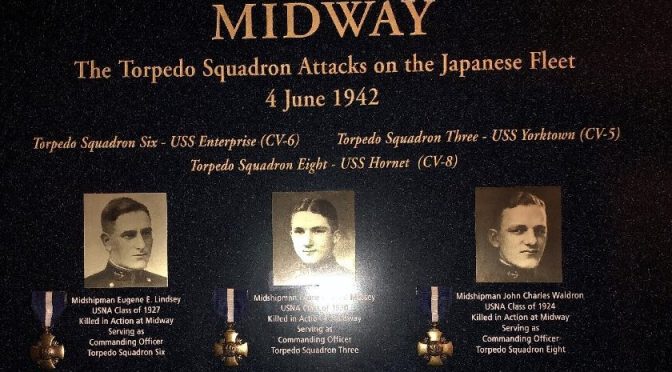
This plaque at the United States Naval Academy Club honors the three commanders of the torpedo bomber squadrons:
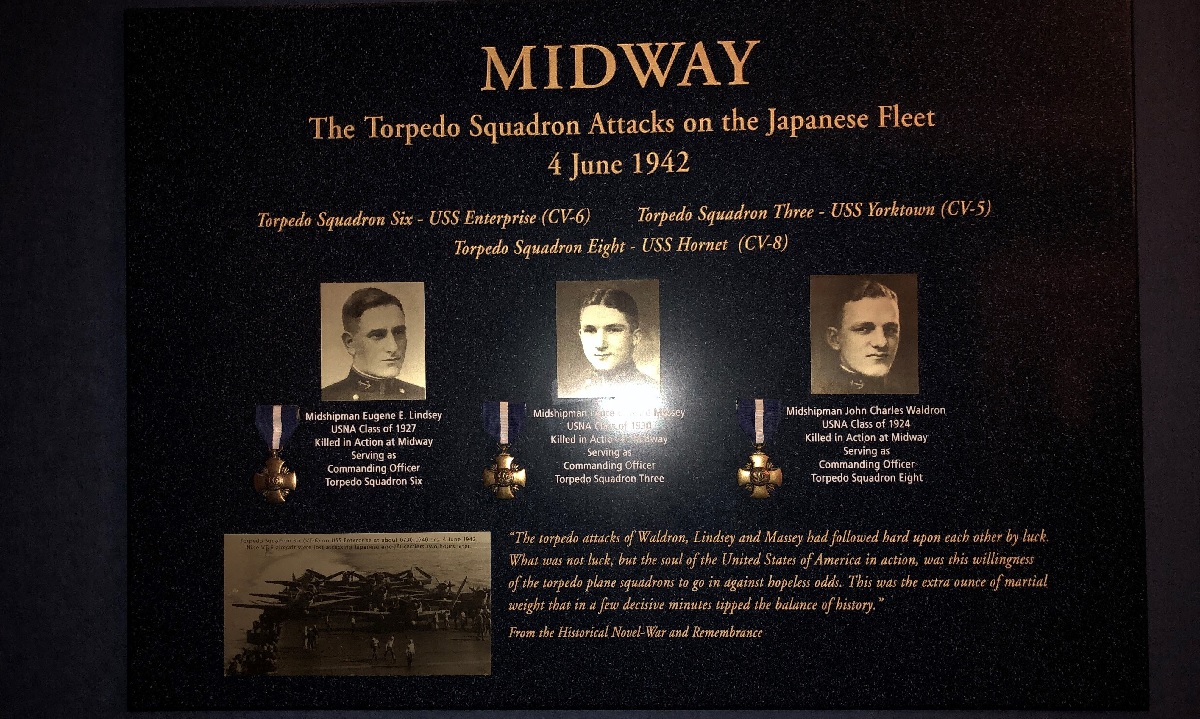
Plaque honoring the Torpedo Squadron commanders at Midway
Plaque honoring the Midway torpedo bomber squadron commanders

According to the Family Research Council, the plaque reads:

The torpedo attacks of Waldron, Lindsey, and Massey had followed hard upon each other by luck. What was not luck, but the soul of the United States in action, was the willingness of the torpedo plane squadrons to go in against hopeless odds. This was the extra ounce of martial weight that in a few decisive minutes tipped the balance of history.

When I read this story, it immediately occurred to me that this is the problem that serious Christians are facing today. Parents and pastors are not equipping young people to actually make a difference. Instead of finding and fighting the real targets: atheism, radical feminism, communism, etc., all our forces have been sent on wild goose chases, so that now “Christians” are actually trying to promote the priorities of the secular left, e.g. – global warming, wealth redistribution, affirming sexual immorality, open borders, critical race theory, etc.

The few of us who actually know how to do our jobs are poorly equipped. We are prevented from leading by organizations that are focused on feelings rather than results. We can only hope that our decision to attack against hopeless odds somehow paves the way for a second wave to succeed. It has happened before, and that’s why we should be brave and continue to engage our opponents using tools that work (philosophy of religion, evidential apologetics, scientific research, historical evidence, chastity, sobriety, self-control, good stewardship of our educations, careers and finances, effective charitable giving, self-sacrificial love, etc.).

What’s the best book for introducing all the basics of defending the faith?

Let’s look at the table of contents of my favorite introduction to Christian apologetics, which is “Is God Just a Human Invention?” written by Sean McDowell and Jonathan Morrow.

In that book, you will find 18 topics.

  1. Is Faith Irrational? (Commentary by: Gregory Koukl)
  2. Are Science and Christianity at Odds? (Commentary by: John Warwick Montgomery)
  3. Are Miracles Possible? (Commentary by: Gary R. Habermas)
  4. Is Darwinian Evolution the Only Game in Town? (Commentary by: William A. Dembski)
  5. How Did the Universe Begin? (Commentary by: R. Douglas Geivett)
  6. How Did Life Begin? (Commentary by: Fazale R. Rana)
  7. Why Is the Universe Just Right for Life? (Commentary by: Jay W. Richards)
  8. Has Science Shown There Is No Soul? (Commentary by: Dale Fincher and Jonalyn Fincher)
  9. Is God Just a Human Invention? (Commentary by: Garry DeWeese)
  10. Is Religion Dangerous? (Commentary by: Douglas Groothuis)
  11. Does God Intend for Us to Keep Slaves? (Commentary by: Paul Copan)
  12. Is Hell a Divine Torture Chamber? (Commentary by: Frank Turek)
  13. Is God a Genocidal Bully? (Commentary by: Clay Jones)
  14. Is Christianity the Cause of Dangerous Sexual Repression? (Commentary by: Kerby Anderson)
  15. Can People Be Good Without God? (Commentary by: Mark D. Linville)
  16. Is Evil Only a Problem for Christians? (Commentary by: Randy Alcorn)
  17. What Good Is Christianity? (Commentary by: Glenn S. Sunshine)
  18. Why Jesus Instead of the Flying Spaghetti Monster? (Commentary by: Darrell L. Bock)

Prominent atheist scholars are quoted in each chapter to introduce the challenges, and then scholarly arguments and evidence are presented to defend the Christian worldview. The language is simple enough, but the material is solid enough to use in a real debate. I would say that introductory books like this one are more than enough to equip you for everyone who will challenge you.

Why are these 18 topics important? Because these are the questions that atheists ask. These are the questions that cause Christians to leave the faith. These are the questions that your children will face in high school and college, which might cause them to leave the faith.

Let’s start with chapter one. One of the most prominent arguments by atheists is that faith is irrational. This chapter allows you to define faith using the Bible’s definition of faith, which relies on logic and evidence.

Atheists also say that Christianity is at war with science. In chapter 2, they discuss the history of science and how Christianity provided the framework that allowed scientific method to take root and flourish.

Atheists like to claim that miracles are impossible. Chapter 3 defends the view that God, if he exists, is capable of interacting with his created world.

Atheists love to put forward Darwinism as means to deny that God is the designer of life. Chapter 4 explains the concept of intelligent design, and why intelligent design is a better explanation for the history of life.

Atheists love to talk about how the universe has always existed, and there’s no need for a Creator. Chapter 5 contains a philosophical argument that is supported by mainstream science to argue that the universe had a beginning, just like the Bible says.

Atheists love to argue that life can emerge from non-life, and the process is simple. Chapter 6 is written by a biochemist, and it takes a look at the real complexity of the simplest living cell.

Atheists like to argue that the universe itself is just an accident, and there is no need for a Designer. Chapter 7 introduces the scientific evidence for fine-tuning and habitability.

Atheists like to say that there is no soul and no afterlife. Chapter 8 gives some arguments for the existence of the soul.

Atheists like to argue that Christians invent God because God makes them feel good. But chapter 9 explains that having an all-powerful God who can hold humans accountable is the last thing any human would want to invent.

Atheists like to talk about how religion, with it’s habit of teaching to believe in things that can’t be tested, causes religious people to do a lot of harm. Chapter 10 takes a look at the real record of Christianity as a force for good in the world.

Atheists like to talk about slavery in the Bible. Chapter 11 talks about what the Bible really says, and provides some rational responses to the accusation.

Atheists like to talk about eternal punishment in Hell isn’t a just punishment for just getting a few questions wrong on a theology exam. Chapter 12 provides an explanation and defense of the concept of Hell.

Atheists love to talk about how God commanded the Israelites to attack their enemies in the Bible. Chapter 13 explains who their enemies really were, and what was really happening in those wars.

Atheists feel that unrestricted sexual activity is very healthy and normal, and that the Biblical prohibitions outside of male-female marriage are repressive and unhealthy.  Chapter 14 explains why God has these rules in place, and supports his rules with evidence.

Atheists love to assert that they don’t need God, because they can behave morally on their own. Chapter 15 explains how to answer this claim by talking about how well atheism grounds objective moral values, objective moral duties, free will and moral accountability: the minimum requirements for objective morality.

Atheists think that the mere existence of natural disasters and human immorality are incompatible with the God of the Bible. Chapter 16 explains why this argument doesn’t work, and why even the concept of evil requires God to exist.

I have an atheist friend in my office who can’t defeat my scientific arguments for the origin of the universe, the fine-tuning and the origin of life. But still, he says to me, even if God exists, why would that matter to my life? Chapter 17 explains what difference Christianity makes in a person’s life.

Atheists think that the life of Jesus has no relevance to their life, and that he has nothing to offer them anyway. Chapter 18 explains the uniqueness of Jesus and explains why his resurrection is relevant to our lives today.

It’s important to understand that this book is not on the level of A. W. Tozer, G.K. Chesterton, Francis Chan, John Piper, etc. Those authors write for a Christian audience and therefore they do not equip you to answer realistic challenges from non-Christians. But the apologetics book we looked at actually equips you to answer challenges from non-Christians using logical arguments and evidence from mainstream history and science. You can use the material in that book in discussions outside the confines of your home and your church.

NYT: LGBT youth have greater approval, but mental health is “significantly worse”

It’s LGBT pride month, so everyone is going to tell me that I have to affirm LGBT doctrines and lifestyles, or else! So, instead of doing that, let’s look at some evidence about these topics. Did you know how the secular left looks at the poor mental health of LGBT youth, and asserts (without evidence) that more acceptance would make those outcomes better? Turns out the exact opposite is true.

Here’s the left-wing extremist New York Times, dated June 3rd, 2023:

For L.G.B.T.Q. teenagers, high school is a much more accepting place than even a decade ago. They change their pronouns, go to school dances with people of the same gender, and are more likely than any previous generation to openly identify as gay, lesbian, bisexual, transgender or otherwise queer.

[…]Yet there is a darker side. Even as they are increasingly welcomed by peers, their mental health is significantly worse than that of heterosexual young people.

[…]Their experiences highlight a “paradoxical finding,” as researchers have described it: Even as social inclusion for young L.G.B.T.Q. people has grown, large health disparities between them and their non-L.G.B.T.Q. peers have not shrunk.

The article talks about the strongest reasons why young people embrace LGBT:

  1. there are pro-LGBT TV shows, movies, music.
  2. famous pro athletes identify as LGBT
  3. the Supreme Court overturned legislation passed by elected legislators
  4. “everyone knows someone who is LGBT”
  5. social media supports LGBT
  6. big corporations support LGBT

Growing up in the situation I was in – poverty, different skin color, two working parents, public schools run by secular leftists – I wasn’t much interested in feeling good in the moment. I wanted an accurate view of the battlefield so I could make good decisions, and get out of the mess I was born into. I read the Bible, Shakespeare and my parents’ textbooks from their night classes at the local universities.

My approach was very different from the secular left. They don’t care about truth, or making good decisions to get good results. They care about living in the moment. They want to give in to their desires now, and point fingers later. They want to borrow money and run up expenses now, and pass the bill to someone else later. They are reckless and irresponsible. And they feel entitled to the life outcomes of those detestable Christians later. But they can’t be bothered to behave like those detestable Christians right now.

People who are LGBT are facing little to no disagreement or disapproval:

A recent survey by The New York Times and Morning Consult of 1,574 young adults found that people ages 18 to 28 — who mostly graduated from high school since 2013 — were significantly more likely to know L.G.B.T.Q. students in school than those a decade older, who were teenagers in the 2000s.

The younger group was twice as likely to report knowing at least one transgender student, and three times as likely to have known three or more. Four in 10 said they knew numerous gay, lesbian or bisexual people in high school, compared with a quarter of the older group.

And while both groups reported hearing the words “gay” and “queer” used negatively at similar rates — a data point reflected in interviews with teenagers, who say they still hear “that’s so gay” in school hallways — the younger graduates were significantly more likely to hear those words used in a positive light, too. They were also more likely to have a gay-straight alliance or similar club at their school.

This reflects other data that has found that verbal harassment of L.G.B.T.Q. teenagers declined during the 2010s, while support for same-sex marriage became the norm among young people.

And finally:

“You’re at the point among young adults where almost all these measures of acceptance are in the high 80s, low 90s,” said Jeff Jones, a senior editor who oversees research at Gallup. “It’s basically getting toward a consensus.”

Sounds wonderful for the secular left. They got the morality of the Bible removed from society. Young people today don’t even know what the Bible teaches are dating, relationships, marriage, sexuality, etc. All they know is TV shows, celebrities, entertainers, athletes, and what their public school teachers tell them.

Just one little problem. Secular leftists don’t get to determine what is objectively right and wrong. In a God-designed universe, God decides what works, and what doesn’t work. And no amount of community, peer-approval, propaganda, etc. is going to overrule God’s design for his creatures.

More:

As acceptance has grown, though, the mental health of queer youth has continued to suffer. Reported rates of mental health problems among all young people have been rising for the last decade, but non-heterosexual students face far higher rates than straight students.

About 70 percent of high school students who identify as gay, lesbian or bisexual reported persistent sadness, according to recent data from the Centers for Disease Control and Prevention, twice the rate of their heterosexual peers. One in five attempted suicide in the past year, nearly four times the rate of straight young people. (The C.D.C. does not track the mental health of transgender youth, but other data shows that roughly half had considered suicide in the past year.)

The New York Times tries to blame these numbers on being in a minority group. But Bible-believing Christians who embrace chastity, marriage, parenting and homeschooling are also a “minority group”. We don’t run the show any more. In fact, we’re the only minority that is still able to be targeted for ridicule and persecution, even by the police and government. But we also don’t have mental illnesses like the poor young people who believed the lies of the secular left, either. I wonder why that is. Could it be that chastity, marriage, parenting and homeschooling are morally right, whether anyone thinks it is or not? Could it be that these activities are self-evidently moral, and therefore just doing them makes the approval and celebration of other people completely unnecessary? For some behaviors, having an audience of One is enough.