New survey: 43% of millennials “don’t know, don’t believe” God exists

A new survey reported in Christian Post. Let’s see the numbers, then I’ll recommend a solution.

Excerpt:

The American Worldview Inventory 2021, a survey of the philosophy of life on American adults from Arizona Christian University, assessed the worldviews of four generations: millennials (born 1984-2002), Gen X (1965-1983), baby boomers (1946-1964) and builders (1927-1945).

Researchers found that among other recent generations, millennials have gone farther in cutting ties with traditional Christian views and normative biblical teaching.

[…]43% of millennials stated they either don’t know, don’t care or don’t believe God exists compared to 28% of boomers, and 44% of millennials believe Satan is a real and influential, compared to 64% of boomers.

The study also found that overall, younger Americans are significantly more likely than the two previous generations to embrace horoscopes as a guide and Karma as a life principle, to see “getting even” with others as defensible, to accept evolution over creation, and to view owning property as fostering economic injustice.

On spiritual matters, Americans younger than 55 are far more likely to distrust the Bible and to believe God is uninvolved in people’s lives.

So first point about this… just as with the recent election, the first thing that occurred to me is “what are Christian parents and Christian pastors doing to counter this?” It seems like we’ve been living with this problem for some time, but we just keep trying the same old approaches. Missions trips. Hearing the voice of God. Prosperity gospel. Chasing Democrat priorities like BLM and CRT and global warming and socialism and amnesty for illegal immigrants (see Russell Moore). Youth groups filled with entertainment and pizza. Pious Reformed theology that emphasizes fideism (presuppositionalist apologetics). Young-Earth creationism of the Ken Ham variety. Fact/Value splits with no rational grounding for any of the values in fact. There’s no point trying to convince anyone of the truth, because we are in the “last days” and everyone just wants to be evil.

I attend PCA and SBC churches, and there is zero emphasis on training church people to have conversations about basic questions like “does God exist?”, “is the Bible historically reliable?”, and “did Jesus rise from the dead?”. In these churches, we have very conservative leaders and parents. Parents and pastors are “competent” if they are married, have lots of children, kids in private Christian schools, hearing the voice of God. No one is able to have conversations with atheists that are persuasive. That would be “arguing” and “arguing” is bad.

I’ve spent YEARS trying to get debates and lectures from Christian academics who debate non-Christians into the church. Not just material from apologetics organizations, but mainstream training from groups like Focus on the Family. Nobody wants to watch debates with people like William Lane Craig. And nobody wants to read any books about science or history. That would be “testing God” with our “fallen reason”. And so, the exodus of young people from Christianity continues. I have to work with the people who were born into Christian homes and who went to youth group and Christian schools – I know how they lost their faith. I ask them.

Solving the Problem

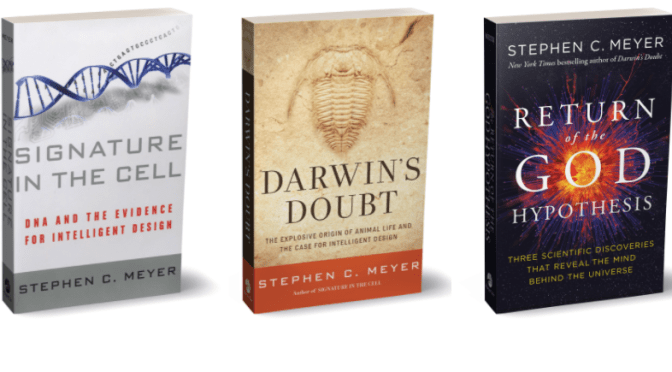
Anyway, with that said, I listened to a nice podcast from Apologetics 315 yesterday where they interviewed Dr. Stephen C. Meyer. In my opinion, no one does a better job of approaching the most core issues of the Christian faith with evidence that is convincing to open-minded non-Christians.

Here’s the podcast.

And they have an outline:

Episode 021 – Return of the God Hypothesis with Stephen C. Meyer

In this episode, Brian Auten and Chad Gross interview Dr. Stephen C. Meyer on his latest book Return of the God Hypothesis.

0:43 – Intro to Dr. Stephen Meyer, author of Return of the God Hypothesis, Signature in the Cell, and Darwin’s Doubt.
3:00 – Dr. Meyer’s background, education, and how he got interested in the question of intelligent design.
9:58 – Meyer’s view of science and philosophy of science, the importance for understanding philosophy when doing science.
16:28 – reviewing five centuries of the history of science, the false idea that science and religion have always been at war.
23:49 – The reason for telling the story of the rise of science, the rejection of the God hypothesis, and its subsequent return based on the most recent scientific discoveries.
28:15 – Explaining the methodology of inference to the best explanation. How this fits within theistic apologetics.
36:30 – Is our goal truth, or a pre-commitment to naturalism? What challenges has Meyer faced when arguing for intelligent design?
39:45 – Are there problems with postulating a mind as an intelligent cause? Are certain explanations “out of bounds” when doing science?
43:00 – Shannon information
43:55 – The origin of the universe, the fine-tuning of the universe, and the information in the cell. Resistance to change from a materialistic worldview.
47:40 – Huge theistic implications and the corresponding push-back to them.
49:15 – Helpful illustrations to explain the fine-tuning of the universe for life.
53:38 – Douglas Adams’ “puddle objection” to the fine-tuning argument; the response, and a counter-analogy. The weak-anthropic principle.
58:50 – How might these arguments fit into an apologetic for Christianity? The role of natural theology and the need for special revelation. The false dichotomy between evidentialism and presuppositional apologetics.

In the podcast, Dr. Meyer talks about evidence that bears on the question of God’s existence from science. Specifically, the origin of the universe, the cosmic fine-tuning, the origin of life, and the sudden origin of body plans in the fossil record. This is mainstream evidence from mainstream science that points to a Creator and Designer.

This podcast is not for beginners, it’s more for intermediate-level Christians. If you’re looking for something for beginners, I recommend the True U DVDs, which feature Dr. Meyer talking to college students.

New study: model of 700 quintillion terrestrial exoplanets suggests Earth is special

The Circumstellar Habitable Zone, where liquid water could potentially exist

This is from Scientific American. (H/T William)

Excerpt:

More than 400 years ago Renaissance scientist Nicolaus Copernicus reduced us to near nothingness by showing that our planet is not the center of the solar system. With every subsequent scientific revolution, most other privileged positions in the universe humans might have held dear have been further degraded, revealing the cold truth that our species is the smallest of specks on a speck of a planet, cosmologically speaking. A new calculation of exoplanets suggests that Earth is just one out of a likely 700 million trillion terrestrial planets in the entire observable universe. But the average age of these planets—well above Earth’s age—and their typical locations—in galaxies vastly unlike the Milky Way—just might turn the Copernican principle on its head.

Astronomer Erik Zackrisson from Uppsala University and his colleagues created a cosmic compendium of all the terrestrial exoplanets likely to exist throughout the observable universe, based on the rocky worlds astronomers have found so far. In a powerful computer simulation, they first created their own mini universe containing models of the earliest galaxies. Then they unleashed the laws of physics—as close as scientists understand them—that describe how galaxies grow, how stars evolve and how planets come to be. Finally, they fast-forwarded through 13.8 billion years of cosmic history. Their results, published to the preprint server arXiv (pdf) and submitted to The Astrophysical Journal, provide a tantalizing trove of probable exoplanet statistics that helps astronomers understand our place in the universe.

Discover magazine, which is all in for Darwinism and aliens everywhere, says this about the study:

Zackrisson found that Earth appears to have been dealt a fairly lucky hand. In a galaxy like the Milky Way, for example, most of the planets Zackrisson’s model generated looked very different than Earth — they were larger, older and very unlikely to support life.

[…]Zackrisson’s work suggests an alternative to the commonly held assumption that planets similar to Earth must exist, based on the sheer number of planets out there.

[…]One of the most fundamental requirements for a planet to sustain life is to orbit in the “habitable zone” of a star — the “Goldilocks” region where the temperature is just right and liquid water can exist. Astronomers have, to this point, discovered around 30 exoplanets in the habitable zones of stars. Simply extrapolating that figure based on the known number of stars suggests that there should be about 50 billion such planets in the Milky Way alone. Probability seems to dictate that Earth-twins are out there somewhere.

But according to Zackrisson, most planets in the universe shouldn’t look like Earth. His model indicates that Earth’s existence presents a mild statistical anomaly in the multiplicity of planets. Most of the worlds predicted by his model exist in galaxies larger than the Milky Way and orbit stars with different compositions — an important factor in determining a planet’s characteristics. His research indicates that, from a purely statistical standpoint, Earth perhaps shouldn’t exist.

Time for me to list out some of the things that are required for a galaxy, solar system and planet to support complex embodied life. Not just life as we know it, but life of any conceivable kind given these laws of physics.

  • a solar system with a single massive Sun than can serve as a long-lived, stable source of energy
  • a terrestrial planet (non-gaseous)
  • the planet must be the right distance from the sun in order to preserve liquid water at the surface – if it’s too close, the water is burnt off in a runaway greenhouse effect, if it’s too far, the water is permanently frozen in a runaway glaciation
  • the solar system must be placed at the right place in the galaxy – not too near dangerous radiation, but close enough to other stars to be able to absorb heavy elements after neighboring stars die
  • a moon of sufficient mass to stabilize the tilt of the planet’s rotation
  • plate tectonics
  • an oxygen-rich atmosphere
  • a sweeper planet to deflect comets, etc.
  • planetary neighbors must have non-eccentric orbits

It’s not easy to make a planet that supports life. For those who are interested in reaching out to God, he has left us an abundance of evidence for his existence – and his attention to detail.

Related posts

Does abortion reduce violent crime? Does abortion reduce child abuse?

If abortion reduces crime, why does the evidence show that it doesn't?
If abortion reduces crime, why does the evidence show that it doesn’t?

Grr, my annoying co-workers are at it again this morning. This time, it’s the man who annoyed me about overpopulation fears, which I responded to earlier this week. He says to me this morning that Alabama is going to have a big problem with violent crime because they’ve stopped abortions. These sorts of views are common among TV-watchers, but not among those study-readers.

Life Site News reports on a Yale Law & Economics Research Paper.

First, let’s see the abstract:

Abortion may prevent the birth of “unwanted” children, who would have relatively small investments in human capital and a higher probability of crime. On the other hand, some research suggests that legalizing abortion increases out-of-wedlock births and single parent families, which implies the opposite impact on investments in human capital and thus crime. The question is: what is the net impact? We find evidence that legalizing abortion increased murder rates by around about 0.5 to 7 percent. Previous estimates are shown to suffer from not directly linking the cohorts who are committing crime with whether they had been born before or after abortion was legal.

And now, let’s see the Life Site News article:

Law professors John R. Lott, Jr. of Yale Law School and John E. Whitley of the University of Adelaide found that legalizing abortion increased murder rates by up to seven percent. They concluded that legalizing abortion is a contributing factor to the great increase in out‑of‑wedlock births and single parent families, which in turn contribute to increased crime rates. Since 1970, the percentage of single‑parent households in the United States has nearly tripled, from 11 percent to 32 percent, and the percentage of out‑of‑wedlock births has nearly quadrupled, from 11 percent to 43 percent of all children.7 Children born out-of-wedlock and raised by only one parent have a significantly higher incidence of crime.

There are many other fundamental problems with the conclusion that legalized abortion leads to a decrease in crime.

Statistician David Murray confirmed that young males between the ages of 17 and 25 commit the majority of crimes. However, if abortion had reduced crime, the crime rates in the United States would have dropped first among young people. They did not. Instead, the number of crimes committed by older people dropped first. Nearly 60% of the decline in murder since 1990 involved killers aged 25 and older — who were born before Roe v. Wade.8

Murray also found that other nations with high abortion rates showed a large increase in crime about eighteen years after they legalized abortion. For example, in Great Britain, which legalized abortion in 1968, violent crime has been rising steeply since about 1985 ― exactly when it should have been declining, according to the Donohue‑Levitt thesis. Additionally, Russia, with the highest abortion rate on earth, has experienced a tidal wave of every kind of violent crime following the breakup of the Soviet Union.9

FBI statistics showed that the murder rate in 1993 for 14‑ to 17‑year‑olds in the USA (born in the years 1975‑1979, which had very high abortion rates) was 3.6 times higher than that of kids who were the same age in 1984 (who were born in the pre‑legalization years of 1966‑1970). Additionally, since Black women were having abortions at a much higher rate than White women, we should have expected the murder rate among Black youth to have declined beginning in about 1991. Instead, it increased more than five hundred percent from 1984 to 1993.10

Finally, the huge increase in violent crime that peaked in 1991 and then began to decline is more closely related to the crack epidemic, not abortion. The Donohue‑Levitt study confirms that the crime rate rose and fell exactly where crack cocaine was most easily available ― in the large cities and among young Black males.11 This is also confirmed by the rise in crime during the time period 1984 to 1991, after a decline from 1980 to 1984. If abortion were the primary cause of a decline in violent crime, the crime rate would have been relatively stable during the time period 1980 to 1991.

By the way, a good book to buy on this is John Lott’s “Freedomnomics: Why the Free Market Works and Other Half-Baked Theories Don’t“. One third of the book covers this topic.

And if you’re wondering what caused the decline in violent crime rates in the 1990s, the answer to that is that it was multiple factors. Better policing, mandatory sentencing laws, legalized concealed carry laws, and other factors were responsible.

Abortion and child abuse

Sometimes, pro-abortion people put forward a similar argument about abortion preventing child abuse. This argument seems intuitive, but from an evidence point of view, it’s false.

Here’s a report from Life News about a study out of Bowling Green State University.

Excerpt:

For decades, evidence has existed showing abortion contributes to a rise in child abuse. Now a new study by a post-abortion research institute and Bowling Green State University professors finds that women who have abortions are more likely to abuse their children.

Published in the medical journal Acta Paediatrica, the study found that women who have had abortions are 2.4 times more likely to physically abuse their children. Pro-life advocates say it proves the need for providing women with post-abortion counseling to help deal with the emotional trauma of the abortion.

[…]The authors suggested that “emotional difficulties and unresolved grief responses” from pregnancy loss, whether voluntary or involuntary, could have a negative impact on women’s mental health and lead to unhealthy parenting responses.

According to the Illinois-based Elliot Institute, which released information about the study’s findings, prior surveys “have linked pregnancy loss to an increase in grief reactions, anxiety, depression, sleep disturbances, and symptoms of post-traumatic stress disorder, all of which can have a negative impact on parent/child relationships.”

The post-abortion research group also points to a 2002 study published in the Journal of Child Psychiatry and Psychology that found abortion has been linked to an increase in substance abuse and thoughts of suicide, which could also contribute to child abuse.

The new study also found that women who had more than one miscarriage or stillbirth were more likely to engage in child abuse than women who had just one. However, women who had abortions were more likely to abuse their children whether they had one or more than one abortion.

“Regardless of the specific mechanisms at play, maternal history of one induced abortion does appear to be a marker for increased risk of physical abuse,” the authors concluded.

Whenever I read about how studies contradict people’s intuitions about what will and will not work, it makes me sad that so many people who live life on intuitions and feelings are still allowed to vote. If only we had a society where reason and evidence were seen as indispensable for building up your view of the world.

By the way, if you’re looking for a good article for debating other aspects of the Alabama pro-life law, my friend William, who loves to debate everything, and he always wins, just posted this article about 9 myths about the Alabama pro-life law.

General advice on countering your co-workers

I found that if I passed on TV and movies, I could buy pretty much any book I wanted that has research-based responses to these common questions from secular leftists. All it takes is a commitment to dedicate your book-buying budget to the task of responding to challenges, instead of producing feelings.

I notice a lot of Christian women in my office reading fiction books, while the Christian men are always talking about TV and movies. Fiction and entertainment are useless for putting forward Bible-based views and supporting evidence in controversial discussions. Instead of wasting your money on fiction and entertainment, listen closely to what people in your office are saying, and then purchase and train with resources that help you to serve God in these discussions. Bible verses and prayers alone will not equip you to serve in difficult situations.