

Judge rules that man must pay $50,000 a month to ex-girlfriend for 10 years

When I was younger, I got the impression from young women that men with strong views on theology and morality made them uncomfortable. I had my share of rejections by Christian women who didn’t like my strong Biblical views. At the time, I was worried that I might not be able to get married at all. But looking at how the family courts operate, that turned out to be a good thing.

The news story is from one of Canada’s national newspapers, the National Post:

A wealthy businessman will have to pay more than $50,000 a month in spousal support for 10 years to a woman with whom he had a long-term romantic relationship even though they kept separate homes and had no children together, Ontario’s top court has ruled.

Under Ontario law, an unmarried couple are considered common-law spouses if they have cohabited — lived together in a conjugal relationship — continuously for at least three years. But that doesn’t necessarily mean living in the same home, the court found.

[…]When their 14-year relationship finally broke down in May 2015, Climans asked the courts to recognize her as Latner’s spouse and order him to pay her support. He argued she had been a travel companion and girlfriend, nothing more. As such, he said, they were never legally spouses and he owed no support. An eight-day trial ensued.

In her decision in February 2019, Superior Court Justice Sharon Shore sided with Climans. She ruled they were in fact long-time spouses, finding that despite their separate home, they lived under one roof at Latner’s cottage for part of the summer, and during winter vacations in Florida. Shore ordered him to pay her $53,077 monthly indefinitely.

Superior Court Justice Sharon Shore didn’t care that the man never married this woman, or lived with her, or had children with her. He had money, and she wanted it, so the judge gave it to her.

Elsewhere in the article, we learn that he had asked her to sign a pre-nuptial agreement many times, and each time she refused. (Those are not even enforced in divorce courts) It’s like her plan all along was to demand that a judge awarded her all of this man’s money.

Some people will say “well, these are Ontario family courts, this is normal. Haven’t you heard about what happened to Dave Foley?” I think every man knows the story of what the Ontario divorce courts did to Dave Foley.

Here is a story about it from the far-left Toronto Star, otherwise known as the Toronto Red Star.

It says:

Dave Foley of beloved Toronto sketch troupe the Kids in the Hall is starting a new career in standup comedy, but not in Toronto — he suspects he’ll be arrested if he returns to Canada.

The 48-year-old faces a back child-support bill in Ontario of more than half a million dollars: the accumulation of a debt that accrues steadily at more than $17,000 per month. On the set of Servitude, a film shot in Toronto last year, “I told the production guys, I have a court appearance on Monday and there’s a good chance I’ll be in jail on Monday afternoon,’” Foley said in an interview with the Star.

During an appearance on comic Marc Maron’s WTF podcast last month, Foley explained that his marriage to Toronto writer Tabatha Southey ended during his run on NBC’s five-year hit comedy NewsRadio, and he has failed in his efforts to adjust his child support downward to reflect his new life after sitcom stardom.

“My income has dropped in the last 10 years, as anyone can tell from the number of s—ty movies I’ve been in,” says Foley. “I’m not exactly picking and choosing my projects.” However, four years ago, Superior Justice Nancy Backhouse denied his motion to vary his support payments.

[…]Foley says that Ontario’s Family Responsibility Office now has an enforcement order and last year sought a six-month jail sentence for him, which was to extend indefinitely, until the overdue support was paid.

Ontario family courts are notoriously anti-male, and men know this. Unfortunately, the female judges who make these rulings don’t seem to understand that men know what they are doing, and then opt out of marriage. It must be so wonderful for these judges to punish the men who appear before them. But they can’t punish the men who respond to what they are doing by declining to marry women, and then declining to date women, and then declining to even speak to women.

I looked up Superior Justice Nancy Backhouse, and found another article about her decisions, entitled “Judge rejects pre-nup, awards ex-wife $5.3-million”. So, pre-nuptial agreements are also thrown out in Ontario divorce courts.

But it’s not just Ontario. I have two Christian friends here in America who married their Christian wives as virgins, and then their wives divorced them. I heard what happened to them in divorce court. They lost custody of their kids, and they are forced to pay alimony and child support even though their ex-wives poison the children against them, and deny them communication rights and visitation rights. And men know that this is happening to other men. How can women expect men to marry when the financial risks are so high?

Forbes magazine explains:

Of the 400,000 people in the United States receiving post-divorce spousal maintenance, just 3 percent were men, according to Census figures. Yet 40 percent of households are headed by female breadwinners — suggesting that hundreds of thousands of men are eligible for alimony, yet don’t receive it.

The divorced courts are biased against men, and men are getting the message. They look at these cases, and they understand that marriage is not worth the financial risks. They don’t want to have their possessions stolen by radical feminist judges.

Further reading

An excellent book to read about this issue is Dr. Stephen Baskerville’s book “Taken Into Custody: The War Against Fathers, Marriage, and the Family“. You can read what the book is about here. Dr. Baskerville is a Christian and a conservative. He has a PhD from London School of Economics and does a good job of explaining the negative view that society has about men, and male leadership. And sadly, these negative man-blaming views are often shared by Christians, too.

William Lane Craig lectures on the historical Jesus at Columbia University

One of the other software engineers at work is always finding interesting sermons and lectures to listen to. On Friday afternoon, things were a bit slow, so she messaged me a lecture featuring Dr. William Lane Craig, talking on “Who Was Jesus?” at Columbia University. I wanted to encourage her, so I put it on to listen as well. I liked it so much, I wrote out a summary below to go with it.

Here is the lecture:

Description:

Dr. William Lane Craig unpacks questions surrounding Jesus’ resurrection and the historical accuracy of the biblical claims.  Columbia University, 2009.

And my outline:

Different views of Jesus:

  • Jewish view of Jesus
  • Muslim view of Jesus
  • skeptical historian view of Jesus
  • what did Jesus think about himself?
  • Jesus didn’t write anything of his own
  • best sources are the records of Jesus followers
  • problem: how do we know these records are accurate
  • maybe stories of Jesus’ divinity emerged over time

New tools from the Renaissance:

  • historiography
  • textual criticism
  • investigate Jesus as a historical figure
  • same tools are used for other historical figures

Sources:

  • Christian
  • Jewish
  • Roman
  • Many more sources than other figures of antiquity

External sources:

  • confirm what the gospels say, but don’t say anything new

Treating the Bible as a collection of ancient documents

  • not using the Bible to prove the Bible is divine
  • just treating the books as historical documents

New Testament

  • a collection of the earliest documents
  • much later documents about Jesus not included
  • later documents not written by eyewitnesses

Skeptical scholars:

  • ignore the earliest sources
  • focus on the later sources
  • result is a more radical left-friendly Jesus

Burden of proof

  • are the gospels assumed reliable until proven unreliable?
  • are the gospels assumed unreliable until proven reliable?

Five reasons to assume the New Testament is reliable

1. Insufficient time for legendary influences to erase the historical core

  • the gap between the events and the sources is much shorter than other comparable sources
  • Greek and Roman sources are at least 1-2 generations from the events they record
  • Gospels written down and circulated within first generation after the events they record
  • the eyewitnesses were alive at the time they were written down

2. Gospels are not the same genre as folk tales or urban legends

  • Gospels talk about real people who actually lived
  • Gospels talk about real places excavated by archaeologists

3. Oral tradition in first century Jewish society

  • Jewish culture valued reliable transmission of religious tradition
  • Memorization of long passages and entire books

4. Restraints on the embellishment of traditions about Jesus

  • The apostles and other eyewitnesses could correct embellishments

5. Gospel writers make testable statements that are found to be true

  • Luke is the author of the Gospel of Luke and the Book of Acts
  • In Acts, Luke accompanies with the eyewitnesses to the life of Jesus
  • Acts contains many historical details accurate to the times and places he writes about
  • Luke’s gospel is in accord with archaeological discoveries made since

It’s reasonable to accept the general reliability of the Gospels, unless they are found unreliable

Historical basis for facets of Jesus

1. Unique Son of God

  • historical critics claim that the divinity of Jesus developed over time
  • why would monotheistic Jews contradict their monotheism by inventing a divine Jesus?
  • the only reasonsable answer is that Jesus claimed divinity for himself
  • His followers accepted it because Jesus provided reasons to believe
  • Mark 12:1-8
    Earliest gospel reveals Jesus’ self-understanding as God’s “only beloved son”
  • Matthew 11:27
    “No one knows the Son except the Father, and no one knows the Father except the Son and those to whom the Son chooses to reveal him.” This story is also in Luke. Source is “Q”, an early set of traditions common to Matthew and Luke
  • Mark 13:32
    Jesus sees himself as above humans and angels, but subordinate to God the Father

Why would anyone take Jesus seriously, unless he was able to provide evidence?

2. Jesus’ miracles

  • Jesus’ miracle stories are in all four sources
  • The only reason to reject them is because of a philosophical bias against the supernatural

3. Trial and crucifixion

  • Crucifixion narrative is in the Gospels, Paul’s letters, Acts
  • Also confirmed by Josephus and Roman historians
  • Historians across the ideological spectrum affirm the crucifixion

Why was Jesus crucified?

  • Doesn’t fit with the skeptical view that Jesus was uncontroversial and had few followers

4. Jesus’ resurrection

  • Jesus resurrection is the best explanation for historical facts accepted by diverse majority of historians
  1. Burial location known to friends and enemies, and corpse would refute the resurrection
  2. Tomb was found empty by a group of Jesus’ women followers
  3. Post-mortem appearances to individuals and groups, friends, skeptics and enemies
  4. Original disciples became convinced that Jesus rose from dead counter to their own interests
  • The facts are accepted by a majority of scholars across the ideological spectrum
  • Dr. Craig’s debate with a scholar who invented an unknown, identical twin brother who was separated from Jesus at birth
  • Jewish historian Pinchas Lapide affirms the resurrection of Jesus as a historical event

Then there is a period of question and answer, which I did not find useful, because the questions seemed to be more about the needs and feelings of Christians, rather than about the facts presented by Dr. Craig, or about how these facts survive in debates on university campuses. Facts don’t care about your feelings.

It never hurts to listen to William Lane Craig. If you listen enough, you can remember his points when you get the opportunity. In college, all of my friends at Crusade could do his opening speech from his debates on God’s existence from memory.

For Independence Day, let’s learn about George Washington and the Battle of Trenton

My favorite book about the American Revolutionary war by far is called “1776”. It’s written by famous historian David McCullough. The part of the book that really stuck out to me was the Battle of Trenton. I think that this battle really defines the essential character of America, as seen in the decision-making of its great general and first President, George Washington.

In the book, I learned about how George Washington and his revolutionary army had suffered a string of defeats at the hands of the powerful Commonwealth army, and their mercenary allies. It was the middle of a freezing cold winter, and the many of the sickly and ill-equipped American troops were just days from having their enlistment contracts run out. Some of the troops were not waiting for their enlistments to expire, they were just deserting. In droves.

Washington was losing, and was just days from losing his Continental Army. If the Americans lost the revolutionary war, then it would mean that every man who signed the Declaration of Independence would be hanged as a traitor. The American revolutionaries had risked everything for liberty, and they were about to lose everything – their money, their property and even their lives.

I found a page that summarizes the battles leading up to the Battle of Trenton.

First battle, a defeat for Washington:

The Battle of White Plains

October 28, 1776

RESULT: BRITISH VICTORY

With the British army maneuvering to make his Harlem Heights position untenable, George Washington withdrew from the island of Manhattan, and established a new encampment further north near White Plains, New York.

On October 28, 1776, a flank attack by the British on this new position resulted in the collapse of Washington’s line. Thankfully, he was able to orchestrate an orderly withdrawal that preserved the army. Unfortunately, Washington’s retreat further exposed Fort Washington, which remained garrisoned on Manhattan.

Next, another defeat for Washington:

The Battle of Fort Washington

November 16, 1776

RESULT: BRITISH VICTORY

Following the defeat of George Washington’s army at White Plains, New York, British General William Howe focused his army’s attention on Fort Washington, the last post defended by the Continental army on Manhattan.  Although Washington hoped to abandon the fort, his officers convinced him that it needed to be held in order to keep British ships from ascending the Hudson River.

During a carefully-orchestrated, all-out attack on November 16, 1776, British and Hessian forces overwhelmed the fort’s garrison after vicious fighting. When he heard the attack begin, Washington, who had stationed himself across the Hudson River in New Jersey, travelled across the river to the enter the fort and personally inspect its defenses. Several officers accompanied Washington, including Generals Israel Putnam, Hugh Mercer, and Nathanael Greene. They convinced Washington to leave the fort just 30 minutes before it was surrounded.

And then, another defeat for Washington:

Evacuation of Fort Lee

November 20, 1776

RESULT: BRITISH VICTORY

After the fall of Fort Washington, George Washington made plans for the evacuation of Fort Lee, which stood across the Hudson River in New Jersey. In a letter written to John Hancock on November 19, 1776, the general wrote that “…Fort Lee was always considered as only necessary in conjunction with [Fort Washington]…,” and that it would be abandoned as soon as provisions and other supplies were removed.

Unfortunately, a large British force succeeded in scaling the heights close to the fort on November 20, 1776. Faced with superior numbers, Washington called for the immediate evacuation of the fort, which resulted in the loss of dozens of cannon, 2-300 tents, and 1,000 barrels of flour.

That brings us to the Battle of Trenton. Across the Delaware river from Washington’s army was an encampment of Hessian mercenaries, fighting for the British. The Hessians believed that Washington’s Continental army was in full retreat. The British generals had already written home to the King to tell him that the war was nearly over, and that they had won. But had they?

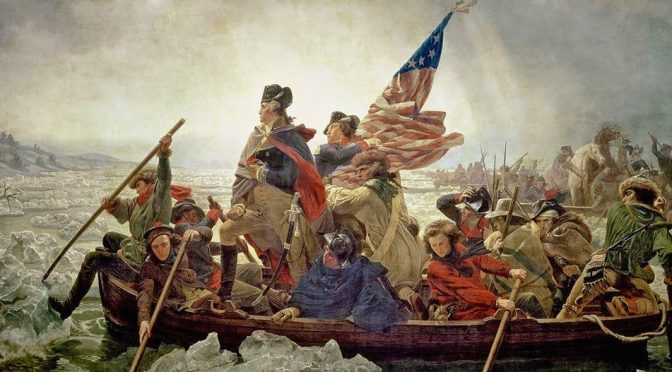
Washington crosses the Delaware

Here is what Washington decided to do on December 25th, 1776:

General George Washington’s commitment to cross the Delaware River on Christmas 1776 foreshadowed the many hardships faced as well as the eventual victory of the Continental Army during the American Revolution. At first glance, the decision to transport 2,400 Continental soldiers across an icy river in one night, directly into a severe winter storm of sleet and snow seems irrational.

Washington’s decision, however, was based on strategic motivation, understanding that the Continental Army desperately needed a victory after months of intense fighting with several significant defeats and no major victories. Washington also understood that the element of surprise was the only way that he and his army stood a chance of defeating the highly trained Hessian mercenaries.

On the morning of December 25, 1776, Continental soldiers woke up in their camps along the Delaware River to a frozen, snowy covered ground. Weather conditions worsened and temperatures continued to drop throughout the day. Late in the afternoon, the Continentals left their tents and began to form along the river in anticipation of the night’s events. Washington kept almost all of the details of the crossing a secret; as a result, none of the soldiers knew anything about their upcoming mission.

Washington’s crossing of the Delaware River on December 25, 1776 allowed his army to strike the Hessians at Trenton the next morning.

Washington’s plan was to cross the river at night, march to the nearby town of Trenton, New Jersey, and attack the Hessian garrison right before dawn. Time was Washington’s greatest enemy; to combat it his orders called for the various regiments to assemble at their designated crossing points no later than sunset. The close proximity to the crossing points allowed the soldiers to begin the journey immediately after nightfall struck and complete the crossing no later than midnight. Once across, Washington intended for the armies to reassemble and march approximately ten miles to Trenton, arriving there no later than five o’clock in the morning to achieve surprise. Despite his meticulous planning, the schedule failed almost before it even began.

Many of the regiments did not arrive at the river until well after dark. Additionally, a severe winter storm that included wind, rain, snow, hail, and sleet met the soldiers at the banks of the river significantly slowing their crossing. Many of the boats had to combat ice jams and unfavorable currents. To make matters even worse, the extreme darkness caused by the storm made it hard for the boatmen to see the opposite shore.

The necessity of using larger ferries to carry pieces of artillery across the river caused even more delays. Washington crossed the river with John Glover’s Marblehead mariners and upon arrival debated whether or not to cancel the entire operation because it was more than three hours behind schedule. Washington decided it was too costly to retreat and he painfully watched as his army continued to trickle across the river.

If you were standing by the river along with Washington watching his sick, frozen, ill-equipped army struggle across the Delaware, then you would probably think that Washington had lost the element of surprise. This attack was just taking too long to happen. Maybe Washington would give up his plan, because things hadn’t gone his way. But Washington didn’t quit – he persisted.

The Battle of Trenton, December 25, 1776
The Battle of Trenton, December 25, 1776 (click for larger image)

The Battle of Trenton

This is how the battle went down in Trenton, New Jersey:

Immediately following his famous crossing of the Delaware River, General George Washington marched the Continental Army to Trenton, New Jersey. The army’s forces included horses, guns, wagons, and soldiers, stretching for nearly one mile. The weather was worse than it had been crossing the river, but the army continued to proceed as Washington rode up and down the column pressing his men to carry on.

Shortly after eight o’clock on the morning of December 26, 1776, the Continental Army started its charge on the city. Three columns marched through thick snow with Washington personally leading the middle charge. As the soldiers pushed forward, artillery began to fire. At the same time, German drums urgently called the Hessians to arms. To his astonishment, Washington had maintained the element of surprise.

Immediately after the firing began, three Hessian regiments ran from their quarters ready to fight, quickly forming ranks. As the Hessians grouped, the Continental Army entered the city at two points: John Stark marched into the city on River Road from the west, while Nathanael Greene and Washington arrived from the north.

Andreas von Wiederholdt, a Hessian lieutenant, incorrectly reported to Colonel Johann Rall that the Continental Army had surrounded Trenton and there was no available route for retreat. As a result, Rall decided to counterattack Washington within the city and not retreat across Assunpink Creek. This proved to be costly as Washington’s forces occupied the highest ground in the city and had clear views of all of Rall’s movements.

Time after time, Washington countered Rall’s efforts to outflank the Continentals. Eventually, Washington’s forces overpowered the Hessians. Rall was mortally wounded and many of his soldiers broke ranks, fleeing from the fighting. Normally very disciplined, Rall’s regiment was confused and disoriented without their commander. They retreated to an orchard east of Trenton where they were forced to surrender.

Despite the large number of Hessians that escaped Trenton, Washington still won a crucial strategic and material victory. In only one hour of fighting, the Continental Army captured nearly nine hundred Hessian officers and soldiers as well as a large supply of muskets, bayonets, swords, and cannons. Washington ordered his soldiers to treat the Hessian prisoners in a humane manner, and the general quickly focused his attention on what to do next. Washington assembled all of his officers in Trenton to discuss whether they should attack another post, hold their position in Trenton, or retreat back across the Delaware. Washington decided that because of the condition of his army, the best move was to return to their camps across the River.

When the Continental Army returned to camp on the Pennsylvania side of the Delaware River, soldiers were exhausted. They had marched and fought for two straight days through rain, snow, sleet, and hail. Washington knew that his army had far exceeded expectations at Trenton and that they faced many more challenges going forward.

Washington won two more battles in rapid succession. Many of his troops re-enlisted because of these victories. There were many battles remaining to fight, and many hardships such as the winter at Valley Forge. But the Battle of Trenton was the turning point of the revolution. George Washington would not let a string of defeats stop him.