

New video series on intelligent design starts off discussing the Cambrian explosion

I am always on the lookout for good resources on science and Christianity. And I found some. Well, Uncommon Descent found them, and I read their blog, so I found them too. The first four episodes are out, and the topics are: 1) introducing the Cambrian explosion, 2) pre-Cambrian fossils, 3) punctuated equilibrium, and 4) Darwin’s “tree of life”. Each video is 12-20 minutes long.

So, before we see the videos, I feel I should explain the outline for arguing for a creator / designer of the universe from scratch. There are six main arguments. 1) the origin of the universe from nothing, 2) fine-tuning of the creation event, 3) fine-tuning for habitability in the galaxy, solar system, and planet, 4) the origin of the first living self-replicating organism, 5) irreducible / minimal complexity in molecular machines, 6) the sudden origin of basic body plans in the Cambrian explosion (a geological period a long time ago).

These four videos introduce you to the sixth argument in that list, the Cambrian explosion.

First video: Introducing the Cambrian explosion

Description:

When Charles Darwin published “On the Origin of Species” in 1859, he was painstakingly aware of the fact that the fossil record diametrically opposed his theory. Ever since Darwin’s time, paleontologists have put their finger on the Cambrian explosion, where most of the major animal phyla appear abruptly in the fossil record suddenly and without any evidence of intermediate forms preceding them in Precambrian strata.

Second video: evaluating precursors to the Cambrian explosion

Description:

Are there transitional forms and Precambrian fossils which reveal the evolution of the diverse animal phyla that appear in the Cambrian explosion? The history of paleontology shows the answer is no! As paleontologists have learned more about the fossil and geological record, the challenge of the Cambrian explosion to Darwinian theory has only increased.

Third video: evaluating punctuated equilibrium

Description:

In the 1970s, paleontologists Stephen Jay Gould and Niles Eldredge proposed a model of evolution called punctuated equilibrium, intended to resolve the lack of transitional forms in the fossil record. Can “Punk Eek,” as it’s often called, resolve the abrupt appearance of new animal phyla in the Cambrian explosion? This video explains why the answer is No—among many other problems, Punk Eek requires too much evolutionary change too quickly and lacks a biological mechanism to account for the rapid origin of anatomical novelty we see in the Cambrian period.

Fourth video: evaluating homology and phylogenetics

Description:

As more scientists have realized that the fossil record poses serious challenges to Darwin’s theory of evolution, many have turned to molecular homologies and phylogenetic trees to defend Darwin’s tree of life. But do these approaches really support Darwin’s tree? Nope.

If you like these videos, you can read a much longer, more detailed book about it by Dr. Stephen C. Meyer, called “Darwin’s Doubt”. Or, you can do what I’m doing and just read a chapter about it in the new book “The Comprehensive Guide to Science and Faith“. That book covers all 6 of the arguments I mentioned before. You can see the table of contents on the Discovery Institute web site. The chapter by Dr. Gunter Bechly entitled “Does the Fossil Record Demonstrate Darwinian Evolution?” covers the fossil record, and the Cambrian explosion in particular. I like Gunter a LOT, because he had a recent debate on the Unbelievable show on this topic, and he really cleaned the clock of his opponent, a slippery theistic evolutionist named Joshua Swamidass. It was beautiful. He cut through all the theistic evolution garbage and got straight into the science.
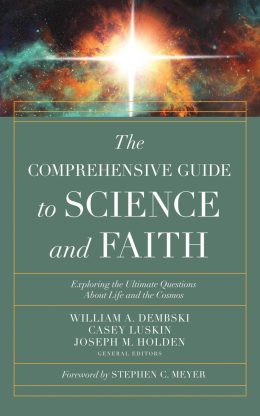
I’m reading the book right now. Or rather, I’m having it read to me, because I got the audio book version. If you remember reading books like “Mere Creation” (1998) and “The Creation Hypothesis” (1994) as a young man like I do, then you will love this book.

I like to know a little about every interesting topic, and then watch lots of university lectures and formal debates about them, so I can debate these topics in the places where I live and work. The new book has a lot of different authors from a lot of different perspectives writing on a lot of different topics. You could find a way to talk about these topics in pretty much any environment.

So far, I like Dr. Fazale Rana’s chapter on Adam and Eve the best, but I’m still in Section I. I’m just starting on Jay Richards chapter next. Jay Richards is one of my favorite Christian scholars.


A skeptical ancient historian explains which sources for the life of Jesus are earliest

We (WK and my friend Rose) have recorded and edited a half-dozen episodes for our new podcast. Rose wants to do one about the resurrection in time for Easter.  I have blogged here a lot about the early creed in 1 Corinthians 15, and how Paul confirmed that creed not once, but twice, in Galatians 1 and 2. And skeptical scholars accept that creed. In this post, we’ll take a look at one.

So, Rose and I have noticed that – at least at the beginning of their apologetics careers – many Christians think that apologetics is just pointing out relevant Bible verses to non-Christians, as if Bible verses were going to be accepted as evidence by non-Christians.  Or they quote people like C.S. Lewis and G.K. Chesterton, who are not typically making careful arguments or appealing to evidence.

I want to equip Christians discuss Christianity in the neighborhood, schools or workplace. So, I recommend reading books that have footnotes and indices. Books that engage non-Christian scholars are better than opinions / poetry. You should be watching good debates. William Lane Craig debates are good. I also like Stephen C. Meyer and Michael Behe debates. These are people who read and interact with skeptics.

So, as part of our Easter episode script development, I was showing Rose William Lane Craig’s debate with Gerd Ludemann, a German New Testament scholar. Their debate was published in book form as “Jesus’ Resurrection: Fact or Figment?: A Debate Between William Lane Craig & Gerd Ludemann“. Dr. Ludemann is considered to be on the far-left, and doesn’t accept miracles. His book on the resurrection is called “What Really Happened to Jesus: A Historical Approach to the Resurrection“. And I thought it would be interesting for us to see which historical sources HE considers reliable.

This guy is as skeptical as you can get.

In chapter 2 of his book, he writes:

The letters of Paul are the earliest texts of the New Testament and come from the years (40) 50-60. Only later did the Gospel of Mark appear (c. 70) and then the Gospel of Luke (c. 80), the Gospel of Matthew (c.85), Acts (c. 90) and finally the Gospel of John (c. 100).

It is generally recognized that none of the Gospels was written by companions or close associates of Jesus. People whom for more or less plausible reasons we call Matthew, Mark, Luke and John shaped the text in the form in which we now have it. Moreover, the occurrence of the same passages in several Gospels in wording which is very similar does not mean that such texts intrinsically have a greater truth content.

That’s the strong skeptical position, with extremely late dates for the gospels, and denying eyewitness authors. In contrast, a more moderate skeptic who also debated Dr. Craig named James Crossley dated the gospel of Mark from 37-43 AD in his published work.

So what does Ludemann think is early testimony?

This:

The testimony of Paul in 1 Corinthians 15:1-11 is the earliest text in the New Testament to make concrete mention of the death, resurrection and appearances of the risen Christ. Here Paul uses traditions which he knows from an earlier period. As I Corinthians is usually dated around 50, we may note, first, that the traditions which he mentions must be even older. Just how old remains to be seen. This early text will be the guideline for our investigations.

And a bit later:

There are different views about the origin of the piece of tradition in 1 Cor 15:3b-5. One trend of scholarship derives it from the Greek-speaking communities around Antioch and Damascus (with whom Paul had particularly close contact); another derives it from the Aramaic-speaking earliest community in Jerusalem, in which case we must presuppose a translation into Greek. On the whole the alternative ‘Jerusalem or Antioch?’ here seems to be exaggerated. ‘For even if the tradition came to Paul via the church in Antioch, this would only have handed on what it had received – from Jerusalem.”‘ Moreover, an argument in terms of content suggests Jerusalem as the origin of the tradition: the closing remark in 1 Cor 15:11 that Paul’s preaching corresponds with that of the others mentioned, i.e. the original apostles – and initially these were in Jerusalem.

The source for the material in 1 Corinthians 15:3-5 is Jerusalem, where the historical events are alleged to have occurred.

Here is his conclusion:

All the pieces of tradition investigated here (death, burial, resurrection, appearances) came into being at a very early date. We can assume that all the events reported in them are to be dated to the first couple of years after the crucifixion of Jesus. At all events this theory is probable for 1 Cor 15:3b-5. However, 1 Cor 15:6a,7 also provides compelling reasons for putting the conversion of Paul at the chronological end of the appearances listed, and this is to be thought of as being soon after the death of Jesus, which is generally put around the year 30.

A fairly certain date can similarly be worked out for the conversion of Paul as well. The Acts of the Apostles credibly reports a stay of Paul in Corinth when Gallio was there as governor of Achaia (Acts 18). Now this Gallio was in office in 51/52. If we calculate back from this date the intervals which Paul mentions in Gal 1:18 (‘three years’) and [Gal] 2:1 (‘fourteen years’), and add two years for travelling, the date of his conversion comes out at around 33.

So we may state that the appearances mentioned in 1 Cor 15:3-8 took place in the time between 30 and 33 CE (the fact of the appearances) because the appearance to Paul is the last in this list and is not to be dated later than 33 CE.

So, when we talk about making a minimal facts case for the bodily resurrection from reports that even the most skeptical historians accept, this is what we are talking about. Ludemann has his own naturalistic explanation for these reports, of course. But he accepts the same historical data that we use to make our case for the resurrection of Jesus. That’s important.

If you want to see Dr. Craig’s response to Dr. Ludemann’s case from the debate book, he’s posted it online. You can also watch the debate here. It’s not my favorite debate on the resurrection. Ludemann is pretty shocked by Craig’s conservative views, and hadn’t prepared as well as Craig for the debate.

The conclusion of this post is that I think it’s important for people not to go around quoting G.K. Chesterton and C.S. Lewis and Josh McDowell in the neighborhood, the schools and in the workplace. We can do a lot better than those guys now.

Governor Ron DeSantis signs bill banning grooming of young children in Florida schools

First let’s see the story, then I want to go over a bunch more laws that he’s signed into law. This guy is definitely running for President in 2024. He’s my current pick for the Republican nominee, because he has a pattern of taking on the secular left, and their allies in Big Tech and the corporate media. We have to measure his actions and see what he can do for us, if elected President.

Here’s the most recent action from Monday – a ban on teachers discussing sexual topics with children in grades K to 3:

Governor Ron DeSantis has signed H.B. 1557, the Parental Rights in Education Act. The signing ceremony took place Monday.

“A school district may not encourage classroom discussion about sexual orientation or gender identity in primary grade levels,” the bill says, not singling out any gender identity or sexual orientation – meaning the dominant kind of sexual orientation – non-LGBTQ – is banned in grades K-3 as classroom discussion.

Last week,  there was more action – signing a new bill to ensure transparency in the schools:

Friday, Governor Ron DeSantis signed H.B. 1467, “K-12 Education,” a bill that will require school districts to enact greater transparency measures like allowing parents to see library books, class book lists, instructional materials, along with the ability to review and object to class materials.

The bill will also ensure that the school curriculum and “teacher professional development” align with state standards and the required instruction “including no CRT [Critical Race Theory] or Common Core.”

“In Florida, our parents have every right to be involved in their child’s education. We are not going to let politicians deny parents the right to know what is being taught in our schools. I’m proud to sign this legislation that ensures curriculum transparency,” DeSantis said Friday.

The new legislation will also require that school districts make meetings open to the public when selecting instructional materials. There must be 20 days of public access to these materials before taking “official action” on them.

The Department of Education must publish a list of materials that have been removed or discontinued by school boards due to objections.

Last week there was more action – signing a new law designed to teach children basic financial skills in high school:

 Only one day after passing both chambers of the State Legislature, Florida Governor Ron DeSantis (R) signed a bill into law requiring students complete a financial literacy course for graduation in all Florida high schools.

Passed in the midst of the final week of legislative session, S.B. 1054, or the “Dorothy L. Hukill Financial Literacy Act,” sailed through the bicameral state legislature with a tremendous amount of support. Both the State House and Senate approved the measure unanimously.

Just prior to DeSantis signing the bill, the Governor stated, “Financial literacy is an important life skill for a student to have.”

“We think it will improve a student’s capability for financial management when they enter the real world.”

And don’t forget, last year, DeSantis signed bills to protect wildlife, banning biological males from women’s sports, and punishing Big Tech social media companies for censoring conservatives.

This is what you’re going to get from this man as President. He was willing to fight these battles against the Democrats and the corporate media and the corporations (e.g. – Disney) in his state, and that means we can expect the same from him as President.

It’s not just words that make a man trustworthy to be given authority. Look at the demonstrated actions. If a person can be trusted with a little authority, then they can be trusted with more authority. DeSantis did a good job with a little authority. We know what he likes to do when he’s given power. Surely, judging him by his actions is a lot better than just choosing a candidate based on mere words. Right? Right.