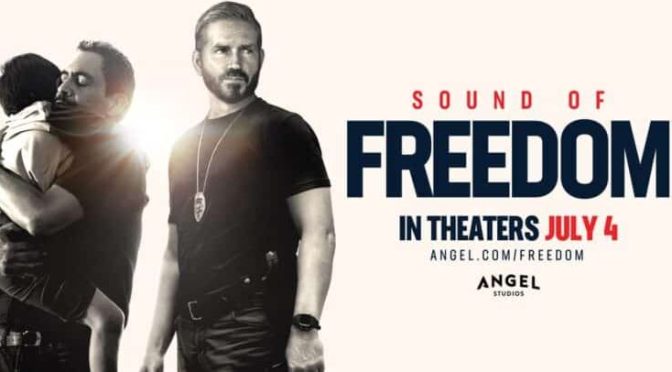
Is the new Jim Caviezel movie “Sound of Freedom” worth watching?

Well, Rose went to see the new Jim Caviezel movie on Wednesday night, and she reported back to me. She said it was the best movie she’s ever seen, or close to it. In this post, I wanted to go over a couple of points about the movie, then we’ll hear from the famous actor. Then I want to say something about whether society wants men to lead on moral and spiritual issues.

So, to start, something from Christian Post:

Devout Christian actor Jim Caviezel, who stars in the upcoming film “Sound of Freedom,” is calling on 2 million people to stand with him and expose the evil of child exploitation and trafficking.

Scheduled for release on July 4, “Sound of Freedom” tells the true story of one man’s journey to combat child sex trafficking. The studio behind the film, Angel Studios, unveiled the first trailer at their Illuminate event on Thursday.

“God’s children are not for sale,” the actor declares in the trailer.

Caviezel then delivered a call to action for anyone willing to buy a ticket to see the film and raise awareness against this prevalent form of slavery.

“We know this is heartbreaking and it hurts to look at, but the first step in helping these children is hearing their story. Not enough people know this problem exists and even fewer people are willing to do anything about it,” Caviezel declared.

“Our goal is to inspire 2 million people to attend the film’s opening weekend to represent the 2 million trafficked children around the world.”

[…]“Sound of Freedom” is based on the life of Tim Ballard, a former U.S. agent who battles human trafficking after rescuing a little boy whose sister remained captive to traffickers and was sent to Colombia.

Hollywood, which is largely dominated by secular leftist Democrats, does not like movies that are critical of pedophilia and sex-trafficking.

The film was rejected by multiple Hollywood studios but Angel Studios acquired worldwide distribution rights earlier this year.

Angel Studios is a platform for filmmakers to collaborate with the audience and bring projects to life by crowdfunding. It currently creates and distributes films and TV series worldwide and is known as the studio behind “The Chosen” and “Dry Bar Comedy.”

Angel Studios CEO Neal Harmon said his company feels a responsibility to take action and answer the prayers of the 2 million children around the world who are crying for freedom.

You can’t watch the movie on Netflix, HBO Max, Hulu, or Amazon Prime, because they apparently oppose movies that make pedophiles and sex-traffickers feel bad.

According to this video, Disney did not want the movie to come out, which is understandable, given their actions in Florida:

This interview with Caviezel is also very good, and makes the point that Hollywood is opposed to movies that are critical of pedophilia and sex-trafficking of children.

So what I wanted to comment on was this article that Rose sent me from the Daily Wire, which has some challenging words for Christians about moral evils like sex-trafficking:

“The problem is that modern day Christianity has become so weak and useless,” Caviezel told Fox News Digital in a new interview. “I mean, modern day Christians are more afraid of the devil than they are of God. God could destroy the devil without a glance, but he looks to us to make a decision.”

The “Person of Interest” actor went on to say that Americans mostly “don’t want” God in their lives, which has led to the overall deterioration of society.

So I wanted to say something about whether Christians – especially Christian men – are allowed to make truth claims and moral claims. I think a lot of opposition to truth and morality comes from inside the church. Let me explain.

I have no problem with Christian teachings like a real, eternal Hell or the immorality of homosexuality. But when I bring up my views in Christian environments, it is not well received by emotional people in the church. And that’s because the emotional people in the church are forming their views on truth and morality based on their feelings. They liked the idea of postmodernism – that things are true and false based on feelings. They liked the idea of relativism – that right and wrong are different for each person. When they hear a man claiming that something is false, or that something is wrong, they feel bad. They want everything to be equally true, and they want everything to be equally right. “Don’t judge” they say.

That’s what I see happening today. This emotion-dominated view of truth and morality has taken over the culture, making it hard for Christian men to lead on moral and spiritual issues. The new religion is “don’t judge”. So, when a man sees someone acting in reckless, irresponsible ways, he cannot be allowed to identify their action as the root cause and shame them for it. Because that would hurt their tender feelings. The answer to evils can only ever be that other people are forcing the bad behavior. “The cause is systemic, so don’t judge” the emotional people say. And then the emotional people demand that you solve problems with forgiveness and redistributing wealth to equalize outcomes.

I have even had one woman tell me not to judge women who have unpaid student loans for useless degrees, because “if God forgives them, then you have no right to speak out against student loans for useless degrees”. That’s where we are now. “Don’t judge” is ruling and reigning our culture. We can never warn people before they make a costly mistake, by telling them the truth, or by telling them what’s right and wrong. That’s “judging”. We have to let them follow their hearts, and then pay the costs ourselves.

Imagine that you walk into the house and find the floors covered with 2 inches of water. You go upstairs and find that all the faucets in the bathtub, shower and sinks are on, and overflowing. You say “It’s wrong to flood the house” and then you take action to turn off the faucets. Right now, the emotional people are telling the truth and morality people not to turn off the faucets, but to take a bucket and throw water out. Why? Because we don’t want to make the person who opened the faucets feel bad for doing reckless, irresponsible actions. Just leave the faucets on, and grab a bucket instead.

Well, I’m not going to use my time, money and effort to fix problems without addressing the root cause. Either we go back to allowing men to tell the truth and defend right and wrong – even if some people’s feelings are hurt – or we can count men out of solving problems. Men are not designed to be servants who tip-toe around the feelings of other people. Men tell the truth, and men defend the moral law. We are not here to be the clowns and servants of emotional people. And we are not here to be slowed down in our championing of truth and morality by the emotional people.

What should Christians bring up when discussing truth with Muslims?

I have some experience dicussing Islam because my mother’s side of the family is all Muslim. My go-to argument has always been to confront them about the Qur’an’s claim that Jesus did not die of crucifixion. But I noticed a different argument from Laura Powell, who knows far more about this topic than I do. Do you think her approach is the best one?

She writes about it over at her blog, An Affair with Reason:

The crux of the argument is this: The Qur’an affirms the inspiration, authority, and preservation of the New Testament Gospels;[2] yet the Qur’an also contradicts the Gospels on major theological and historical points. Therefore, the Qur’an cannot be reliable.

According to the Qur’an, the Gospel is the trustworthy, reliable revelation of God given as a guidance for mankind (Qur’an 3:3-4). These Scriptures from God were available and trustworthy when the Qur’an was revealed in the 7th century A.D., and those who had access to them were repeatedly told to obey them, judge by them, submit to their teaching, and stand fast upon them. In other words, according to the Qur’an, the Gospels are the inspired and authoritative words of God.

Qur’an 5:47 says, “And let the People of the Gospel judge by what Allah has revealed therein. And whoever does not judge by what Allah has revealed—then it is those who are the defiantly disobedient.”

Furthermore, Qur’an 5:68 states, “Say, ‘O People of the Scripture, you are [standing] on nothing until you uphold [the law of] the Torah, the Gospel, and what has been revealed to you from your Lord’” (see also 6:114; 3:3-4).

What I like about her argument is that she’s just taking the words of the Qur’an seriously, and asking the Muslims who claim to believe it what’s going on here. Why say that the gospels are unreliable today, when the Qur’an said that the gospels were reliable, yesterday.

My argument about the death of Jesus requires us to ask Muslims “where is the non-Muslim historian who thinks that Jesus did not die?” There isn’t one.

But my argument requires that the Muslim know something about historical scholarship, to know what non-Muslim historians think.Laura’s argument has wider appeal, because it doesn’t require that the Muslim have any knowledge about history – only knowledge about what their own holy book says.

She concludes with this:

What we see here is that the Qur’an teaches the inspiration, authority, and preservation of the Gospels. The Qur’an was intended as an Arabic version of the message of truth found in the Jewish and Christian Scriptures, but this presents a huge problem for Muslims because the Qur’an contradicts the Christian Scriptures on essential doctrines. Most notably, the Qur’an teaches that Jesus was not God incarnate, he did not die on a cross, and he was not raised from the dead (Qur’an 4:157; 5:116).

Here’s the dilemma for Muslims: If the Gospels are not trustworthy, then the Qur’an is false because it teaches that the Gospels are the inspired, perfectly preserved, authoritative words of God. But if the Gospels are trustworthy, then the Qur’an is false because it teaches contradictory, mutually exclusive facts about key issues. Either way, the Qur’an is false.

This, of course, is a huge problem for Muslims. The validity of Islam rests upon the reliability of the Qur’an, just as Christianity rests upon the truth of the divinity, death, and resurrection of Jesus. If the Qur’an is unreliable, then Islam is a false religion.

I like that she’s comfortable having disagreements with people. That’s not very common in the church today, in my experience.

By the way, this is the same Laura who wrote that really good article about how she found a better way to discuss her Christian worldview when she moved on from sharing her testimony. I blogged about it here.

For Independence Day, let’s learn about George Washington and the Battle of Trenton

My favorite book about the American Revolutionary war by far is called “1776”. It’s written by famous historian David McCullough. The part of the book that really stuck out to me was the Battle of Trenton. I think that this battle really defines the essential character of America, as seen in the decision-making of its great general and first President, George Washington.

In the book, I learned about how George Washington and his revolutionary army had suffered a string of defeats at the hands of the powerful Commonwealth army, and their mercenary allies. It was the middle of a freezing cold winter, and the many of the sickly and ill-equipped American troops were just days from having their enlistment contracts run out. Some of the troops were not waiting for their enlistments to expire, they were just deserting. In droves.

Washington was losing, and was just days from losing his Continental Army. If the Americans lost the revolutionary war, then it would mean that every man who signed the Declaration of Independence would be hanged as a traitor. The American revolutionaries had risked everything for liberty, and they were about to lose everything – their money, their property and even their lives.

I found a page that summarizes the battles leading up to the Battle of Trenton.

First battle, a defeat for Washington:

The Battle of White Plains

October 28, 1776

RESULT: BRITISH VICTORY

With the British army maneuvering to make his Harlem Heights position untenable, George Washington withdrew from the island of Manhattan, and established a new encampment further north near White Plains, New York.

On October 28, 1776, a flank attack by the British on this new position resulted in the collapse of Washington’s line. Thankfully, he was able to orchestrate an orderly withdrawal that preserved the army. Unfortunately, Washington’s retreat further exposed Fort Washington, which remained garrisoned on Manhattan.

Next, another defeat for Washington:

The Battle of Fort Washington

November 16, 1776

RESULT: BRITISH VICTORY

Following the defeat of George Washington’s army at White Plains, New York, British General William Howe focused his army’s attention on Fort Washington, the last post defended by the Continental army on Manhattan.  Although Washington hoped to abandon the fort, his officers convinced him that it needed to be held in order to keep British ships from ascending the Hudson River.

During a carefully-orchestrated, all-out attack on November 16, 1776, British and Hessian forces overwhelmed the fort’s garrison after vicious fighting. When he heard the attack begin, Washington, who had stationed himself across the Hudson River in New Jersey, travelled across the river to the enter the fort and personally inspect its defenses. Several officers accompanied Washington, including Generals Israel Putnam, Hugh Mercer, and Nathanael Greene. They convinced Washington to leave the fort just 30 minutes before it was surrounded.

And then, another defeat for Washington:

Evacuation of Fort Lee

November 20, 1776

RESULT: BRITISH VICTORY

After the fall of Fort Washington, George Washington made plans for the evacuation of Fort Lee, which stood across the Hudson River in New Jersey. In a letter written to John Hancock on November 19, 1776, the general wrote that “…Fort Lee was always considered as only necessary in conjunction with [Fort Washington]…,” and that it would be abandoned as soon as provisions and other supplies were removed.

Unfortunately, a large British force succeeded in scaling the heights close to the fort on November 20, 1776. Faced with superior numbers, Washington called for the immediate evacuation of the fort, which resulted in the loss of dozens of cannon, 2-300 tents, and 1,000 barrels of flour.

That brings us to the Battle of Trenton. Across the Delaware river from Washington’s army was an encampment of Hessian mercenaries, fighting for the British. The Hessians believed that Washington’s Continental army was in full retreat. The British generals had already written home to the King to tell him that the war was nearly over, and that they had won. But had they?

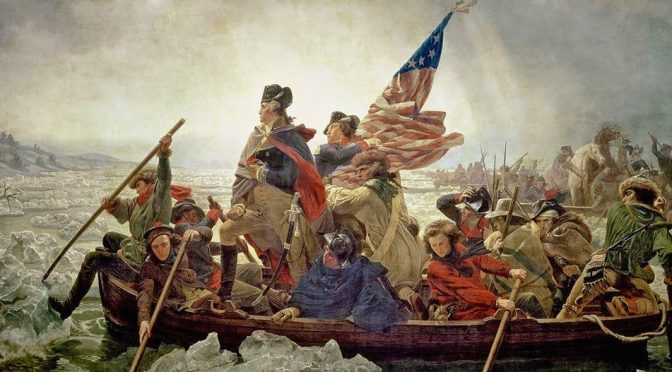
Washington crosses the Delaware

Here is what Washington decided to do on December 25th, 1776:

General George Washington’s commitment to cross the Delaware River on Christmas 1776 foreshadowed the many hardships faced as well as the eventual victory of the Continental Army during the American Revolution. At first glance, the decision to transport 2,400 Continental soldiers across an icy river in one night, directly into a severe winter storm of sleet and snow seems irrational.

Washington’s decision, however, was based on strategic motivation, understanding that the Continental Army desperately needed a victory after months of intense fighting with several significant defeats and no major victories. Washington also understood that the element of surprise was the only way that he and his army stood a chance of defeating the highly trained Hessian mercenaries.

On the morning of December 25, 1776, Continental soldiers woke up in their camps along the Delaware River to a frozen, snowy covered ground. Weather conditions worsened and temperatures continued to drop throughout the day. Late in the afternoon, the Continentals left their tents and began to form along the river in anticipation of the night’s events. Washington kept almost all of the details of the crossing a secret; as a result, none of the soldiers knew anything about their upcoming mission.

Washington’s crossing of the Delaware River on December 25, 1776 allowed his army to strike the Hessians at Trenton the next morning.

Washington’s plan was to cross the river at night, march to the nearby town of Trenton, New Jersey, and attack the Hessian garrison right before dawn. Time was Washington’s greatest enemy; to combat it his orders called for the various regiments to assemble at their designated crossing points no later than sunset. The close proximity to the crossing points allowed the soldiers to begin the journey immediately after nightfall struck and complete the crossing no later than midnight. Once across, Washington intended for the armies to reassemble and march approximately ten miles to Trenton, arriving there no later than five o’clock in the morning to achieve surprise. Despite his meticulous planning, the schedule failed almost before it even began.

Many of the regiments did not arrive at the river until well after dark. Additionally, a severe winter storm that included wind, rain, snow, hail, and sleet met the soldiers at the banks of the river significantly slowing their crossing. Many of the boats had to combat ice jams and unfavorable currents. To make matters even worse, the extreme darkness caused by the storm made it hard for the boatmen to see the opposite shore.

The necessity of using larger ferries to carry pieces of artillery across the river caused even more delays. Washington crossed the river with John Glover’s Marblehead mariners and upon arrival debated whether or not to cancel the entire operation because it was more than three hours behind schedule. Washington decided it was too costly to retreat and he painfully watched as his army continued to trickle across the river.

If you were standing by the river along with Washington watching his sick, frozen, ill-equipped army struggle across the Delaware, then you would probably think that Washington had lost the element of surprise. This attack was just taking too long to happen. Maybe Washington would give up his plan, because things hadn’t gone his way. But Washington didn’t quit – he persisted.

The Battle of Trenton, December 25, 1776
The Battle of Trenton, December 25, 1776 (click for larger image)

The Battle of Trenton

This is how the battle went down in Trenton, New Jersey:

Immediately following his famous crossing of the Delaware River, General George Washington marched the Continental Army to Trenton, New Jersey. The army’s forces included horses, guns, wagons, and soldiers, stretching for nearly one mile. The weather was worse than it had been crossing the river, but the army continued to proceed as Washington rode up and down the column pressing his men to carry on.

Shortly after eight o’clock on the morning of December 26, 1776, the Continental Army started its charge on the city. Three columns marched through thick snow with Washington personally leading the middle charge. As the soldiers pushed forward, artillery began to fire. At the same time, German drums urgently called the Hessians to arms. To his astonishment, Washington had maintained the element of surprise.

Immediately after the firing began, three Hessian regiments ran from their quarters ready to fight, quickly forming ranks. As the Hessians grouped, the Continental Army entered the city at two points: John Stark marched into the city on River Road from the west, while Nathanael Greene and Washington arrived from the north.

Andreas von Wiederholdt, a Hessian lieutenant, incorrectly reported to Colonel Johann Rall that the Continental Army had surrounded Trenton and there was no available route for retreat. As a result, Rall decided to counterattack Washington within the city and not retreat across Assunpink Creek. This proved to be costly as Washington’s forces occupied the highest ground in the city and had clear views of all of Rall’s movements.

Time after time, Washington countered Rall’s efforts to outflank the Continentals. Eventually, Washington’s forces overpowered the Hessians. Rall was mortally wounded and many of his soldiers broke ranks, fleeing from the fighting. Normally very disciplined, Rall’s regiment was confused and disoriented without their commander. They retreated to an orchard east of Trenton where they were forced to surrender.

Despite the large number of Hessians that escaped Trenton, Washington still won a crucial strategic and material victory. In only one hour of fighting, the Continental Army captured nearly nine hundred Hessian officers and soldiers as well as a large supply of muskets, bayonets, swords, and cannons. Washington ordered his soldiers to treat the Hessian prisoners in a humane manner, and the general quickly focused his attention on what to do next. Washington assembled all of his officers in Trenton to discuss whether they should attack another post, hold their position in Trenton, or retreat back across the Delaware. Washington decided that because of the condition of his army, the best move was to return to their camps across the River.

When the Continental Army returned to camp on the Pennsylvania side of the Delaware River, soldiers were exhausted. They had marched and fought for two straight days through rain, snow, sleet, and hail. Washington knew that his army had far exceeded expectations at Trenton and that they faced many more challenges going forward.

Washington won two more battles in rapid succession. Many of his troops re-enlisted because of these victories. There were many battles remaining to fight, and many hardships such as the winter at Valley Forge. But the Battle of Trenton was the turning point of the revolution. George Washington would not let a string of defeats stop him.