
What produces more fraud? The free market or government-run programs?

From National Review, an article examining how government programs like Medicare and Medicaid are ripe for fraud and waste.

Excerpt:

The three most salient characteristics of Medicare and Medicaid fraud are: It’s brazen, it’s ubiquitous, and it’s other people’s money, so nobody cares.

Consider some of the fraud schemes discovered in recent years. In Brooklyn, a dentist billed taxpayers for nearly 1,000 procedures in a single day. A Houston doctor with a criminal record took her Medicare billings from zero to $11.6 million in one year; federal agents shut down her clinic but did not charge her with a crime. A high-school dropout, armed with only a laptop computer, submitted more than 140,000 bogus Medicare claims, collecting $105 million. A health plan settled a Medicaid-fraud case in Florida for $138 million. The giant hospital chain Columbia/HCA paid $1.7 billion in fines and pled guilty to more than a dozen felonies related to bribing doctors to help it tap Medicare funds and exaggerating the amount of care delivered to Medicare patients. In New York, Medicaid spending on the human-growth hormone Serostim leapt from $7 million to $50 million in 2001; but it turned out that drug traffickers were getting the drug prescribed as a treatment for AIDS wasting syndrome, then selling it to bodybuilders. And a study of ten states uncovered $27 million in Medicare payments to dead patients.

These anecdotes barely scratch the surface. Judging by official estimates, Medicare and Medicaid lose at least $87 billion per year to fraudulent and otherwise improper payments, and about 10.5 percent of Medicare spending and 8.4 percent of Medicaid spending was improper in 2009. Fraud experts say the official numbers are too low. “Loss rates due to fraud and abuse could be 10 percent, or 20 percent, or even 30 percent in some segments,” explained Malcolm Sparrow, a mathematician, Harvard professor, and former police inspector, in congressional testimony. “The overpayment-rate studies the government has relied on . . . have been sadly lacking in rigor, and have therefore produced comfortingly low and quite misleading estimates.” In 2005, the New York Timesreported that “James Mehmet, who retired in 2001 as chief state investigator of Medicaid fraud and abuse in New York City, said he and his colleagues believed that at least 10 percent of state Medicaid dollars were spent on fraudulent claims, while 20 or 30 percent more were siphoned off by what they termed abuse, meaning unnecessary spending that might not be criminal.” And even these experts ignore other, perfectly legal ways of exploiting Medicare and Medicaid, such as when a senior hides and otherwise adjusts his finances so as to appear eligible for Medicaid, or when a state abuses the fact that the federal government matches state Medicaid outlays.

Government watchdogs are well aware of the problem. Every year since 1990, the U.S. Government Accountability Office has released a list of federal programs it considers at a high risk for fraud. Medicare appeared on the very first list and has remained there for 22 straight years. Medicaid assumed its perch eight years ago.

They waste money because it’s not their money – it’s your money. Private companies minimize waste because it is in their interest to minimize waste – they have to be competitive and be responsive to customers, or they don’t get paid. The profit motive reduces waste and fraud.
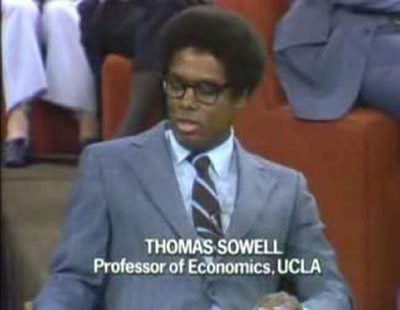
Thomas Sowell on health care: thinking beyond stage one

Young Thomas Sowell

Economist Thomas Sowell explains what socialized medicine means for all parties – and what evidence is ignored.

Excerpt:

The same preference for talking points, and the same lack of interest in digging into the facts about realities, prevails today in discussions of whether to have a government-controlled medical system.

Since there are various countries, such as Canada and Britain, that have the kind of government-controlled medical systems that some Americans advocate, you might think that there would be great interest in the quality of medical care in these countries.

The data are readily available as to how many weeks or months people have to wait to see a primary-care physician in such countries, and how many additional weeks or months they have to wait after they are referred to a surgeon or other specialist. There are data on how often their governments allow patients to receive the latest pharmaceutical drugs, as compared with how often Americans use such advanced medications.

But supporters of government medical care show virtually no interest in such realities. Their big talking point is that the life expectancy in the United States is not as long as in those other countries. End of discussion, as far as they are concerned.

They have no interest in the reality that medical care has much less effect on death rates from homicide, obesity, and narcotics addiction than it has on death rates from cancer or other conditions that doctors can do something about. Americans survive various cancers better than people anywhere else. Americans also get to see doctors much sooner for medical treatment in general.

Conservatives are the reality-based community.

How the Obama administration opposes the creation of 100,000 jobs

Comparison of unemployment rates - Bush vs Obama

The Wall Street Journal reports on how Obama’s Environmental Protection Agency is trying to block a pipeline from Alberta that would create 100,000 jobs and lower oil prices at the pump.

Excerpt:

With 9.1% unemployment and gasoline prices in the stratosphere, President Obama must sometimes wish that some big corporation would suddenly show up and offer a shovel-ready, multibillion-dollar project to create 100,000 jobs and reduce U.S. reliance on oil from dictatorships.

Oh, wait. His Secretary of State has had that offer sitting on her desk since she was sworn in. The trouble is that the Administration can’t approve it without upsetting its anti-fossil fuel constituency. And so the proposal sits.

In September 2008 TransCanada applied to build a new pipeline—the Keystone XL—to bring diluted bitumen from the oil-rich tar sands of Alberta to thirsty American refineries on the Gulf Coast. It is hardly a radical proposal. Canadian crude has been flowing to the U.S. for decades. Another Canadian company—Enbridge—operates the Clipper pipeline across the Canadian border to Chicago. In July 2010 TransCanada began operating its Keystone pipeline from Alberta to Cushing, Oklahoma, which is a major storage and pricing depot.

The Keystone XL would cut a slightly different path, through the American heartland to Port Arthur, Texas. Judging from its past experience and that of Enbridge, TransCanada expected that permitting would take roughly 23 months. Thirty-three months, two State Department studies and 208,000 public comments later, TransCanada is still waiting. On current trend, the company will be lucky to get its permit by January, or after 40 months. But even that is far from certain.

If Mr. Obama were drawing up a plan from scratch to boost union employment and deflate Iranian-ally Hugo Chávez of Venezuela, it might look like the Keystone XL. TransCanada estimates that building the pipeline will mean more than $20 billion—$13 billion from TransCanada itself—in investment and 13,000 new American jobs in construction and related manufacturing. The company also expects more than 118,000 “spin-off” jobs during the two years of construction.

TransCanada says it has signed building contracts with four major U.S. unions. It projects that construction will generate $600 million in new state and local tax revenue and that over its life the pipeline will generate another $5.2 billion in property taxes. The Energy Policy Research Foundation in Washington estimates that by linking to the XL, oil producers in North Dakota’s Bakken region will enjoy efficiency gains of between $36.5 million and $146 million annually. Lower transport costs will mean savings for Gulf Coast refiners of $473 million annually if the pipeline meets conservative expectations of shipping 400,000 barrels per day.

Today those refineries are highly dependent on imports from Mexico and Venezuela, which have decreased output in recent years. TransCanada would help to provide Gulf Coast refiners with a more reliable source of supply from a U.S. ally.

Obama wants to create jobs – he just wants to create jobs in Mexico, Venezuela and the Middle East.