NHS makes patients wait unnecessarily in order to avoid “raising expectations”

From the UK Telegraph. (H/T Secondhand Smoke)

Excerpt:

NHS managers are making patients wait longer than necessary for operations, with one claiming that treating them quickly “raises expectations” At least 10 primary care trusts (PCTs) have told hospitals to increase the length of time before they see patients in order to save money, an investigation by The Daily Telegraph has found. In some areas, patients endured delays of 12 or 15 weeks after GPs decided they needed surgery, even though hospitals could have seen them sooner. The maximum permitted time between referral and treatment is 18 weeks. In one case a manager said the policy keeps patients in line as “short waiting times also create more demand for treatment due to the expectations this raises”. It comes after an NHS watchdog suggested that if patients are forced to wait a long time, they will remove themselves from lists “either by dying or by paying for their own treatment”.

Wesley J. Smith writes:

And the lessons are? Patients are people, not objects to be maneuvered to meet check list goals.  Centralized control has no place in health care.  Bureaucrats are not patient friendly.  What a disgrace.

Indeed. The best way to run a health care system is to let consumers hold onto their own money. When you keep your own money, you make the decisions. Not some health insurance company nor some government bureaucrat.

Related posts

Everything you need to know about Paul Krugman and the New York Times

Government Spending Vs Jobs
Nancy Pelosi and Harry Reid took control in 2007

From Newsbusters.

Excerpt:

Exactly what country does New York Times columnist Paul Krugman actually reside in?

Before you answer, consider the following sentence from his article Monday:

Although you’d never know it listening to the ranters, the past year has actually been a pretty good test of the theory that slashing government spending actually creates jobs.

For the past year to be a good test of this theory, there would have needed to be a slash to government spending, right?

Was this the case?

Hardly.

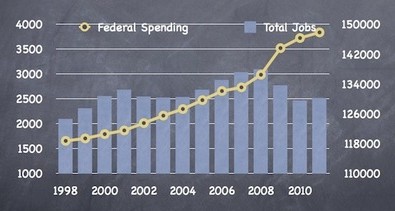
In fiscal 2010, total federal outlays were $3.72 trillion. In fiscal 2011 which ends September 30, we’re projected to spend $3.83 trillion. That’s a $111 billion increase.

Yet this Nobel laureate in economics thinks government spending was slashed.

In reality, since the last time such outlays declined year over year was 1965, we should really be testing Krugman, Obama, and the Democrats’ theory that dramatic increases in government spending creates jobs.

Democrats have been radically increasing outlays since they took over Congress in 2007. During this time, as spending rose by 41 percent, the economy lost roughly seven million jobs sending unemployment skyrocketing from 4.4 percent to 9.1 percent.

If Krugman wasn’t delusional, the above referenced sentence from his Monday column would read, “Although you’d never know it listening to the ranters like Barack Obama, the Democrats, Robert Reich, and me, the past four years have actually been a fabulous test of the theory that exploding government spending actually creates jobs.

Isn’t that really the only conclusion that one could draw given what’s happened since this recent Keynesian experiment began in 2007?

Of course, it’s unfair to expect this Nobel laureate in economics to make such an obvious determination.

He thinks a $111 billion increase in spending is a slash.

I think that Paul Krugman is going beyond mere mendacity these days, as his Keynesian worldview is disproved right before his eyes. The whole country is being treated to a massive disproof of all of his ideas, and this must be causing him some mental strain.

Is Paul Krugman seen as reliable?

I’m not the only one to point out how nutty Krugman has become of late.

Here’s a bunch of non-conservatives:

Why does the New York Times hire a deluded person? Because they don’t so much report the news as they provide their readers with “confirmation” of a worldview that allows them to feel that they are right without having to care about reality. In short, Krugman is a well-paid writer of fiction.

Related posts

William Lane Craig: do all roads lead to God?

Do all roads lead to God? Christian philosopher William Lane Craig explains the Christian view of how imperfect humans are related to a morally-perfect God in this lecture presented to the students at the University of California, Santa Barbara in 2004. He also defends against the charges of intolerance made by religious pluralists, who believe that all religions are basically the same – and all valid paths to God.

About the speaker:

William Lane Craig is Research Professor of Philosophy at Talbot School of Theology in La Mirada, California.

Dr. Craig pursued his undergraduate studies at Wheaton College (B.A. 1971) and graduate studies at Trinity Evangelical Divinity School (M.A. 1974; M.A. 1975), the University of Birmingham (England) (Ph.D. 1977), and the University of Munich (Germany) (D.Theol. 1984). From 1980-86 he taught Philosophy of Religion at Trinity… In 1987 they moved to Brussels, Belgium, where Dr. Craig pursued research at the University of Louvain until assuming his position at Talbot in 1994.

He has authored or edited over thirty books, including The Kalam Cosmological Argument; Assessing the New Testament Evidence for the Historicity of the Resurrection of Jesus; Divine Foreknowledge and Human Freedom; Theism, Atheism and Big Bang Cosmology; and God, Time and Eternity, as well as over a hundred articles in professional journals of philosophy and theology, including The Journal of Philosophy, New Testament Studies, Journal for the Study of the New Testament, American Philosophical Quarterly, Philosophical Studies, Philosophy, and British Journal for Philosophy of Science.

Craig’s CV is here.

Craig’s list of publications is here.

The lecture and discussion

Here’s the lecture and Q&A in 10 parts.

First part:

The lecture is in 6 parts:

Part 1 of 10
Part 2 of 10
Part 3 of 10
Part 4 of 10
Part 5 of 10
Part 6 of 10

And then 4 more parts for Q&A:

Part 7 of 10
Part 8 of 10
Part 9 of 10
Part 10 of 10

There is also a paper that follows the lecture very closely, for those who do not have the bandwidth for the videos.