
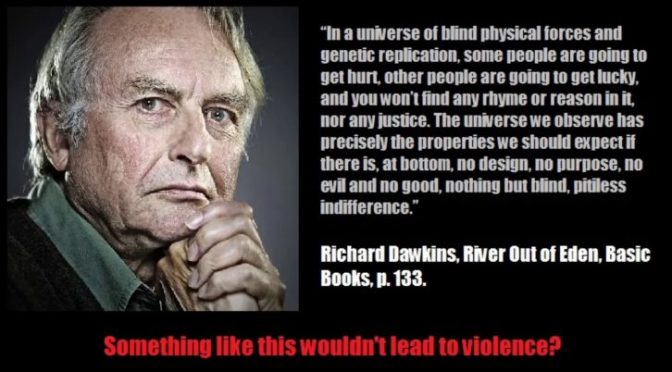
What happens to your worldview if you reject a Creator / moral lawgiver?

I noticed that there was a news story about how belief in God is declining even further in America. And it’s happening the most among younger Americans. In this post, I wanted to talk about the common atheist idea that you can just remove God, and life will go on as before, with everything making perfect sense.

I don’t think I’ve ever written a post about ALL the changes that happen when a person ejects a Creator / Moral Lawgiver from their worldview. And now I don’t have to, because this blogger has done the work for us.

He introduces his post like this:

I recently wrote an article targeted at committed atheists who claim that Christians carry all the burden of proof. There, I pointed out that atheism is not a neutral position and is justified only if it, too, can provide answers for the hard questions of science and human experience. In this article, though, I’d like to offer something similar only targeted to the agnostic, who flirts with the idea that this universe may be devoid of a God after all. My intent is to get such persons to consider the impact that true atheism would logically have on their beliefs and values, and to consider whether this package deal sounds more reasonable than theism.

Now, I’ve interacted with the author a little by e-mail, and it turns out that he actually spent a good part of his life living as a functional atheist. And he’s got a bunch of friends and relatives who don’t exactly fit in with the standard raised-in-a-Christian-home happy path. And best of all, he’s a software engineer, so you know he’s practical and sensible about these topics.

Here are the major areas of worldview that are affected by the rejection of God:

  • Meaning
  • Sovereignty
  • Morality
  • Rights
  • Mind
  • Free Will
  • Science

When I talk about these things, I usually talk about the 3 Ms: Mind, Meaning, Morality. You can see he’s got a lot more there. And he quotes a lot of prominent atheists that you’ve probably heard of: Richard Dawkins, Sam Harris, Sean Carroll, Jerry Coyne, etc.

Here’s the one on Rights:

Universal human rights presuppose that each of us has unique, intrinsic value. The Founding Fathers asserted that our rights were endowed by God, and Scripture claims it is His own image within us that makes us special. If you dispense with this idea, what standard do you use to ground human rights?

We are not equal by any measure one could offer, such as fitness, talent, race, or intelligence. Even grounding it in our mere humanity is arbitrary, since there is no higher standard that would favor humans over the rest of the biological world, and some animals are more fit or intelligent than young, elderly, or disabled humans. Animal rights activists understand this and traffic in this “speciesist” notion. They point out the blight of the human race’s impact on nature, and do not temper that with any belief in the special value of humanity.

The loss of intrinsic human value leads to creative redefinitions for personhood and rights which traffics in things like contribution to society and a life worth living. This road leads to infanticide for the unwanted, eugenics for the unfit, and euthanasia for the elderly. We saw these ideas on display in Nazi Germany as well as, to an extent, the US and other European countries. However, they have been making a comeback in an increasingly secular western culture that has forgotten its dark past. But what principle does atheism offer you to object to any of this beyond your instinctive revulsion?

The conclusion cannot be missed:

Embracing atheism has consequences. Removing God from your life is not like removing a piece of furniture from your house. It’s more like replacing the foundation, which impacts anything that has been built upon it. I’ve discussed several important things that are affected, but many more could be offered, like beauty and the arts, logic, truth, and even the reliability of our senses. In fact, every area of thought and life are affected, or are at least fair game for deconstruction by the universal acid that is atheism.

He also links to a post by James Bishop in the comments, featuring TONS of interesting quotes by famous atheists, about the implications of adopting the worldview of atheism.

Here’s one by former Cornell University paleontologist Will Provine:

Let me summarize my views on what modern evolutionary biology tells us loud and clear … There are no gods, no purposes, no goal-directed forces of any kind. There is no life after death. When I die, I am absolutely certain that I am going to be dead. That’s the end for me. There is no ultimate foundation for ethics, no ultimate meaning to life, and no free will for humans, either.

Is Provine smarter than the average atheist? I think he is, and he’s certainly thought about it more than the average Twitter atheist in his 20s.

I guess what I would say to young atheists is that you probably haven’t 1) evaluated the evidence for a Creator / Designer / Moral Lawgiver at age 14, and 2) you certainly haven’t considered the implications of the decision.

Earlier this week, I wrote a post about an educated 24-year-old feminist woman who was trying to get a man to commit to her. She was choosing men and the timing of sexual activity based on her atheist worldview. As she tells her story, you can clearly see the difference that the worldview makes in the area of relationships. She doesn’t have the resources in her atheism to conduct herself wisely enough to get the results she is looking for.

What kind of “Constitution” can there be for a relationship, if the universe is an accident, human beings are robots made out of meat, and the purpose of life is to be happy here and now? Relationships are stable when each person is able to execute self-sacrificial love. Can you ground a respectful, committed relationship in a worldview of “survival of the fittest”? I think not. And yet this is the approach that most young people take.
The downside of the soul mate / fairy tale view of relationships


Husband and wife doing some woodworking together

(Image: Husband and wife doing some woodworking together)

Astonishing article from the leftist Huffington Post, of all places. (links removed)

Excerpt:

As millennial women, we were groomed for a white knight fantasy. From childhood favorites such as Snow White to adult rom-com staples such as How to Lose a Guy in Ten Days or Sleepless in Seattle, the media perpetuates a romantic storyline in which compatibility and lasting romance is something effortless, built on chance, sustained by good looks, fun dates and electric sexual chemistry. These story lines shape our expectations for romantic happiness. It is not enough to find someone with whom we are mostly compatible, who would make a good parent, with whom we could learn and grow wrinkly; now, we expect a perfect fit and an easy, instantaneous “connection.” In short, we want a soul mate. But it is this desire for a soul mate that is actually the undoing of our happy ending.

A “soul mate” is defined as one who is ideally suited to us, perfectly completes us, one with whom the relationship feels easy and natural. With them, a relationship is just “meant to be”… A survey of young adults conducted by the National Marriage Project found that while 84% of young adults report finding a marriage partner “very important,” a full 94% of young adults say they would like to marry a soul mate, and 73% of people ages 18 – 29 believe that there is a soul mate out there for them.

Wow. That doesn’t sound like a good approach to me. My approach has always been to pick the girl who was most willing to learn new things. And then to explain to her my vision for marriage and see if I could get her to work independently on that plan before I married her. I don’t favor this soul mate approach at all.

Does the “soul mate” approach work?

We heard that those who get married later and possess a college degree have fewer divorces and more stable marriages. So we spend our twenties trying to find ourselves through travel, accumulating degrees and building a career. Marriage will be the capstone of our achievements, and nothing less than tying the knot with a soul mate will suffice. But the tragic irony is that soul mate thinking makes us increasingly likely to divorce. A study of 1,400 married men and women shows that people who hold soul mate orientations are 150% more likely to end up divorced than those who do not.

The widespread cultural belief in “soul mate ideology” undermines our chances at happiness because it makes us passive receivers of idyllic romantic expectations. Further, it fosters self-centeredness; one rarely longs to be a soul mate for someone else, which would require effort. For this reason, believing in soul mates is one of the most dis-empowering belief systems we can adopt. As millennials, we pride ourselves on actively pursuing the life we want to live, rather than simply accepting whatever hand we are dealt. We are innovative, passionate, proactive and not afraid to take risks. Yet, there is a disconnect when it comes to our desire for lasting love. Though there are prospects around us, we forgo taking the concrete steps needed to build happy compatible relationships because we do not “feel a spark.” We are passively waiting on the sidelines for love to “happen,” and then wonder why it is so difficult.

I’ve always felt that the soul mate approach was like the evil villain in opposition to my noble plan-based approach. My approach is to pick a woman who wants to learn and work hard. Explain your marriage plan to her, and how your marriage plan serves God. My marriage plan accomplishes four goals, for example. 1) Influence the university with apologetics, 2) influence the church with apologetics, 3) provide a model of a good marriage to people in the community, including co-workers, college students and neighbors, and 4) raise effective, influential children who will have an impact for God. Now if you are a Christian woman raised in a church that affirms the soul mate / fairy tale view of marriage with this “God has a wonderful plan for your life” stuff, then a specific, non-emotional plan from a man is the last thing you want to hear about.

Their solution is for people to work at compatibility:

Compatibility is something co-created through intentionality and conscious choice. It involves mutual sacrifice, effort and commitment for the sake of the other’s benefit. A recent study found that of the couples who demonstrate above average daily generosity, 50% of them report being “very happy” in marriage; among the low generosity scores, only 14% can say the same. As studies indicate, selflessness is required to create mutual compatibility. It is not instantaneous, nor does it usually begin with true love’s kiss.

We both know from experience that there are some you naturally connect with and others you do not. This is not a call towards forced attraction or companionship. But, our romantic futures should not be placed in the hands of blind chance. It is time we roll up our sleeves and shift our expectations from unattainable perfection to realistic romance, one that accounts for imperfection. We must understand that work in a relationship is a necessary key to success, rather than an indication of imminent failure. We will be letting go of a tired plot line that sets us up for disappointment and embracing an active role in our own unique story.

How refreshing to know that we do not have to be perfect to be lovable, and that our romantic success is not solely dependent on finding the “right” fit, but instead built through cultivating daily moments of generosity, sacrifice and conscious coupling.

So in my case, I am looking for a woman who listens to the plan, develops the skills for the plan and then independently engages in activities to achieve the goals of the plan. In the past, I have had women listen to the plan carefully, including my motivations and experiences that caused me to choose this plan. And they have been willing to read books, listen to lectures, watch debates, to gain the skills needed to make a difference. And they have even engaged independently with activities like public speaking, teaching classes, and so forth. But none of the women who had done that accepted the soul mate / fairy tale view of marriage. They all wanted to hear a good plan, learn useful skills and then get to work. Big difference.

Knight and Rose Show #40: J. Warner Wallace: New Cold-Case Christianity

Welcome to episode 40 of the Knight and Rose podcast! In this episode, Wintery Knight and Desert Rose interview J. Warner Wallace about his new revised and updated edition of “Cold Case Christianity”. If you like this episode, please subscribe to the podcast, and subscribe to our YouTube channel. We would appreciate it if you left us a 5-star review on Apple Podcasts or Spotify.

Podcast description:

Christian apologists Wintery Knight and Desert Rose discuss apologetics, policy, culture, relationships, and more. Each episode equips you with evidence you can use to boldly engage anyone, anywhere. We train our listeners to become Christian secret agents. Action and adventure guaranteed. 30-45 minutes per episode. New episode every week.

Episode 40:

Episode  Summary:

Wintery Knight and Desert Rose interview Christian apologist J. Warner Wallace about the updated and expanded edition of his book “Cold-Case Christianity”. Can modern people take a book seriously if it contains miracles? Are the biographies of Jesus reliable? Did the bias of the Gospel writers affect their accuracy? We also discuss the other sections, including the new afterword that responds the critics.

Speaker biographies

Wintery Knight is a black legal immigrant. He is a senior software engineer by day, and an amateur Christian apologist by night. He has been blogging at winteryknight.com since January of 2009, covering news, policy and Christian worldview issues.

Desert Rose did her undergraduate degree in public policy, and then worked for a conservative Washington lobbyist organization. She also has a graduate degree from a prestigious evangelical seminary. She is active in Christian apologetics as a speaker, author, and teacher.

J. Warner Wallace is a Dateline featured cold-case homicide detective, popular national speaker and best-selling author. He continues to consult on cold-case investigations while serving as a Senior Fellow at the Colson Center for Christian Worldview. He is also an adjunct professor of apologetics at Talbot School of Theology (Biola University), Gateway Seminary, and Southern Evangelical Seminary, and a faculty member at Summit Ministries. J. Warner became a Christ-follower at the age of thirty-five after investigating the claims of the New Testament gospels using his skill set as a detective.

Podcast RSS feed:

https://feed.podbean.com/knightandrose/feed.xml

You can use this to subscribe to the podcast from your phone or tablet. I use the open-source AntennaPod app on my Android phone.

Podcast channel pages:

Video channel pages:

Music attribution:

Strength Of The Titans by Kevin MacLeod
Link: https://incompetech.filmmusic.io/song/5744-strength-of-the-titans
License: https://filmmusic.io/standard-license