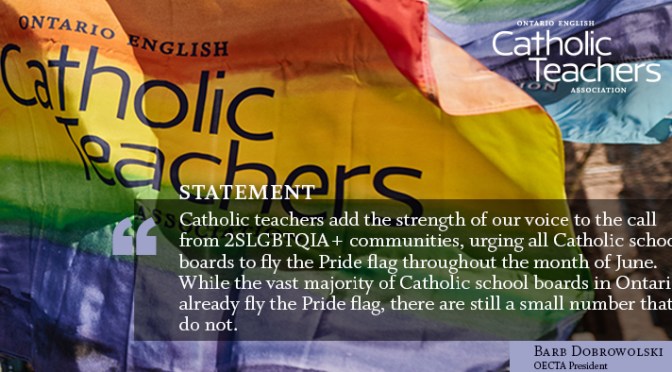
Church of England and Catholic Church offer blessings to same-sex couples

In this post, I wanted to first review Jesus’ position on marriage, and then we’ll look at a couple major churches that have decided to bless same-sex relationships. And not minor churches, either. The Church of England and the Roman Catholic church. Let’s take a look at what Jesus says, and then what these two major churches say.

We find Jesus’ teaching on marriage in Matthew 19.

Matthew 19:1-6:

1 Now when Jesus had finished these sayings, he went away from Galilee and entered the region of Judea beyond the Jordan.

2 And large crowds followed him, and he healed them there.

3 And Pharisees came up to him and tested him by asking, “Is it lawful to divorce one’s wife for any cause?”

4 He answered, “Have you not read that he who created them from the beginning made them male and female,

5 and said, ‘Therefore a man shall leave his father and his mother and hold fast to his wife, and the two shall become one flesh’?

6 So they are no longer two but one flesh. What therefore God has joined together, let not man separate.”

To be a Christian, minimally, is to be a follower of Jesus Christ. That means that we accept what Jesus teaches, on whatever he teaches about. We don’t overturn the teachings of Jesus in order to make people who are rebelling against God feel better about their rebellion. It is central to the Christian worldview that Christians care more about what God thinks of them than what non-Christians think of them. In fact, Christians are supposed to be willing to endure suffering rather than side with non-Christians against God’s authority.

So, with that said, let’s take a look at what the Church of England is doing about marriage.

Look at this article from the UK Telegraph:

For the first time in history, same-sex partners can receive a blessing to celebrate their unions…

[…]With the rainbow LGBTQIA+ flag waving outside, Jane Pearse and Catherine Bond became one of the first couples in England to receive a prayer that would publicly affirm and celebrate their union. A move made legal at the turn of midnight Saturday – instead of the usual clink of teacups, the pop of champagne corks punctured the post-service chatter, with congregants and the women, both vicars, well aware of the magnitude of the morning’s celebration.

I thought this part was interesting:

Bond and Pearse got together six years ago, when working in the same benefice (an ecclesiastical office), and now live in Felixstowe and are both associate priests… Both have adult children from their prior marriages, to men.

So both of these women were married to men, and left those marriages. That’s how they got their children. And they inflicted divorce on those children.

The Church of England was not the only organization trying to gain the respect of the secular left by compromising on the plain meaning of Jesus’ words about marriage. They are event investigating a vicar who called the the institution’s first transgender archdeacon a “bloke”.

The UK Telegraph reported on that, too:

The Church of England (CofE) is investigating a vicar after he called the institution’s first transgender archdeacon a “bloke”.

The Rev Brett Murphy faces an official rebuke from the CofE over “intentionally derogatory and disrespectful” remarks he made about the Rev Canon Dr Rachel Mann shortly after her appointment in June.

LGBT+ campaigners had hailed her appointment as a “beacon of light and hope”.

For Protestant Christians, it’s easy to switch from Bible-denying denominations to Bible-believing denominations. But it’s not so easy for Roman Catholics to do the same.

Here’s another story reported by Crux, a Catholic news source:

In the hours that followed release of a Vatican note outlining the pastoral grounds for same-sex blessings, reactions among American Catholics seemed to run the gamut from styling it as a major step forward to insisting on hitting the brakes, on the grounds that not much has really changed.

[…]The declaration outlines situations in which blessings are appropriate for same-sex couples or those in irregular unions. It states that these blessings should never be given “in concurrence with the ceremonies of a civil union, and not even in connection with them.”

The declaration continues that the blessing cannot be performed with any clothing, gestures, or words that are proper to a wedding. Conversely, the declaration states that the blessings can be provided in informal situations such as a visit to a shrine, a meeting with a priest, a prayer group, or during a pilgrimage.

Still, despite its narrow scope, LGBTQ Catholics view the declaration as a significant step forward.

Francis DeBernardo, executive director of the Catholic advocacy organization New Ways Ministry, said in a statement that “it cannot be overstated how significant the Vatican’s new declaration is,” for the fact that it “expands the ways that LGTBQ+ Catholics can know God’s love.”

Father James Martin, a leading minister to and advocate for LGTBQ Catholics, in a series of statements called the declaration “a major step forward in the church’s ministry to LGBTQ people and recognizes the deep desire in many Catholic same-sex couples for God’s presence in their loving relationships.”

“Along with many priests, I will now be delighted to bless my friends’ same-sex unions,” Martin said.

So, that’s where we are now. Major denominations have abandoned Jesus’ teaching on marriage. And why? Who are these church leaders trying to impress with their faithlessness? Wouldn’t it be much better if they dug into some studies and make a defenseof the teachings of Jesus using evidence? It’s not that hard. I’ve been doing it for nearly 15 years on this blog. But you just have to accept that it may not win you respect from the secular leftists who run the corporate news. I accept that. Why can’t they?
Trump wants the most conservative Congressman to lose in 2024

If you asked me why I opposed Trump in during the 2016 Republican primary, I would have pointed at his extensive record of siding with Democrats on nearly every issue. He surprised me during his first term, by being American’s most conservative president. But something seems to have gone wrong. He is no longer the conservative that he was during his first term.

Here’s the latest story from Daily Wire:

Late on Monday, former President Donald Trump called for someone to take up a primary challenge against Rep. Chip Roy (R-TX), who has endorsed Trump’s primary rival, Florida Governor Ron DeSantis, for president.

“Has any smart and energetic Republican in the Great State of Texas decided to run in the Primary against RINO Congressman Chip Roy,” Trump said, using the acronym for “Republican in name only,” in a post to his Truth Social platform. “For the right person, he is very beatable. If interested, let me know!!!”

Is Chip Roy a “RINO”? Let’s take a look at the data.

Voters first elected Roy to the House in 2018 after he established himself in politics working for other prominent Texas Republicans, including former Governor Rick Perry and Sen. Ted Cruz (R-TX). Now in his third term, Roy represents the 21st Congressional District in Texas, which includes South Austin, North San Antonio, and the Texas Hill Country.

As a congressman, Roy has pressed for reining in government spending, grilled and blasted Democrats over the border and immigration crisis, advocated for the development and better access to lifesaving medicines, and challenged leadership over COVID-19 vaccine and mask mandates during the pandemic.

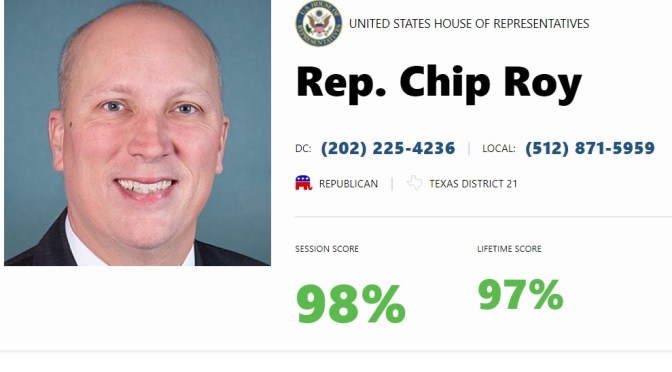
Roy became a member of the House Freedom Caucus and boasts a “Liberty Score” of 100% as well as a 98% on the Heritage Action’s Scorecard, which looks at how conservative members are in their voting records and co-sponsorships. A few weeks ago, Roy shot back at keyboard warriors who call GOP legislators like him a “RINO,” saying, “You can kiss my a**,” adding, “I’ve spent a lifetime fighting for limited government conservatism.”

Whenever I want to know whether a legislator is conservative, I always go straight for the Heritage Foundation scorecard. Chip Roy’s score is 98%, and his lifetime rating is 97%. That makes him tied for FIRST PLACE for most conservative member of the House of Representatives. Why would Trump oppose such a conservative legislator? Maybe it’s because Trump isn’t a conservative at all, and doesn’t care about conservatives winning the House and the Senate. He just cares about himself. He’s a narcissist.

How do so many left-wing fake Republicans get into the House and Senate? Could it because of people like Trump demanding that they get primary challengers, so that the most conservative candidates don’t get elected? Can we really trust someone who only cares about himself to be the leader of the conservative movement? This would be like picking a quarterback who refuses to throw the ball to the star receiver, because the star receiver doesn’t like the quarterback’s hairstyle. It’s that level of childish and stupid. And we can’t afford to pick a stupid child to run as the Republican nominee. Especially if that stupid child is in prison in Spring of 2024.

One of the of reasons why Republican voters might want to choose DeSantis over Trump in 2024 is that Trump is almost certain to be convicted and imprisoned in early 2024. Even if he were to run and win, he would be a lame duck president. We would only get one term out of him. But most of all, some of his comments lately clearly show that he’s returning to his Democrat roots. Especially his opposition to pro-life legislation at the state level. We can do better than Trump in 2024. A lot better.

The authors of the gospels of Mark and Luke knew eyewitnesses to the life of Jesus

Were the authors of the gospels of Mark and Luke connected to eyewitnesses to the life of Jesus? Well, it turns out that there are good reasons to think that Mark was linked to the eyewitness Peter, and Luke was linked to Paul, who had a post-mortem appearance of Jesus in 1 Cor 15:8, and who met with Peter and James in Galatians 1 and again in Galatians 2.

There is a list of evidence for Peter’s influence on Mark on the Cold Case Christianity blog.

Here’s my favorite one from the list:

Peter’s Embarrassments Have Been Omitted

There are many details in the Gospel of Mark consistent with Peter’s special input and influence,including omissions related to events involving Peter. How can Mark be a memoir of Peter if, in fact, the book contains so many omissions of events involving Peter specifically? It’s important to evaluate the entire catalogue of omissions pertaining to Peter to understand the answer here. The vast majority of these omissions involve incidents in which Peter did or said something rash or embarrassing. It’s not surprising these details were omitted by the author who wanted to protect Peter’s standing in the Christian community. Mark was quite discreet in his retelling of the narrative (other Gospel writers who were present at the time do, however, provide details of Peters ‘indiscretions’ in their own accounts. See Cold-Case Christianity for a more detailed explanation).

It makes me laugh to imagine Peter looking over Mark’s shoulder and saying “no, don’t put that in it” and “no, don’t tell them I did that”. Funny! But also very good evidence. The rest of Wallace’s list makes it even more clear.

And what about the gospel of Luke? Well, did you know that the author of Luke’s gospel knew Paul? If you read it carefully, you’ll see that Luke switches from describing history from an “I” perspective to describing things from a “we” perspective in the book of Acts (which he also wrote). Who is the “we” he is talking about?

Here’s famous Christian scholar William Lane Craig to explain:

Now who was this author we call Luke? He was clearly not an eyewitness to Jesus’s life. But we discover an important fact about him from the book of Acts. Beginning in the sixteenth chapter of Acts, when Paul reaches Troas in modern-day Turkey, the author suddenly starts using the first-person plural: “we set sail from Troas to Samothrace,” “we remained in Philippi some days,” “as we were going to the place of prayer,” etc. The most obvious explanation is that the author had joined Paul on his evangelistic tour of the Mediterranean cities. In chapter 21 he accompanies Paul back to Palestine and finally to Jerusalem. What this means is that the author of Luke-Acts was in fact in first hand contact with the eyewitnesses of Jesus’s life and ministry in Jerusalem.

[…]There is no avoiding the conclusion that Luke-Acts was written by a traveling companion of Paul who had the opportunity to interview eyewitnesses to Jesus’s life while in Jerusalem. Who were some of these eyewitnesses? Perhaps we can get some clue by subtracting from the Gospel of Luke everything found in the other gospels and seeing what is peculiar to Luke. What you discover is that many of Luke’s peculiar narratives are connected to women who followed Jesus: people like Joanna and Susanna, and significantly, Mary, Jesus’s mother.

Was the author reliable in getting the facts straight? The book of Acts enables us to answer that question decisively. The book of Acts overlaps significantly with secular history of the ancient world, and the historical accuracy of Acts is indisputable.

This has recently been demonstrated anew by Colin Hemer, a classical scholar who turned to New Testament studies, in his book The Book of Acts in the Setting of Hellenistic History. [5] Hemer goes through the book of Acts with a fine-toothed comb, pulling out a wealth of historical knowledge, ranging from what would have been common knowledge down to details which only a local person would know. Again and again Luke’s accuracy is demonstrated: from the sailings of the Alexandrian corn fleet to the coastal terrain of the Mediterranean islands to the peculiar titles of local officials, Luke gets it right.

I know a lot of people (like my Dad) read the Bible devotionally, looking for feelings or trying to “get right with God” so they get blessings. But I think it’s helpful to look at things from an evidential point of view – how am I going to make a case for this? When you look at things from that perspective, the Bible gets a whole lot more interesting. And you can talk about it with non-Christians when you know about these interesting details.