Three debates on divine sovereignty, predestination and free will

The two views being debated below are Calvinism and simple foreknowledge. Calvinism is the view that God unilaterally predetermines a selected group of individuals who will know him – the “elect”. Foreknowledge is the view that God draws people to him who he foreknows will freely respond to his overtures and come to know him. What does the Bible teach about these issues?

The Calvinist debater is Dr. James White:

James White is the director of Alpha and Omega Ministries, a Christian apologetics organization based in Phoenix, Arizona. He is a professor, having taught Greek, Systematic Theology, and various topics in the field of apologetics. He has authored or contributed to more than twenty books, including The King James Only ControversyThe Forgotten TrinityThe Potter’s Freedom, and The God Who Justifies. He is an accomplished debater, having engaged in more than one-hundred moderated, public debates with leading proponents of Roman Catholicism, Islam, Jehovah’s Witnesses, and Mormonism, as well as critics such as Bart Ehrman, John Dominic Crossan, Marcus Borg, and John Shelby Spong. He is an elder of the Phoenix Reformed Baptist Church, has been married to Kelli for more than twenty-eight years, and has two children, Joshua and Summer.

The Foreknowledge debater is Dr. Michael Brown:

Michael L. Brown holds a Ph.D. in Near Eastern Languages and Literatures from New York University and has served as a visiting or adjunct professor at Southern Evangelical Seminary, Gordon Conwell Theological Seminary (Charlotte), Trinity Evangelical Divinity School, Fuller Theological Seminary, Denver Theological Seminary, the King’s Seminary, and Regent University School of Divinity. He has contributed numerous articles to scholarly publications, including the Oxford Dictionary of Jewish Religion and the Theological Dictionary of the Old Testament. Dr. Brown is the author of twenty books, including, Our Hands Are Stained with Blood: The Tragic Story of the “Church” and the Jewish People, which has been translated into more than twelve languages, the highly-acclaimed five-volume series, Answering Jewish Objections to Jesus, a commentary on Jeremiah (part of the revised edition of the Expositor’s Bible Commentary), and several books on revival and Jesus revolution.

Now, let’s get ready to rumble!

First debate

A nice friendly debate that introduces the topic. This is the best debate for casual listeners and non-Christians.

The MP3 file is here.

Summary:

  • Introduction to Calvinist James White and some of his 90 debates
  • What is Calvinism and why is it important?
  • Does God love all people the same way in Calvinism?
  • Does God desire the salvation of all people in Calvinism?
  • Is the offer of salvation to all people a genuine offer on Calvinism?
  • Does Calvinism diminish or augment God’s sovereignty?
  • Can God accomplish his will by permitting evil creaturely actions?
  • Did Jesus die only for the “chosen”, or for the possibility of salvation for all?
  • Does a person’s responding to God’s offer of savaltion detract from Gods glory?
  • Does our ability to resist God’s grace mean that we are “stronger” than God?

There is a little static in the audio for a few seconds every time they come back from a break, but nothing major.

Second debate, on specific passages in the Bible

Same two guys, but this time they tackle the meaning of specific Bible passages.

The MP3 file is here.

The passages being disputed:

  • John 6
  • Romans 8, 9
  • Ephesians 1
Each person gets 8 minutes to exegete the text, followed by 4 minutes of cross-examination by the other debater, followed by 3 minute conclusions by each debater. These texts were chosen by the Calvinist debater.

Third debate, on specific passages in the Bible

Same two guys, but this time they tackle the meaning of specific Bible passages.

The MP3 file is here.

The passages being disputed:

  • Luke 13:34-35 (Deuteronomy 5:28-29)
  • Ezekiel 18:21-32 (Jeremiah 3:19-20; Ezekiel 22:30-31)
  • 1 John 2:1-2 (2 Pet 2:1).
Each person gets 8 minutes to exegete the text, followed by 4 minutes of cross-examination by the other debater, followed by 3 minute conclusions by each debater. These texts were chosen by the foreknowledge debater.

Democrat bill to punish criticism of cross-dressing heads to Senate

CNS News reports.

Excerpt:

The full Senate will consider a bill sponsored by Sen. Jeff Merkley (D-Ore.) that would add “actual or perceived sexual orientation” and “gender identity” to the list of federally protected traits, which currently include race, religion, age, gender and disability.

The Family Research Council describes The Employment Non-Discrimination Act (S. 815) as “giving special rights and protections to people based solely on their sexual behavior,” warning that ENDA “is to the office what the repeal of Don’t Ask, Don’t Tell was to the military.” (S.815.pdf)

ENDA cleared the Health, Education, Labor and Pensions Committee July 10th on a 15-7 vote, with Republicans Mark Kirk (Ill.), Orrin Hatch (Utah), and Lisa Murkowski (Alaska) voting with the committee’s Democratic majority.

[…]“[The President]  thanks Committee Chairman [Tom] Harkin, Senator Merkley, and Senator Kirk for their leadership on this important issue.  The President has long supported an inclusive ENDA, which would enshrine into law strong, lasting and comprehensive protections against employment discrimination on the basis of sexual orientation or gender identity. “

The bill imposes penalties under Title VII of the Civil Rights Act of 1964 and the Employee Rights Act of 1991 on private employers who discriminate against individuals on the basis of their “gender identity,” which the legislation describes as “the gender-related identity, appearance or mannerisms or other gender-related characteristics of an individual, with or without regard to the individual’s designated sex at birth.”

Under the bill, state and local officials, including those who work for local school districts, are not immune, and can also be sued in federal court for employment discrimination.

“Unlike past bills, Sen. Merkley’s version doesn’t include an exemption for bathrooms, which means that employers at daycares, public schools, and Christian businesses would all have to change their restroom and shower policies to accommodate men who dress like women and vice-versa.,” FRC president Tony Perkins noted.

Republican senator Ted Cruz is alarmed at the way that government is trying to force their moral views on individuals and businesses.

Excerpt:

In an interview with the Christian Broadcasting Network, Senator Ted Cruz (R-TX) said he believes the legalization of same-sex “marriage” may lead to those who express religious objections to homosexuality being prosecuted for hate speech.

“If you look at other nations that have gone down the road towards gay marriage, that’s the next step of where it gets enforced,” Cruz told CBN host David Brody. “It gets enforced against Christian pastors who decline to perform gay marriages, who speak out and preach biblical truths on marriage, that has been defined elsewhere as hate speech, as inconsistent with the enlightened view of government.”

In Canada, where gay ‘marriage’ was legalized in 2005, Christian pastors, public officials, educators and business owners have all faced heavy fines and lengthy court battles after speaking critically of the homosexual lifestyle. In one case a pastor was fined $7000 and ordered never again to speak publicly about the issue of homosexuality after he wrote a letter to the editor of a local newspaper criticizing the homosexual agenda in schools.

Both Sweden and the United Kingdom have also prosecuted people who expressed traditional views on homosexuality, including a Christian pastor in Sweden who was sentenced to a suspended jail term for “inciting hatred” for preaching against homosexual behavior. The UK has recently seen a rash of cases in which Christian street preachers were arrested simply for preaching that homosexual conduct is sinful.

The French government has criminalized speech against homosexuality, resulting in a member of parliament being hit with a $4,000 penalty and ordered to pay $2,000 in court fees after he said he thought homosexuality was “inferior” to heterosexuality and said the practice would be “dangerous for humanity if it was pushed to the limit.”

There is a word for using the power of government to force religious and moral views onto citizens. That word is fascism.

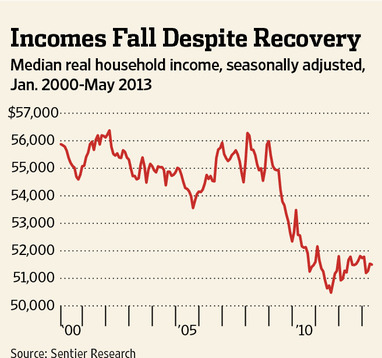
Annual median household income down $4,500 since Democrats won Congress in 2006

Median Household Income Under Obama

The Wall Street Journal reports.

Excerpt:

The recovery that began four years ago has been one of the weakest on record, averaging a little more than 2%. And it has not gained speed. Growth in the fourth quarter of 2012 was 0.4%. It rose to a still anemic 1.8% in the first quarter but most economists are predicting even slower growth in the second quarter.

We hope the predictions of a faster growth in the second half will be right, but the Obama Treasury and Federal Reserve have been predicting for four years that takeoff was just around the corner. Stocks are doing great, and housing prices are rising, but job growth remains lackluster. What has never arrived is the 3%-4% growth spurt during typical expansions.

[…]What about the middle class that is the focus of Mr. Obama’s rhetoric? Each month the consultants at Sentier Research crunch the numbers from the Census Bureau’s Current Population Survey and estimate the trend in median annual household income adjusted for inflation. In its May 2013 report, Sentier put the figure at $51,500, essentially unchanged from $51,671 a year earlier.

And that’s the good news. The bad news is that median real household income is $2,718, or 5%, lower than the $54,218 median in June 2009 when the recession officially ended. Median incomes typically fall during recessions. But the striking fact of the Obama economy is that median real household income has fallen even during the recovery.

While the declines have stabilized over the last two years, incomes are still far below the previous peak located by Sentier of $56,280 in January 2008. No wonder Mr. Obama is now turning once again to his familiar political narrative assailing inequality and blaming everyone else for it. He wants to change the subject from the results on his watch.

The core problem has been Mr. Obama’s focus on spreading the wealth rather than creating it. ObamaCare will soon hook more Americans on government subsidies, but its mandates and taxes have hurt job creation, especially at small businesses. Mr. Obama’s record tax increases have grabbed a bigger chunk of affluent incomes, but they created uncertainty for business throughout 2012 and have dampened growth so far this year.

The food stamp and disability rolls have exploded, which reduces inequality but also reduces the incentive to work and rise on the economic ladder. This has contributed to a plunge in the share of Americans who are working—the labor participation rate—to 63.5% in June from 65.7% in June 2009. And don’t forget the Fed’s extraordinary monetary policy, which has done well by the rich who have assets but left the thrifty middle class and retirees earning pennies on their savings.

Mr. Obama would have done far better by the poor, the middle class and the wealthy if he had focused on growing the economy first. The difference between the Obama 2% recovery and the Reagan-Clinton 3%-4% growth rates is rising incomes for nearly everybody.

And remember, thanks to Obamacare, medical insurance premiums have soared over $3,000. We are getting poorer because of Obama’s big government policies.

Whose fault is it?

In the 2006 mid-term elections, the Democrats took over the House and Senate. That was the beginning of the Nancy Pelosi and Harry Reid spending spree. Millions of dollars have been wasted on ineffective government programs, handouts and bailouts. We’ve had trillion dollar deficits for the last four years under Obama, and over 8 trillion added to the national debt since Pelosi/Reid 2007. All that deficit spend does have an effect on economic growth – businesses know that they are going to have to pay it off at some point, either through higher taxes or inflation or both.