Three reasons why Christians should read military history

A while back, I finished a book called “Beyond The Call: The True Story of One World War II Pilot’s Covert Mission to Rescue POWs on the Eastern Front”. It’s about a World War 2 heavy bomber pilot who completes 35 missions, and then goes into the Soviet Union (our allies, at the time) to rescue American POWs who were starving or being kidnapped or murdered by the Soviet secret police.

I found a very good article about it from Stripes, to just quickly introduce the story:

Later, after making contact with POWs roaming the Polish countryside, [Capt. Robert Trimble] fully embraced his mission. He saw the desperate plight of those who had been liberated from Third Reich prison camps. Many were sick, emaciated, often clothed in rags and left to fend for themselves during a brutally harsh winter.

Trimble risked his life numerous times over six weeks, helping to rescue hundreds of POWs. He came to the aid of others, too. In one daring rescue, nearly foiled by Russian agents who had become suspicious of his activities, Trimble helped 400 French women make it out of Poland and back to France.

Although he was being constantly trailed by Russian spies and informers, he would evade them, and bring food and money to the POWs, then put them on a train to Odessa, Ukraine, where they could get onto a ship going home.

Roger Trimble, standing second from the left, in front of his B-24 Liberator

Why I read military history

It is hard to develop virtues just by wishing and hoping. Something has to go into your mind that causes you to think differently, and feel differently. Everything that you watch on TV, hear on the radio, or see in the movie theater, is made by secular leftists. They aren’t trying to build your moral character. They’re goal is to break down your resistance to their unBiblical worldview and moral values. Instead of giving people who hate Jesus your money, just so you can be entertained, why not try to put something in front of your eyes that will make you better?

Look at this famous passage from the Bible.

Romans 12:1-2:

1Therefore I urge you, brethren, by the mercies of God, to present your bodies a living and holy sacrifice, acceptable to God, which is your spiritual service of worship. 

2 And do not be conformed to this world, but be transformed by the renewing of your mind, so that you may prove what the will of God is, that which is good and acceptable and perfect.

And also this from Philippians, my favorite book of the Bible.

Philippians 4:8:

8 Finally, brethren, whatever is true, whatever is honorable, whatever is right, whatever is pure, whatever is lovely, whatever is of good repute, if there is any excellence and if anything worthy of praise, dwell on these things.

So you can see that when I am reading, my goal is to work on my character. I want to have feelings about things that are appropriate for a Christian man.

So why military history? Here are three reasons why I read these military history books.

Humility

First, humility. Humility used to be one of my biggest challenges. So I thought to myself “instead of seeing yourself as some heroic figure, why don’t you read about some real heroes… people who willingly gave their lives for their friends, like the Bible urges, and like Jesus did by example”.

Remember this from John 15:13?

13 Greater love has no one than this, that one lay down his life for his friends.

Military history is filled with stories of courage, bravery, self-sacrifice, endurance, unselfishness, and many other virtues. When you read about people who are better than you, doing more important things than what you’re doing, it really helps you to be humble.

The best thing for humility is reading Medal of Honor citations. You can find a bunch of them online here. And if you want a book to read, try these books about Medal of Honor recipients:

Endurance

Second, endurance. I sometimes feel badly about not having found someone to marry and not having lots of children. I wanted a good marriage to be a model for others, and also to have an influence in the next generation through my children. However, whenever I read military history, I see a lot of young men dying in battle. And I think, they too won’t know what sex is like. And, they too won’t know what marriage is like. And, they too won’t know what having children is like. But it’s not just the ones who die, it’s the hardships they have to go through, as well. Cold, hunger, imprisonment, pain, loss of their friends, etc.

I remember reading about one of my favorite battles – probably the most famous battle of the Korean War, which is our most moral war. It’s about Fox Company of the 2nd Battalion, 7th Regiment, 1st Marine Division. They had to hold a hill beside a vital road against overwhelming numbers of Chinese soldiers during the freezing cold North Korean winter. I remember reading about how one soldier got up to go to the bathroom, and was nearly shot by a sniper. He fell over on his own poop, which had already frozen by the time it hit the ground. For months after, I would always think about this whenever I went into a bathroom. We have pre-warmed water in our bathrooms at work, along with soap, lysol spray, febreeze, contact lense cleaner, hand sanitizer, and other things. Just understanding what other people have to go through in war helps me to be more patient with the little tiny setbacks that I experience. I used to get very anxious when anything went wrong, because of I was raised by strict immigrant parents. That anxiety seemed to last a long time, but since I started to read military history, I’ve been much more patient. I know that things could be worse.

Thankfulness

The third thing that I’ve experienced is thankfulness. Not just for all the things that I have because of what our armed forces have done, e.g. – basic human rights, prosperity, liberty, security, etc. But also specifically about those who gave their lives so that I could live free in a free country, and practice my Christian faith without fear.

Here are two of my favorite Medal of Honor stories from World War 2, in the Battle of Pearl Harbor:

Congressional Medal of Honor
Awarded Posthumously
PETER TOMICH

Rank and organization: Chief Watertender, U.S. Navy.
Place and date: Pearl Harbor, 7 December 1941.
Born: 3 June 1893, Prolog, Austria.

Although realizing that the ship was capsizing as a result of enemy bombing and torpedoing, Tomich remained at his post in the engineering plant of the U.S.S. Utah, until he saw that all boilers were secured and all fireroom personnel had left their stations, and by so doing lost his own life.

And:

Congressional Medal of Honor
Awarded Posthumously
JAMES RICHARD WARD

Rank and organization: Seaman First Class, U.S. Navy.
Place and date: Pearl Harbor, 7 December 1941.
Born: 10 September 1921, Springfield, Ohio.

When it was seen that the U.S.S. Oklahoma was going to capsize and the order was given to abandon ship, Ward remained in a turret holding a flashlight so the remainder of the turret crew could see to escape, thereby sacrificing his own life.

I do think that it’s important for Christians to read these kinds of stories in order to feed their own awareness of what it must have been like for Jesus to give his life voluntarily for us.

There is no shortcut to gratitude. You have to constantly reflect on the sacrifices made by others for you, if you are to have any concrete reason for feeling grateful. The more you read about examples of people giving their lives for others, the more you’ll appreciate what Jesus did for you. It will make you grateful.

There is a very annoying idea out there in the culture that says that people just do whatever is easy and fun for themselves, and since everyone else is always doing what makes them feel good, then there is no need to be thankful for anything. It’s comforting for people to delude themselves with that belief, but it’s false.

My reading list

You can check out the “What I am Reading” section of the blog to see which military history books I’ve been reading.

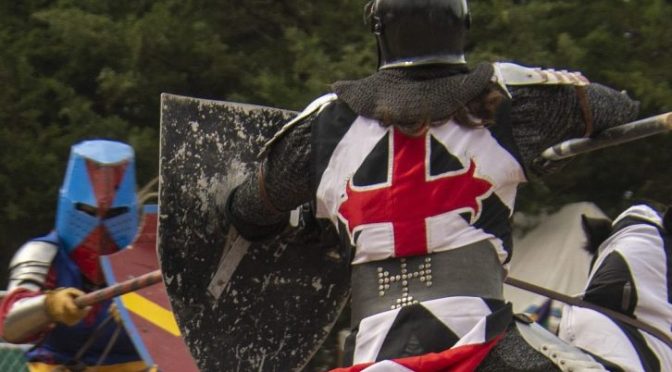
Correcting four myths about the history of the Crusades

Here is an interesting article from Intercollegiate Studies Institute.

Intro:

The verdict seems unanimous. From presidential speeches to role-playing games, the crusades are depicted as a deplorably violent episode in which thuggish Westerners trundled off, unprovoked, to murder and pillage peace-loving, sophisticated Muslims, laying down patterns of outrageous oppression that would be repeated throughout subsequent history. In many corners of the Western world today, this view is too commonplace and apparently obvious even to be challenged.

But unanimity is not a guarantee of accuracy. What everyone “knows” about the crusades may not, in fact, be true. From the many popular notions about the crusades, let us pick four and see if they bear close examination.

The four myths:

  • Myth #1: The crusades represented an unprovoked attack by Western Christians on the Muslim world.
  • Myth #2: Western Christians went on crusade because their greed led them to plunder Muslims in order to get rich.
  • Myth #3: Crusaders were a cynical lot who did not really believe their own religious propaganda; rather, they had ulterior, materialistic motives.
  • Myth #4: The crusades taught Muslims to hate and attack Christians.

Here’s the most obvious thing you should know. The Crusades were defensive actions:

In a.d. 632, Egypt, Palestine, Syria, Asia Minor, North Africa, Spain, France, Italy, and the islands of Sicily, Sardinia, and Corsica were all Christian territories. Inside the boundaries of the Roman Empire, which was still fully functional in the eastern Mediterranean, orthodox Christianity was the official, and overwhelmingly majority, religion. Outside those boundaries were other large Christian communities—not necessarily orthodox and Catholic, but still Christian. Most of the Christian population of Persia, for example, was Nestorian. Certainly there were many Christian communities in Arabia.

By a.d. 732, a century later, Christians had lost Egypt, Palestine, Syria, North Africa, Spain, most of Asia Minor, and southern France. Italy and her associated islands were under threat, and the islands would come under Muslim rule in the next century. The Christian communities of Arabia were entirely destroyed in or shortly after 633, when Jews and Christians alike were expelled from the peninsula.6 Those in Persia were under severe pressure. Two-thirds of the formerly Roman Christian world was now ruled by Muslims.

What had happened? Most people actually know the answer, if pressed—though for some reason they do not usually connect the answer with the crusades. The answer is the rise of Islam. Every one of the listed regions was taken, within the space of a hundred years, from Christian control by violence, in the course of military campaigns deliberately designed to expand Muslim territory at the expense of Islam’s neighbors. Nor did this conclude Islam’s program of conquest. The attacks continued, punctuated from time to time by Christian attempts to push back. Charlemagne blocked the Muslim advance in far western Europe in about a.d. 800, but Islamic forces simply shifted their focus and began to island-hop across from North Africa toward Italy and the French coast, attacking the Italian mainland by 837. A confused struggle for control of southern and central Italy continued for the rest of the ninth century and into the tenth. In the hundred years between 850 and 950, Benedictine monks were driven out of ancient monasteries, the Papal States were overrun, and Muslim pirate bases were established along the coast of northern Italy and southern France, from which attacks on the deep inland were launched. Desperate to protect victimized Christians, popes became involved in the tenth and early eleventh centuries in directing the defense of the territory around them.

If you asked me what are the two best books on the Crusades, I would answer God’s Battalions: The Case for the Crusades by Baylor professor Rodney Stark and The Concise History of the Crusades by Professor Thomas F. Madden. If you get this question a lot from atheists, then I recommend you pick these up. Anything by Rodney Stark is useful for Christians, in fact.

Miranda Devine asks: where are the men of courage?

Men tend to focus more on quietly enduring suffering, and they rarely speak up when they have been hurt. That’s why we get excited when women speak up for us. But it’s rare for a woman to see what men’s plans and motivations are. Rarer still to see who is standing in opposition to those plans and motivations. And rarest of all is to speak up to defend men from their opponents.

So, this post is about a woman doing all three. And not just any woman, but famous conservative woman Miranda Devine, who recently wrote the book “Laptop from Hell: Hunter Biden, Big Tech, and the Dirty Secrets the President Tried to Hide“, which is all about Hunter Biden’s laptop, and how Big Tech and the Biden administration tried to cover it all up.

Anyway, here is her article in the New York Post:

We pathologize manly virtues and bow to the tyranny of identity politics that seeks power by overthrowing a make-believe patriarchy. We raise boys in a soup of ­reproach and negativity that tells them their intrinsic nature is ­diseased.

“Traditional masculinity is psychologically harmful,” the American Psychological Association declared in 2019. These were the masculine attributes it listed as diseased: “stoicism, competitiveness, dominance, aggression, anti-femininity, achievement, eschewal of the appearance of weakness, and adventure, risk and violence.”

The only acceptable man now is a man who wants to be a woman. We celebrate “pregnant men” and “chestfeeding” men.

[…]We ignore the crisis that sees men commit suicide at ever increasing rates or succumb to drug abuse and porn addiction while savvy young women graduate from college in disproportionate numbers. Trained from childhood to be entitled and unrealistic about relationships, their fertility and the sacrifices and joys of motherhood, many become bitter and blame men for their confusion.

I’ll be writing an article for Friday about the unrealistic expectations of young feminist women.

But for now, here’s more Miranda, and quoting C.S. Lewis:

Along the way, we emasculate the institutions that were necessarily masculine for our protection, notably the military. As an example, on Wednesday, the US Marines celebrated Lesbian, Gay, Bisexual, Transgender, Queer and Intersex Pride Month by tweeting a picture of a combat helmet adorned with rainbow-colored bullets.

So, what do men do? They recoil and retreat. They leave the stage for hysterical epsilon men like Beto O’Rourke who whine and posture but can’t protect a thing.

Then when we need a strong, quick-thinking Gary Cooper to save us from outlaws, he’s nowhere to be found.

“We make men without chests and expect from them virtue and enterprise,” C.S. Lewis foretold in his dystopian 1943 book “The Abolition of Man.”

“We laugh at honor and are shocked to find traitors in our midst. We castrate and bid the geldings be fruitful.”

Maybe men have had it with being screeched at, so no more protecting and providing? (or leading, but nobody wants the leading anymore) Society can’t spend all of their time attacking masculinity, then demand men perform male roles just when it suits them.

You would expect to see men retreating from traditional masculinity precisely in the states that attack traditional masculinity as “toxic”.

The American Thinker notes:

On May 28, Sky News Australia posted a video titled “New York bearing signs of ‘societal decay.'”  The video shows a man (who seems as if he is on drugs) entering a train car and sitting next to a young woman.  He then touches her without consent, grabs her, drags her around a bit, and generally is an extremely unpleasant nuisance.

[…]During the video, the young woman is seen looking at other passengers, with obvious worry in her eyes, begging somebody to please “help me.”  Nobody tries to help her.

Where were the men? The author speculates:

If I had to guess, they were standing in their place, checking their male privilege, toning down their toxic masculinity, and coping with how their Time’s Up.

[…]My guess is that none of the men watching wanted to become the next George Zimmerman.  We all saw the emotional toll Kyle Rittenhouse suffered for defending himself.

The article notes New York’s laws against self-defense:

New York has a duty to retreat, after all.  Besides, New York has been in the habit of arresting those who defend themselves.

New York is a very feminized state. Male nature is suspicious – something for the government to outlaw and restrain by force. But when videos like this emerge, they reverse themselves and ask “where are all the good men?”

Matt Walsh has been talking about how the effeminate, weak Prime Minister of Canada just recently announced that there is no right to self-defense in Canada. No castle doctrine. No stand your ground. No use of force at all is allowed to defend yourself (or your family) from criminals.

Daily Wire reported:

Guns are for hunting and target practice, but never for self defense, Canadian Prime Minister Justin Trudeau said this week, continuing his crusade against firearms.

Trudeau, who is pushing a sweeping measure aimed at freezing the sale, purchase, or transfer of handguns in Canada, told the Pod Save America podcast his country takes a completely different view of firearms than its southern neighbor. No one in Canada has a right to defend themselves, their family or their property with a firearm, Trudeau declared.

“We have a culture where the difference is: Guns can be used for hunting or for sport shooting in Canada – and there are lots of gun owners, and they’re mostly law-respecting and law-abiding – but you can’t use a gun for self-protection in Canada,” Trudeau said. “That’s not a right that you have in the Constitution or anywhere else.”

Matt noted on his show that this doesn’t just apply to guns. It applies to every form of self-defense, e.g. – pepper spray. The victim of a criminal is more likely to run afoul of the “law enforcement” in Canada than the actual criminal. For Trudeau, to lift up evil, and to stamp down good, is “compassionate”. He’s very compassionate.

It makes you wonder why anyone would live there, doesn’t it? I mean, especially men. Why would a man live there, and pay taxes there, knowing that the clown in charge makes it illegal for him to defend himself, or defend others? But Trudeau won re-election, so they must believe he is a good Prime Minister, and that his view of male nature is accurate and good.