
Why is it so hard for young people to find a job?

Young people have a sense of entitlement

Bloomberg News discusses the “Professionalism in the Workplace” survey of human resources specialists from York College of Pennsylvania.

Forty-nine percent of [those surveyed] stated that less than half of new employees “exhibit professionalism in their first year.” More than half (53 percent) have noticed “a sense of entitlement” rising among younger workers; almost 45 percent have seen a “worsening of the work ethic,” including “too casual of an attitude toward work” and “not understanding what hard work is.”

Younger workers believe they can multitask and remain productive, the human-resources people told the York researchers. Thirty-eight percent of respondents blamed multitasking for the lack of “focus” among younger workers. The authors of the study explained that the younger generation “believes that it is possible to multi-task effectively” and that using social media, for example, is an efficient way to communicate. In interviews, the applicants check their phones for texts and calls, dress inappropriately and overrate their talents.

“The sad fact is some of these persons probably do not understand what is wrong with this,” the authors note.

Older workers have always complained about younger workers, of course, but there’s a difference: This time they attribute the youthful flaws not to ignorance or waywardness, but to a “sense of entitlement.”

We might forgive 18-year-olds fresh out of high school for lacking employability skills (the manufacturing sector hires many workers lacking undergraduate degrees). But when he or she reaches 23 and has four years of college, employers expect a white-collar worker to recognize basic norms of dress and deportment.

What happened in college, then? The survey by York College’s Center for Professional Excellence assigns colleges part of the blame, observing that letting students miss deadlines without penalty and assigning good grades for middling work only make them form the wrong expectations.

Meanwhile, the UK Daily Mail had the results from a 2013 survey:

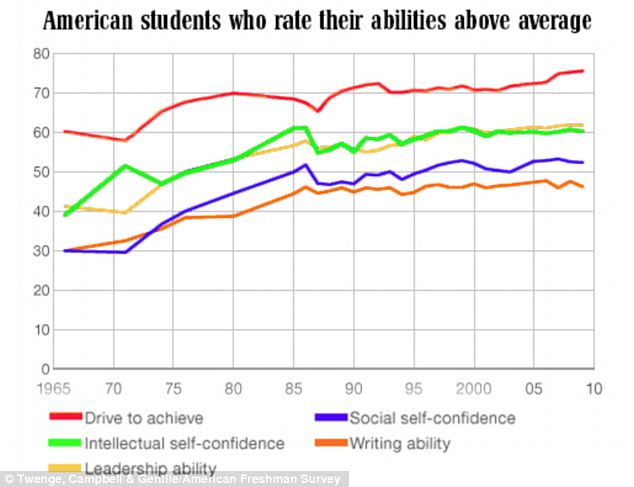
Young people’s unprecedented level of self-infatuation was revealed in a new analysis of the American Freshman Survey, which has been asking students to rate themselves compared to their peers since 1966.

Roughly 9 million young people have taken the survey over the last 47 years.

Psychologist Jean Twenge and her colleagues compiled the data and found that over the last four decades there’s been a dramatic rise in the number of students who describe themselves as being ‘above average’ in the areas of academic ability, drive to achieve, mathematical ability, and self-confidence.

But in appraising the traits that are considered less invidualistic – co-operativeness, understanding others, and spirituality – the numbers either stayed at slightly decreased over the same period.

Researchers also found a disconnect between the student’s opinions of themselves and actual ability.

While students are much more likely to call themselves gifted in writing abilities, objective test scores actually show that their writing abilities are far less than those of their 1960s counterparts.

Also on the decline is the amount of time spent studying, with little more than a third of students saying they study for six or more hours a week compared to almost half of all students claiming the same in the late 1980s.

Though they may work less, the number that said they had a drive to succeed rose sharply.

[…]Twenge is the author of a separate study showing a 30 per cent increase towards narcissism in students since 1979.

‘Our culture used to encourage modesty and humility and not bragging about yourself,’ Twenge told BBC News. ‘It was considered a bad thing to be seen as conceited or full of yourself.’

Just because someone has high self-esteem doesn’t mean they’re a narcissist. Positive self-assessments can not only be harmless but completely true.

However, one in four recent students responded to a questionnaire called the Narcissistic Personality Inventory with results pointing towards narcissistic self-assessments.

Narcissism is defined as excessive self-love or vanity; self-admiration, or being self-centered.

Twenge said that’s a trait that is often negative and destructive, and blames its boom on several trends – including parenting styles, celebrity culture, social media, and easy credit – for allowing people to seem more successful than they really are.

I think what I am seeing is that not only do they work less, but they work at things they “like”, rather than at things that will allow them to provide value to others. So, you’re not going to find a lot of computer programmers or petroleum engineers among young Americans, but you will find a lot of people gravitating to jobs that are easy that make them feel good about themselves, and look good to other people, too.

Obviously, there are policy reasons for youth unemployment being so high, but I think this attitude that young people have is definitely part of it.

Why is college so expensive? Why does university tuition cost so much?

The correct answer appeared in the radically leftist New York Times, of all places.

This is by Paul F. Campos, law professor at the radically leftist UC Boulder.

He writes:

[P]ublic investment in higher education in America is vastly larger today, in inflation-adjusted dollars, than it was during the supposed golden age of public funding in the 1960s. Such spending has increased at a much faster rate than government spending in general. For example, the military’s budget is about 1.8 times higher today than it was in 1960, while legislative appropriations to higher education are more than 10 times higher.

In other words, far from being caused by funding cuts, the astonishing rise in college tuition correlates closely with a huge increase in public subsidies for higher education. If over the past three decades car prices had gone up as fast as tuition, the average new car would cost more than $80,000.

Some of this increased spending in education has been driven by a sharp rise in the percentage of Americans who go to college. While the college-age population has not increased since the tail end of the baby boom, the percentage of the population enrolled in college has risen significantly, especially in the last 20 years. Enrollment in undergraduate, graduate and professional programs has increased by almost 50 percent since 1995. As a consequence, while state legislative appropriations for higher education have risen much faster than inflation, total state appropriations per student are somewhat lower than they were at their peak in 1990. (Appropriations per student are much higher now than they were in the 1960s and 1970s, when tuition was a small fraction of what it is today.)

As the baby boomers reached college age, state appropriations to higher education skyrocketed, increasing more than fourfold in today’s dollars, from $11.1 billion in 1960 to $48.2 billion in 1975. By 1980, state funding for higher education had increased a mind-boggling 390 percent in real terms over the previous 20 years. This tsunami of public money did not reduce tuition: quite the contrary.

[…]State appropriations reached a record inflation-adjusted high of $86.6 billion in 2009. They declined as a consequence of the Great Recession, but have since risen to $81 billion. And these totals do not include the enormous expansion of the federal Pell Grant program, which has grown, in today’s dollars, to $34.3 billion per year from $10.3 billion in 2000.

The more money that is attached to students, the more money universities charge – simple.

But where is the money going? Is it mostly going to research? To the classroom? To hire more and better professors?

No:

Interestingly, increased spending has not been going into the pockets of the typical professor. Salaries of full-time faculty members are, on average, barely higher than they were in 1970. Moreover, while 45 years ago 78 percent of college and university professors were full time, today half of postsecondary faculty members are lower-paid part-time employees, meaning that the average salaries of the people who do the teaching in American higher education are actually quite a bit lower than they were in 1970.

By contrast, a major factor driving increasing costs is the constant expansion of university administration. According to the Department of Education data, administrative positions at colleges and universities grew by 60 percent between 1993 and 2009, which Bloomberg reported was 10 times the rate of growth of tenured faculty positions.

Even more strikingly, an analysis by a professor at California Polytechnic University, Pomona, found that, while the total number of full-time faculty members in the C.S.U. system grew from 11,614 to 12,019 between 1975 and 2008, the total number of administrators grew from 3,800 to 12,183 — a 221 percent increase.

If you’re going to college or trade school, go to a low-cost school. Do a STEM degree or do a trade that pays well. Try to get tuition assistance even if it means going to a less prestigious school. And work at every opportunity you get in the most serious job you can find. Don’t spend your money – save it. Especially don’t spend your money on fun, vacations and alcohol. As soon as you grow up, you’re going to wish you could have it all back.

What got me started on apologetics? William Lane Craig debate transcripts

To have informed views, listen to both sides
To have informed views, you should listen to both sides

Yes, William Lane Craig debate transcripts. In fact, I still read them from time to time to keep up my skills.

Here’s one of my favorites, the Craig-Nielsen debate on grounding morality without God

Summary:

THE CRAIG-NIELSEN DEBATE: GOD, MORALITY, AND EVIL
William Lane Craig and Kai Nielsen
with annotations by William Lane Craig
February 1991, University of Western Ontario

Best part:

Finally, he raises the issue of immortality and says, “Death doesn’t undermine moral values. In fact, things that we value become all the more precious.” Well, in one sense he’s right. It’s the absence of God that undermines the objectivity of moral values, not death. But let’s suppose that there are objective moral values. What would be undermined by the lack of immortality? I think two things.

First, I think there would be no reason to adopt the moral point of view. Since you’re going to die, everyone ends up the same. It doesn’t make any difference whether you live as a Hitler or a Mother Teresa. There is no relationship between your moral living and your ultimate fate. And so in that sense, death undermines the reason for adopting the moral point of view rather that just being an egoist and living for self.

Second, there’s no basis for self-sacrifice on this point of view. Why should an atheist, who knows everything is going to end in death, do things that are morally right that go against self-interest? For example, a few years ago there was a terrible mid-winter air disaster in Washington, DC, as a plane crashed into a bridge spanning the Potomac River, spilling its passengers into the icy waters. And as the helicopters came to rescue these people, attention focused on one man who again and again passed by the rope ladder rather than be pulled to safety himself. Seven times he did this, and when they came again, he was gone. The whole nation turned its eyes to this man in respect and admiration for the noble act of self-sacrifice that he did. And yet on the atheistic view, that man wasn’t noble. He did the stupidest thing possible. He should have gone for the rope ladder first, pushed others away, if necessary, in order to survive! But to give up all the brief existence he will ever have for others he didn’t even know? Why? It seems to me, then, that it’s not simply the absence of God that undermines objective moral values, but ethical living is also undermined by the atheistic point of view because you then have no reason to adopt the moral point of view and you have no basis for acts of self-sacrifice.

By contrast, on the Christian view, where you have both God and immortality, you have the necessary presuppositions for the affirmation of objective moral values and for consistent living of the ethical life.

And another of my favorites, the Craig-Taylor debate on the ontological grounding of morality.

Summary:

Is The Basis Of Morality Natural Or Supernatural?
Richard Taylor and William Lane Craig
October 1993, Union College, Schenectady, New York

Sample Craig:

(2) I argued that moral accountability also exists under the supernaturalist view, and Professor Taylor didn’t deny the point.

(II) What about my critique, then, of naturalism? I said that naturalism doesn’t provide a sound foundation for morality, and here I made two points:

(1) On the naturalist view, objective right and wrong do not exist. Again, Professor Taylor doesn’t deny this point; he just says, “Well, to say that they’re conventional doesn’t mean they’re contemptible.” Well, granted; but it does mean they’re arbitrary, they’re non–objective. There’s no more difference between moral right and wrong than driving on the right–hand side of the road versus the left–hand side of the road. It’s simply a societal convention. And the modern evolutionist thinks these conventions are just based in socio–biological evolution. According to Michael Ruse, a professor of the philosophy of science,

The position of the modern evolutionist…is that humans have an awareness of morality…because such an awareness is of biological worth. Morality is a biological adaptation, no less than are hands and feet and teeth…. Considered as a rationally justifiable set of claims about an objective something, [ethics] is illusory. I appreciate that when somebody says, ‘Love thy neighbor as thyself,’ they think they are referring above and beyond themselves…. Nevertheless…such reference is truly without foundation. Morality is just an aid to survival and reproduction and…any deeper meaning is illusory….{26}

This is essentially the same view as Professor Taylor’s. Moral values are simply rooted in socio–biological evolution, that have passed down as certain taboos and certain commands, but they have no objective validity in terms of their moral rightness or wrongness. Professor Taylor says, “But I have a high regard for people who are truly moral and decent.” I don’t deny that. Of course he does! But the point is that in his ethics, in his philosophy, he has no basis for that affirmation. What I bring is not a new set of values—I think we pretty much hold those in common—but I’m offering a secure foundation for those values that we all want to hold dear.

You see, on Professor Taylor’s view, there really isn’t any objective morality. I think every one of us here tonight would agree that it’s wrong to kill babies and that the holocaust was morally wrong. But in his book Professor Taylor says, “The infanticide practiced by the Greeks of antiquity did not violate their customs. If we say it was nevertheless wrong, we are only saying that it is forbidden by our ethical and legal rules. And the abominations practiced by the Nazis…are forbidden by our rules, and not, obviously, by theirs.”{27} I submit that that is simply a patently false view of moral values and that naturalism, therefore, can’t provide any objective basis for right and wrong.

And another of my favorites, the Craig-Tooley debate on the problem of evil.

Summary:

A Classic Debate on the Existence of God
Dr. William Lane Craig & Dr. Michael Tooley
November 1994, University of Colorado at Boulder

Sample Craig:

(2) Christian doctrines increase the probability of the coexistence of God and the evils in the world. Let me just mention a couple of these.

(i) On the Christian view, the purpose of life is not happiness as such in this life. Rather it is the knowledge of God—which will ultimately produce true and everlasting happiness. What that means is that many evils occur in this life which might be utterly pointless with respect to producing human happiness. But they might not be pointless with respect to producing the knowledge of God. Dr. Tooley assumes when he talks about changes that would make this world a better place, that the purpose of life is basically to be happy in this life. And I certainly admit that you could make changes that might appear to make this life a better place, make it happier. But that’s not God’s purpose. So if you understand that the purpose of life is not happiness as such, I think that you can see that the existence of evil doesn’t necessarily cast any improbability upon God’s existence.

(ii) It’s also the Christian view that God’s purpose spills over into eternal life. In the afterlife God will bestow a glory and happiness upon us that is incomparable to what we’ve suffered here on earth. And the longer we spend in eternity with Him, the more the sufferings in this life shrink by comparison to an infinitesimal instant. Dr. Tooley admits in his article that it is possible that immortality could justify such evils. But, he says, it’s “very unlikely” that there is life after death. Well, I have two comments. First, I’d like him to prove that it’s unlikely that there is life after death.{26} Second, I suggest that the resurrection of Jesus gives us grounds for hoping in life after death, and I’ve attempted to justify that historically. So given these Christian doctrines, I think you can see that the existence of God and evil is not so improbable after all.

[…](4) Finally, I think that there is actually an argument for God from evil. It would go like this:

(i) If God does not exist, objective moral values do not exist. If there is no God, moral values are either socio-biological by-products or just expressions of personal preference.

(ii) Evil exists. That’s the premise of the atheist. There is real evil in the world.

(iii) Therefore, objective values do exist. Some things are really wrong.

(iv) Therefore, God exists.

Thus the presence of evil in the world actually demonstrates God’s existence because in the absence of God, there wouldn’t be any distinction objectively between good and evil, between right and wrong. So although evil in one sense calls into question God’s existence, in a much deeper sense, I think, it actually requires God’s existence.

So in the light of these four responses, I think that the argument from evil, as difficult and emotionally pressing as it might be, in the end doesn’t constitute a good argument against the existence of God. So I think the four arguments given against the existence of God by Dr. Tooley are inconclusive. You’ve still got my six arguments for God’s existence, and therefore I still think that on balance the evidence favors theism as the more rational worldview.

You can find more debates here.