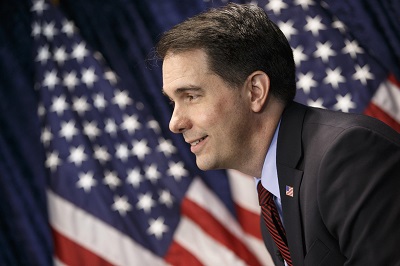
Scott Walker’s immigration plan is more conservative than Bush or Rubio

Wisconsin Governor Scott Walker

According to Breitbart News, which took a good look at it.

Excerpt:

Wisconsin Gov. Scott Walker, a likely 2016 GOP presidential candidate, pledged to protect American workers from the economic effects, not only of illegal immigration but also of a massive increase in legal immigration.

During an interview with Glenn Beck, Walker became the first declared or potential 2016 GOP presidential candidate to stake out a position on immigration fully in line with that of Senate Judiciary Committee subcommittee on Immigration and the National Interest chairman Sen. Jeff Sessions (R-AL). He also noted that he has been working with Chairman Sessions on the issue to learn more about it.

His view is now secure the border and implement E-Verify for foreign workers:

Walker says he discussed immigration policy in depth with Texas Gov. Greg Abbott when he visited the border a few weeks ago. He said that he doesn’t think he was “directly wrong” before but didn’t have a “full appreciation for what is the risk along our border.”

He continued:

I knew there were people traveling, coming across the border, but really what you have is much greater than that. What you have is international criminal organizations, the drug cartels aren’t just smuggling drugs—they’re smuggling firearms and smuggling not only humans but trafficking and horrific situations. It’s an issue that’s not just about safety or about national security, it’s about sovereignty. If we had this kind of assault along our water based ports, the federal government would be sending in the navy. And yet there is a very minimal force along our land-based borders, be it New Mexico, Texas, Arizona, or California, and so to me it was clearly far bigger than immigration.

We need to have a much bigger investment from the federal government to secure the border, through not only infrastructure but personnel and certainly technology to do that and to make a major shift. If you don’t do that, there’s much greater issues than just immigration. Folks coming in from potentially ISIS-related elements and others around the world, there’s safety issues from the drugs and drug trafficking and gun trafficking and gun things with regard—but to get to immigration you have got to secure the border, because nothing you do on immigration fundamentally works if you don’t secure that border.

Walker also discussed the need for interior enforcement:

Then I think you need to enforce the law and the way you effectively do that is to require every employer in America to use an effective E-Verify system and by effective I mean you need to require particularly small businesses and farmers and ranchers. We got to have a system that works, but then the onus is on the employers and the penalties have to be steep that they’re only hiring people who are here, who are legal to be here. No amnesty, if someone wants to be a citizen, they have to go back to their country of origin and get in line behind everybody else who’s waiting.

This development, perhaps one of if not the biggest of the 2016 presidential campaign so far, comes as Walker has taken a commanding lead in polls in all three of the first GOP primary states: Iowa, New Hampshire, and South Carolina.

Walker also said in the interview that he would “absolutely” repeal Common Core in Wisconsin. Jeb Bush is, of course, a huge proponent of Common Core.

So, whatever our worries were about Walker on immigration, I think now we can relax. The only trouble now is getting the electorate to care more about accomplishments than charisma. But if the fight is between Walker and Clinton, I have no doubt that Clinton’s “entitled” attitude is going to lose her the election. No matter how much money she has. And remember that Walker is able to speak to any issue in a way that is persuasive to independents – he proved that in Wisconsin. While Hillary is taking about “equal pay” and smashing the glass ceiling, Walker’s going to be cleaning up on the issues middle-class Americans care about.

Chins up, buttercups! Things are looking good for our side.

Related posts

Do tax hikes, welfare spending and minimum wage hikes lower income inequality?

Here’s Heritage Foundation economist Stephen Moore to explain.

He writes:

Massachusetts Sen. Elizabeth Warren recently appeared on one of the late night talk shows, beating the class warfare drum and arguing for billions of dollars in new social programs paid for with higher taxes on millionaires and billionaires. In recent years, though, blue states such as California, Illinois, Delaware, Connecticut, Hawaii, Maryland and Minnesota adopted this very strategy, and they raised taxes on their wealthy residents. How did it work out? Almost all of these states lag behind the national average in growth of jobs and incomes.

So, if income redistribution policies are the solution to shrinking the gap between rich and poor, why do they fail so miserably in the states?

The blue states that try to lift up the poor with high taxes, high welfare benefits, high minimum wages and other Robin Hood policies tend to be the places where the rich end up the richest and the poor the poorest.

California is the prototypical example. It has the highest tax rates of any state. It has very generous welfare benefits. Many of its cities have a high minimum wage. But day after day, the middle class keeps leaving. The wealthy areas such as San Francisco and the Silicon Valley boom. Yet the state has nearly the highest poverty rate in the nation. The Golden State, alas, has become the inequality state.

In a new report called “Rich States, Poor States” that I write each year for the American Legislative Exchange Council with Arthur Laffer and Jonathan Williams, we find that five of the highest-tax blue states in the nation—California, New York, New Jersey, Connecticut and Illinois—lost some 4 million more U.S. residents than entered these states over the last decade. Meanwhile, the big low-tax red states—Texas, Florida, North Carolina, Arizona and Georgia—gained about this many new residents.

What’s wrong? Isn’t raising taxes, growing government and spending more on welfare supposed to make reduce income inequality? Well, the trouble is that you need to think about things from the point of view of the people who create the jobs. People who want to start a business prefer to move to states where they can keep more of the money they earned. So, that’s why there is a mass exodus from states that don’t allow job creators to keep the money they earn. And naturally, they hire workers in their new state once they get there. Eventually people in the high-tax states move to where the jobs are, too.

Stephen Moore has actually measured it:

The least “regressive” tax states [high tax states] had average population growth from 2003 to 2013 that lagged below the national trend. The 10 most highly “regressive” tax states [low tax states], including nine with no state income tax, had population growth on average 4 percent above the U.S. average. Why was that? Because states without income taxes have twice the job growth of states with high tax rates. 

[…]Ohio University economist Richard Vedder and I compared the income gap in states with higher tax rates, higher minimum wages and more welfare benefits with states on the other side of the policy spectrum. There was no evidence that states with these liberal policies had helped the poor much and, in many cases, these states recorded more income inequality than other states as measured by the left’s favorite statistic called the Gini Coefficient.

[…]The 19 states with minimum wages above the $7.25 per hour federal minimum do not have lower income inequality. States with a super minimum wage—such as Connecticut ($9.15), California ($9.00), New York ($8.75), and Vermont ($9.15)—have significantly wider gaps between rich and poor than states without a super minimum wage.

No, I am not an economist, but I think that this is because the real minimum wage is ZERO, and that’s what more people in high minimum wage states make compared to people in low minimum wage states. If Seattle raises the minimum wage to $15 and the workers end up making the real minimum wage (ZERO) because job creators can’t pay them, then naturally the gap between rich and poor increases.

I think it’s always a good idea for people to think about things from the point of view of the small business job creator, and it all makes sense. If you want to get trained in how to do this, I recommend picking up introductory books by economists like Thomas Sowell, Milton Friedman or even F.A. Hayek. The goal here is to achieve good results, not to have good intentions.

“Dead broke” Hillary Clinton makes more money in an hour than top-paid CEO

$300,000 an hour for a speech

Astonishing article from the Washington Examiner.

Excerpt:

Democratic presidential candidate Hillary Clinton is drawing a populist bead on lavish Wall Street pay packages as she revs up her march to the 2016 Democratic presidential nomination, but in some respects the fat-per-speech fee she can charge puts her far ahead of the top 10 highest-paid American CEOs.

“I think it’s fair to say that if you look across the country, the deck is stacked in favor of those already at the top. There’s something wrong when CEOs make 300 times more than the American worker…,” Clinton said during her first campaign swing last week at an Iowa community college.

Bashing Wall Streeters is part of Clinton’s strategy of remaking her image to appear more sympathetic to middle class voters, while also appealing to left-wing Democrats who are attracted to Sen. Elizabeth Warren, D-Mass., and the even more radical supporters of Sen. Bernie Sanders, the Vermont socialist who talks of seeking the 2016 nomination.

Let’s compare the per-hour rate of pay for Hillary compared to the top American CEOs:

On that basis, the CEOs are pikers compared to an hour of Clinton speaking for $300,000. Hammergren, for example, makes only $63,076 for the same hour of labor. Clothing magnate Ralph Lauren, the second best-paid CEO on the Forbes list receives $32,067. Vornado Realty’s Michael Fasitelli, the third-place CEO, gets $30,961 per hour.

Now at least those CEOs are being paid to produce a return – invent new products and services that people are willing to pay for. What does a speech do? Do the people who pay for it get anything in return? What does she talk about?

Here’s a sample from one of her speeches:

I think she is making a pitch there for Soviet-style re-education camps – not sure why this is worth $300,000, comrades.

But she’s not the only hypocrite on the left.

Here’s a crazy racist, pro-abortion MSNBC commentator named Melissa Harris-Perry:

According to the IRS, although she likely makes a substantial living anchoring a weekend MSNBC show and as a professor at Wake Forest University, the left-wing Melissa Harris-Perry does not pay her taxes. The Internal Revenue Service just placed a $70,000 tax lien against Harris-Perry.

She is the second left-wing MSNBC anchor caught not paying her fair share. Al Sharpton reportedly owes Uncle Sam upwards of $3 million.

According to Harris-Perry, a left-wing activist who frequently rails against the wealthy for not paying enough taxes, the tax bill is from 2013, and she and her husband plan to pay the lien off as quickly as possible.

Harris-Perry is most famous for her the terrible things she has said about Mitt Romney’s black grandchild, wearing tampon earrings, and telling parents that their children belong to the community.

Meanwhile, here she is advocating for higher taxes:

Indeed! People on the left often advocate in favor of higher taxes, but you shouldn’t infer from that that they want to pay higher taxes themselves. Studies show that people on the left give far less money to charity as well. They talk about the poor, but when they get the chance to do something about it, they don’t. It’s just a pose, but it works on a lot of stupid people to get them to vote Democrat.