
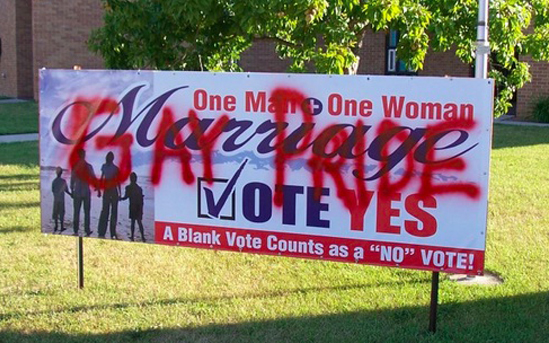
Kentucky bans pastor from prison ministry because he disagrees with homosexuality

Gay activist vandalizes pro-marriage sign

Yes, in Kentucky.

The Stream has the story.

Excerpt:

Like Christian ministers across the confessional spectrum, David Wells takes seriously the words of Jesus in the Gospel of Matthew: “I was in prison and you did not visit me.” Minister of evangelism of Pleasant View Baptist Church in McQuady, Kentucky, he has been visiting and mentoring juveniles in the Warren County Regional Juvenile Detention Center for 12 years.

Not any more. On July 7th, the Kentucky Department of Juvenile Justice (DJJ) revoked his volunteer credentials and permanently barred him from visiting, counseling or leading worship services for juveniles. He was found in violation of a newly revised departmental policy on “Sexual Orientation and Gender Identity” because he could not sign a state-mandated statement that he would not use the word “sinful” when talking about homosexuality. The policy states that volunteers:

shall not refer to juveniles by using derogatory language in a manner that conveys bias towards or hatred of the LGBTQI community. DJJ staff, volunteers, interns, and contractors shall not imply or tell LGBTQI juveniles that they are abnormal, deviant, sinful, or that they can or should change their sexual orientation or gender identity.

The acronym “LGBTQI” stands for “Lesbian, Gay, Bisexual, Transgender, Queer/Questioning, and Intersexed.”

I recommend reading the articles to get the details on the inmates, so that you see what they are in for, what their real problems are, and what it is that the pastor talks to them about.

But I want to skip to the end, which is about the conflict between the gay agenda (don’t offend me by saying that what I am doing is wrong, because it makes me feel bad) with the Constitutional right of religious liberty.

More:

The issue really isn’t the way Wells speaks to the juveniles he ministers to. The issue is what he says. In effect, the DJJ wants to remove the Bible from his hands. The policy equates the teaching of Biblical morality with derogatory and hateful speech.

Removing the Bible from a pastor’s hands is like taking a scalpel from the hands of a surgeon. The policy effectively deletes passages such as Romans 1:24-27, 1 Corinthians 6:9-10, and 1 Tim 1:10 from the New Testament. The words of Scripture are the gifts a pastor has to offer. He’s not there just to counsel the young people. He’s there to tell them the good news of Jesus Christ. That’s not hate speech, it’s love speech.

Wells is represented by Liberty Counsel. In a letter to the commissioner of the Kentucky Department of Juvenile Justice, Liberty Counsel explained that the new policy creates an unconstitutional religious test for access to the DJJ. The First Amendment prohibits the government from discriminating on the basis of viewpoint. This detention center may not prohibit the expression of biblical morality because DJJ policymakers object to the Bible.

That’s what the American Constitution says, but the authorities in other states and in federal and military prisons have begun imposing similar restrictions on religious speech. This may become one more aftershock of the Obergefell v Hodges decision. The homosexual equivalency movement wants to insert homosexual activity into the category of a protected class under State and Federal law in order to use the police power of the State against those who disagree with them. It’s one more example of a growing soft persecution underway in the United States.

I have been saying for some time that Christians have been really missing the boat by focusing on charity without theology. We are interested in being nice so we can be liked. We are not interested in telling the truth, so that we can be faithful. We spend all our money feeding hungry people and helping the poor and so on, and nothing is going to defend religious liberty – the freedom to actually treat what the Bible about God as real and serious – in public. Maybe instead of doing nice things, we can try to focus more on doing good things. We can start by not voting for secularists who charm us with their desire solve the world’s problems by redistributing wealth, and instead vote for people who promise to protect our religious liberty and our freedom of conscience. No more giving money to World Vision and the Boy Scouts of America and Susan G. Komen Race for the Cure. We have other things to think about now.
Utilitarianism and the Moral Life by J. P. Moreland

I found this essay on After All, but it looks like their site is not working well, so I’m just going to steal it and post it here, in case it disappears completely. This is one of my favorite short essays on utilitarianism, and it’s a wonder that the thing can’t stay up somewhere. Well, it will have a home here now. I’d be surprised to see anyone else be this awesome in a measly 1000 words as Dr. Moreland is below.

—-

Utilitarianism and the Moral Life

What Is Utilitarianism?

Utilitarianism (also called consequentialism) is a moral theory developed and refined in the modern world by Jeremy Bentham (1748-1832) and John Stuart Mill (1806-1873). It can be defined as follows:

An action or moral rule is right if and only if it maximizes the amount of nonmoral good produced in the consequences that result from doing that act or following that rule compared with other acts or rules open to the agent.

By focusing on three features of utilitarianism, we can clarify this definition.

(1) Utilitarian theories of value.

What is a nonmoral good? Utilitarians deny that there are any moral actions or rules that are intrinsically right or wrong. But they do believe in objective values that are nonmoral.

Hedonistic utilitarians say that the only intrinsic good is pleasure and the avoidance of pain. Quantitative hedonists (Bentham) say that the amount of pleasure and pain is the only thing that matters in deciding between two courses of action, I should do the one that produces the greatest amount of pleasure and the least amount of pain (measured by factors like the duration and intensity of the pleasure). Qualitative hedonists (Mill) say that pleasure is the only intrinsic good, but the type of pleasure is what is important, not the amount. They would rank pleasures that come from reading, art, and friendship as more valuable than those that come from, say, a full stomach.

Pluralistic utilitarians
say there are a number of things that have intrinsic, nonmoral value: pleasure, friendship, health, knowledge, freedom, peace, security, and so forth. For pluralists, it is not just the pleasure that comes from friendship that has value but also friendship itself.

Currently, the most popular utilitarian view of value is subjective preference utilitarianism. This position says it is presumptuous and impossible to specify things that have intrinsic nonmoral worth. So, they claim, intrinsic value ought to be defined as that which each individual subjectively desires or wants, provided these do not harm others. Unfortunately, this view collapses into moral relativism.

(2) Utilitarians and maximizing utility.

Utilitarians use the term utility to stand for whatever good they are seeking to produce as consequences of a moral action (e.g., “pleasure” for the hedonist, “satisfaction of subjective preference” for others). They see morality in a means-to-ends way. The sole value of a moral action or rule is the utility of its consequences. Moral action should maximize utility. This can be interpreted in different ways, but many utilitarians embrace the following: the correct moral action or rule is the one that produces the greatest amount of utility for the greatest number of people.

(3) Two forms of utilitarianism: act utilitarianism and rule utilitarianism.

According to act utilitarianism, an act is right if and only if no other act available maximizes utility more than the act in question. Here, each new moral situation is evaluated on its own, and moral rules like “don’t steal” or “don’t break promises” are secondary The moral agent must weigh available alternatives and choose the one that produces the best consequences. Rule utilitarianism says that correct moral actions are done in keeping with correct moral rules, However, no moral rule is intrinsically right or wrong. Rather, a correct moral rule is one that would maximize utility if most people followed it as opposed to following an alternative rule. Here, alternative rules (e.g., “don’t lie” vs. “don’t lie unless doing so would enhance friendship”) are compared for their consequences, not specific actions.

What Is Wrong with Utilitarianism?

Several objections show the inadequacy of utilitarianism as a normative moral theory.

First, utilitarianism can be used to justify actions that are clearly immoral. Consider the case of a severely deformed fetus. The child is certain to live a brief, albeit painless life. He or she will make no contribution to society. Society, however, will bear great expense. Doctors and other caregivers will invest time, emotion, and effort in adding mere hours to the baby’s life. The parents will know and love the child only long enough to be heartbroken at the inevitable loss. An abortion negates all those “utility” losses. There is no positive utility lost. Many of the same costs are involved in the care of the terminally ill elderly. They too may suffer no pain, but they may offer no benefit to society. In balancing positives and negatives, and excluding from the equation the objective sacredness of all human life, we arrive at morally repugnant decisions. Here deontological and virtue ethics steer us clear of what is easier to what is right.

Second, in a similar way, utilitarianism denies the existence of supererogatory acts. These are acts of moral heroism that are not morally obligatory but are still praiseworthy. Examples would be giving 75 percent of your income to the poor or throwing yourself on a bomb to save a stranger. Consider the bomb example. You have two choices — throwing yourself on the bomb or not doing so. Each choice would have consequences and, according to utilitarianism, you are morally obligated to do one or the other depending on which option maximized utility. Thus, there is no room for acts that go beyond the call of morality.

Third, utilitarianism has an inadequate view of human rights and human dignity. If enslaving a minority of people, say by a lottery, would produce the greatest good for the greatest number, or if conceiving children only to harvest their parts would do the same, then these could he justified in a utilitarian scheme. But enslavement and abortion violate individual rights and treat people as a means to an end, not as creatures with intrinsic dignity as human beings. If acts of abortion, active euthanasia, physician-assisted suicide, and so forth maximize utility, then they are morally obligatory for the utilitarian. But any moral system that makes abortion and suicide morally obligatory is surely flawed.

Finally, utilitarianism has an inadequate view of motives and character. We should praise good motives and seek good character because such motives and character are intrinsically valuable. But utilitarianism implies that the only reason we should praise good motives instead of bad ones, or seek good character instead of bad character, is because such acts would maximize utility. But this has the cart before the horse. We should praise good motives and blame bad ones because they are good or bad, not because such acts of praising and blaming produce good consequences.

In sum, it should be clear that utilitarianism is an inadequate moral theory. Unfortunately, ours is a pragmatic culture and utilitarianism is on the rise. But for those of us who follow Christ, a combination of virtue and deontological ethics is a more adequate view of common sense morality found in natural law and of the moral vision contained in the Bible.

Alabama Governor terminates contract with Planned Parenthood

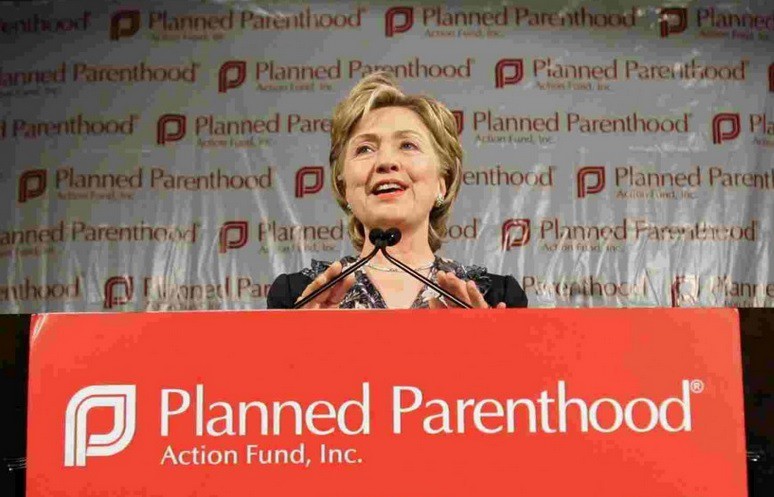
Hillary Clinton and Planned Parenthood

ECM sent me this great story about the great state of Alabama.

Excerpt:

Alabama Gov. Robert Bentley announced Thursday that he was terminating the state’s Medicaid contract with Planned Parenthood, making it the third state to cut ties with the abortion provider following the release of undercover videos that allegedly show employees discussing the distribution of fetal organs.

“The deplorable practices at Planned Parenthood have been exposed to Americans, and I have decided to stop any association with the organization in Alabama,” said Bentley in a statement. “As a doctor and Alabama’s Governor, the issue of human life, from conception to birth and beyond, is extremely important to me. I respect human life, and I do not want Alabama to be associated with an organization that does not.”

In addition to Bentley’s actions, Alabama’s Senate also advanced a measure Thursday that would make it a felony to give or receive any money in return for fetal tissue.

And in case you missed the awesome from earlier in the week:

Louisiana Gov. Bobby Jindal made a similar move earlier this week, as did New Hampshire yesterday after its executive council voted 3-2 to override Gov. Maggie Hassan and reject a $639,000 contract with the organization. More states may join them soon, though, as investigations of Planned Parenthood prompted by the videos are still ongoing in several Republican-controlled states.

What do we learn from this? If you want to cut off the flow of money to Planned Parenthood, then elect Republicans. Democrats are with Planned Parenthood all the way.