Are the poor in America really poor?

Let's take a look at the data
Let’s take a look at the data

This article is from the Daily Signal.

Excerpt:

Today, the Census Bureau will release its annual poverty report. It will almost certainly report that over 40 million Americans “live in poverty.”

But what does it mean to be poor in America? To the average American, the word “poverty” suggests significant material deprivation. But the actual living conditions of those the government defines as poor differ greatly from this perception.

According to the government’s own reports, the typical American defined as poor by the Census Bureau has a car, air conditioning, and cable or satellite TV. Half of the poor have computers, 43 percent have Internet, and 40 percent have a wide-screen plasma or LCD TV.

Far from being overcrowded, poor Americans have more living space in their home than the average non-poor person in Western Europe. Some 42 percent of all poor households actually own their own homes; on average, this is a well-maintained three-bedroom house with one and a half baths, a garage, and a porch or patio.

According to the U.S. Department of Agriculture, only 4 percent of poor children were hungry for even a single day in the prior year because the family could not afford food. By its own report, the average poor person had sufficient funds to meet all essential needs and was able to obtain medical care for his family throughout the year whenever needed.

The left likes to claim that the U.S. has far more poverty than other advanced nations. But those claims are based on comparisons that set a higher standard for escaping poverty in the U.S. than elsewhere.

When a single uniform standard is used, the U.S. is shown to have poverty rates that are very similar to other advanced nations, slightly higher or lower depending on the exact measure used.

I think we definitely want to be careful about the outcry on the secular left about “poverty”. Their solution always seems to be that we need to move in the direction of socialism. And socialism means that the government gets bigger by taking money and liberty away from families, churches and businesses.

As a Christian, my goals are all gospel-centric. My interest in politics is because I want to live in a society that respects my right to work, earn and save, so that I can spend and give in a way that advances the gospel. My job is not to transfer my money to lazy people in their dependence on government. I go to work so that I can have the fuel I need to respect God in my decision-making. The secular government is interested in other goals – like getting elected. I don’t want them using my money for their goals. I have my own goals.
Is Obamacare working? State exchanges losing enrollees in 29 states

He's better at golf than foreign policy
He’s better at golf than health care policy

This article is from the Daily Caller, and was pointed out to me by one of my secular leftist co-workers.

It says:

Obamacare exchanges had a net loss total of 238,119 enrollees in 29 states and the District of Columbia within the three-month period between the end of March and end of June.

According to analysis the Washington-based Americans for Tax Reform (ATR), numbers released from Centers for Medicare and Medicaid Services (CMS) show that enrollment in all 50 states and DC as of June 31 is at 9.9 million. This number is down from 10.2 million on March 31.

Florida lost 101,091 enrollees, Georgia 34,925, North Carolina 32,300, Pennsylvania 29,487, Texas 23,194, New Jersey 14,273, Indiana 13,268, and Arizona 10,905.

“The poor performance of the program is bad news for the long-term sustainability of the federal and state Obamacare exchanges given their reliance on paying enrollees to meet costs,” ATR explained.

“Exchanges typically fund their operations through a fee on premiums: the federal exchange that provides 37 states with coverage charges a 3.5 percent premium, while state exchanges are free to choose their own rate. Fewer enrollees could signal the beginning of a death spiral for the Obamacare exchanges,” according to ATR.

Many state exchanges, however, are also reportedly in disarray. Reason Magazine reports that while the federal government “spent billions on creating Obamacare’s exchanges” it did not track the money appropriately, and many of the state-run exchanges are not working.

According to a Government Accountability Office report, only Vermont completed work on technology to send data to the IRS, while only 10 other states were partially complete. Additionally, Hawaii and Minnesota performed no testing at all on their exchange systems.

Government shouldn’t be running health care, that is something best left to health care specialists in the free market, who have skin in the game and have to compete with other providers in order to produce products and services that people actually want. It’s not working, and it’s costing us too much to move forward with a failed plan.

Bobby Jindal won first CNN debate, Carly and Rubio win second CNN debate


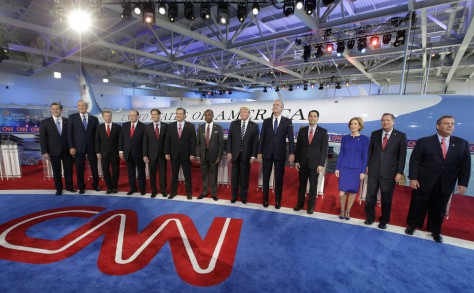
CNN Debate at the Ronald Reagan Presidential Library

First of all, if you missed the two debates on CNN on Wednesday night, you missed two great political debates. Hugh Hewitt asked great questions of the candidates. Jake Tapper and Dana Bash were slightly biased against Republicans. Really both debates were so good, and a million times better than the two Fox News debates. There were no gotcha questions, there were plenty of issue-focused exchanges between the candidate.

First debate:

Here’s an exchange between Jindal and Graham:

Jindal: “If we can’t defund Planned Parenthood… It is time to be done with the Republican Party.”

JIndal on Trump and Obama:

Jindal: “He’s declared war on trans fats, and a truce with Iran. Think about that – he’s more worried about Twinkies than he is about the Ayatollahs having a nuclear weapon!”

Jindal on the refugee crisis and illegal immigration:

Jindal: “Simply allowing more people into this country doesn’t solve this problem.”

Jindal on radical Islam, and discrimination against Christians in America:

Jindal: “In America … right now, the biggest discrimination going on is against Christian business owners and individuals who believe in traditional forms of marriage.”

Here are my ratings, candidates in red are the ones I support.

First debate grades:

  • Bobby Jindal: A-
  • Lindsay Graham: B+
  • Rick Santorum: C
  • George Pataki: D

Jindal went after Trump hard, but didn’t talk enough about policy and his own record. LIndsay Graham was solid on foreign policy. He is far too liberal on fiscal issues and social issues, and especially on illegal immigration. Graham is one of the most establishment RINOs in the Senate. It was fun watching Jindal take him on. Jindal is still my favorite candidate, and I hope he gets a bump in the polls from his debate performance.

Second debate:

Carly Fiorina on Planned Parenthood:

Marco Rubio on foreign policy:

If you watch only one clip, watch this one – Rubio and Christie on global warming:

Ted Cruz on illegal immigration:

Scott Walker on minimum wage, jobs and Obamacare:

Second debate grades:

  • Carly Fiorina: A
  • Marco Rubio: A
  • Chris Christie: B+
  • Ted Cruz: B
  • Scott Walker: B-
  • Ben Carson: C+
  • Jeb Bush: C+
  • Rand Paul: C
  • Mike Huckabee: C
  • John Kasich: D
  • Donald Trump: F

Fiorina solid on the facts, but took a few hits on her record at Hewlett Packard, which was not good. She is much too liberal and inexperienced for me, but she talks about these issues very seriously. I am more conservative than she is on abortion, marriage, religious liberty, criminal justice, and many other issues. She has no record of achievement as a governor, either. Marco Rubio is amazing at foreign policy, and knocked a question on global warming out of the park. I love to see a Republican explain the global warming issue so that people understand what is at stake. Rand Paul made some great points about federalism, which I think was valuable in explain conservative principles to the CNN audience.

I’m glad to see that Erick Erickson of the grassroots site Red State agrees with me on the winner of the first debate, and the winners of the second debate.

For a good review of the second debate, here’s something from The Weekly Standard and a new episode of the The Weekly Standard podcast, as well.

My top 4 candidates are still Jindal, Walker, Cruz, Rubio.