
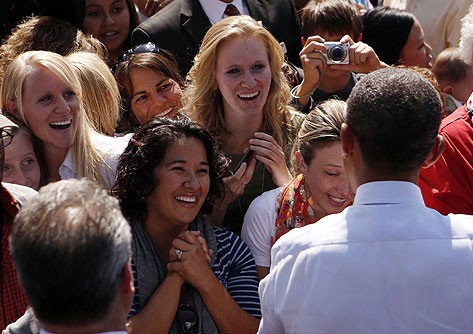
Barack Obama had a lot of confident words and personal charisma during his campaign speeches in 2008. Many young people want to believe that their positive emotional reaction to confident words will somehow make plans “work out”. But can you really compel the universe to give you goodies just by having positive feelings? Does your emotional response to handsome looks and confident words mean that somehow the universe will give you what you desire?
I want to use this article from Investors Business Daily to illustrate the importance of not picking a President based on confident words and personal charisma.
It says:
Employer-based health insurance premiums climbed 4.2% this year for family plans, according to an annual Kaiser Family Foundation report. That’s up from 3% the year before.
Since 2008, average family premiums have climbed a total of $4,865.
The White House cheered the news, saying it was a sign of continued slow growth in premium costs.
[…]”We will start,” Obama said back in 2008, “by reducing premiums by as much as $2,500 per family.”
That $2,500 figure was Obama’s mantra on health care. You can watch the video if you don’t believe it.
And Obama wasn’t talking about government subsidized insurance or expanding Medicaid or anything like that. He specifically focused on employer provided health care.
For “people who already have insurance, and the employers who are providing it,” he said at one campaign event, “we will work to lower your premiums by up to $2,500 per family.”
Let’s watch the video. I want everyone to see how confident a clown can sound when he lies about being able to solve problems that he knows nothing about.
He had no record of achievement in this area. None, Zero, Zip. And the same goes for his claims about keeping your doctor, keeping your health care plan, and so on.
But America voted to elect him. There were a lot of voters who did not want to think too hard about economics in 2008, and again in 2012. They did not want to have to put in any work to study the achievements of the candidate in the area of health care policy, to see if he had actually done anything to reduce health care premiums. They had a problem: health care costs are too high. A charismatic clown stepped forward and made their fears go away with confident talk. They made a decision to believe him. They wanted to believe that serious problems could be solved by the words of a charismatic clown, so that they would then be saved from having to evaluate the records of the candidates, to see which of them had put in place policies that had solved similar problems in their past. That’s too much work for the American voter. Better to just pick the one who seems to be able to solve the problem based on surface qualities, like confident words that produce emotional reactions. The universe will adjust because we have a positive attitude.
This is an attitude that no practical engineer like me could take. It’s a recipe for disaster. Nothing important in life – from designing e-commerce web sites, to developing cures to sickness, to constructing jet fighters – is conducted in such a stupid, emotional way.
Now, I’m pretty angry that two of my candidates, Rick Perry and Scott Walker, are out of the 2016 election. And why? Because an unqualified leftist clown is ruining the process with brash, insulting confident talk. Again, we are dealing with a clown who has no record of actual problem-solving in the areas where the American people need problems solved.
This article from Investors Business Daily explains:
Which of these two sounds like someone on an ego trip, someone content to let the Middle East go up in flames and, like Barack Obama, someone overconfident in his own abilities to persuade others? And which sounds like he would practice the sober, principled foreign policy of Ronald Reagan as president?
Yet it is the latter, Scott Walker, who was just forced to drop out of the race, the reality TV star front-runner having sucked so much air out of the room that it was becoming impossible to survive. He laudably called it his patriotic duty to depart, thus consolidating the opposition to Trump.
Walker is one of the most successful governors in the country, having brought unemployment down from over 8% to about 4.5%, and turning Big Labor’s targeting him for destruction into three successive electoral victories in a blue state.
A week ago a governor with a longer record of accomplishment, in a state Americans are flocking to for its vibrant jobs-rich economy, was also forced to drop out. In doing so, Rick Perry of Texas made a statement affirming his rock-ribbed commitment to free-market principles, traditional values and a strong America on the world stage.
Perry and Walker are both leaders of substance. Eight years of the inexperienced, self-obsessed Obama had many Republicans concerned about 2016 looking to the governors’ mansions for someone with a proven track record of actually solving crises and reversing misguided big-government policies. These two may have been the most accomplished figures in the nation in that regard. How is it that they are early dropouts?
Political journalists are having a ball dissecting the ins and outs of fundraising and styles of campaign managing to explain Walker and Perry’s exit. But there is no ignoring the 800-pound loudmouth in the room.
In Donald Trump, the left’s caricature of conservatism — the bombast, the misogyny, the hype-above-substance — is defeating the real thing.
I do hiring interviews in my company. I always make sure to ask questions to test the claims on the candidate’s resume. It’s not hard to find out whether a person knows how to do what they claim to know how to do. Many of the people who show up for interviews try to finesse their way through engineering questions with confident talk, and emotional appeals. We don’t hire them. Why is it so hard for the American people to understand what is at stake here?



 WINTERY KNIGHT