The transsexuals were hurting his business, so he asked them to please stop, or he would go out of business. But instead, they complained to the government.
An Oregon bar has been ordered by a judge to pay $400,000 for telling a group of transgender customers not to come back to the bar because people were starting to think it was a “tranny bar.”
The Oregon Court of Appeals stood by a ruling Wednesday that Chris Penner, owner of the Portland bar Twilight Room Annex, had illegally discriminated against the transgender customers, Oregon Live reports.
The transgender customers were part of a group called the Rose City T-girls who went to the bar regularly on Friday nights. Penner called them and left messages asking them to stop coming.
“People are not coming in because they just don’t want to be there on a Friday night now,” Penner said in a message. “In the beginning sales were doing fine, but they’ve been on a steady decrease so I have to look at what the problem is, what the reason is and take care of it.”
An Oregon judge found that Penner had violated the Oregon Equality Act of 2007, which bans discrimination against people based on sexual orientation.
Now he has to cough up $400,000.
Two points to make about this. First, note that Oregon is one of the liberal states in this map where such things are happening:
States with non-discrimination laws
These are the states where all the problems are happening with sexual minorities going to the government to compel celebration from businesses. Business owners are having to pay big fines, and/or go to jail. The judges and human rights commissions in these states are siding with the plaintiffs, and against freedom of speech, freedom of religion, and now even freedom of association.
And the Democrats want to push this up to the federal level, so that businesses can be sued in all 50 states. If they had a majority in the House, that’s exactly what they would do.
What’s interesting about this story is that now it’s not just religious people who are going to get impacted by these changes. It’s not just the florists, the bakers, the wedding photographers, the bed-and-breakfast owners. Now it’s bars. And the objection is not religious liberty or conscience. And that’s not surprising… if you looked up north to Canada, it started with the religious people, and then pretty soon bar owners, fitness club owners and other secular business owners were impacted, too.
Here’s an article from Greg Koukl of Stand to Reason.
He answers the question “Am I going to Hell if I don’t believe in Jesus?”.
Excerpt:
Sometimes we have to reframe a critic’s question in order to give an accurate answer. The questions, Am I going to Hell if I don’t believe in Jesus?, is an example. As it is asked, it makes it sounds as though Jesus were the problem, not the answer. As though failing a theology quiz sends us to Hell. Instead, we need to reframe the question to answer accurately and show that sin is the problem, and Jesus is the only way because He alone has solved that problem. Sinners don’t go to Hell for failing petty theology quizzes.
While giving a talk at a local Barnes & Noble, someone asked why it was necessary for him to believe in Jesus. He was Jewish, believed in God, and was living a moral life. Those were the important things, it seemed—how you lived, not what you believed.
To him the Christian message depicted a narrow-minded God pitching people into Hell because of an arcane detail of Christian theology. How should I answer?
Remember that the first responsibility of an ambassador is knowledge—an accurately informed message. What is our message?
One way to say it is, “If you don’t believe in Jesus, you’ll go to Hell. If you do believe, you’ll go to Heaven.”
That’s certainly true, as far as it goes. The problem is it’s not clear. Since it doesn’t give an accurate sense of why Jesus is necessary, it makes God sound petty.
So how do we fix this? Here’s how I responded to my Jewish questioner. I asked him two simple questions.
Christians all need to understand how to explain why sincere beliefs and good works are not enough to satisfy God’s moral demands on us. God is more concerned that we understand the truth about his existence and character – that is the whole point of sending Jesus to die as an atonement for our rebellion. The problem isn’t just that we lie, cheat, steal and murder. The problem is that we want to get our own happiness apart from God, without wanting to know him as he is, and without having to care about his goals and his character in the relationship.
Here’s what God wants us to know about ourselves:
we have to realize that what we really are is rebels against God
rebels don’t want God to be there
rebels don’t want God to have any goals or character different from their goals and character
rebels don’t want God to place any demands on them
rebels don’t want to have any awareness that God is real or that he is morally perfect
rebels want to be liked as they are now – they don’t want to change as part of a relationship
rebels want to conceive of their own way to happiness, and to use other people and God for their own ends
rebels don’t want there to be a mind-independent objective reality, they want to invent their own reality that allows them to be praised and celebrated for doing whatever makes them happy at every point along their lives
rebels would rather die that put their pursuit of happiness second
rebels have no interest in rules, judgments, accountability or punishments
Here’s what God wants for us to be saved from our rebelling:
we have to know his real character so we have a genuine relationship with him
the best way to know his character is by taking time to study what Jesus did in history
what the incarnation tells us is that God is willing to humiliate himself by taking on a human nature
what the crucifixion tells us is that God is willing to die in our place even though we’re rebelling against him (Jesus is Savior)
part of being saved is to trust God by allowing his character to transform our desires and actions (Jesus is Lord)
as we grow in letting the character of Jesus inform our actions, we build a set of experiences that are like Jesus’ experiences – i.e. – we obey God rather than men, and we suffer for our obedience – just like Jesus
So don’t Christians have to do good things? Yes. But a Christian’s good deeds are the result of identifying Jesus as Savior and Lord, and then following him by making decisions that respect his character. God doesn’t need you to solve all the world’s problems – he could do that himself. It’s not what you do, it’s who you know and trust that counts. The good deeds are just your way of trying to be like him and trying to feel the same thing he felt when he gave his life for you. You have a friend and you want to be like him in order to know what he feels so you have sympathy with him.
The main point is that knowing Jesus as the revelation of God’s character, and then following Jesus, is more important than doing “good things”.
The first commandment, according to Jesus, is found in Matthew 22:34-38:
34Hearing that Jesus had silenced the Sadducees, the Pharisees got together.
35One of them, an expert in the law, tested him with this question:
36“Teacher, which is the greatest commandment in the Law?”
37Jesus replied: ” ‘Love the Lord your God with all your heart and with all your soul and with all your mind.’
38This is the first and greatest commandment.
The second commandment which comes after that one has to do with loving your neighbor. But the second one is not the greatest commandment. You can’t love God unless you know God. That it, unless you make knowing about his existence and character a priority in your life to the point where you find out the truth about his existence and character. And not as your own opinion, or as the opinion of the people around you, or as the faith-tradition you were raised in. No. You have to value God enough to respond to his overtures to you. You have to know him in truth, not as a quick checkbox that you check off for an hour on Sundays to make your life “easier” because you are happier and the people around you like you. You have to know him before you can act to love him – who he is and what he’s done.
The way that Protestants like me draw the line is as follows – justification (how your rebellion is canceled) is God’s job. He draws you to him while you are still in rebellion, but you have a choice to resist him or not. If you resist his action to save you, then you are responsible for rejecting him. Sanctification (about doing good works) is not about canceling your rebellion, it’s about the later step of re-prioritizing your life, so that you make decisions that reflect the character of Jesus, so that you become more like him. Even your desires change as the relationship progresses. It is something you work at – you study and experience, study and experience. The whole point of studying apologetics is to build yourself into a love machine that fears nothing and holds up under fire, because you know the truth and the truth makes you free to do what you ought to do regardless of the consequences (e.g. – failure to be recognized and requited by someone you loved well).
The most important relationship is not the horizontal relationship with your neighbor, it’s the vertical relationship with God himself. And when you know God as he really revealed himself in history, then your desires – and consequently your actions – will change naturally. When you know God as a person, you freely make all kinds of sacrifices for him. You put yourself second because you want to work on the relationship. You start to believe that your own happiness isn’t as as important as working on the relationship. It’s like building a house. You don’t notice the sacrifices.
Sometimes, I think that the whole point of Christianity and that vertical relationship is so that we know God better. We sympathize more with him than we do with ourselves, because of how unfairly people treat him, how good and loving he is, and how right his goals are. It’s not that he needs help, because he’s God – he’s sovereign. But the relationship gets to the point where it becomes reasonable for you to put yourself second with God, and to let his goals become your goals – you want the relationship with a loving God more than you want to be happy. You get tired of ignoring the person who loves you most – you start to wonder what it would be like to actually respond to him. For Christians, the demands of this other being eventually seem to be not so terrible after all – and we try to put aside our own desires and to give him gifts and respect instead of worrying so much about being happy all the time.
It’s not irrational to be kind to the person who loves you the most – who sacrificed the most for you.
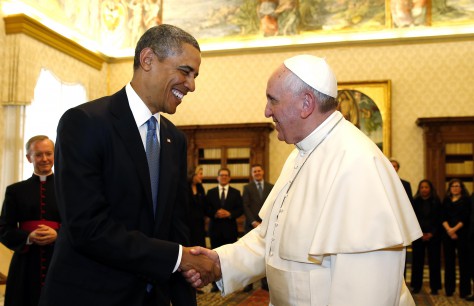
The Pope came to America and he had a lot to say about economics and politics. In fact, he endorsed Barack Obama’s plan to slow down our economy, so that Russia and China can catch up to us.
But experts at a Heritage Foundation event Monday painted a bleak picture of its adverse impact on the poor, warning that the shift away from natural energy sources would lead to skyrocketing electricity costs that will have “devastating” impacts on low-income families.
Mario Lopez, president of the Hispanic Leadership Fund, cited a report from the National Black Chamber of Commerce that found that by 2030, the plan will increase electricity costs for consumers by $565 billion annually.
“This makes it one of the costliest regulations in American history,” he said.
That cost, Lopez continued, will hit families directly through increased prices on nearly everything ranging from luxury items to everyday necessities like clothing and toothpaste.
“When you reduce the annual income of the individual by hundreds of dollars, then you are going to have an impact, and especially a disproportionate impact on poor people,” he said.
The regulation will also directly hit businesses, forcing owners to cut costs through layoffs and reduced hiring, Lopez said. The Black Chamber of Commerce report found that these predicted job losses would disparately hit minority communities.
By 2035, African-Americans are expected to lose nearly 7 million jobs because of the regulation, while Hispanics will lose over 12 million. The result is a projected 25-percent increase in total poverty.
“These are real people we’re talking about,” Lopez said. “The EPA and the Obama administration sometimes forget that, unfortunately.”
That response made me think of this clip of Marco Rubio from the CNN debate:
If you want to find out here “green energy” initiatives take a country, look no further than Germany. The electricity bills for consumers and businesses have been skyrocketing, damaging their entire economy. Oh well, it’s not like they were facing any kind of demographic crisis or anything.
Anyway, back to the Pope. Apparently, he didn’t have anything to say to Obama about abortion. The headline at The Federalist is “Pope Francis Visits White House South Lawn, Says Nothing About Abortion”. I didn’t see anything about him defending marriage either.
FrontPage magazine talks about how the Pope met with Fidel Castro, a brutal atheistic communist dictator, but declined to meet with Cuban pro-democracy dissidents.
Excerpt:
In 1960, Cuban bishops declared that “Catholicism and Communism respond to two totally different concepts of man and the world which it will never be possible to conciliate.” Pope Francis however contends that Communism is really Christianity. “The Communists have stolen our flag,” he said.
The Cuban bishops condemned Communism as “a system which brutally denies the most fundamental rights of the human being.” Pope Francis’ criticisms of the Castro regime were limited to oblique references, a plea for religious freedom for Catholics and general criticisms that could apply to Cuba or any one of a number of other places. He failed to even reiterate his old criticisms of the regime.
Cuban dissidents were kept from meeting Pope Francis and even the “passing greeting” that had been planned was shut down when the Communist authorities detained political dissidents. When the protesters risked their freedom to get near him, they were arrested without receiving any acknowledgement from the pope. The Castros got their meetings and their publicity.
The oppressed, whom Pope Francis claimed to speak for during his visit and during his international travels, were left out in the cold. They were treated to another oblique reference, as Pope Francis expressed his desire to “embrace especially all those who for various reasons I will not be able to meet.”
“It simply doesn’t appear to us to be right or just that the pope doesn’t have a little time to meet with those Cubans who are defending human rights,” the head of the country’s largest dissident organization said.
Pope Francis spoke of Obama’s deal with Castro as a “process of normalizing relations between two peoples following years of estrangement.” But he knows quite well that it’s nothing of the kind. The Cuban people are not estranged from the Cuban refugees in America by a lack of diplomatic relations, but by the brutal suppression of political and religious freedom by the Castro regime.
The Obama deal doesn’t bring the “two peoples” together; it puts money in the pockets of a regime that Pope Francis had once called corrupt and authoritarian. It allows American leftists to tour Cuba for the trade in underage prostitutes that it has become notorious for. This isn’t reconciliation. It’s exploitation.
[…]If Pope Francis really wished to speak for the oppressed, there are eleven million of them in Cuba. They are not oppressed by capitalism or by global warming. They are oppressed by that fear, the paralyzing anguish that it brings and the apathy that comes with it. They needed weapons against that fear.
The pope’s visit gave the Castros what they wanted, but failed to give the Cuban people what they needed.
I’m a Protestant evangelical Christian, and Bible-based. I’m pro-life, pro-marriage and I defend religious liberty and conscience rights. I’m not Roman Catholic.




 WINTERY KNIGHT